A comprehensive slide deck for teaching absolute advantage in high school business. Features a warm-up activity, guiding questions for the lesson's video, interactive pause points, and a detailed project brief for the 'Consultant Mission' activity.
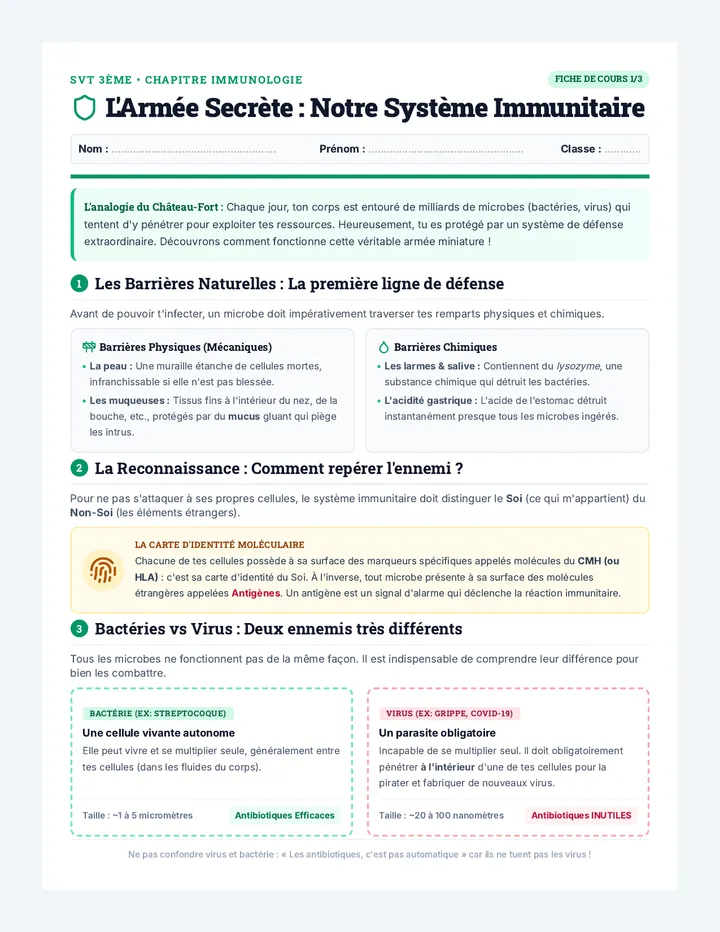
Un guide complet pour l'enseignant incluant les corrigés des exercices, des pistes de différenciation pour les différents niveaux du collège et un barème de notation pour la rédaction.
Un guide de rédaction créative où les élèves conçoivent leur propre robot de sauvetage avant d'écrire le récit de sa première mission.
Un texte narratif sur un sauvetage effectué par un robot humanoïde, accompagné de questions de compréhension pour tester l'analyse et la lecture fine.
Une présentation dynamique introduisant les enjeux, les types de robots et des exemples concrets pour lancer le débat sur la robotique de sauvetage.
Une fiche de vocabulaire complète avec glossaire technique, exercices d'association et texte à trous pour maîtriser le lexique de la robotique de secours.
Presentation deck for Investigation 7, covering the anchoring phenomenon, karyotypes, and gel electrophoresis.
Comprehensive Teacher Guide for Investigation 7 (5 Blocks). Covers pedigrees, genetic disorders, and molecular biotechnology with pacing and monitoring guides.
Expanded Teacher Guide for Investigation 7, covering all 3 Experiences over 5 blocks. Includes preparation checklists, common misconceptions, and detailed monitoring feedback loops. Fixes page breaks.
Comprehensive Master Answer Key for Investigation 7, updated to match the revamped station activities. Covers pedigree analysis, Trisomy 21 karyotype diagnosis, structural mutation logic, and gel electrophoresis fragment analysis.
High-impact presentation deck for Investigation 7, revamped to focus on Karyotypes, Chromosomal Mutations (Numerical and Structural), and Gel Electrophoresis. Matches the new station activities and anchoring phenomenon. Fixes text contrast and visual alignment issues.
Master Answer Key for Investigation 7, covering the anchoring phenomenon probability and all three station activities (Pedigrees, Mutations, Biotech).
Detailed Teacher Guide for Investigation 7, covering the 5-block structure and anchoring phenomenon. Includes pacing for all three instructional Experiences.
Student Investigator Logbook for Investigation 7, containing tracking for pedigrees, genetic mutations, and biotechnology tools.
Investigator Logbook for Investigation 7, covering all 3 Experiences (Genetics, Disorders, Biotech) across 5 blocks. Includes sections for the anchoring phenomenon (Polydactyly), pedigree analysis, nondisjunction modeling, and gel electrophoresis.
Four detailed station cards for the Human Genome investigation. Fixes pedigree diagrams, page overflow, and improves contrast for accessibility. Added Hemophilia to the Disorder Database to cover sex-linked traits.
Comprehensive answer key for the Human Genome Blueprint lesson, covering all station activities and differentiated worksheet tiers.
A teacher-facing monitoring tracker for the Genetic Disorders lesson, designed to record student progress in identifying mutation types and analyzing chromosomal abnormalities.
Answer key for the Final Review Quiz. Rationales were improved for clarity and consistency. Removed instructor notes and resource headers for a cleaner layout. Added layout improvements for page-break consistency.
A 30-question multiple-choice review for introductory chemistry laboratory students. Improved diagram rendering and ensured question integrity across page breaks. Removed unstable LaTeX in favor of clean HTML entities for broader compatibility.
A comprehensive study guide covering pH calculations, laboratory indicator tests, organic chemistry functional groups, and quantitative solution calculations for chemistry laboratory students. Added a Quick Practice Arena for calculation practice and fixed layout issues.
An exit ticket assessment for the Genetic Disorders lesson, evaluating student mastery of mutation types, meiotic nondisjunction, and hierarchical impact of genetic errors.
A station pack for the Genetic Disorders lesson, including clinical karyotype analysis, pedigree forensics, and molecular triage scenarios for evaluating mutation impact.
A professional high-impact slide presentation for the Genetic Disorders lesson, focusing on mutation mechanics, nondisjunction, and karyotype analysis with built-in discussion prompts.
A clinical student handout for the Genetic Disorders lesson, designed as a medical case file with space for bell ringer responses, guided notes on mutations, and station observation logs.
A high-stakes exit ticket for the Human Genetics lesson, evaluating student understanding of genetic hierarchy and their ability to solve Punnett square problems.
A teacher-facing resource for aggressive monitoring during the Human Genetics lesson, featuring specific 'look-fors' and a tracking grid for student mastery.
A set of three station activities for the Human Genetics lesson, including hands-on modeling instructions, a vocabulary matching game, and genetic cross task cards.
A high-impact slide presentation for the 90-minute Human Genetics lesson, covering DNA hierarchy and Punnett squares with built-in Think-Pair-Share and station instructions.
A student handout for the Human Genetics lesson featuring a bell ringer, guided notes with sentence stems, and practice Punnett square problems for aggressive monitoring.
Advanced investigator worksheet for high-achieving students. Features DOK 3 level strategic thinking questions, including probability justification, evolutionary persistence of alleles, and a complex CER on meiosis errors. Fixes page breaks and increases response space with a more compact layout. Added a mini-pedigree for Task 1.
Scaffolded investigator worksheet for students needing support. Fixes missing pedigree diagram, alignment in the matching section, and keeps stations on single pages. Added sex-linked support content.
Investigator Logbook for Investigation 7, covering the 4 revamped station activities (Pedigree, Karyotypes, Mutation Mapping, and Biotech). Standard tier with clear response areas and Punnett square modeling.
Revamped Human Genome stations with clear visual diagrams for Karyotypes and Chromosomal Mutations (Deletion, Inversion, etc.). Includes a specific polydactyly pedigree and a high-contrast gel electrophoresis lab analysis. Fixes pedigree consistency and layout overflow. Added more reliable connector logic for the pedigree.
A comprehensive 9-slide presentation deck covering Investigation 7. Includes the anchoring phenomenon (Polydactyly), Experience 1 (Genetics/Pedigrees/Sex-linked), Experience 2 (Disorders/Nondisjunction/Sickle Cell), and Experience 3 (Molecular Biotechnology/Gel Electrophoresis).
A teacher guide containing the answer keys for the worksheet and task cards, along with instructional tips and scaffolding strategies for teaching symbiotic relationships.
A graphic organizer featuring a relationship matrix for definitions and symbols, and a visualization tool for mapping specific symbiotic interactions. Includes writing lines and word bank support.
Eight task cards featuring unique animal and plant interaction scenarios. Students must classify each as mutualism, commensalism, or parasitism. Perfect for scavenger hunts or small group work. Polished for high-quality printing.
A two-page 'Field Report' worksheet where students identify and reason about symbiotic relationships using provided case studies. Includes a scaffolded word bank with definitions and clear horizontal writing lines within reasoning boxes for improved student response areas. consolidated to fit exactly two pages.
An introductory slide deck for the 'Wild Bonds' lesson, defining symbiosis and explaining mutualism, commensalism, and parasitism with clear visual cues and examples.
A participant handout for Lesson 2 (Decomposition) with a Rally Coach section for low-lift tasks, a Professional Blueprint for classroom application, and a reflective Coach's Corner connecting early exposure to long-term CS success.
A 5-slide presentation for Lesson 2 (Decomposition) featuring the Allison Cuttler quote, the video intro, Rally Coach instructions, and professional application examples across storytelling, standards, and math.
Updated facilitation guide for Lesson 2 (Decomposition), featuring quotes from Krauss & Prottsman and Allison Cuttler, a Rally Coach instructional strategy, and cross-curricular connections from literacy to industrial tech.
A teacher guide with standards, pacing, and pedagogical tips. Optimized for single-page use with improved contrast and layout.