Viking Ships Practice Assessment
Grade 3 • Reading and Vocabulary Practice Module 3, Week 1 Assessment
Weekly Skills Assessment
Name: Date:
Directions: Review the vocabulary words below, then read Passage 1. Answer the questions that follow on the next page.
📖 Words to Know: Passage 1 Vocabulary Preview
Vikings: People from Northern Europe who were skilled seafarers and builders.
longships: Fast, wooden ships with sails and oars used to travel.
breezeless: Still and calm, without any wind or breeze blowing.
knarr: A wide ocean ship used to carry goods across the sea to trade.
ferje: A small rowboat with a flat, strong base for short trips.
base: The bottom piece or foundation of an object or boat.
Passage 1
Viking Ships
1 Long ago, people called Vikings ruled a large part of Europe. They used different kinds of ships to travel from place to place. The size and shape of each ship were based on its job. Being smart about building ships made Vikings different from other people who lived at the same time.
Early Ships
2 Many early Viking ships were long and thin. They had many names, but scientists today call them longships. Longships were built from wood. They were light and quick. The longship’s shape helped it sail in both shallow rivers and deeper ocean waters. The largest longships could hold up to 300 people. Vikings used these ships to travel between villages and search for new places.
3 Longships were powered by wind and people. At sea, the ship used a sail to catch the wind. The wind moved the ship forward. When the ship needed to move faster or when the ocean was breezeless, long oars were pushed through holes in the side of the ship. Sailors used the oars to row the ship quickly to safety.
Later Ships
4 Over time, Vikings made other kinds of ships. One ship called the knarr (nar) was built for long trips across the ocean. It could hold about 30 people, but its main use was carrying goods. In the knarr, Vikings could travel far to trade with other countries.
5 Another kind of Viking ship was a two-person rowboat called the ferje (FAIR-yuh). These boats were used for shorter trips. Although the ferje was small, the base of the ship was flat and very strong, so it could be used to carry horses or cattle.
Grade 3 • Module 3, Week 1 Assessment Go on to the next page → Page 1
Passage 1 (continued) & Questions 1–3 Passage 1 Questions
The End of Viking Ships
6 As time moved on, people stopped using Viking ships because new ships were bigger and stronger. Many Viking ships sank or were buried underground. Finding these old ships has taught scientists a lot about how Viking ships were made.
7 In one important find, five ships were found together underwater. When scientists found these ships, they carefully lifted the thousand-year-old wooden boats out of the water to study them. Scientists later sent the ships to museums so that everyone could learn from them.
Viking Ships Today
8 Today, many Viking ships are in museums in Europe. Some people have even started building new ships that look like old Viking ships. Riding these ships offers a peek at how Vikings lived long ago.
Questions for Passage 1
Answer Questions 1–3
1. Read the sentence from paragraph 5 of Passage 1.
“Although the ferje was small, the base of the ship was flat and very strong, so it could be used to carry horses or cattle.”
Which meaning of the word base is used in the sentence?
A a spot where people can meet
B the starting point for a journey
C the bottom piece of something
D a safe place to take a short rest
2. Read the sentence from the section “The End of Viking Ships” in Passage 1.
“In one important find, five ships were found together underwater.”
Based on this section, why was this an important find?
A It helped many people learn about longships.
B It proved that Viking longships were easy to sink.
C It explained why Vikings stopped using longships.
D It showed that people were interested in longships.
3. Passage 1 includes descriptions of three kinds of Viking ships. Draw a line from each kind of ship to what it helped Vikings do.
• ferje
• knarr
• longship
search for new places
carry goods to trade
move heavy animals
Grade 3 • Module 3, Week 1 Assessment Turn to Passage 2 → Page 2
Passage 2 • Building a Longship Passage 2 & Question 4
🔨 Words to Know: Passage 2 Vocabulary Preview
oak: Strong hardwood trees that bend without breaking.
strip: A long piece of wood acting as the ship’s backbone.
balanced: Kept steady and upright so it does not tip over.
fastened: Attached firmly together with iron nails.
tar: Thick, sticky black goo used to seal cracks and keep water out.
shallow: Not deep; having little water (like small rivers).
Passage 2
Building a Longship
1 Long ago, people called Vikings were known for traveling by water. They were some of the best shipbuilders in the world during their time. They built special boats called longships. These ships were strong and fast. They were able to move through both deep oceans and shallow rivers. This helped the Vikings reach faraway places.
2 Building a longship started with choosing the right trees. Viking builders used oak trees because the wood was strong and could bend without breaking. They looked for tall, straight oak trees to cut into long boards. They shaped each piece with simple metal tools.
3 Next, the builders made a long, thin strip of wood that ran along the bottom of the ship. This piece acted like the ship’s backbone. Then they added curved wooden ribs on each side. The ribs gave the ship a shape that helped it stay balanced in the water.
4 The builders carefully put the wooden boards together to cover the ribs. This made the outside of the ship. The builders put boards together in a special way that made the ship lighter and stronger. The boards were fastened together with iron nails. To keep water out, the Vikings filled any tiny spaces with animal hair and a black, sticky goo called tar.
5 Once the outside of the ship was complete, the builders added a tall pole that held a large, colorful sail. They also put oars along the sides so the sailors could power the ship when there was no wind.
6 When finished, a Viking longship was smooth, strong, and ready for adventure. These amazing ships helped the Vikings explore new lands and travel great distances across the sea.
Question for Passage 2
Answer Question 4
4. Read the sentence from paragraph 4 of Passage 2.
“The builders put boards together in a special way that made the ship lighter and stronger.”
Why did the builders make the longships light and strong?
A so they could make long trips
B so they could carry many people
C to make them easier for sailors to row
D to help them stay balanced in the water
Grade 3 • Module 3, Week 1 Assessment Turn to Comparing Passages → Page 3
Reading & Vocabulary • Comparing Both Passages Questions 5–6
Directions: Questions 5 and 6 ask about BOTH “Viking Ships” and “Building a Longship.”
5. Read the following statements about longships. Check the correct box to show whether each statement relates to “Viking Ships,” “Building a Longship,” or both passages.
| Statement | Viking Ships | Building a Longship | Both Passages |
|---|
| The author explains what longships looked like. | | | |
| | | |
|
|
| The author explains that people still find longships interesting. |
|
|
|
| The author explains how longships were powered. |
|
|
|
| The author explains how oak trees were used for longships. |
|
|
|
Vikings used longships to move through different kinds of waters. Explain how the way longships were built made them good for that job. Use evidence from BOTH passages to support your answer.
Grade 3 • Module 3, Week 1 Assessment Turn to Grammar → Page 4
Language • Grammar Questions 1–3
Grammar • Verb Tenses
Editing
Jack wrote about his science project. Read Jack’s writing and look for any changes he should make. When you finish reading, answer the questions that follow.
The Science Project
(1) For my science project, I made a model with different bodies of water. (2) Last week when Dad took me to buy glue, I picked the wrong kind. (3) I worked on the project all weekend. (4) Now my model show how water flows from mountains to the oceans. (5) I think it is a good idea for a science project, but I’m not happy with it. (6) Parts of the model keep falling off. (7) Next time, I look for a stronger glue to use.
1. What change should be made in sentence 2?
A Change picked to pick.
B Change picked to picks.
C Change picked to will pick.
D No change is needed.
2. What change should be made in sentence 4?
A Change show to shows.
B Change show to showed.
C Change show to will show.
D No change is needed.
3. What change should be made in sentence 7?
A Change look to looks.
B Change look to looked.
C Change look to will look.
D No change is needed.
Grade 3 • Module 3, Week 1 Assessment • STOP • You have completed the assessment. Page 5
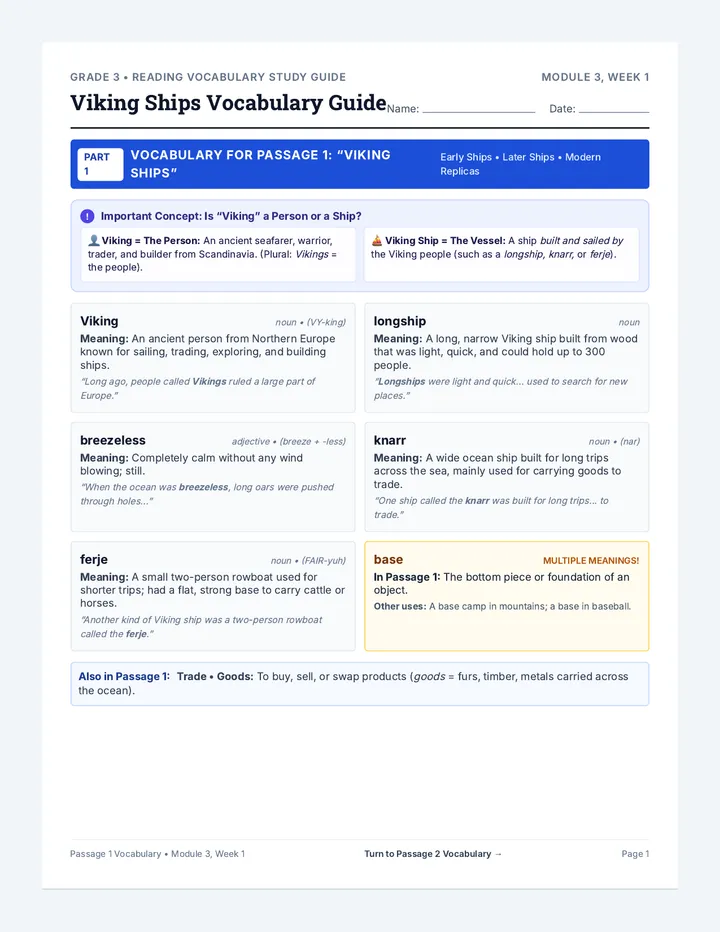
Viking Ships Vocabulary Guide
Grade 3 • Reading Vocabulary Study Guide Module 3, Week 1
Viking Ships Vocabulary Guide
Name: Date:
Part 1
Vocabulary for Passage 1: “Viking Ships”
Early Ships • Later Ships • Modern Replicas
! Important Concept: Is “Viking” a Person or a Ship?
👤 Viking = The Person: An ancient seafarer, warrior, trader, and builder from Scandinavia. (Plural: Vikings = the people).
⛵ Viking Ship = The Vessel: A ship built and sailed by the Viking people (such as a longship, knarr, or ferje).
Viking noun • (VY-king)
Meaning: An ancient person from Northern Europe known for sailing, trading, exploring, and building ships.
“Long ago, people called Vikings ruled a large part of Europe.”
longship noun
Meaning: A long, narrow Viking ship built from wood that was light, quick, and could hold up to 300 people.
“Longships were light and quick... used to search for new places.”
breezeless adjective • (breeze + -less)
Meaning: Completely calm without any wind blowing; still.
“When the ocean was breezeless, long oars were pushed through holes...”
knarr noun • (nar)
Meaning: A wide ocean ship built for long trips across the sea, mainly used for carrying goods to trade.
“One ship called the knarr was built for long trips... to trade.”
ferje noun • (FAIR-yuh)
Meaning: A small two-person rowboat used for shorter trips; had a flat, strong base to carry cattle or horses.
“Another kind of Viking ship was a two-person rowboat called the ferje.”
base Multiple Meanings!
In Passage 1: The bottom piece or foundation of an object.
Other uses: A base camp in mountains; a base in baseball.
Also in Passage 1: Trade • Goods: To buy, sell, or swap products (goods = furs, timber, metals carried across the ocean).
Passage 1 Vocabulary • Module 3, Week 1 Turn to Passage 2 Vocabulary → Page 1
Grade 3 • Reading Vocabulary Study Guide Module 3, Week 1
Passage 2 Vocabulary & Review
Part 2
Part 2
Viking Ships Teacher Key
Teacher Scoring Guide • Module 3, Week 1 Grade 3 Answer Key
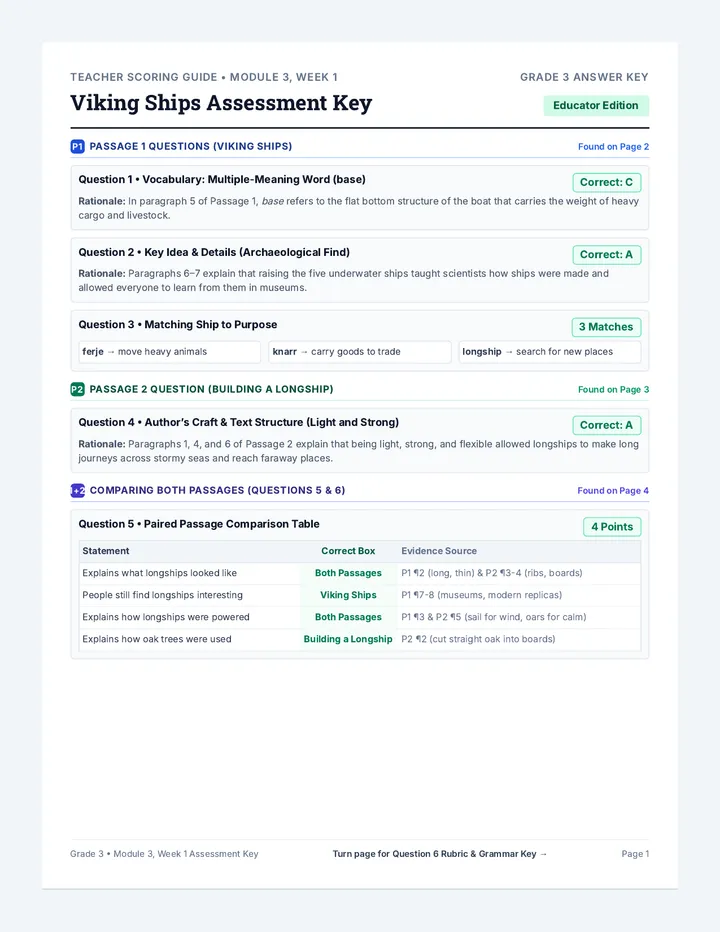
Viking Ships Assessment Key
Educator Edition
P1 Passage 1 Questions (Viking Ships)
Found on Page 2
Question 1 • Vocabulary: Multiple-Meaning Word (base) Correct: C
Rationale: In paragraph 5 of Passage 1, base refers to the flat bottom structure of the boat that carries the weight of heavy cargo and livestock.
Question 2 • Key Idea & Details (Archaeological Find) Correct: A
Rationale: Paragraphs 6–7 explain that raising the five underwater ships taught scientists how ships were made and allowed everyone to learn from them in museums.
Question 3 • Matching Ship to Purpose 3 Matches
ferje → move heavy animals
knarr → carry goods to trade
longship → search for new places
P2 Passage 2 Question (Building a Longship)
Found on Page 3
Question 4 • Author’s Craft & Text Structure (Light and Strong) Correct: A
Rationale: Paragraphs 1, 4, and 6 of Passage 2 explain that being light, strong, and flexible allowed longships to make long journeys across stormy seas and reach faraway places.
1+2 Comparing Both Passages (Questions 5 & 6)
Found on Page 4
Question 5 • Paired Passage Comparison Table 4 Points
| Statement | Correct Box | Evidence Source |
|---|
| Explains what longships looked like | Both Passages | P1 ¶2 (long, thin) & P2 ¶3-4 (ribs, boards) |
| People still find longships interesting | Viking Ships | P1 ¶7-8 (museums, modern replicas) |
| Explains how longships were powered | Both Passages | P1 ¶3 & P2 ¶5 (sail for wind, oars for calm) |
| Explains how oak trees were used | Building a Longship | P2 ¶2 (cut straight oak into boards) |
Grade 3 • Module 3, Week 1 Assessment Key Turn page for Question 6 Rubric & Grammar Key → Page 1
Constructed Response Rubric & Grammar Question 6 & Grammar 1–3
Question 6: 2-Point Scoring Rubric & Exemplars (Both Passages)
Score 2 (Complete) 2 pts
States how the longship's construction helped it sail different waters AND provides clear, accurate evidence from BOTH passages (e.g., shallow/light shape from P1; oak wood, keel/ribs, overlapping boards sealed with tar from P2).