Story Craft Quiz
Grade 6 • English Language Arts
Story Craft Quiz
Demonstrate your knowledge of essential literary elements.
Name:
Date:
Period: Score:
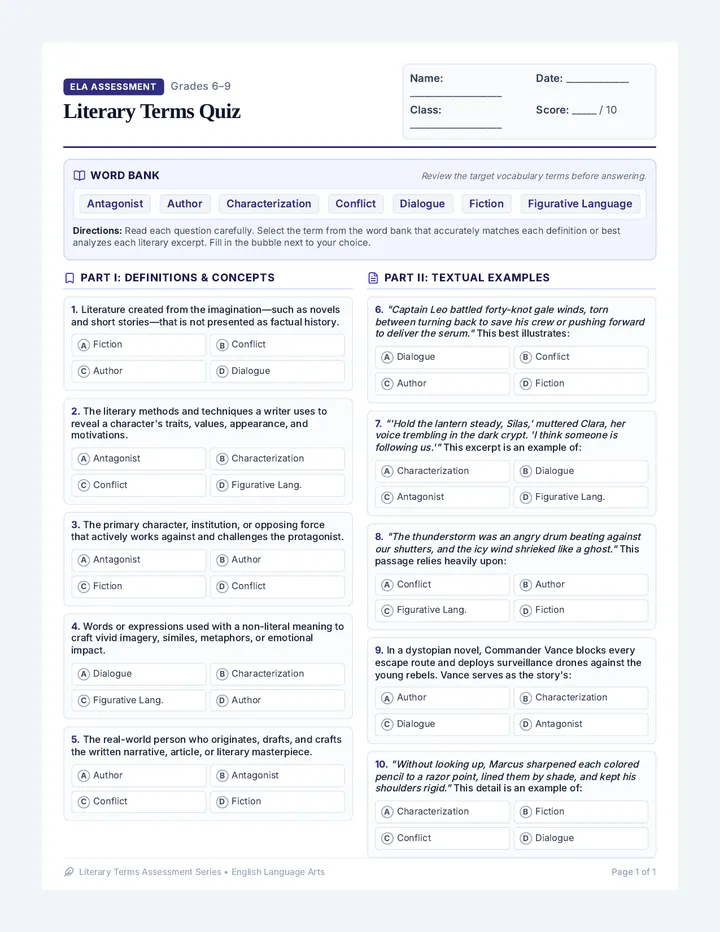
Word Bank
Terms may be used once, more than once, or not at all.
Antagonist
Author
Characterization
Conflict
Dialogue
Fiction
Figurative Language
PART 1
Literary Definitions (Questions 1–7)
1 point each
A story created from a writer's imagination rather than real facts or true historical events is called .
The person who writes a book, article, play, or poem is known as the .
The spoken conversation between two or more characters in a story, typically set inside quotation marks, is .
The main problem, obstacle, or struggle between opposing forces that drives the plot is the .
The character, group, or force that directly opposes or competes against the protagonist is the .
The method a writer uses to reveal a character's traits, appearance, thoughts, and actions is called .
Phrases and descriptive expressions not meant to be taken literally (such as metaphors and similes) are forms of .
PART 2
Literary Detectives: Applied Practice (Questions 8–10)
1 point each
"The fiery summer sun glared down like an angry giant, melting the asphalt beneath our sneakers."
The author's use of a simile and personification here is an example of:
"Keep your flashlight steady, Leo!" whispered Carlos in the dark cavern. "I'm trying, but the battery is dying," Leo stammered back.
The spoken conversation exchanged between Carlos and Leo is called:
Throughout the quest, Captain Vane schemes to steal the treasure map and sabotage Elena's crew at every turn. Because he works directly against the protagonist, Captain Vane is the story's:
Double-check your spelling against the word bank before turning in your quiz! Total Points: ___ / 10
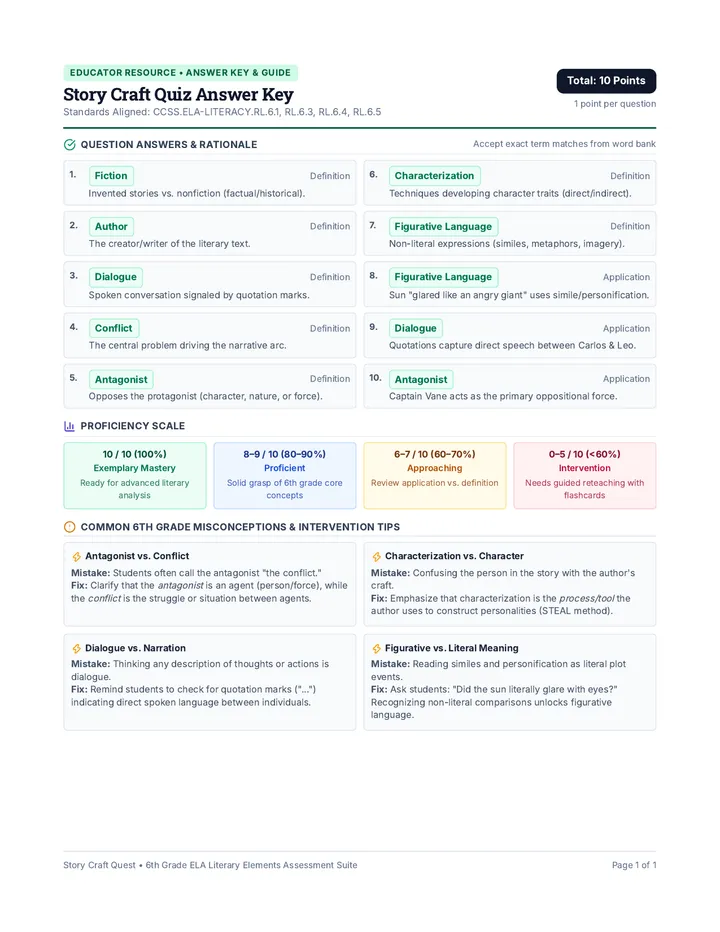
Story Craft Answer Key
Educator Resource • Answer Key & Guide
Story Craft Quiz Answer Key
Standards Aligned: CCSS.ELA-LITERACY.RL.6.1, RL.6.3, RL.6.4, RL.6.5
Total: 10 Points
1 point per question
Question Answers & Rationale
Accept exact term matches from word bank
Fiction Definition
Invented stories vs. nonfiction (factual/historical).
Author Definition
The creator/writer of the literary text.
Dialogue Definition
Spoken conversation signaled by quotation marks.
Conflict Definition
The central problem driving the narrative arc.
Antagonist Definition
Opposes the protagonist (character, nature, or force).
Characterization Definition
Techniques developing character traits (direct/indirect).
Figurative Language Definition
Non-literal expressions (similes, metaphors, imagery).
Figurative Language Application
Sun "glared like an angry giant" uses simile/personification.
Dialogue Application
Quotations capture direct speech between Carlos & Leo.
Antagonist Application
Captain Vane acts as the primary oppositional force.
Proficiency Scale
10 / 10 (100%) Exemplary Mastery
Ready for advanced literary analysis
8–9 / 10 (80–90%) Proficient
Solid grasp of 6th grade core concepts
6–7 / 10 (60–70%) Approaching
Review application vs. definition
0–5 / 10 (<60%) Intervention
Needs guided reteaching with flashcards
Common 6th Grade Misconceptions & Intervention Tips
Antagonist vs. Conflict
Mistake: Students often call the antagonist "the conflict."
Fix: Clarify that the antagonist is an agent (person/force), while the conflict is the struggle or situation between agents.
Characterization vs. Character
Mistake: Confusing the person in the story with the author's craft.
Fix: Emphasize that characterization is the process/tool the author uses to construct personalities (STEAL method).
Dialogue vs. Narration
Mistake: Thinking any description of thoughts or actions is dialogue.
Fix: Remind students to check for quotation marks ("...") indicating direct spoken language between individuals.
Figurative vs. Literal Meaning
Mistake: Reading similes and personification as literal plot events.
Fix: Ask students: "Did the sun literally glare with eyes?" Recognizing non-literal comparisons unlocks figurative language.
Story Craft Quest • 6th Grade ELA Literary Elements Assessment Suite Page 1 of 1