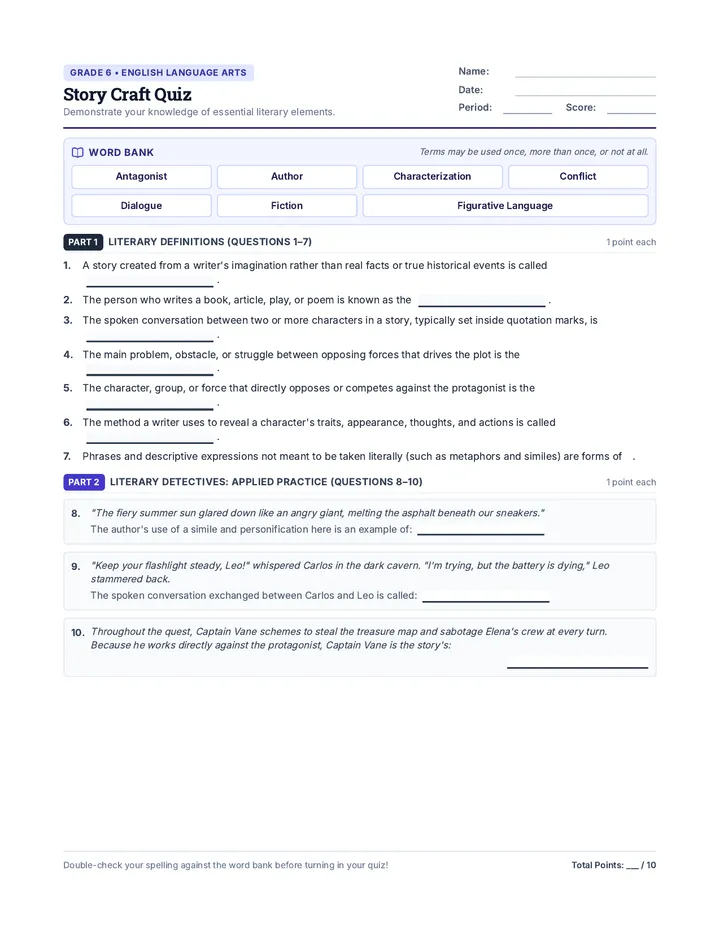
Literary Terms Quiz
ELA Assessment Grades 6–9
Literary Terms Quiz
Name: ___________________
Date: _____________
Class: ___________________
Score: _____ / 10
Word Bank
Review the target vocabulary terms before answering.
Antagonist Author Characterization Conflict Dialogue Fiction Figurative Language
Directions: Read each question carefully. Select the term from the word bank that accurately matches each definition or best analyzes each literary excerpt. Fill in the bubble next to your choice.
Part I: Definitions & Concepts
- Literature created from the imagination—such as novels and short stories—that is not presented as factual history.
A Fiction
B Conflict
C Author
D Dialogue
- The literary methods and techniques a writer uses to reveal a character's traits, values, appearance, and motivations.
A Antagonist
B Characterization
C Conflict
D Figurative Lang.
- The primary character, institution, or opposing force that actively works against and challenges the protagonist.
A Antagonist
B Author
C Fiction
D Conflict
- Words or expressions used with a non-literal meaning to craft vivid imagery, similes, metaphors, or emotional impact.
A Dialogue
B Characterization
C Figurative Lang.
D Author
- The real-world person who originates, drafts, and crafts the written narrative, article, or literary masterpiece.
A Author
B Antagonist
C Conflict
D Fiction
Part II: Textual Examples
- "Captain Leo battled forty-knot gale winds, torn between turning back to save his crew or pushing forward to deliver the serum." This best illustrates:
A Dialogue
B Conflict
C Author
D Fiction
- "'Hold the lantern steady, Silas,' muttered Clara, her voice trembling in the dark crypt. 'I think someone is following us.'" This excerpt is an example of:
A Characterization
B Dialogue
C Antagonist
D Figurative Lang.
- "The thunderstorm was an angry drum beating against our shutters, and the icy wind shrieked like a ghost." This passage relies heavily upon:
A Conflict
B Author
C Figurative Lang.
D Fiction
- In a dystopian novel, Commander Vance blocks every escape route and deploys surveillance drones against the young rebels. Vance serves as the story's:
A Author
B Characterization
C Dialogue
D Antagonist
- "Without looking up, Marcus sharpened each colored pencil to a razor point, lined them by shade, and kept his shoulders rigid." This detail is an example of:
A Characterization
B Fiction
C Conflict
D Dialogue
Literary Terms Assessment Series • English Language Arts
Page 1 of 1
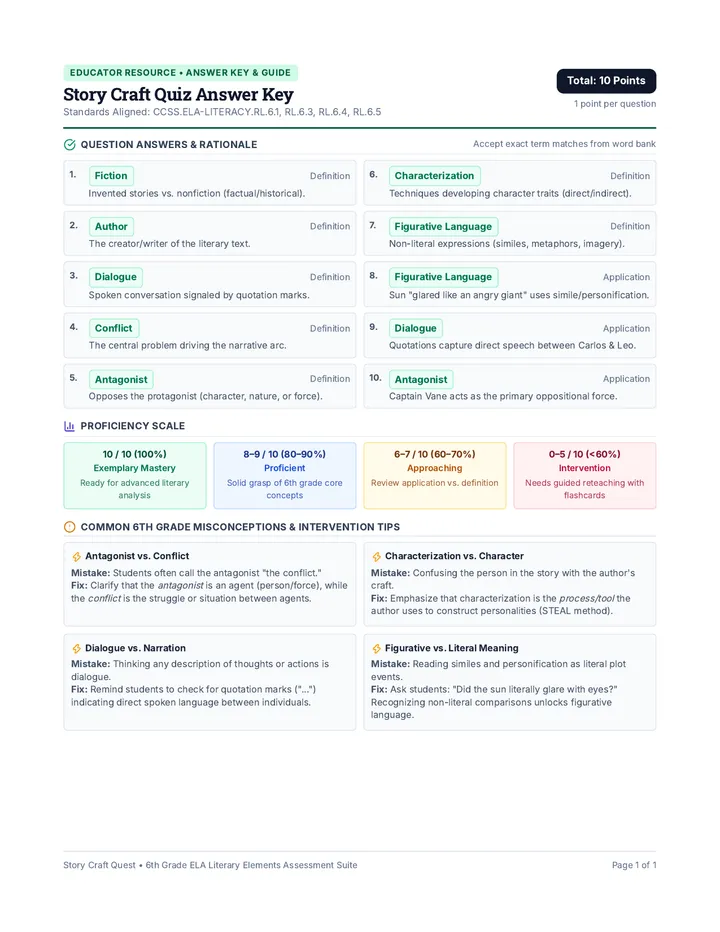
Literary Terms Answer Key
Teacher Resource Grading Key & Explanations
Literary Terms Quiz • Answer Key
Standards: CCSS.ELA-LITERACY.RL.4-8
Total Score: 10 Points (1 pt each)
Rapid Scoring Guide
Q1
A
Q2
B
Q3
A
Q4
C
Q5
A
Q6
B
Q7
B
Q8
C
Q9
D
Q10
A
Part I: Concept Rationales
1. Fiction Key: A
Rationale: Fiction refers to imagined prose narratives rather than factual accounts. Nonfiction deals with factual reporting.
2. Characterization Key: B
Rationale: Characterization is the process authors use to construct and reveal traits (direct description or indirect actions/thoughts).
3. Antagonist Key: A
Rationale: The antagonist is the primary source of conflict for the protagonist; it can be an individual, group, nature, or society.
4. Figurative Language Key: C
Rationale: Any phrasing not intended literally (metaphor, hyperbole, personification) belongs under figurative language.
5. Author Key: A
Rationale: The author is the real human creator of the text, distinct from the internal narrator or persona.
Part II: Textual Rationales
6. Conflict (Excerpt) Key: B
Rationale: The captain experiences both internal conflict (duty vs. saving crew) and external conflict (battling nature's storm).
7. Dialogue (Excerpt) Key: B
Rationale: The spoken words enclosed in quotation marks between characters represent direct narrative dialogue.
8. Figurative Language Key: C
Rationale: Includes metaphor ("sun was a molten bronze coin") and personification/simile ("wind shrieked like a ghost").
9. Antagonist (Excerpt) Key: D
Rationale: Commander Vance directly obstructs the protagonists' goals and enforces opposition, defining him as the antagonist.
10. Characterization Key: A
Rationale: Indirect characterization via actions and posture: shows Marcus's perfectionism and anxiety without explicit narration.