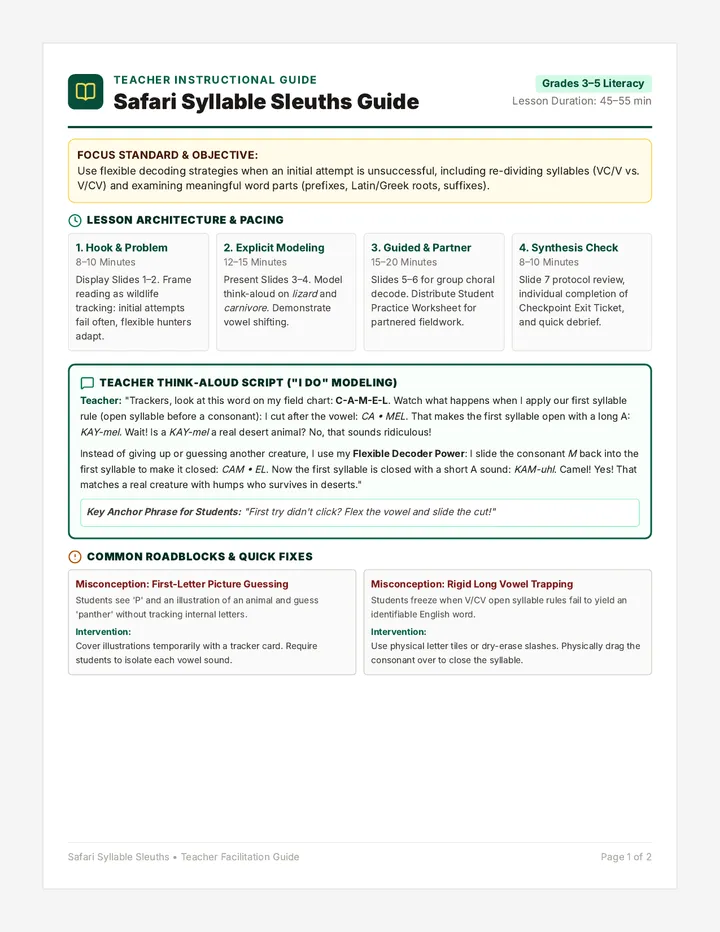
A hands-on reading lesson where students become wildlife expedition trackers, learning to flexibly re-divide syllables and inspect morphemes when decoding challenging animal words. Students practice shifting vowel sounds and recognizing affixes and roots to unlock multisyllabic terms.
Read the ranger log below. When you hit a bold underlined word, apply your flexible decoding strategy.
"Deep in the canopy, our motion camera spotted a PREDATORY feline moving along the branch. It displayed incredible CAMOUFLAGE against the lichen-covered bark. Because it is strictly NOCTURNAL, it rested quietly until dusk before beginning its patrol across the river basin."
Decryption: PREDATORY
Initial Attempt Syllables (Try long E or short E):
Root or Affixes Identified:
What does this tell us about the animal?
Decryption: NOCTURNAL
Syllable Division (NOC • TUR • NAL):
Root meaning (noct = night):
Why does this creature hunt at night?
Tracker Certification Checklist: Did you re-divide syllables? Did you check word parts?
Expedition Pass Approved: [ ]
Safari Syllable Sleuths • Student Field Practice Page 2 of 2
Field Assessment & Differentiation
Master Answer Keys & Support
Instructor Reference
Tiered Differentiation Pathways
Support / Striving Readers
Highlight vowels in yellow before cutting syllables.
Provide syllable cards with movable division strips.
Limit target words to two syllables (e.g., cam-el, rob-in).
English Language Learners
Pair words with real animal photos and habitat icons.
Analyze Greek/Latin root origins: terra (land), aqua (water).
Author their own ranger field log using target vocabulary.
Student Practice Worksheet Answer Key
Part 1: Syllable Switchback
PELICAN: Attempt 1 (PE•LI•CAN) makes sense? No. Re-division: PEL • I • CAN. Vowel sound: Short E (/ɛ/).
OCELOT: Attempt 1 (O•CE•LOT) makes sense? No. Re-division: OC • E • LOT. Vowel sound: Short O (/ɑ/).
SALAMANDER: Attempt 1 makes sense? No. Re-division: SAL • A • MAN • DER. Vowel sound: Short A (/æ/).
Reflection Question:Expected answer: Pull/slide the consonant into the first syllable to close it, which changes the vowel from a long sound to a short sound.
Part 2 & 3: Morpheme Breakdown & Decryption
HERBIVOROUS: An animal that eats only plants / vegetation.
SUBTROPICAL: Regions located immediately next to or border areas bordering the tropics; warm climate.
CARNIVORE: An organism that feeds primarily on animal flesh/meat.
Decryption (PREDATORY): Syllables: PRED • A • TO • RY; Root: predator (hunter); Meaning: An animal that hunts other animals for food.
Decryption (NOCTURNAL): Syllables: NOC • TUR • NAL; Root: noct (night); Meaning: Active primarily during nighttime hours.
Exit Checkpoint Answer Key
1. PLATYPUS: Re-divide as PLAT • Y • PUS (closed first syllable). Vowel sound flexes from Long A to Short A (/æ/).
2. INVERTEBRATE: Prefix in- (not / without) + root vertebrate (backbone). Animal that lacks an internal spine/backbone (e.g., jellyfish, insect).
3. Multiple Choice: Correct answer is B (Slide the consonant into the prior syllable and flex the vowel sound).