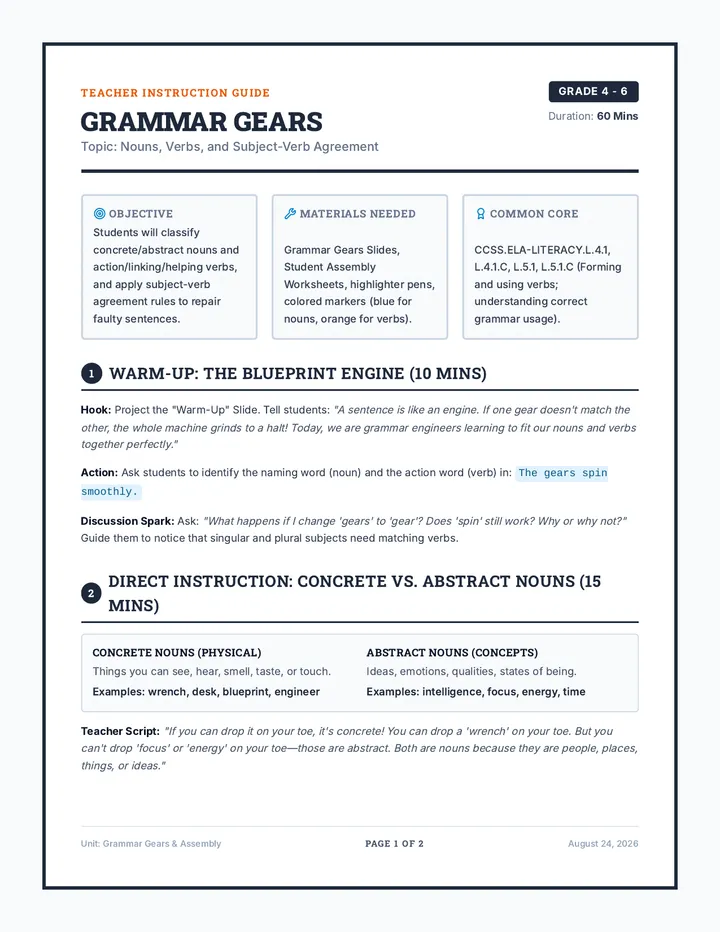
Paraphrase Power Up Lesson Plan Paraphrase Power Up
Lesson Plan • 11th Grade English Language Arts
57 Minutes
Learning Objective
Students will be able to accurately and effectively paraphrase excerpts from a literary non-fiction text, demonstrating comprehension and the ability to restate information in their own words across three increasing levels of complexity.
Why This Matters
Mastering paraphrasing is essential for academic success and ethical writing. It helps students avoid plagiarism, deepens their understanding of texts, and improves their ability to explain complex ideas clearly and concisely in their own voice.
Materials Needed
Whiteboard or Projector
Slide Deck
"Language of the Stars" Reading
Paraphrasing Practice Activity
Teacher Answer Key
Teacher Preparation
Review Lesson Plan, Slide Deck, and Script.
Familiarize yourself with the "Language of the Stars" reading.
Print copies of the Reading and Activity for each student.
Set up projector for the slide deck.
Review the Answer Key for expected responses.
Time check: 15 minutes prep required.
Instructional Sequence
5 MIN
Warm-Up: What's the Gist?
Display the warm-up prompt on the board. Ask students to quickly write the main idea of a short provided sentence in their own words. Discuss a few responses, emphasizing meaning preservation.
5 MIN
Introduction to Paraphrasing
Use the Slide Deck and Script. Define paraphrasing vs. summarizing/quoting. Introduce the "Three Rs": Reword, Rearrange, Recheck .
10 MIN
Phase 1: Sentence-Level Rewording
Students paraphrase specific sentences from the reading. Focus on changing words and structures. Teacher circulates for support. Peer-sharing encouraged.
15 MIN
Phase 2: Paragraph-Level Rephrasing
Challenge students to rephrase entire paragraphs. Requires extensive rearrangement and thinking about flow. Discuss strategies and challenges as a class.
20 MIN
Phase 3: Concept-Level Interpretation
Deepest level. Paraphrase underlying concepts or main arguments across multiple sections. Synthesis and interpretation focus. Follow with pair-share or group discussion.
2 MIN
Cool-Down: Paraphrasing Power
Exit Ticket: Students reflect on the most important takeaway from the lesson.
Language of the Stars Reading The Language of the Stars
A Cosmic Reflection
From the moment humanity first tilted its gaze towards the vast, inky canvas above, stars have been more than mere pinpricks of light. They have been storytellers, navigators, gods, and muses. Long before telescopes pierced the veil of distance, our ancestors wove intricate tapestries of myth around constellations, believing the patterns held the destinies of kings and the secrets of the cosmos. The hunter Orion, the loyal dog Canis Major, the majestic Leo – these were not just random arrangements of celestial bodies, but characters in an epic drama playing out across eternity. This profound connection wasn't scientific in the modern sense, but it was deeply human, an innate yearning to find meaning in the overwhelming grandeur of the universe.
Even now, in an age of space travel and quantum physics, the stars retain an almost primal allure. We understand their fiery birth in nebulae and their eventual collapse into white dwarfs, neutron stars, or even black holes. We know they are cosmic furnaces, forging the very elements that make up our bodies and our planet. Carbon, oxygen, iron – every atom within us was once part of a star, flung across the cosmos in a spectacular supernova explosion. This scientific truth, while seemingly cold and analytical, reveals an even more breathtaking narrative: we are literally stardust, intimately connected to the grand cosmic cycle.
Yet, for all our technological prowess, the stars continue to challenge our understanding. The accelerating expansion of the universe, the mystery of dark matter and dark energy, the search for exoplanets that might harbor life – these are the frontiers where our current knowledge falters and speculation takes flight. It is in these moments of scientific humility that we echo the ancient astronomers, staring upwards with a blend of awe and wonder, asking new questions, perhaps even whispering old ones into the void.
The act of looking at stars is, in many ways, an act of looking back in time. The light from even our nearest star, the Sun, takes approximately eight minutes to reach us. When we gaze at Alpha Centauri, we are seeing it as it was over four years ago. The faint glow of a galaxy millions of light-years away is a window into a past that predates humanity, perhaps even Earth itself. This temporal displacement is not a flaw in our vision but a profound gift, allowing us to witness the universe's autobiography unfold in slow motion.
Consider the possibility of other intelligent life gazing back. Are there alien astronomers on distant worlds, cataloging their own constellations, constructing their own myths? Do they, too, feel the same sense of smallness and grandeur, the same existential wonder that stirs within us? The sheer scale of the cosmos, with its estimated two trillion galaxies, each containing billions of stars, makes the notion of our unique existence feel increasingly improbable. The silence from the void, therefore, is not necessarily a sign of absence, but perhaps a testament to the immense distances and the vastness of time.
Paraphrase Power Up Slide Deck Paraphrase Power-Up
Unlocking Your Own Voice
What's the Gist?
"The vast, interconnected network of the internet has revolutionized how humans communicate, access information, and conduct business across the globe."
Your Mission:
Explain this to a younger sibling or friend without using the author's words. Capture the "gist"!
Your Words, Their Ideas
Definition
Taking someone else's thoughts and expressing them in your own unique way .
Why do we do it?
Avoid plagiarism
Show true understanding
Simplify complex ideas
The Citation Spectrum
Direct Quote
Exact words. Quotation marks. Use sparingly for high impact.
Paraphrasing
Roughly same length. All key ideas. Your words. Citation needed.
Summarizing
Shorter than original. Big picture only. Main ideas focus.
The Power-Up Strategy: 3 R's
1
Reword
Swap vocabulary (synonyms) and change sentence structure.
2
Rearrange
Change the order of ideas or clauses within the text.
3
Recheck
Does it keep the exact meaning? Is it truly your voice?
Phase 1: Sentence Level
10 Minutes
The Goal
Practice basic Rewording and Rearranging with single sentences.
Example from text:
"They have been storytellers, navigators, gods, and muses."
Open your practice activity and begin Phase 1!
Phase 2: Paragraph Level
15 Minutes
The Goal
Rebuild whole ideas . Think about the flow and connection between sentences.
Identify the main point of the paragraph first.
How does each sentence support that point?
Try to synthesize multiple sentences into new structures.
Focus on the designated paragraphs on your sheet.
Phase 3: Concept Level
20 Minutes
Unpacking the Big Ideas
What is the author really trying to say?
Paraphrase Power Up Script Guide Paraphrase Power-Up! Script
A Step-by-Step Facilitation Guide for 11th Grade ELA
5 MIN
Warm-Up: What's the Gist?
Teacher Action: Display Slide 1 & 2. Ensure students have the Warm-Up handout.
[SAY]: "Good morning, everyone! Let's kick off today with a quick warm-up. Take a look at the sentence on the screen. I want you to quickly write down the main idea of this sentence in your own words, as if you were explaining it to someone who hadn't read it. Don't copy any words directly, just capture the essence."
Pause for students to write (1-2 minutes). Ask for volunteers.
[SAY]: "Alright, who would like to share their 'gist'? What did you come up with? (Affirm responses). Excellent! What you just did—putting an idea into your own words without changing its meaning—is exactly what we're focusing on today: paraphrasing !"
5 MIN
Introduction to Paraphrasing
Teacher Action: Move to Slide 3: 'What is Paraphrasing?'
[SAY]: "So, what *is* paraphrasing? At its core, it's about taking someone else's ideas and expressing them in your own unique way. Why is this skill so important for 11th graders? First, it helps you avoid plagiarism. Second, successfully paraphrasing something proves you truly understand it—you can't put something into your own words if you don't 'get' it. Finally, it helps you integrate sources smoothly into your own writing."
Teacher Action: Move to Slide 4: 'Not Just Summarizing or Quoting'
[SAY]: "Paraphrasing isn't a direct quote —that's exact words in quotation marks. And it's not a summary , which is much shorter. A paraphrase is usually about the same length as the original, but in your voice."
3 MIN
The 3 R's Strategy
Teacher Action: Move to Slide 5: 'The Paraphrasing Power-Up: 3 R's!'
[SAY]: "Here's your strategy guide. 1: Reword —change vocabulary and sentence structure. 2: Rearrange —shift the order of ideas while keeping the logic. 3: Recheck —compare your version to the original. Does it mean the exact same thing? Is it truly your words?"
10 MIN
Phase 1: Sentence-Level Rewording
Teacher Action: Distribute Reading and Activity. Move to Slide 6.
[SAY]: "We're starting small. Look at the Phase 1 sentences on your activity sheet. Focus heavily on reword and rearrange . Try to change individual words and alter the sentence structure as much as you can without losing the meaning. Remember to recheck !"
Circulate and provide feedback. After 5-7 mins, have a few volunteers share.
Whats the Gist Warm Up Handout Warm-Up: What's the Gist?
Paraphrase Power-Up • Lesson Introduction
Name:
Date:
Instructions
Read the sentence below carefully. In the space provided, write down the main idea or the "gist" of the sentence in your own words. Important: Do not copy any words or phrases directly from the original.
Original Sentence
"The vast, interconnected network of the internet has revolutionized how humans communicate, access information, and conduct business across the globe."
My Gist
Try to explain this as if you were speaking to a younger sibling or friend.
Paraphrasing Practice Activity Handout Paraphrasing Practice Activity
Source Text: "The Language of the Stars"
Name:
Date:
Complete the following exercises using the 3 R's strategy: Reword , Rearrange , and Recheck . Ensure you maintain the original meaning while using your own unique voice and sentence structure.
Phase 1
Sentence-Level Rewording
10 Minutes
1. Original Sentence
"They have been storytellers, navigators, gods, and muses."
2. Original Sentence
"Carbon, oxygen, iron – every atom within us was once part of a star, flung across the cosmos in a spectacular supernova explosion."
3. Original Sentence
"This profound connection wasn't scientific in the modern sense, but it was deeply human, an innate yearning to find meaning in the overwhelming grandeur of the universe."
4. Original Sentence
"The faint glow of a galaxy millions of light-years away is a window into a past that predates humanity, perhaps even Earth itself."
Phase 2
Paragraph-Level Rephrasing
15 Minutes
Paragraph excerpt
"Even now, in an age of space travel and quantum physics, the stars retain an almost primal allure... This scientific truth, while seemingly cold and analytical, reveals an even more breathtaking narrative: we are literally stardust, intimately connected to the grand cosmic cycle."
Paragraph excerpt
"Yet, for all our technological prowess, the stars continue to challenge our understanding. The accelerating expansion of the universe... It is in these moments of scientific humility that we echo the ancient astronomers... asking new questions, perhaps even whispering old ones into the void."
Phase 3
Concept-Level Interpretation
20 Minutes
1. Synthesize the main argument from "The Interconnectedness Concept" (Page 2):
Focus on the author's message regarding humility and participation in the cosmic narrative.
2. Synthesize the main argument from "The Search for Life Concept" (Page 2):
Focus on the implications of cosmic scale and the interpretation of the "silence from the void."
Paraphrasing Power Exit Ticket Paraphrasing Power
Cool-Down Exit Ticket
Name:
Date:
The Big Takeaway
What is the most important takeaway or the single most valuable thing you learned about paraphrasing today?
The universe of your own words.
Paraphrasing Activity Answer Key Paraphrasing Activity
Teacher Answer Key & Exemplars
Teacher Resource
Note to Educator
The paraphrases provided below are exemplars. Students may produce variations that are equally correct, provided they accurately convey the original meaning using their own vocabulary and structure. Focus on evaluating their application of the 3 R's (Reword, Rearrange, Recheck).
Phase 1: Sentence-Level Rewording
1. Original
"They have been storytellers, navigators, gods, and muses."
Exemplar Paraphrase:
For humanity, the stars have functioned as sources of narratives, guides for exploration, figures of worship, and inspirations for art and thought.
2. Original
"Carbon, oxygen, iron – every atom within us was once part of a star, flung across the cosmos in a spectacular supernova explosion."
Exemplar Paraphrase:
Our bodies and planet contain elements like carbon, oxygen, and iron, all of which originated in stars and were dispersed throughout the universe by powerful supernova events.
Phase 2: Paragraph-Level Rephrasing
Original Paragraph Excerpt
"Even now, in an age of space travel... we are literally stardust, intimately connected to the grand cosmic cycle."
Exemplar Paraphrase:
Despite advancements in space exploration and quantum physics, stars continue to hold a fundamental fascination for us. While modern science has illuminated how stars are born in clouds of gas and dust and how they die as white dwarfs, neutron stars, or black holes, we also understand their crucial role as factories that create all the elements of life, including those found in our own bodies and on Earth. For instance, substances like carbon, oxygen, and iron were formed inside stars before being scattered across the universe by immense stellar explosions. This scientific knowledge, though precise, actually deepens a more profound story: that humanity is intrinsically linked to the universe's vast, continuous process, as we are, quite literally, composed of stardust.
Phase 3: Concept-Level Interpretation
1. Interconnectedness Concept
Exemplar Concept Paraphrase:
In essence, the author argues that the stars serve as profound teachers, instilling in humanity a sense of humility and a realization of our deep interconnectedness with the cosmos. They highlight that our personal existences, while important, are merely small components of a much grander universal story. The stars encourage us to see ourselves not as separate spectators of the universe, but as active, albeit minor, participants in its ongoing narrative.
2. Search for Life Concept