Tension Tactics Slides CSI: LIT DEPT CASE DEPT-109 / INTRO
Classified Lecture
TENSION TACTICS
The Forensic Art of building Suspense, Pacing, and Mood in Narrative Writing.
DO NOT DISTRIBUTE OUTSIDE OF LAB
SLIDE 01/05
THE METRICS SUBJECT: CORE CONCEPTS
Narrative Pacing
The speed at which a story unfolds.
Slow Pacing: Drags out small moments using high sensory detail to prolong anxiety.Fast Pacing: Uses short sentences and rapid actions to simulate panic and danger.
Foreshadowing
Placing subtle clues about what's to come.
Plants sub-conscious worries in the reader's mind.
Makes future horrors feel inevitable and earned.
Can be objects (e.g., ticking clock) or words ("I was never insane").
MISSION: DETECT SUSPENSE STRUCTURES
SLIDE 02/05
CASE EVIDENCE SUBJECT: THE TELL-TALE HEART
CRIME SCENE EXCERPT:
"Now this is the point. You fancy me mad. Madmen know nothing. But you should have seen me. You should have seen how wisely I proceeded—with what caution—with what foresight—with what dissimulation I went to work!"
— Edgar Allan Poe
Forensic Notes
01
The Denial: Repetition of sanity triggers automatic reader doubt (unreliability).
02
The Pacing Brake: Dashes (—) force the reader to pause, creating artificial heartbeats.
LOOK FOR PULSE MARKS IN THE TEXT
SLIDE 03/05
DIAGNOSTICS SUBJECT: TENSION MOVEMENT
The Anatomy of a Suspense Peak
TENSION SCALE (1-10) ▲ PEAK DREAD
1
2
3
5
7
10
3
Introduction Inciting Incident Rising Suspense The Climax (Slow-Motion) Resolution
Suspense is NOT a flat line. Good writers use pacing manipulation to stretch the curve before dropping the hammer.
PULSATING TENSION ARCHITECTURE
SLIDE 04/05
MISSION REPORT DEBRIEFING: LAB WORK
ACTIVE INVESTIGATION
Your Assignment: The Tell-Tale Casefile
STEP 01
Examine Passages
Read the classic scene from 'The Tell-Tale Heart' on your forensic worksheet.
STEP 02
Trace Pacing Marks
Underline and map sentence lengths, pauses, and repetition triggers.
STEP 03
Measure Tension
Rate the tension levels of specific phrases to chart the rising line.
OPEN YOUR TELL-TALE WORKSHEET NOW
SLIDE 05/05
Tell Tale Casefile Worksheet Classified Lab Use Only
FORENSIC CASEFILE
LITERARY CRIMINOLOGY DIVISION • METRIC ANALYSIS
CASE: EDGAR ALLAN POE
CODE: POE-1843-HEART
INVESTIGATOR:
DATE:
EXHIBIT A: THE STEALTHY ENTRY
Directions: Read the crime scene excerpt below. Pay close attention to dashes, sentence structures, and repetitive pulses.
1
2
3
4
5
6
"And every night, about midnight, I turned the latch of his door and opened it—oh, so gently! And then, when I had made an opening sufficient for my head, I put in a dark lantern, all closed, closed, that no light shone out, and then I thrust in my head."
"Oh, you would have laughed to see how cunningly I thrust it in! I moved it slowly—very, very slowly, so that I might not disturb the old man's sleep. It took me an hour to place my whole head within the opening so far that I might see him as he lay upon his bed."
LABORATORY DIAGNOSTICS
1 Pacing Brakes: Identify Poe's use of dashes and punctuation in Exhibit A. How do these "brakes" affect the speed of your reading?
2 Repetitive Echoes: Analyze the repetition of words like "closed, closed" and "very, very slowly." What internal psychological state does this reveal?
3 The Time Warp: The narrator claims it took an hour to stick his head in the door. How does stretching physical time build narrative suspense?
TENSION DETECTIVES • LAB WORKBOOK #1 PAGE 1 OF 1
Tension Detectives Teacher Guide TEACHER UNIT DOSSIER
LITERARY CRIMINOLOGY DIVISION • INSTRUCTIONAL BRIEFING
SEQUENCE: TENSION DETECTIVES
TARGET GRADE: 6-8 (ELA)
UNIT OBJECTIVE OVERVIEW
This 5-day unit teaches students to look at fiction with a detective's eyes, examining mechanics like punctuation, sensory atmospheric cues, and dramatic perspective unreliability to understand how authors systematically construct anticipation and dread.
5-DAY INSTRUCTIONAL PACING
DAY 1
The Blueprint
Analyze Poe's pacing brakes (dashes, repetition) in 'The Tell-Tale Heart'.
DAY 2
Sensory Shadows
Track sensory climate and mood transitions in Jacobs' 'The Monkey's Paw'.
DAY 3
Unreliable Eyes
Deconstruct dramatic irony and gaps in narrator credibility.
DAY 4
Drafting Chills
Write 200-300 word suspense scenes using the 1-10 Tension Thermometer.
DAY 5
Peer Review
Conduct diagnostic peer evaluations using professional rubrics.
COMMON MISCONCEPTIONS & PITFALLS
Pitfall A: "Pacing is always about speed." Students often write action-packed scenes, thinking fast verbs create suspense. Guide them to see that slowing down time is what builds anxiety.Pitfall B: "The setting is just decoration." Clarify that an effective atmospheric setting is active; weather changes and soundscapes should mirror the psychological tension of characters.Pitfall C: "Dashes are just mistakes." Middle schoolers struggle with non-standard ELA punctuation. Emphasize that Poe uses dashes structurally to control breathing.
TENSION DETECTIVES • INSTRUCTIONAL SYLLABUS PAGE 1 OF 2
DIAGNOSTIC ANSWER CASEKEY
LITERARY CRIMINOLOGY DIVISION • VERIFICATION DOCUMENTS
SEQUENCE: TENSION DETECTIVES
LAB REPORT: ANSWER KEYS
DAY 1 KEY: "THE TELL-TALE HEART" PACING
Pacing Brakes (Question 1):
"Poe uses dashes like 'door and opened it—oh, so gently!' and repetition to interrupt standard syntax. This mimics a stammering heartbeat or anxious breath, forcing the reader to physically pause."
Repetitive Echoes (Question 2):
"Words like 'closed, closed' and 'slowly—very, very slowly' mimic the obsessive, hyper-focused mania of the narrator, alerting the reader that his mind is highly unstable."
DAY 2 KEY: "THE MONKEY'S PAW" SENSORY
Sensory Calibration (Exemplar Responses):
Shadow Sensory Chart SENSORY PROFILE DEPT
SENSORY ANALYSIS CHART
LITERARY CRIMINOLOGY DIVISION • MOOD & ATMOSPHERE DEPT
CASE: W.W. JACOBS
CODE: JAC-1902-PAW
INVESTIGATOR:
DATE:
EXHIBIT B: LABURNAM VILLA INTRUSIONS
Directions: Read the environmental briefings below. Focus on the sharp contrast between inside safety and outside danger.
SCENE 1: THE COSY SANCTUARY
"Without, the night was cold and wet, but in the small parlour of Laburnam Villa the blinds were drawn and the fire burned brightly. Father and son were at chess..."
SCENE 2: THE MIDNIGHT KNOCK
"A cold wind rushed up the staircase... there was a knock, so quiet and stealthy as to be scarcely audible... then a third knock sounded through the house."
EVIDENCE MATRIX: SENSORY RADAR
Directions: Isolate sensory elements from the story. Underline specific keywords, define their psychological impact, and rate their chilling effect.
Sensory Organ
Text Clues / Specific Words
Psychological Mood Effect
SIGHT & LIGHT
SOUND & SILENCE
TOUCH & TEMP
FORENSIC SUMMARY: How does W.W. Jacobs use the transition from indoor warmth to outdoor cold wind to build a sense of inescapable doom?
TENSION DETECTIVES • LAB WORKBOOK #2 PAGE 1 OF 1
Unreliable Eye Organizer PSYCHOLOGICAL PROFILING DEPT
UNRELIABLE EYE ORGANIZER
LITERARY CRIMINOLOGY DIVISION • PERSPECTIVE PSYCHOLOGY
CASE: NARRATOR PROBATION
CODE: DET-103-IRONY
INVESTIGATOR:
DATE:
UNRELIABLE NARRATOR
A storyteller whose credibility is compromised. The reader must cross-examine their claims because they are hiding details, lying, or losing touch with sanity.
DRAMATIC IRONY
A suspense mechanism where the reader knows a critical truth that the protagonist or characters in the story remain completely blind to.
CASE EXCERPT DEBRIEFING:
"I felt that I must scream or die!—and now—again!—hark! louder! louder! louder!— 'Villains!' I shrieked, 'dissemble no more! I admit the deed!—tear up the planks!—here, here!—it is the beating of his hideous heart!'"
Poe's narrator cracks because they believe the officers hear the heart too. But the reader knows the officers hear absolutely nothing.
EVIDENCE MATRIX: REVELATION VS DENIAL
Narrator's Version (What they claim)
The Reader's Intel (What we actually suspect)
The Suspense Gap (How this builds dread)
The narrator is totally calm, sane, and has perfect logical control over their criminal crime scene.
The polite police officers are chatting and laughing innocently, making pleasant conversation.
FORENSIC VERDICT: How does an author’s choice to use an UNRELIABLE narrator force the reader to do detective work? Explain in 2-3 sentences.
TENSION DETECTIVES • LAB WORKBOOK #3 PAGE 1 OF 1
Tension Thermometer Worksheet DRAFTING DEPT • STAGE IV
TENSION THERMOMETER
LITERARY CRIMINOLOGY DIVISION • CREATIVE CRIME LAB
CASE: CREATIVE SYNTHESIS
CODE: DET-505-DRAFT
INVESTIGATOR:
DATE:
PILOT METRICS: THE DREAD INDEX (1-10)
1-2Calm
3-4Unease
5-6Suspicion
7-8Dread
9-10Panic / Flash Point
Your Goal: Write a 200-300 word suspense scene that begins at level 3 (Unease) and rises continuously to level 9 (Panic) . Include at least 1 "pacing brake" (dash pause) and 2 specific "sensory shadow" details.
LABORATORY DRAFT SHEET TARGET: 200-300 WORDS
TENSION DETECTIVES • LAB WORKBOOK #4 PAGE 1 OF 1
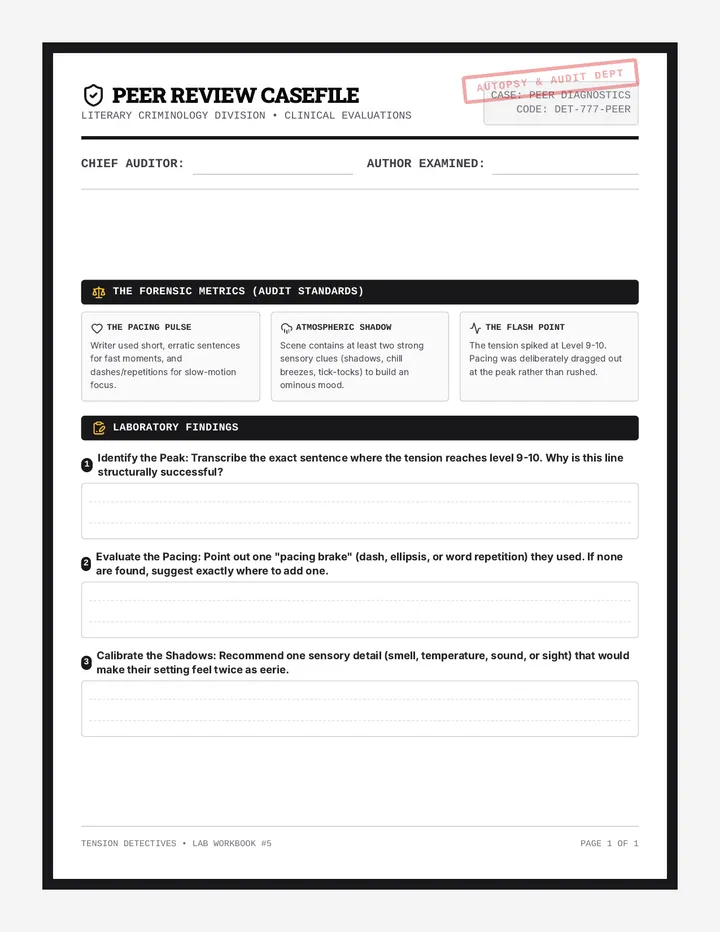
Peer Review Casefile AUTOPSY & AUDIT DEPT
PEER REVIEW CASEFILE
LITERARY CRIMINOLOGY DIVISION • CLINICAL EVALUATIONS
CASE: PEER DIAGNOSTICS
CODE: DET-777-PEER
CHIEF AUDITOR:
AUTHOR EXAMINED:
THE FORENSIC METRICS (AUDIT STANDARDS)
THE PACING PULSE
Writer used short, erratic sentences for fast moments, and dashes/repetitions for slow-motion focus.
ATMOSPHERIC SHADOW
Scene contains at least two strong sensory clues (shadows, chill breezes, tick-tocks) to build an ominous mood.
THE FLASH POINT
The tension spiked at Level 9-10. Pacing was deliberately dragged out at the peak rather than rushed.
LABORATORY FINDINGS
1 Identify the Peak: Transcribe the exact sentence where the tension reaches level 9-10. Why is this line structurally successful?
2 Evaluate the Pacing: Point out one "pacing brake" (dash, ellipsis, or word repetition) they used. If none are found, suggest exactly where to add one.
3 Calibrate the Shadows: Recommend one sensory detail (smell, temperature, sound, or sight) that would make their setting feel twice as eerie.
TENSION DETECTIVES • LAB WORKBOOK #5 PAGE 1 OF 1