Nucleus Unleashed Notes
Núcleo Desatado
Guía de referencia estudiantil: Fisión y Fusión
Tema 4.2
El Núcleo
- Núcleo: El centro denso de un átomo que contiene protones y neutrones.
- Isótopos: Átomos del mismo elemento con diferente número de neutrones.
- Quarks: Partículas fundamentales que componen los protones y neutrones.
Energía y Desintegración
- Energía de enlace: La energía requerida para separar un núcleo en sus partes componentes.
- Desintegración radiactiva: El proceso por el cual un núcleo inestable pierde energía mediante radiación.
- Desintegración Alfa: Un tipo de desintegración donde un núcleo emite una partícula alfa (2p, 2n).
Términos de Procesos
- Vida media: El tiempo necesario para que la mitad de una muestra radiactiva se desintegre.
- Reacción en cadena: Una secuencia donde el producto de una reacción inicia la siguiente.
- Plasma: Un estado de la materia de alta energía donde los electrones son arrancados de los núcleos.
Fisión Nuclear
Definición:
La división de un núcleo pesado e inestable en dos núcleos más pequeños y ligeros. Este proceso libera una cantidad masiva de energía y a menudo desencadena una reacción en cadena.
Ejemplo del mundo real
Centrales nucleares de Uranio-235
Los reactores nucleares utilizan la fisión controlada de átomos de uranio para generar calor, que convierte el agua en vapor para mover turbinas que producen electricidad.
Características clave:
- Requiere elementos pesados (uranio, plutonio).
- Produce residuos radiactivos.
- Puede ser controlada para energía o no controlada para armamento.
Fusión Nuclear
Definición:
La combinación de dos núcleos ligeros para formar un único núcleo más pesado. Este proceso requiere calor y presión extremos para superar la repulsión entre los núcleos.
Ejemplo del mundo real
El Sol y las estrellas
En el núcleo del Sol, los núcleos de hidrógeno se fusionan para formar helio. Esto proporciona la luz y el calor esenciales para la vida en la Tierra.
Características clave:
- Ocurre en estado de plasma.
- Produce mucha más energía que la fisión.
- Produce muy pocos residuos radiactivos (principalmente helio).
U
Fisión
"La energía no se crea ni se destruye, solo se transforma."
+ Calor
He
Fusión
Atomic Power Worksheet
Nuclear Fission, Fusion, and Decay
NAME:
DATE:
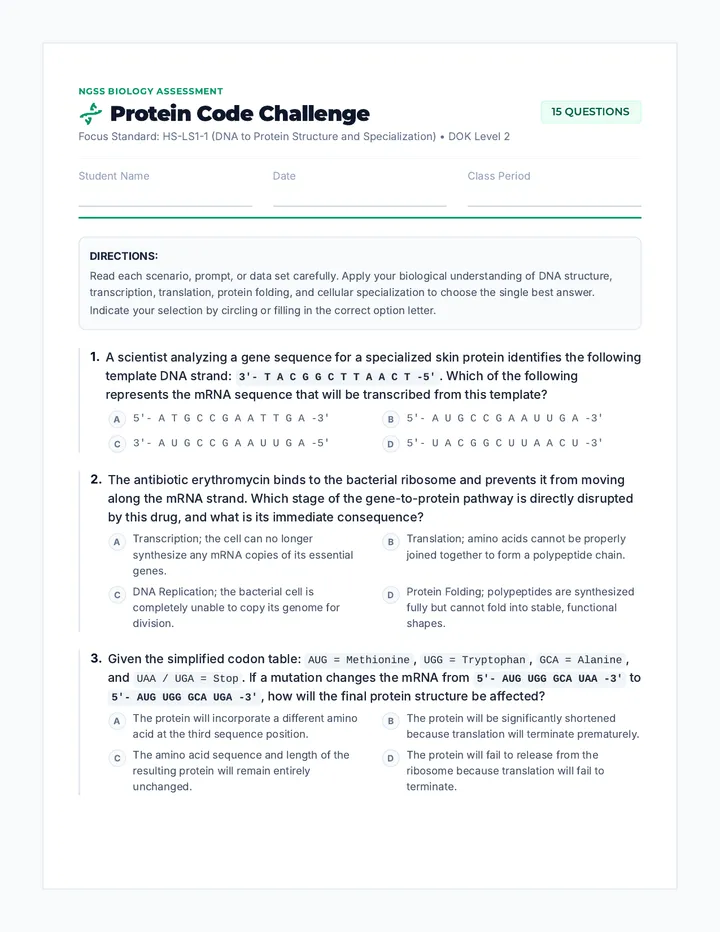
1
Vocabulary Matching
Match the correct term on the right with its definition on the left by writing the letter in the space provided.
1. The fundamental particles that make up protons and neutrons.
2. Atoms of the same element that have different numbers of neutrons.
3. The energy required to hold the nucleus of an atom together.
4. A high-energy state of matter where electrons are stripped from nuclei.
5. A process where one nuclear reaction triggers further reactions.
- A. Isotopes
- B. Quarks
- C. Binding Energy
- D. Chain Reaction
- E. Plasma
2
Multiple Choice
6. Which process is primarily responsible for the energy output of the Sun?
Nuclear Fission
Alpha Decay
Nuclear Fusion
Chemical Oxidation
7. When a nucleus undergoes alpha decay, it emits a particle consisting of:
One electron
Two protons and two neutrons
Pure electromagnetic radiation
One lone neutron
8. Which of the following is a drawback of nuclear fission reactors?
Requirement of high-heat plasma
Production of radioactive waste
Fusion of hydrogen nuclei
Release of zero greenhouse gases
9. Radioactive decay occurs because an atom's nucleus is:
In a gaseous state
Unstable and seeking a lower energy state
Rotating too slowly
Composed entirely of quarks
3
Analysis & Applications
10. Half-Life Calculation: A sample of Carbon-14 has a mass of 80g. If the half-life of Carbon-14 is 5,730 years, how much of the original sample will remain after 11,460 years?
11. Radioactive Decay: Explain the difference between alpha decay and the general process of radioactive decay. Why does an atom undergo these processes?
12. Scenarios: A scientist is trying to build a fusion reactor on Earth. Explain why they must create a plasma state to achieve fusion, and what the primary obstacle is compared to fission.
13. Chain Reactions: In a fission reactor, "control rods" are used to absorb neutrons. Describe what would happen to the chain reaction if these rods were completely removed.
14. Binding Energy: How does binding energy relate to the stability of a nucleus? What happens to this energy during a fusion reaction?
Atomic Power Answer Key
Teacher Answer Key
Atomic Power: Fission, Fusion, and Decay
Section 1: Vocabulary Matching
-
B Quarks
-
A Isotopes
-
C Binding Energy
-
E Plasma
-
D Chain Reaction
Section 2: Multiple Choice
- Nuclear Fusion
Hydrogen nuclei fuse to form helium in stars.
- Two protons and two neutrons
An alpha particle is effectively a Helium-4 nucleus.
- Production of radioactive waste
Fission byproducts remain radioactive for thousands of years.
- Unstable and seeking lower energy state
Nuclear instability leads to decay to reach a more stable configuration.
Section 3: Analysis & Applications
10. Half-Life Calculation:
Answer: 20g. Explanation: 11,460 years is exactly two half-lives (5,730 x 2). 80g → 40g (first half-life) → 20g (second half-life).
11. Radioactive Decay vs. Alpha Decay:
Radioactive decay is the general process of an unstable nucleus losing energy. Alpha decay is a specific type where an alpha particle (2p, 2n) is emitted. Atoms undergo this because they are unstable (incorrect proton-to-neutron ratio or too heavy).
12. Scenario: Fusion Plasma:
Scientists must create plasma because nuclei are positively charged and naturally repel each other. High heat/pressure (plasma state) provides enough energy to overcome this repulsion. The obstacle is containment (magnetic or inertial) and reaching the extreme temperatures needed.
13. Chain Reactions:
Without control rods, the excess neutrons from each fission event would trigger more fission events exponentially. This would lead to a runaway chain reaction, potentially causing a meltdown or explosion.
14. Binding Energy:
Higher binding energy per nucleon means a more stable nucleus. During fusion, binding energy increases (the new nucleus is more stable), and the mass "lost" in this process is converted into the energy released.
15. The Atomic Core:
The central component is the nucleus. Neutrons (and protons) are composed of fundamental particles called quarks (specifically two 'down' and one 'up' quark for a neutron).