A high-school level physics lesson covering the fundamental calculations of motion, including force, momentum, acceleration, and velocity through mixed practice and real-world scenarios.
Curriculum planning resources for the entire academic year, including standard alignment, pacing, and priority focus areas.
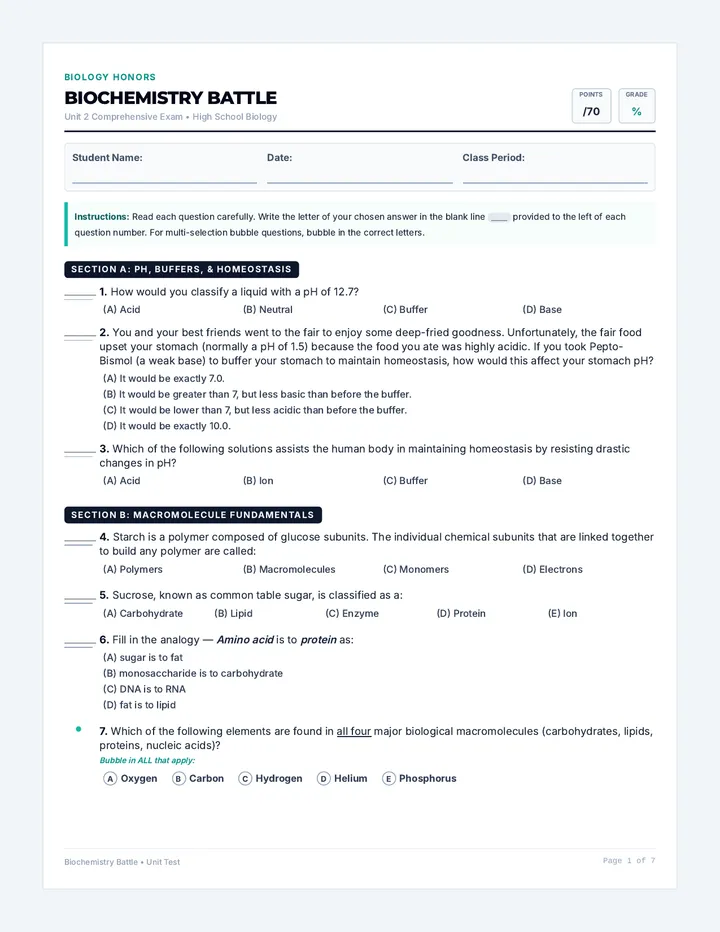
Final review and assessment of the Macromolecules unit.
A culminating creative project where students design a "Biological Structure" based on macromolecule principles.
Connecting macromolecule breakdown to energy transfer and cellular respiration (HS.LS1-7).
Focusing on nucleic acids and their role in coding for life's traits and instructions (HS.LS3-1).
Exploring protein structure and enzyme function, emphasizing the connection between DNA sequences and protein form as per HS.LS1-1.
Investigating the energy storage and structural roles of carbohydrates and lipids in living systems.
Students explore the unique properties of carbon and how simple sugar molecules provide the building blocks for complex organic molecules, focusing on HS.LS1-6.
Students act as molecular detectives to identify the presence of carbohydrates, proteins, and lipids in various food samples using chemical indicators.
This lesson covers the design and purpose of a marketing plan, focusing on customer analysis, market analysis, and the marketing mix. Students will evaluate competition across diverse industries and practice ESB-style assessment questions.
A comprehensive review of advanced baking and pastry techniques, covering leavening agents, mixing methods, bread production, and laminated doughs. This lesson prepares students for their final culinary arts examination.
Synthesizing presentation skills and valuation concepts to deliver high-stakes shareholder or capital market pitches.
Understanding the components of business worth, including tangible assets, intangible assets, and core profitability metrics like EBIT.
Techniques for making information stick using stories, analogies, and the WIIFM principle.
Introduction to the Rule of Three and the FIT model for organizing and delivering effective business presentations.
A deep dive into electromagnetic radiation, covering the spectrum, wave-particle duality, polarization, and the photoelectric effect through guided instruction and hands-on laboratory exploration.
A project-based lesson where students design and build a balloon-powered vehicle to demonstrate Newton's Three Laws of Motion. Students act as 'Kinetic Engineers' to apply physics principles to a real-world engineering challenge.
Students engage in a forensic investigation using microscopy and chemical testing to identify unknown fiber samples found at a crime scene. The lesson emphasizes scientific observation, deductive reasoning, and the classification of natural versus synthetic materials.
A hands-on exploration of human impacts on biodiversity, featuring a collaborative card sorting game and a reflective CER analysis. Students identify and categorize negative and positive impacts while building academic vocabulary.
Students calculate carbon emissions from daily habits and model sustainable alternatives, bridging global climate data with personal agency through data-driven analysis.
A high-impact lesson where students quantify their personal carbon footprint and design actionable, data-driven strategies for sustainability. Bridging the gap between global climate science and individual agency, students use mathematical modeling to project the impact of lifestyle changes.
A high-stakes cryptographic challenge where students master Caesar, Vigenère, and public key encryption to stop a simulated cyber attack. Students act as intelligence agents decoding secret messages to unlock a final digital vault.
A comprehensive scientific investigation where students research, experiment, and analyze the chemical and environmental factors that contribute to creating the world's largest soap bubbles.
A hands-on biotechnology lesson where students act as scientists at the NovaGen Research Institute to design ethical cloning solutions for real-world environmental and medical problems.
A short lesson introducing 10 key genetics terms through application and practice.
An immersive movie guide for Tron: Legacy (2010), featuring a chronological fill-in-the-blank worksheet, an intro presentation, and a comprehensive answer key.
A comprehensive lesson on the critical role of P-traps in plumbing systems, covering sewer gas prevention, water seals, and basic venting principles. Designed for junior plumbing students with diverse learning needs, including specific IEP/504 accommodations.
A lesson focused on the foundational concepts of biochemistry and the nature of life through the lens of Science and Engineering Practices (SEPs), specifically modeling, data analysis, and experimental design.
A 60-minute plumbing shop lesson focused on the critical role of P-traps in preventing sewer gas entry, designed with high-support accommodations for junior students.
A comprehensive 3-page study guide covering Radioactive Decay, Geophysics, Waves, and Momentum for a 9th grade Conceptual Physics final exam.
A comprehensive workshop where students explore the intersection of food science and environmental sustainability, focusing on food waste reduction and traditional preservation techniques.
A comprehensive review lesson covering human impact on the environment, including population dynamics, biodiversity loss, biomagnification, and ecological succession. Students analyze real-world data, maps, and diagrams to evaluate environmental health and sustainability practices.
A focused practice session on monohybrid and dihybrid crosses, designed for 10th-grade biology students to master genetic probability and ratio calculation.
An exploration of Earth's most intense weather events, focusing on the atmospheric physics that drive them and their profound effects on the planet's residents and habitats.
A focused assessment and review on the four major biological macromolecules, their structures, and enzymatic functions. Students will identify functional groups, analyze monomer-polymer relationships, and explain enzyme-substrate interactions through visual diagrams.
A comprehensive review of renewable and non-renewable energy sources and the environmental impact of carbon footprints, designed with accessible language for high school students.
A comprehensive 90-minute lesson on modern wood floor systems, focusing on I-joist installation, subflooring techniques, and structural components. Students will engage in classroom instruction followed by hands-on small-scale framing practice.