Revolutionary Frames Slides Ink and Iron
Persepolis & The Iranian Revolution
Lesson 01: Context, Format, and Identity
The Architect
"I believe that an entire nation should not be judged by the wrongdoings of a few extremists."
— Marjane Satrapi
Who is Marjane Satrapi?
Identity: Born in Iran (1969) to progressive parents.Context: Witnessed the 1979 Revolution as a 10-year-old child.Purpose: Showing the human face of Iran beyond the headlines.
History Check
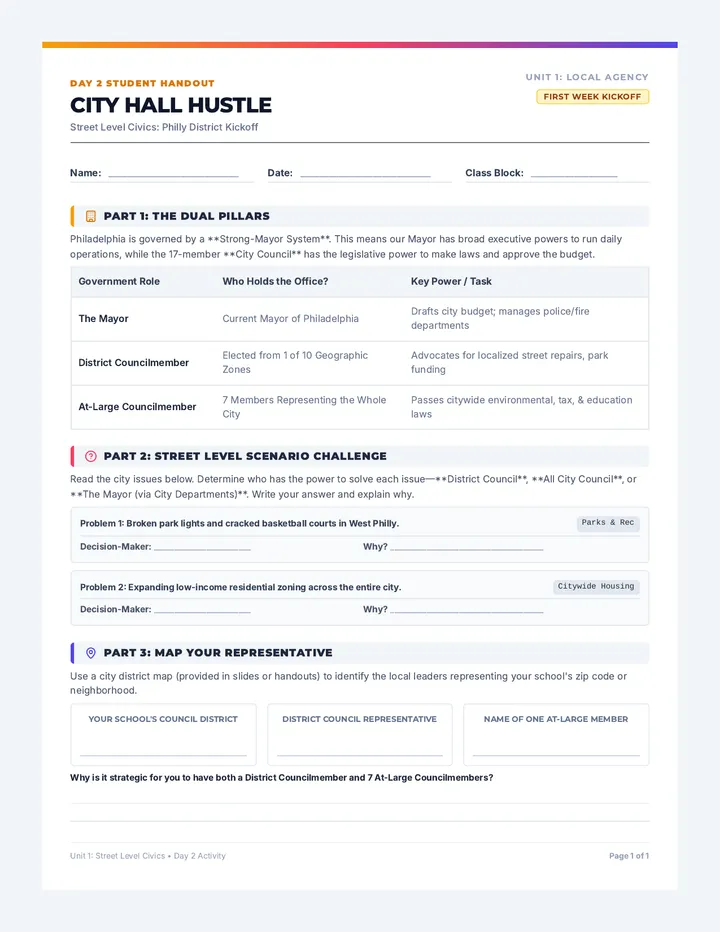
1979: A World Shift
The Shah
Focused on Westernization and modernization. A secular but autocratic and repressive regime.
Revolution
The Shah was exiled. Power shifted to the Islamic Republic led by Ayatollah Khomeini.
The Shift
Monarchy → Revolution → Theocracy
The Grammar of the Gutter
Iconicity
Simple drawings allow readers to more easily identify with the characters.
Closure
The reader mentally connects the action happening in the gutter .
Composition
Panel size and line weight communicate emotion immediately.
Visual Vocabulary
Black & White
Reflects a world without nuance or a memory being reconstructed.
Graphic Weight
Using heavy blacks to establish a sense of doom or weightiness.
🗯️
"The image is the first language of humanity."
ACTION!
Initial Recon
In your Perspective Panels sheet, complete the first two columns of the K-W-L Chart:
K: Know
What do you already know about Iran or graphic novels?
W: Want to Know
What questions do you have about the revolution?
Voices of Tehran Teacher Script Voices of Tehran
Teacher Instructional Script
Lesson 01: Context & Frames
Subject: ELA / Persepolis
Instructional Objective
Students will synthesize historical context of the Iranian Revolution with the visual mechanics of the graphic novel format to analyze how Marjane Satrapi constructs her narrative identity.
SLIDE 01: TITLE
"Welcome everyone. Today we are stepping into the world of Marjane Satrapi’s 'Persepolis.' This isn't just a comic; it’s an archive of a revolution. We're titling today 'Ink and Iron' because it takes the softness of ink to describe the iron-hard reality of political oppression."
Hook: Ask students if they have ever felt like their identity was being "written" by someone else—government, parents, or social media. That is the core of Marji’s journey.
SLIDE 02: THE ARCHITECT
Marjane Satrapi is our architect. Born in 1969, she was a child of the revolution. Her family were intellectuals—Marxists who wanted the Shah gone, but who weren't prepared for what came next.
Deep Dive Prompt: "Satrapi claims she wrote this to provide a 'human face' to Iran. Why does she choose a cartoonish, simplified style rather than realistic photography or oil paintings to show 'truth'?"
SLIDE 03: THE TURNING POINT
History isn't binary. The Shah was modern but a dictator. The people revolted for freedom, but the power vacuum was filled by the Islamic Republic. This shift from Secular (non-religious) to Theocratic (religious-based) government is the friction point of the book.
Critical Historical Link: 1953 Operation Ajax
To understand the "Why" of 1979, we have to look back to 1953. The West (CIA/MI6) orchestrated a coup to remove the democratically elected PM Mosaddegh because he tried to keep Iran's oil profits for Iran. They re-installed the Shah.
Key Insight: This is why "Western" things (music, clothes) aren't just seen as "different" in the book—they are seen as the tools of foreign spies and oppressors who stole Iran's democracy 25 years earlier.
See Resource: "Operation Ajax Briefing" for full details.
SLIDE 04-05: VISUAL GRAMMAR
Explain Closure . It’s what happens in the gutter. The reader's imagination is the engine of the story. If I show a panel of a person swinging an axe, and the next panel is a dark screen with a scream, you commit the murder in your mind. That is closure.
Explain Graphic Weight . Look at the balance of black and white. In Persepolis , heavy blacks often signal the presence of the revolutionary police or moments of total isolation.
SLIDE 06: STUDENT TASK
"Now, transition to the worksheet. For the K-W-L, challenge them. Don't just list 'Iran is in the Middle East.' Think about what you know about power and storytelling . What do you want to know about how a girl survives when her country changes overnight?"
Advanced Discussion Starters
How does Satrapi's use of "Iconicity" (simple faces) allow Western readers to bypass their own biases and see themselves in an Iranian girl?
If 8.RL.9 asks us to analyze how modern works draw on patterns—how might Satrapi be reimagining the classic "Hero's Journey" in a world where the hero has no political power?
Contrast the "Ink" (creative expression) with the "Iron" (state control). Which is more powerful in the long run?
Perspective Panels Activity Sheet Perspective Panels
Analysis & Reflection Worksheet
Name:
Date:
1
Initial Recon: K-W-L Chart
Fill out the 'Know' and 'Want to Know' sections before the presentation. Complete 'Learned' at the end of the lesson.
What I Know
What I Want to Know
What I Learned
2
Mechanics of the Medium
Define 'The Gutter' in your own words:
How does 'Iconicity' (simplicity) help you empathize with Marji?
Critical Thought
Persepolis is drawn in stark black and white. How might this visual choice relate to the theme of "oppression"? Does it suggest a lack of nuance in the regime, or something else?
3
Perspective & Power
Reflect on the standard 8.RL.9. As we begin our reading, predict how a modern work like Persepolis might use the "Coming of Age" pattern differently than traditional myths or stories. How does a setting of political revolution change what it means to "grow up"?
Operation Ajax Briefing Operation Ajax Briefing
Historical Context Resource • Teacher-Facing
CLASSIFIED: 1953
The Core Conflict
In 1951, the democratically elected Prime Minister of Iran, Mohammad Mosaddegh , nationalized the Iranian oil industry. Previously, it was controlled by the British-owned Anglo-Iranian Oil Company (now BP), which gave Iran a very small percentage of the profits.
The British, fearing the loss of oil wealth, convinced the US (CIA) that Mosaddegh was leaning toward Soviet communism. This led to Operation Ajax : a covert mission to overthrow Mosaddegh and consolidate power in the hands of the Shah (Mohammad Reza Pahlavi).
Key Players
Mohammad Mosaddegh Prime Minister / Nationalist
The Shah Monarch / Western Ally
CIA & MI6 Foreign Intelligence Agencies
Why this matters for Persepolis:
The Paradox of Democracy
Advanced students should grapple with the fact that Western democracies (US/UK) actively dismantled a democratic government in Iran to protect economic interests. This created a lasting perception of the West as hypocritical "imperialists."
The Shah's "Shadow"
Because the Shah was restored to power via a foreign coup, he was seen by many Iranians as a Western puppet . His secret police (SAVAK) and his forced modernization programs were viewed not as progress, but as foreign imposition.
Connecting to the Novel
REASON 1
Anti-Western Sentiment: In Persepolis , Marji’s neighbors and the revolutionary police aren't just hating "Western music" because they are religious; they associate it with the 25 years of autocratic rule supported by the West after 1953.
REASON 2
The Family Lineage: Marji’s grandfather was a prince and prime minister before the Shah’s family took over. The 1953 Coup is the "sin" that explains why her father and the intellectual class are so fiercely against the Shah.
"The 1979 Revolution was not a sudden explosion; it was a slow burn that started in 1953."
Revolutionary Frames Slides Simplified Ink and Iron
A Story of Two Irans
The Core Question
"What happens when your country changes overnight?"
Imagine waking up and the music you like, the clothes you wear, and the way you talk are suddenly illegal. This is Marjane's story.
Phase 1: Before 1979
The Western Way
Secular (Religious/State separate)
Modern / Western Fashion
But... the King (Shah) was a dictator.
Phase 2: After 1979
The Revolution
Islamic Republic (Religious Law)
The Veil becomes mandatory
Anti-Western stance
Concept 1: Closure
Essential Vocabulary
🎨
The Gutter
The blank space between the panels. It is where the action happens that the author doesn't draw!
Panel 1
The Gutter
Closure happens here!
Panel 2
Concept 2: Graphic Weight
The Mood of Ink
☁️
Low Weight
Mostly white . Feels safe, innocent, or like a distant memory.
👤
High Weight
Mostly black ink. Feels scary, heavy, or like someone is being oppressed.
Your Mission
K
What do you know about Iran or "Growing Up"?
W
What is one question you have about the "Overnight" change?
Simplified Voices of Tehran Script Voices of Tehran
Simplified Facilitation Script
Optimized for Simplified Slides
Lesson 01: The Overnight Revolution
Slides 1-3: The Change
"Set the scene. Marjane is a normal girl in a normal world, and then the world turns upside down. Remind them: The history we are learning is the reason why the world turned upside down."
Slide 4: Closure & The Gutter
Read Explicitly:
"The Gutter is the blank space between the panels. It is like the 'silence' between notes in a song. Closure is what your brain does to fill that silence. When you see a light switch in Panel 1 and darkness in Panel 2, your brain is the one that flips the switch."
Ask: "If the author drew every single second of the story, would it still be a comic? (No, it would be a flip-book or a movie). The gutter is where the reader's imagination lives."
Slide 5: Graphic Weight
"Think of this like visual volume. When a page is white and light (Low Weight), it's a whisper. When it's covered in deep, heavy black ink (High Weight), it's a scream or a heavy weight pressing down on the character. In Persepolis , heavy black usually means someone is losing their freedom."
Slide 6: Student Task
"Hand out the worksheet. Make sure they see the 'Closure Test' on the front—it’s a quick way for them to practice flipping the finish line into a story in their heads."
The "Vibe" Check
Imagination is the engine.
Identity and Change Simple Worksheet Identity & Change
Persepolis Discovery Sheet
Student:
Phase 0: Personal Connection
"How would you feel if your favorite thing became illegal?"
My "Identity" item is: ___________________________________________________________
Closure Test
The space between panels is the gutter . Use your imagination to fill the gutter below:
A Person Running
A Finish Line
What happened in your head between the panels?
Graphic Weight
If an author uses heavy black ink for a character, how are they trying to make you feel about that person?
Safe & Happy
Threatened or Scared
Confused
The "Overnight" Revolution
K: What I Know
W: Want to Know
L: What I Learned
History Hack
1. Iran wanted profits from their ________________ .
2. The US/UK stopped them and put the ________________ in power.
3. People felt their leader was a "puppet" of the ________________ .