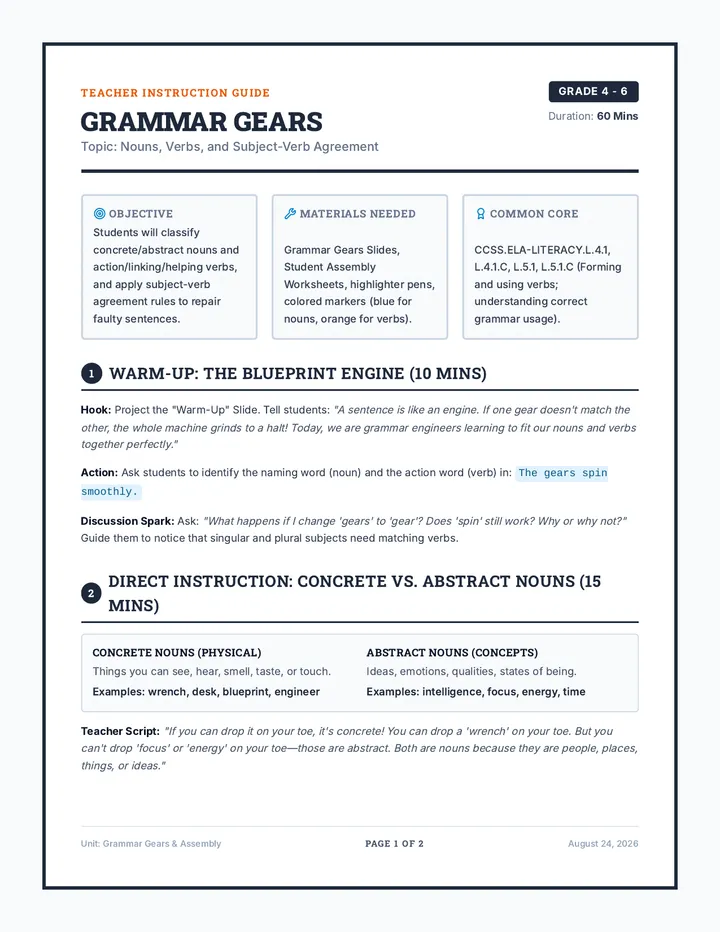
Detail Detective Lesson Guide Detail Detective Lesson Guide
Topic: Non-Defining Relative Clauses | Level: A2/B1 | Duration: 60 Mins
Learning Objectives
Identify the difference between defining and non-defining relative clauses.
Correct use of commas in non-defining clauses to provide "extra info."
Combine simple sentences using 'who', 'which', and 'whose'.
Materials
• Extra Info Slides
• Dossier Linker Worksheets
• Secret Spy Speaking Cards
• Case Closed Exit Tickets
• Red pens (for "Comma Corrections")
Lesson Timeline
10 Mins
The Hook: Mystery Identity
Briefly review defining clauses. Show pictures of famous people/places. Ask: "Who/What is this?" Then provide "extra info" sentences for each:
"Mr. Beast, who is a famous YouTuber , gives away money."
"Taylor Swift, who is a superstar singer , has many fans."
"The Eiffel Tower, which is in Paris , is very tall."
Detective Questions:
1. Identification: If I remove the info between the commas, do we still know exactly who/what I am talking about? (Yes! Names like 'Paris' or 'Mr. Beast' are already specific).
2. Grammar Check: If we delete the bold info, is the sentence still a complete sentence? (Yes, e.g., "Taylor Swift has many fans").
3. The 'That' Trap: In our last lesson, we used 'that'. Can we say "Taylor Swift, that is a singer..."? (No! This is a key difference to highlight).
15 Mins
The Briefing: Presentation
Use the Extra Info Slides . Explain the "Comma Sandwich" rule. Focus on:
People: who | Things: which | Possession: whose
Crucial Rule: No that in non-defining clauses!
15 Mins
The Dossier: Pair Practice
Distribute Dossier Linker Worksheet . Pairs must combine "Secret File" sentences using non-defining clauses. Walk around and ensure they are placing commas correctly.
Differentiation: Provide a "Clue Card" (word bank) for students who struggle with relative pronouns.
15 Mins
Interrogation: Speaking practice
Use Secret Spy Speaking Cards . Students pick a card with a person/place and must describe it using a non-defining clause to their partner. "London, which is the capital of the UK, is very rainy."
05 Mins
Case Closed: Assessment
Hand out Case Closed Exit Tickets . Students must write one original non-defining relative clause sentence about a classmate or a celebrity.
Detective Notes (Pro-Tips)
The "Pause" Test:
Tell students that commas in writing are like short pauses when speaking. If they hear a natural pause, a comma probably goes there!
Common Error:
Students often use "that" because it's easier. Keep repeating: "No 'that' in the sandwich!"
Extra Info Slides Top Secret
Extra Info
Slides
Mastering the Art of Non-Defining Relative Clauses
Unit: Detail Detective
What's the Secret?
Defining (Review)
The man who stole the gold escaped.
We need this info to know which man.
Non-Defining (New!)
Mr. Jones, who is a teacher, escaped.
This is just extra info . We already know it's Mr. Jones.
"If you delete the extra info, the sentence still makes sense!"
The Comma Sandwich 🥪
, ... extra info ... ,
Who
For People
Which
For Things
Whose
For Possession
CRITICAL RULE: NO "THAT" ALLOWED!
Spot the Extra Info
Paris, which is in France, is beautiful.
Extra info: The location
My brother, who is 20 years old, loves pizza.
Extra info: His age
This laptop, whose screen is broken, was expensive.
Extra info: The broken screen
Detective Challenge!
Combine these two sentences into one.
1. My friend Sam is a great singer.
2. He lives in London.
Can you solve it?
Dossier Linker Worksheet Dossier Linker
Assignment: Sentence Combination Practice
Detective Name
Case Date
Mission Briefing
Detectives, these files are too messy! Combine the two sentences into one single sentence using a non-defining relative clause (extra information). Don't forget the Comma Sandwich !
WHO (People) WHICH (Things) WHOSE (Possession) NO "THAT"!
01
File: The Famous Chef
A: Gordon Ramsay is very angry on TV.
B: He owns many restaurants.
Connected Report:
02
File: The Big City
A: Tokyo is the capital of Japan.
B: It is the largest city in the world.
Connected Report:
03
File: The Broken Car
A: My uncle's car is very old.
B: Its engine makes a loud noise.
Connected Report:
04
File: The Best Friend
A: Sarah is my best friend.
B: She lives in the house next door.
Connected Report:
05
File: The New Phone
A: My new smartphone was very expensive.
B: It has three different cameras.
Connected Report:
Confidential - Detail Detective Agency - Case No. 402-RC
Secret Spy Speaking Cards Secret Spy Cards
Speaking Task: Description & Extra Details
How to Play
Pick a card. Describe the person, place, or thing to your partner. You MUST use a non-defining relative clause to give "extra info".
Mount Everest
Prompt: Height / Location
"Mount Everest, which is..."
Taylor Swift
Prompt: Songs / Eras Tour
"Taylor Swift, who..."
The Eiffel Tower
Prompt: Paris / Height
"The Eiffel Tower, which..."
The iPhone
Prompt: Apple / Steve Jobs
"The iPhone, which..."
Golden Retrievers
Prompt: Friendly / Color
"Golden Retrievers, which..."
Italian Pizza
Prompt: Italy / Ingredients
"Italian Pizza, which..."
Detective Speaking Unit
Case Closed Exit Ticket Exit Ticket
Case Closed
Detective Name: _________________________
Final Challenge
Write one sentence using a non-defining relative clause about your favorite city or a famous person.
Self-Correction Checklist:
TWO COMMAS? EXTRA INFO? NO "THAT"?
Exit Ticket
Case Closed
Detective Name: _________________________
Final Challenge
Write one sentence using a non-defining relative clause about your favorite city or a famous person.
Self-Correction Checklist:
TWO COMMAS? EXTRA INFO? NO "THAT"?
Dossier Key Teacher Guide Dossier Key
Answer Key for Teachers | Case No. 402-RC
01
The Famous Chef
Gordon Ramsay, who owns many restaurants, is very angry on TV.
02
The Big City
Tokyo, which is the capital of Japan, is the largest city in the world.
03
The Broken Car
My uncle's car, whose engine makes a loud noise, is very old.
04
The Best Friend
Sarah, who lives in the house next door, is my best friend.
05
The New Phone
My new smartphone, which has three different cameras, was very expensive.
Note: Students may reverse the clauses (e.g., "Sarah, who is my best friend, lives in the house next door"). This is also correct as long as the commas are placed correctly.