William Wordsworth
The world is too much with us; late and soon, Getting and spending, we lay waste our powers;— Little we see in Nature that is ours; We have given our hearts away, a sordid boon! This Sea that bares her bosom to the moon; The winds that will be howling at all hours, And are up-gathered now like sleeping flowers; For this, for everything, we are out of tune; It moves us not. Great God! I’d rather be A Pagan suckled in a creed outworn; So might I, standing on this pleasant lea, Have glimpses that would make me less forlorn; Have sight of Proteus rising from the sea; Or hear old Triton blow his wreathèd horn.
PROMPT 1
What does Wordsworth suggest humanity has lost because of the way we live, and why does that loss matter?
PROMPT 2
What relationship between human beings and nature does Wordsworth believe we should have? What in the poem leads you to that conclusion?
PROMPT 3
How would Wordsworth enter into a conversation with Emerson and Thoreau about nature, materialism, and the way we should live? Where do their ideas converge or diverge?
What specific words or lines support that interpretation?
What might someone who disagrees with you say?
Is there another way to interpret that part of the poem?
How does this connect to something Emerson or Thoreau said?
Where might the poet disagree with Emerson or Thoreau?
What question does this poem leave unanswered?
11th Grade Transcendentalism Unit PAGE 2 OF 4
Fishbowl Observation Round I
ROUND FOCUS: EMILY DICKINSON
OUTER CIRCLE ACTIVE LISTENING
by Emily Dickinson
Much Madness is divinest Sense— To a discerning Eye— Much Sense—the starkest Madness— ’Tis the Majority In this, as All, prevail— Assent—and you are sane— Demur—you’re straightway dangerous— And handled with a Chain—
| LISTEN FOR... | YOUR DETAILED OBSERVER NOTES |
|---|---|
| An interpretation worth remembering: What idea about the poem had you not considered before? | |
| Evidence that mattered: Record a specific word, phrase, image, or stylistic choice used effectively. | |
| A meaningful connection: How did the group connect this poem to Emerson, Thoreau, or another poem? | |
| A move that deepened conversation: What did someone do that helped the group think more deeply? | |
| A question I would ask: What remains unresolved or worth pushing further in their discussion? |
11th Grade Transcendentalism Unit PAGE 3 OF 4
Fishbowl Observation Round II
ROUND FOCUS: WALT WHITMAN
OUTER CIRCLE ACTIVE LISTENING
by Walt Whitman
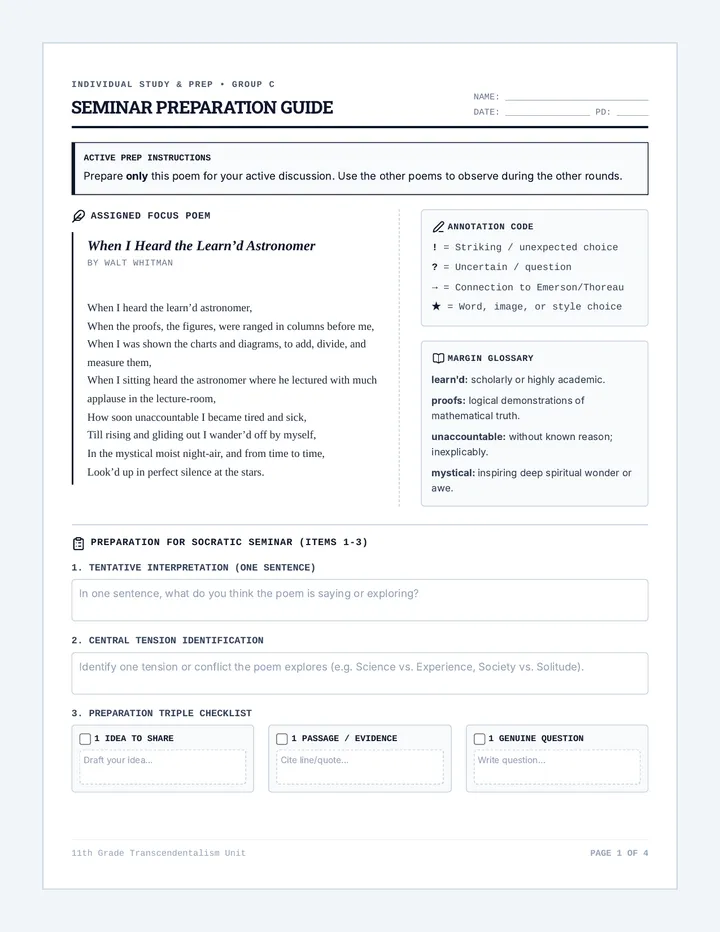
When I heard the learn’d astronomer, When the proofs, the figures, were ranged in columns before me, When I was shown the charts and diagrams, to add, divide, and measure them, When I sitting heard the astronomer where he lectured with much applause in the lecture-room, How soon unaccountable I became tired and sick, Till rising and gliding out I wander’d off by myself, In the mystical moist night-air, and from time to time, Look’d up in perfect silence at the stars.
| LISTEN FOR... | YOUR DETAILED OBSERVER NOTES |
|---|---|
| An interpretation worth remembering: What idea about the poem had you not considered before? | |
| Evidence that mattered: Record a specific word, phrase, image, or stylistic choice used effectively. | |
| A meaningful connection: How did the group connect this to Emerson, Thoreau, or another poem? | |
| A conversation move to notice: What did someone do that helped the group think more deeply? | |
| A question I would ask: What remains unresolved or worth pushing further in their discussion? |
11th Grade Transcendentalism Unit PAGE 4 OF 4
When I heard the learn’d astronomer, When the proofs, the figures, were ranged in columns before me, When I was shown the charts and diagrams, to add, divide, and measure them, When I sitting heard the astronomer where he lectured with much applause in the lecture-room, How soon unaccountable I became tired and sick, Till rising and gliding out I wander’d off by myself, In the mystical moist night-air, and from time to time, Look’d up in perfect silence at the stars.
PROMPT 1
What does the speaker gain by leaving the lecture room and going outside—and what, if anything, does he lose?
PROMPT 2
What distinction does Whitman draw between knowing something intellectually and experiencing it directly? What does the poem suggest about the value of each?
PROMPT 3
How does the speaker’s experience under the stars support, challenge, or complicate ideas about knowledge, nature, and intuition that we encountered in Emerson and Thoreau?
What specific words or lines support that interpretation?
What might someone who disagrees with you say?
Is there another way to interpret that part of the poem?
How does this connect to something Emerson or Thoreau said?
Where might the poet disagree with Emerson or Thoreau?
What question does this poem leave unanswered?
11th Grade Transcendentalism Unit PAGE 2 OF 4
Fishbowl Observation Round I
ROUND FOCUS: EMILY DICKINSON
OUTER CIRCLE ACTIVE LISTENING
by Emily Dickinson
Much Madness is divinest Sense— To a discerning Eye— Much Sense—the starkest Madness— ’Tis the Majority In this, as All, prevail— Assent—and you are sane— Demur—you’re straightway dangerous— And handled with a Chain—
| LISTEN FOR... | YOUR DETAILED OBSERVER NOTES |
|---|---|
| An interpretation worth remembering: What idea about the poem had you not considered before? | |
| Evidence that mattered: Record a specific word, phrase, image, or stylistic choice used effectively. | |
| A meaningful connection: How did the group connect this poem to Emerson, Thoreau, or transcendentalism? | |
| A move that deepened conversation: What did someone do that helped the group think more deeply? | |
| A question I would ask: What remains unresolved or worth pushing further in their discussion? |
11th Grade Transcendentalism Unit PAGE 3 OF 4
Fishbowl Observation Round II
ROUND FOCUS: WILLIAM WORDSWORTH
OUTER CIRCLE ACTIVE LISTENING
by William Wordsworth
The world is too much with us; late and soon, Getting and spending, we lay waste our powers;— Little we see in Nature that is ours; We have given our hearts away, a sordid boon! This Sea that bares her bosom to the moon; The winds that will be howling at all hours, And are up-gathered now like sleeping flowers; For this, for everything, we are out of tune; It moves us not. Great God! I’d rather be A Pagan suckled in a creed outworn; So might I, standing on this pleasant lea, Have glimpses that would make me less forlorn; Have sight of Proteus rising from the sea; Or hear old Triton blow his wreathèd horn.
| LISTEN FOR... | YOUR DETAILED OBSERVER NOTES |
|---|---|
| An interpretation worth remembering: What idea about the poem had you not considered before? | |
| Evidence that mattered: Record a specific word, phrase, image, or stylistic choice used effectively. | |
| A meaningful connection: How did the group connect this to Emerson, Thoreau, or another poem? | |
| A conversation move to notice: What did someone do that helped the group think more deeply? | |
| A question I would ask: What remains unresolved or worth pushing further in their discussion? |
11th Grade Transcendentalism Unit PAGE 4 OF 4