Cafe Party Teacher Guide Celebration Mini Lesson Bundle
Cafe Party Teacher Guide
A cozy coffeehouse celebration paired with Reading, Math, and Writing.
Total Time
50–65 min
Setting the Coffeehouse Vibe
1. Cozy Ambiance
Dim overhead lights, project a fireplace or rainy cafe scene, and play lo-fi jazz or acoustic music.
2. Kid-Friendly Menu
Serve hot cocoa, warm apple cider, or steamed milk with whipped cream, plus mini muffins or donut holes.
3. Cafe Seating
Group desks into 2–4 person bistro tables or allow clipboards on rugs so students can sip and work.
Assignment & Station Plan
Run as 3 Rotations or Independent Packet
Reading: Roast and Read Worksheet
15–20 min
Students read an informational passage about how coffeehouses became community hubs and how baristas craft kid-friendly steamers and cocoa. Includes 3 multiple-choice and 2 short-response questions.
Focus: Main idea, context clues, citing text evidence.
Math: Barista Math Worksheet
15–20 min
Using the "Cozy Cup Cafe" menu, students calculate decimal totals, find change from $10 and $20, solve group order problems, and build a custom order within a $12.00 budget.
Focus: Decimal addition/subtraction, multiplication, budgeting.
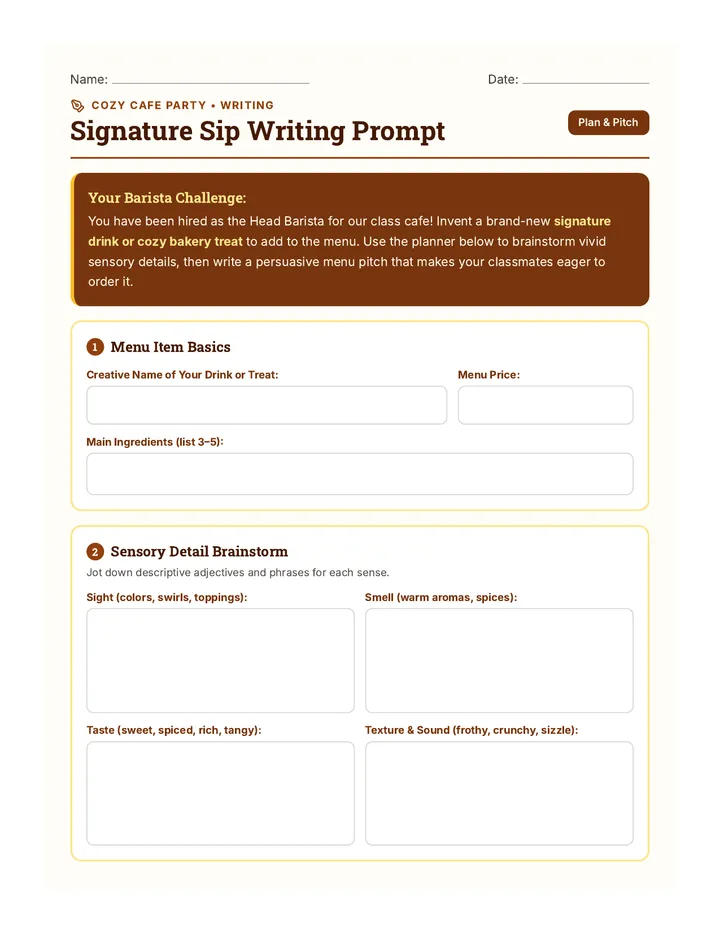
Writing: Signature Sip Writing Prompt
15–20 min
Students invent a signature drink or bakery treat for the class cafe, brainstorm sensory details (sight, smell, taste, texture), and write a persuasive menu pitch.
Focus: Sensory language, persuasive word choice, paragraph structure.
Differentiation & Scaffolds
Support: Partner read the passage aloud; provide calculators or coin mats for Barista Math.
Challenge: Add 8% sales tax to the custom math order or illustrate a mini poster for the Signature Sip.
Open Mic Share (5–10 min)
Wrap up with a "Cafe Open Mic" where volunteers read their Signature Sip pitches aloud.
Classmates give quiet coffeehouse finger-snaps instead of applause!
Roast and Read Worksheet Name:
Date:
Cozy Cafe Party • Reading
Roast and Read Worksheet
Read & Annotate
The Cozy Corner: More Than Just a Drink
Informational Text
Step inside a neighborhood cafe on a chilly morning, and your senses wake up right away. You might hear the gentle hiss of a steam wand, smell toasted cinnamon and warm chocolate, and see friends huddled around wooden tables. For hundreds of years, coffeehouses have been much more than places to grab a quick beverage—they have served as lively gathering spots for conversation, creativity, and community.
The earliest coffeehouses opened in the Middle East during the 1500s. People visited them to share news, play chess, listen to musicians, and debate big ideas. When cafes later spread to Europe and North America, writers and inventors often used them as makeshift offices. Because a single warm drink let a guest sit for hours, coffeehouses earned a famous nickname: "penny universities," since anyone could learn something new for the price of one cup.
Today's cafes welcome visitors of all ages, including kids who do not drink coffee at all. Skilled baristas use espresso machines not only for coffee beans, but also to whip up cozy, caffeine-free treats. A "steamer," for example, is simply warm, frothy milk swirled with vanilla, caramel, or peppermint syrup. Rich hot cocoa, spiced apple cider, and herbal fruit teas are also cafe staples.
Baristas also turn drinks into tiny works of art. By pouring velvety microfoam—milk steamed into thousands of microscopic bubbles—into a mug, a barista can swirl hearts, leaves, or even smiling bears on top. Combined with soft music and comfortable chairs, these small touches transform an ordinary snack break into a welcoming place to read, sketch, and connect with others.
Barista Vocabulary Spotlight
Makeshift: Serving as a temporary substitute.
Staples: Main or popular items always kept on hand.
Microfoam: Milk steamed into tiny, smooth bubbles.
Roast and Read • Comprehension Check
Name:
Part 1: Circle the best answer for each question.
1. Why were early coffeehouses nicknamed "penny universities" (paragraph 2)?
A. They charged one penny for every book you borrowed.
B. Guests could sit, talk, and learn new ideas for the price of a cup.
C. Only college professors were allowed to order drinks there.
D. Baristas taught math lessons while making hot cocoa.
2. What is a "steamer" according to paragraph 3?
A. A machine used to roast coffee beans
B. A type of iced fruit tea with bubbles
C. Warm, frothy milk mixed with flavored syrup
D. A spiced apple cider served with a cookie
3. What is the main idea of the whole passage?
A. Cafes have long been welcoming community spaces that offer creative drinks and cozy experiences for everyone.
B. Microfoam is the hardest skill for a modern barista to learn how to pour.
C. Coffeehouses in the 1500s were much quieter than neighborhood cafes are today.
D. Hot cocoa and apple cider are more popular than coffee in Europe and North America.
Part 2: Answer in complete sentences using evidence from the text.
4. Name two activities people did in early coffeehouses in the 1500s.
5. How do baristas make a cafe feel special even for kids who do not drink coffee? Use details from paragraphs 3 and 4.
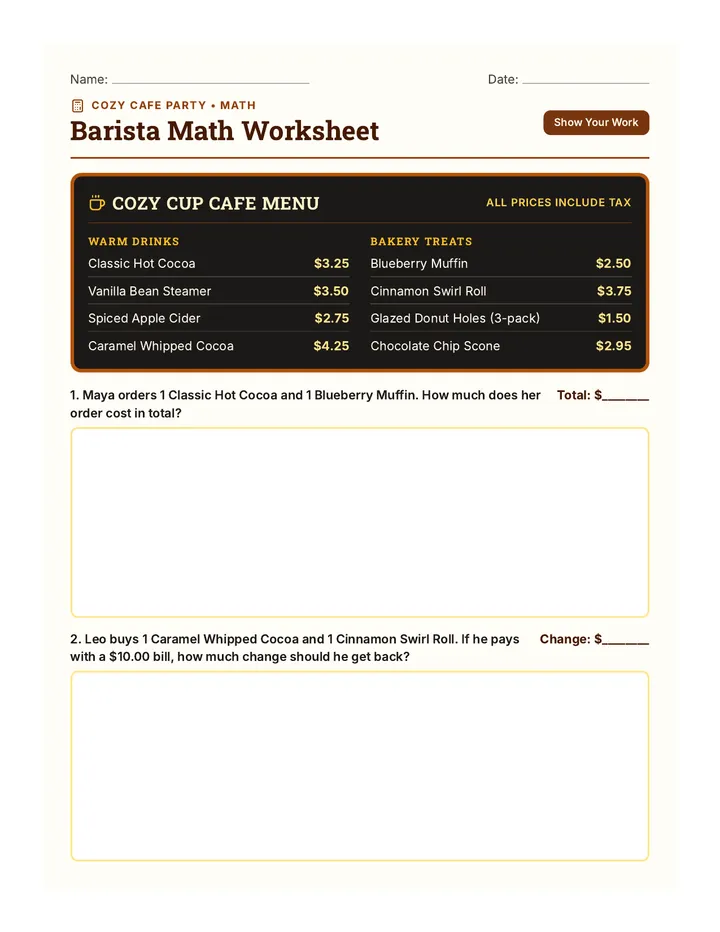
Barista Math Worksheet Name:
Date:
Cozy Cafe Party • Math
Barista Math Worksheet
Show Your Work
COZY CUP CAFE MENU
All Prices Include Tax
Warm Drinks
Classic Hot Cocoa $3.25
Vanilla Bean Steamer $3.50
Spiced Apple Cider $2.75
Caramel Whipped Cocoa $4.25
Bakery Treats
Blueberry Muffin $2.50
Cinnamon Swirl Roll $3.75
Glazed Donut Holes (3-pack) $1.50
Chocolate Chip Scone $2.95
1. Maya orders 1 Classic Hot Cocoa and 1 Blueberry Muffin. How much does her order cost in total?
Total: $________
2. Leo buys 1 Caramel Whipped Cocoa and 1 Cinnamon Swirl Roll. If he pays with a $10.00 bill, how much change should he get back?
Change: $________
Barista Math • Orders & Budgeting
Name:
3. Three friends each order a Spiced Apple Cider, and they share 2 packs of Glazed Donut Holes. What is the total cost for the group?
Total: $________
4. Mr. Alvarez orders 2 Vanilla Bean Steamers and 2 Chocolate Chip Scones. How much change will he receive from a $20.00 bill?
Change: $________
5. Barista Budget Challenge ($12.00 Limit)
Create Your Order
You have $12.00 to spend at the Cozy Cup Cafe! Choose at least 3 items from the menu without going over your budget. List your items, find the total, and calculate your leftover change.
My Menu Items & Prices:
Total Cost & Change from $12.00:
Signature Sip Writing Prompt Name:
Date:
Cozy Cafe Party • Writing
Signature Sip Writing Prompt
Plan & Pitch
Your Barista Challenge:
You have been hired as the Head Barista for our class cafe! Invent a brand-new signature drink or cozy bakery treat to add to the menu. Use the planner below to brainstorm vivid sensory details, then write a persuasive menu pitch that makes your classmates eager to order it.
1 Menu Item Basics
Creative Name of Your Drink or Treat:
Menu Price:
Main Ingredients (list 3–5):
2 Sensory Detail Brainstorm
Jot down descriptive adjectives and phrases for each sense.
Sight (colors, swirls, toppings):
Smell (warm aromas, spices):
Taste (sweet, spiced, rich, tangy):
Texture & Sound (frothy, crunchy, sizzle):
Signature Sip • Persuasive Menu Pitch
Name:
Step 3: Write Your Menu Pitch (1–2 paragraphs)
Start with an exciting hook
Include 3+ sensory details
End with a reason to order
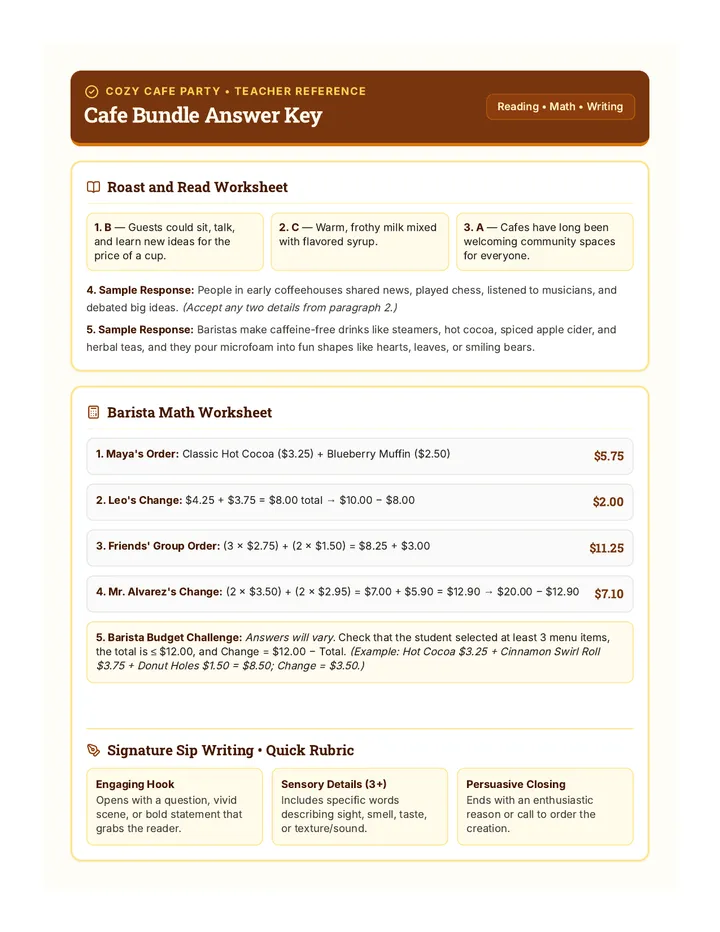
Cafe Bundle Answer Key Cozy Cafe Party • Teacher Reference
Cafe Bundle Answer Key
Reading • Math • Writing
Roast and Read Worksheet
1. B — Guests could sit, talk, and learn new ideas for the price of a cup.
2. C — Warm, frothy milk mixed with flavored syrup.
3. A — Cafes have long been welcoming community spaces for everyone.
4. Sample Response: People in early coffeehouses shared news, played chess, listened to musicians, and debated big ideas. (Accept any two details from paragraph 2.)
5. Sample Response: Baristas make caffeine-free drinks like steamers, hot cocoa, spiced apple cider, and herbal teas, and they pour microfoam into fun shapes like hearts, leaves, or smiling bears.
Barista Math Worksheet
1. Maya's Order: Classic Hot Cocoa ($3.25) + Blueberry Muffin ($2.50)
$5.75
2. Leo's Change: $4.25 + $3.75 = $8.00 total → $10.00 − $8.00
$2.00
3. Friends' Group Order: (3 × $2.75) + (2 × $1.50) = $8.25 + $3.00
$11.25
4. Mr. Alvarez's Change: (2 × $3.50) + (2 × $2.95) = $7.00 + $5.90 = $12.90 → $20.00 − $12.90
$7.10
5. Barista Budget Challenge: Answers will vary. Check that the student selected at least 3 menu items, the total is ≤ $12.00, and Change = $12.00 − Total. (Example: Hot Cocoa $3.25 + Cinnamon Swirl Roll $3.75 + Donut Holes $1.50 = $8.50; Change = $3.50.)
Signature Sip Writing • Quick Rubric
Engaging Hook
Opens with a question, vivid scene, or bold statement that grabs the reader.
Sensory Details (3+)
Includes specific words describing sight, smell, taste, or texture/sound.
Persuasive Closing
Ends with an enthusiastic reason or call to order the creation.