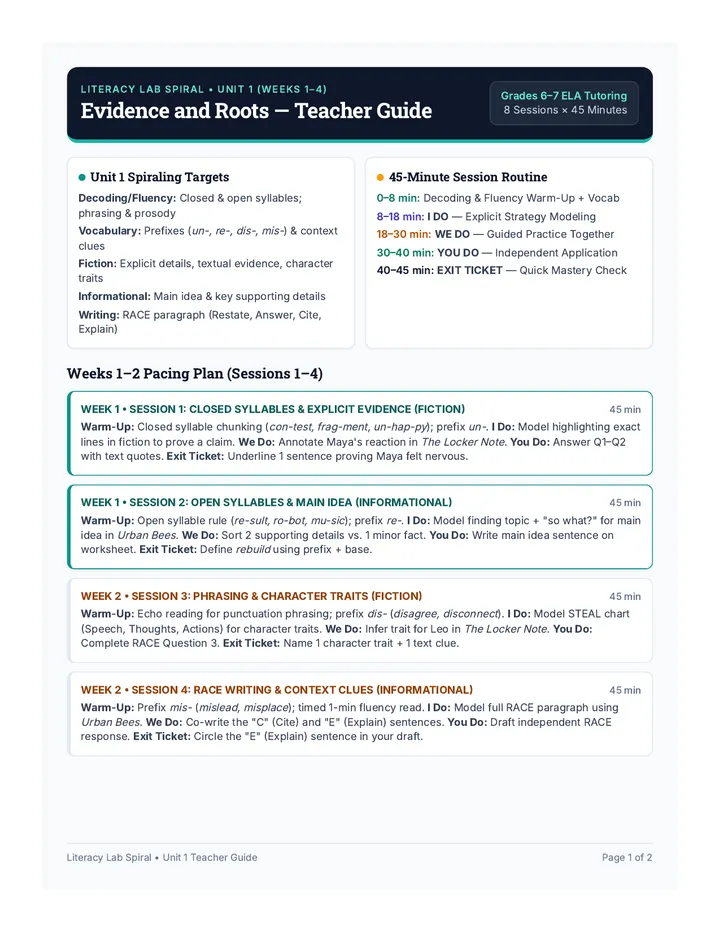
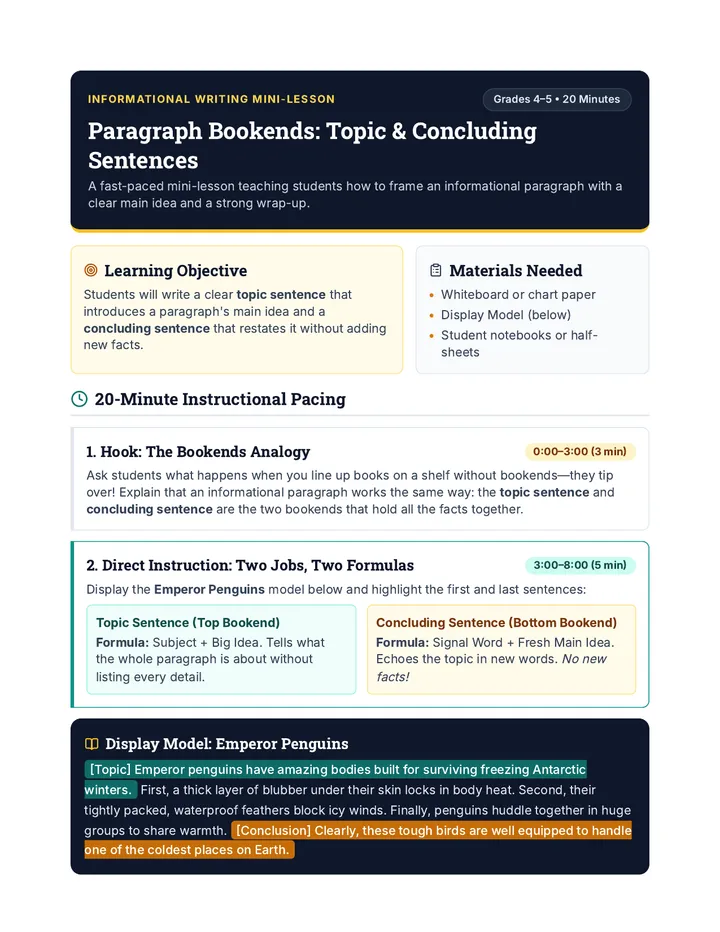
Literacy Launch Curriculum Map
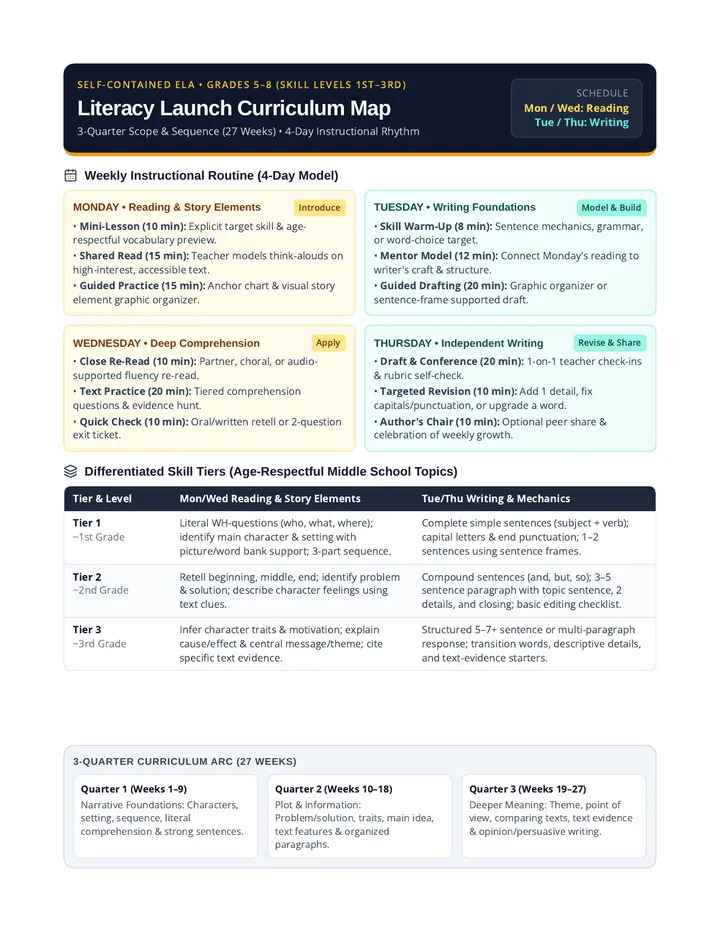
Self-Contained ELA • Grades 5–8 (Skill Levels 1st–3rd)
Literacy Launch Curriculum Map
3-Quarter Scope & Sequence (27 Weeks) • 70-Min Small Group Rotations
Daily Rotations
35m Direct Instruction
35m Independent Practice
Weekly Rotation Routine (35m Direct + 35m Independent)
MONDAY • Reading & Story Elements Introduce
- • Direct (35m): Vocabulary preview, shared read-aloud with think-alouds, & guided story map.
- • Independent (35m): Audio/leveled reading, story element sort, & word-work fluency station.
TUESDAY • Writing Foundations Model & Build
- • Direct (35m): Mechanics warm-up, mentor text craft model, & guided organizer/frame draft.
- • Independent (35m): Sentence-building task cards, grammar practice, & graphic organizer prep.
WEDNESDAY • Deep Comprehension Apply
- • Direct (35m): Choral/partner re-read, text-dependent questioning, & comprehension check.
- • Independent (35m): Tiered evidence hunt, partner retell/response sheet, & independent reading.
THURSDAY • Independent Writing Revise & Share
- • Direct (35m): Mini-conferences, targeted revision (1 detail/fix), & small-group share.
- • Independent (35m): Independent drafting, rubric self-check, & final publish/illustration.
Differentiated Skill Tiers (Age-Respectful Middle School Topics)
| Tier & Level |
Mon/Wed Reading & Story Elements |
Tue/Thu Writing & Mechanics |
| Tier 1 |
|
|
| ~1st Grade |
Literal WH-questions (who, what, where); identify main character & setting with picture/word bank support; 3-part sequence. |
Complete simple sentences (subject + verb); capital letters & end punctuation; 1–2 sentences using sentence frames. |
| Tier 2 |
|
|
| ~2nd Grade |
Retell beginning, middle, end; identify problem & solution; describe character feelings using text clues. |
Compound sentences (and, but, so); 3–5 sentence paragraph with topic sentence, 2 details, and closing; basic editing checklist. |
| Tier 3 |
|
|
| ~3rd Grade |
Infer character traits & motivation; explain cause/effect & central message/theme; cite specific text evidence. |
Structured 5–7+ sentence or multi-paragraph response; transition words, descriptive details, and text-evidence starters. |
3-Quarter Curriculum Arc (27 Weeks)
Quarter 1 (Weeks 1–9)
Narrative Foundations: Characters, setting, sequence, literal comprehension & strong sentences.
Quarter 2 (Weeks 10–18)
Plot & Information: Problem/solution, traits, main idea, text features & organized paragraphs.
Quarter 3 (Weeks 19–27)
Deeper Meaning: Theme, point of view, comparing texts, text evidence & opinion/persuasive writing.
Quarter 1 • Weeks 1–9
Narrative Foundations & Sentence Power
Focus: Story Basics & Complete Sentences
| Wk |
Mon/Wed: Reading & Story Elements |
Tue/Thu: Writing & Mechanics |
Tiered Progression (1st–3rd) |
| W1 |
Reading Routines & "Who": Identify characters in short high-interest stories. |
Sentence Basics: Capital letter, spacing, end mark; naming words (nouns). |
T1: Label/1 sent. • T2: 2–3 sent. • T3: Descriptive character intro. |
| W2 |
Setting ("Where & When"): Use text & visual clues to describe setting. |
Action Words (Verbs): Build complete subject + predicate sentences. |
T1: Sentence frames • T2: Expanded setting • T3: Sensory details. |
| W3 |
Literal WH-Questions: Answer who, what, where, when using text proof. |
Fixing Fragments: Distinguish complete thoughts from fragments. |
T1: Word bank • T2: Restate question • T3: Full-sentence proof. |
| W4 |
Sequence (First, Next, Last): Put 3–4 story events in order. |
Sequence Writing: Use time-order words (First, Next, Then, Last). |
T1: 3-box strip • T2: 4-sentence retell • T3: Multi-event summary. |
| W5 |
Beginning, Middle, End: Map major events on a B-M-E story arc. |
Adjectives & Detail: Add describing words to make sentences vivid. |
T1: 1 detail/part • T2: 3–4 sent. B-M-E • T3: Elaborated B-M-E. |
| W6 |
Character Feelings: Track how a character feels and why it changes. |
Compound Sentences: Combine ideas with and, but, so. |
T1: Feeling + because • T2: 1 compound • T3: 2+ compounds + clue. |
| W7 |
Problem & Solution: Identify the main conflict and how it is solved. |
Paragraph Frame: Topic sentence + 2–3 supporting details. |
T1: Guided frame • T2: 4-sent. para • T3: 5+ sent. with closing. |
| W8 |
Retelling & Summarizing: Combine character, setting, problem, solution. |
Personal Narrative Draft: Plan & draft a real-life 3-part story. |
T1: 3 sentences • T2: 1 paragraph • T3: 2 short paragraphs. |
| W9 |
Q1 Story Showcase & Check: Independent story map on cold-read passage. |
Edit, Revise & Publish: Capitalization/punctuation check & share. |
T1: Picture/word bank • T2: Checklist edit • T3: Peer + self-revise. |
Quarter 1 Checkpoints: Baseline fluency & comprehension probe (W1), Mid-Quarter Story Map check (W5), End-of-Quarter Narrative Writing Rubric & Cold Read (W9).
Quarter 2 • Weeks 10–18
Plot, Character Traits & Informational Craft
Focus: Inferences, Main Idea & Paragraphs
| Wk |
Mon/Wed: Reading & Story Elements |
Tue/Thu: Writing & Mechanics |
Tiered Progression (1st–3rd) |
| W10 |
Character Traits (Inside vs. Outside): Use actions to infer traits. |
"Show, Don't Tell" Sentences: Write actions that reveal a trait. |
T1: Trait word bank • T2: Trait + 1 action • T3: Trait + 2 text clues. |
| W11 |
Character Motivation ("Why"): Explain why a character makes a choice. |
Because / So Clauses: Connect cause and effect in writing. |
T1: Fill-in frame • T2: 3-sent. explanation • T3: Cite line from text. |
| W12 |
Dialogue & Quotation Marks: Identify who is speaking and tone. |
Writing Dialogue: Add 1–2 lines of speech with speaker tags. |
T1: Speech bubble to line • T2: Basic quotes • T3: Punctuated dialogue. |
| W13 |
Making Predictions: Use story clues + prior knowledge to predict. |
Alternative Ending: Write a logical new ending to a class story. |
T1: 2-sent. ending • T2: 4-sent. ending • T3: Ending + dialogue. |
| W14 |
Fiction vs. Nonfiction & Features: Headings, captions, bold words, diagrams. |
Topic Sentences: Write clear opening sentences for facts. |
T1: Label + 1 fact • T2: Topic + 2 facts • T3: Topic + 3 facts + caption. |
| W15 |
Main Idea & Key Details: Distinguish the big idea from small facts. |
Informational Paragraph: Organize 3 facts under one main idea. |
T1: Web organizer • T2: 4-sent. para • T3: Transitions (Also, Next). |
| W16 |
Cause & Effect in Texts: Identify what happened and why in nonfiction/fiction. |
How-To / Procedural Writing: Clear step-by-step instructions. |
T1: 3 numbered steps • T2: 4 steps + verbs • T3: Intro + 5 steps. |
| W17 |
Context Clues for Vocabulary: Use surrounding words to define new terms. |
Informational Mini-Report: Draft a 1–2 paragraph topic report. |
T1: 3–4 facts • T2: 1 full paragraph • T3: 2 paragraphs + heading. |
| W18 |
Q2 Reading Check: Main idea & character trait cold-read assessment. |
Revise, Illustrate & Present: Add a text feature (diagram/caption) & share. |
T1: Assisted read • T2: Checklist edit • T3: Self-rubric + peer share. |
Quarter 2 Checkpoints: Mid-year fluency/decoding check (W10), Character Trait Inference Exit Ticket (W13), End-of-Quarter Informational Paragraph & Main Idea Probe (W18).
Quarter 3 • Weeks 19–27
Deeper Meaning, Evidence & Opinion Writing
Focus: Theme, POV & Persuasive Craft
| Wk |
Mon/Wed: Reading & Story Elements |
Tue/Thu: Writing & Mechanics |
Tiered Progression (1st–3rd) |
| W19 |
Theme / Central Message: What lesson did the character learn? |
Fact vs. Opinion: Sort statements and write clear opinion claims. |
T1: Lesson bank • T2: Theme + 1 reason • T3: Theme + text evidence. |
| W20 |
Point of View (1st vs. 3rd Person): Identify who is telling the story. |
Opinion + Reasons (OREO): State an opinion with 2 supporting reasons. |
T1: "I think __ because __" • T2: 2 reasons • T3: 3 reasons + example. |
| W21 |
Comparing Two Characters: Venn diagram of traits, problems, choices. |
Compare/Contrast Sentences: Use both, same, different, however. |
T1: 2 compare sent. • T2: 4-sent. para • T3: 2 short paras (same/diff). |
| W22 |
Comparing Two Texts: Compare two stories or articles on one topic. |
Text Evidence Starters: Use "In the text..." and "The author says..." |
T1: Point to proof • T2: 1 starter • T3: 2 starters + explanation. |
| W23 |
Author's Purpose (PIE): Persuade, Inform, or Entertain with clues. |
Persuasive Letter / Pitch: Write to an audience (school/community). |
T1: Letter frame • T2: Greeting + 2 reasons • T3: Multi-part letter. |
| W24 |
Figurative Language Basics: Similes & idioms in high-interest stories. |
Word Choice & Strong Verbs: Replace tired words (said, good, went). |
T1: Match simile • T2: Write 1 simile • T3: Revise draft w/ 3 upgrades. |
| W25 |
Synthesizing Story Elements: Full story analysis (characters to theme). |
Culminating Project Plan: Choose genre (Story, Info, or Opinion) & outline. |
T1: 3-box plan • T2: 5-part web • T3: Multi-paragraph outline. |
| W26 |
Independent Reading & Book Talk: Apply comprehension skills to choice text. |
Draft & Teacher Conference: Complete draft & revise for clarity. |
T1: 3–4 sentences • T2: 1–2 paragraphs • T3: 2–3 paragraphs. |
| W27 |
Q3 Growth Showcase: Post-assessment comprehension & story elements check. |
Publish & Author's Celebration: Final polish, share, & portfolio reflection. |
T1: Oral/visual share • T2: Read-aloud share • T3: Peer Q&A + reflection. |
Quarter 3 Checkpoints & Progress Monitoring: Theme & Evidence Quick Check (W22), Opinion Writing Rubric (W23), End-of-Sequence Reading & Writing Portfolio Growth Comparison vs. W1 Baseline (W27).
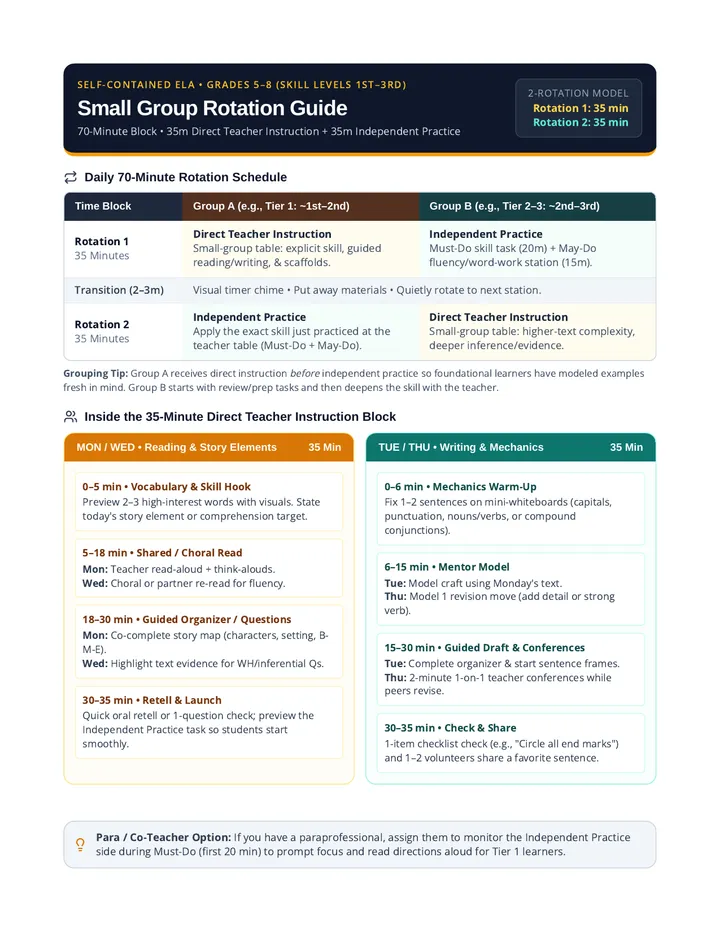
Small Group Rotation Guide
Self-Contained ELA • Grades 5–8 (Skill Levels 1st–3rd)
Small Group Rotation Guide
70-Minute Block • 35m Direct Teacher Instruction + 35m Independent Practice
2-Rotation Model
Rotation 1: 35 min
Rotation 2: 35 min
Daily 70-Minute Rotation Schedule
| Time Block |
Group A (e.g., Tier 1: ~1st–2nd) |
Group B (e.g., Tier 2–3: ~2nd–3rd) |
| Rotation 1 |
|
|
| 35 Minutes |
Direct Teacher Instruction |
|
| Small-group table: explicit skill, guided reading/writing, & scaffolds. |
Independent Practice |
|
| Must-Do skill task (20m) + May-Do fluency/word-work station (15m). |
|
|
| Transition (2–3m) |
Visual timer chime • Put away materials • Quietly rotate to next station. |
|
| Rotation 2 |
|
|
| 35 Minutes |
Independent Practice |
|
| Apply the exact skill just practiced at the teacher table (Must-Do + May-Do). |
Direct Teacher Instruction |
|
| Small-group table: higher-text complexity, deeper inference/evidence. |
|
|
Grouping Tip: Group A receives direct instruction before independent practice so foundational learners have modeled examples fresh in mind. Group B starts with review/prep tasks and then deepens the skill with the teacher.
Inside the 35-Minute Direct Teacher Instruction Block
MON / WED • Reading & Story Elements 35 Min
0–5 min • Vocabulary & Skill Hook
Preview 2–3 high-interest words with visuals. State today's story element or comprehension target.
5–18 min • Shared / Choral Read
Mon: Teacher read-aloud + think-alouds.
Wed: Choral or partner re-read for fluency.
18–30 min • Guided Organizer / Questions
Mon: Co-complete story map (characters, setting, B-M-E).
Wed: Highlight text evidence for WH/inferential Qs.
30–35 min • Retell & Launch
Quick oral retell or 1-question check; preview the Independent Practice task so students start smoothly.
TUE / THU • Writing & Mechanics 35 Min
0–6 min • Mechanics Warm-Up
Fix 1–2 sentences on mini-whiteboards (capitals, punctuation, nouns/verbs, or compound conjunctions).
6–15 min • Mentor Model
Tue: Model craft using Monday's text.
Thu: Model 1 revision move (add detail or strong verb).
15–30 min • Guided Draft & Conferences
Tue: Complete organizer & start sentence frames.
Thu: 2-minute 1-on-1 teacher conferences while peers revise.
30–35 min • Check & Share
1-item checklist check (e.g., "Circle all end marks") and 1–2 volunteers share a favorite sentence.
Para / Co-Teacher Option: If you have a paraprofessional, assign them to monitor the Independent Practice side during Must-Do (first 20 min) to prompt focus and read directions aloud for Tier 1 learners.
Page 2 • Student Independence & Grouping
35-Minute Independent Practice & Tracker
20m Must-Do + 15m May-Do
MON / WED • Reading Independent (35m)
Must-Do (20 min):
- • Mon: Audio/leveled text + visual Story Element Sort or B-M-E cut-and-match/label sheet.
- • Wed: Highlight text evidence for 3–4 tiered comprehension questions + 2-sentence summary.
May-Do Choice (15 min):
- High-interest independent reading (graphic novels, sports/science mags) • 2) Vocabulary match cards • 3) Whisper-phone fluency re-read.
TUE / THU • Writing Independent (35m)
Must-Do (20 min):
- • Tue: Complete graphic organizer & sentence-frame draft (or sentence-building task cards).
- • Thu: Finish weekly draft, run 3-item editing checklist, & write/type clean final copy.
May-Do Choice (15 min):
- Sentence-fix-it task cards • 2) Quick-write prompt journal • 3) Illustrate/add a caption or diagram to final draft.
Classroom Systems for 35-Minute Independence
1. Visual Timer & Chunking
Project a 35-min timer (20m Must-Do / 15m May-Do) so students pace themselves.
2. "Stuck? Try 3" Card
- Re-read directions • 2) Check word wall/anchor chart • 3) Quietly ask a table partner.
3. Audio & Frame Access
Keep headphones, text-to-speech, and sentence-starter rings at the independent station.
Small Group Roster & Weekly Rotation Notes
| Group / Tier |
Students |
Current Focus / Accommodations |
| Group A |
|
|
| Rotation 1: Direct |
|
|
| Rotation 2: Indep. |
|
|
| Group B |
|
|
| Rotation 1: Indep. |
|
|
| Rotation 2: Direct |
|
|
Week of: ______________________ Mon/Wed Target: ___________________________ Tue/Thu Target: ___________________________