Text Sleuths Homework
Text Sleuths Homework
Grade 5 ELA • NC Standards Practice
Name:
Date:
Directions: Read both passages carefully. Use evidence from the text to choose the best answer for each multiple-choice question.
Part 1: Literature Standards: RL.5.1, RL.5.2, RL.5.3, RL.5.6
The Rooftop Frost
(1) When the weather alert chimed on my phone at dinner, my stomach dropped. Temperatures were supposed to plunge below freezing before midnight. Up on the fourth-floor roof of our apartment building, twelve wooden planter boxes held the last ripe tomatoes of the neighborhood garden. I immediately grabbed a notepad to calculate how many bedsheets we would need to cover every box.
(2) "Come on, Maya, we don't have time for math!" my little brother Leo called, already tugging his coat over his pajamas. He scooped up an armful of beach towels and dashed toward the stairwell. I sighed and followed him, clutching my flashlight and a roll of twine. Leo always leaped first and worried about the details later, which usually left me fixing his messes.
(3) On the roof, a sharp wind rattled the metal railing. Leo flung a bright striped towel over the nearest planter, only to watch a gust lift it like a kite and drop it into the alley below. "Oops," he muttered, his shoulders slumping. I bit back an "I told you so" when I saw how worried he looked. Instead, I handed him half the twine. "Let's anchor the corners together," I said. "You hold the cloth steady while I tie."
(4) Working side by side, we found a rhythm. Leo's quick hands tucked the heavy blankets around the tomato stakes before the wind could catch them, and my tight knots kept every cover in place. When we finally stepped back, the twelve boxes looked like a row of cozy, bundled-up tents. My fingers were numb, but watching Leo grin at our handiwork made me realize that speed and careful planning worked best as a team.
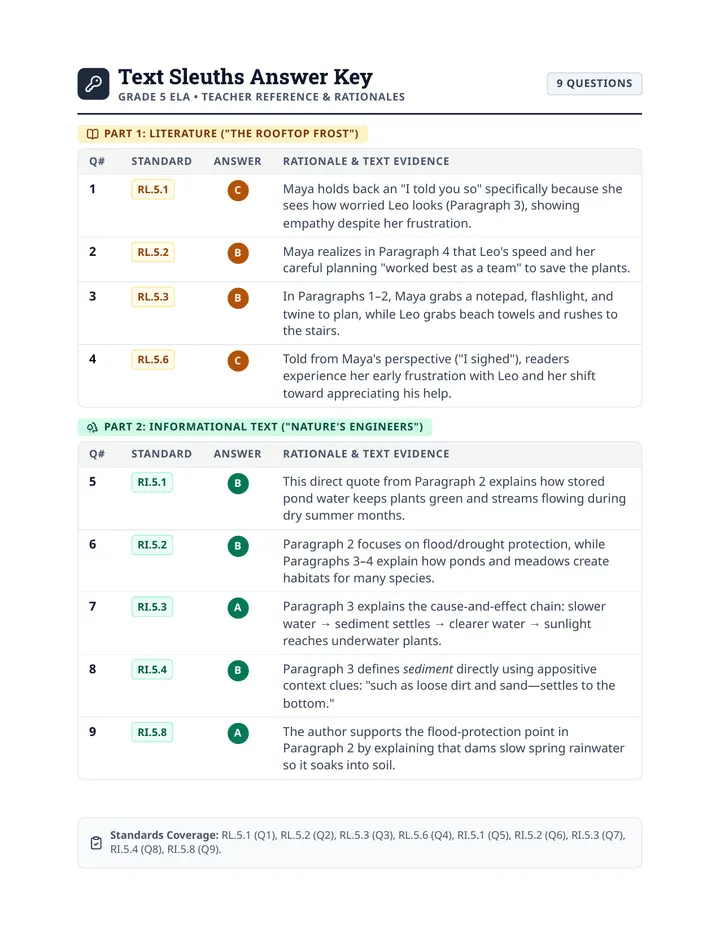
1. Which quote from the story best supports the inference that Maya cares about Leo's feelings even when she is frustrated? RL.5.1
A. "I immediately grabbed a notepad to calculate how many bedsheets we would need to cover every box."
B. "I sighed and followed him, clutching my flashlight and a roll of twine."
C. "I bit back an 'I told you so' when I saw how worried he looked."
D. "When we finally stepped back, the twelve boxes looked like a row of cozy, bundled-up tents."
Part 1: Literature Questions (Continued) Refer back to "The Rooftop Frost"
2. Which statement best expresses a theme of "The Rooftop Frost"? RL.5.2
A. Gardening in the city is too difficult when the weather changes unexpectedly.
B. Combining different strengths helps people overcome a difficult challenge together.
C. Older siblings should always be in charge during an emergency.
D. Moving quickly is more important than making a careful plan.
3. How do Maya and Leo differ in the way they respond to the weather alert at the beginning of the story? RL.5.3
A. Maya wants to leave the plants alone, while Leo wants to pick all the tomatoes right away.
B. Maya stops to calculate supplies and gather tools, while Leo grabs towels and rushes straight to the stairs.
C. Maya is excited by the wind on the roof, while Leo is afraid of going outside in the dark.
D. Maya refuses to share the twine, while Leo insists on tying every knot by himself.
4. How does Maya's first-person point of view influence how the events on the roof are described? RL.5.6
A. It lets the reader know what the neighbors in the apartment building are thinking about the garden.
B. It shows only Leo's excitement without explaining why the frost is dangerous to the plants.
C. It helps the reader understand Maya's initial annoyance with Leo and how her attitude toward him changes.
D. It gives a scientific explanation of how freezing temperatures damage tomato plants.
Text Evidence Check (Optional)
Before moving to Part 2, underline one sentence in "The Rooftop Frost" that helped you answer Question 2 or Question 3.
Part 2: Informational Text Standards: RI.5.1, RI.5.2, RI.5.3, RI.5.4, RI.5.8
Nature's Engineers: How Beavers Shape Wetlands
(1) Most animals adapt to the environment they live in, but beavers do the opposite: they rebuild it. Using sharp front teeth that never stop growing, beavers chew down trees and weave branches, mud, and stones into sturdy dams across flowing streams. Within weeks, a narrow stream slows down and spreads into a deep, calm pond. Because beavers change the landscape so dramatically, scientists call them "ecosystem engineers."
(2) Beaver dams do far more than create homes for beaver families; they also protect surrounding land from floods and droughts. During heavy spring rains, dams act like giant speed bumps. They slow rushing water and let it soak into the soil instead of washing away riverbanks. Later, during dry summer months, the stored water in beaver ponds keeps nearby plants green and streams flowing long after other creeks have dried up.
(3) In addition, beaver ponds improve water quality and support hundreds of other species. As fast-moving water slows behind a dam, heavy sediment—such as loose dirt and sand—settles to the bottom of the pond instead of clouding the stream below. Clearer water allows sunlight to reach underwater plants, which provide food and shelter for frogs, dragonflies, and young fish. Herons and otters soon arrive to hunt in the thriving wetland.
(4) Even after beavers move away, their work continues to benefit the land. Over many years, a drained beaver pond fills with rich soil, turning into a lush meadow where wildflowers and grasses grow. By building simple dams out of sticks and mud, beavers create healthy habitats that last for generations.
5. Which quote from the article best supports the inference that beaver ponds help animals survive dry weather? RI.5.1
A. "Within weeks, a narrow stream slows down and spreads into a deep, calm pond."
B. "Later, during dry summer months, the stored water in beaver ponds keeps nearby plants green and streams flowing long after other creeks have dried up."
C. "Using sharp front teeth that never stop growing, beavers chew down trees and weave branches, mud, and stones into sturdy dams across flowing streams."
D. "Over many years, a drained beaver pond fills with rich soil, turning into a lush meadow where wildflowers and grasses grow."
Part 2: Informational Questions (Continued) Refer back to "Nature's Engineers"
6. Which two statements best express the main ideas of the article? RI.5.2
A. Beavers have teeth that never stop growing, and they prefer to live in deep ponds rather than streams.
B. Beaver dams reshape streams to prevent floods and droughts, and beaver ponds create healthy habitats for many other species.
C. Herons and otters are the main predators in wetlands, and wildflowers grow best in drained ponds.
D. Streams always flood during the spring, and mud is the strongest material for building animal homes.
7. Based on paragraph 3, what is the relationship between slower water behind a beaver dam and underwater plants? RI.5.3
A. Slower water lets dirt settle to the bottom, making the water clearer so sunlight can reach the plants.
B. Slower water pushes underwater plants onto the riverbank where herons and otters can eat them.
C. Slower water blocks sunlight from reaching the pond floor, which stops plants from growing too tall.
D. Slower water washes loose sand downstream so frogs and dragonflies have room to swim.
8. What does the word sediment mean as it is used in paragraph 3? RI.5.4
A. Tiny fish and insects that live near the surface of a pond
B. Bits of dirt, sand, and rock carried by water that settle to the bottom
C. Large tree branches woven together to block a fast stream
D. Sunlight shining through shallow water onto green leaves
9. Which evidence does the author use in paragraph 2 to support the point that beaver dams protect land from floods? RI.5.8
A. Dams slow rushing spring rainwater and allow it to soak into the soil instead of washing away riverbanks.
B. Beavers use their sharp front teeth to chew down trees and build dams out of sticks and mud.
C. Drained beaver ponds eventually turn into lush meadows filled with wildflowers and grasses.
D. Beaver ponds provide food and shelter for frogs, dragonflies, young fish, herons, and otters.