Leech Cures Worksheet
Name:
Date:
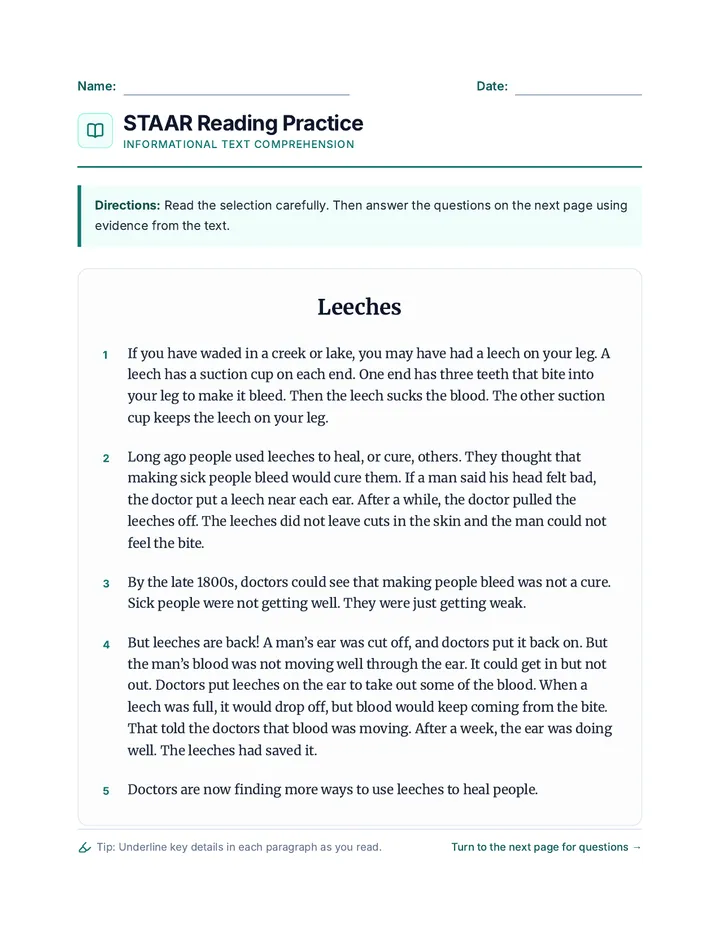
STAAR Reading Practice
Informational Text Comprehension
Directions: Read the selection carefully. Then answer the questions on the next page using evidence from the text.
Leeches
1
If you have waded in a creek or lake, you may have had a leech on your leg. A leech has a suction cup on each end. One end has three teeth that bite into your leg to make it bleed. Then the leech sucks the blood. The other suction cup keeps the leech on your leg.
2
Long ago people used leeches to heal, or cure, others. They thought that making sick people bleed would cure them. If a man said his head felt bad, the doctor put a leech near each ear. After a while, the doctor pulled the leeches off. The leeches did not leave cuts in the skin and the man could not feel the bite.
3
By the late 1800s, doctors could see that making people bleed was not a cure. Sick people were not getting well. They were just getting weak.
4
But leeches are back! A man’s ear was cut off, and doctors put it back on. But the man’s blood was not moving well through the ear. It could get in but not out. Doctors put leeches on the ear to take out some of the blood. When a leech was full, it would drop off, but blood would keep coming from the bite. That told the doctors that blood was moving. After a week, the ear was doing well. The leeches had saved it.
5
Doctors are now finding more ways to use leeches to heal people.
Tip: Underline key details in each paragraph as you read. Turn to the next page for questions →
Comprehension Questions
Leeches
1. In paragraph 2, what does the word cure mean?
A To make someone feel weak
B To help someone get well
C To pull something off the skin
D To wade in a creek or lake
2. According to paragraph 3, why did doctors in the late 1800s stop using leeches to make sick people bleed?
A Leeches were too hard to find in creeks and lakes.
B Patients could feel the leeches biting their skin.
C The bleeding did not heal patients and only made them weak.
D Doctors found faster ways to reattach ears without leeches.
3. What is the most likely reason the author included the story about the man’s ear in paragraph 4?
A To show a modern way doctors use leeches to help patients heal
B To warn readers to stay out of creeks and lakes
C To explain how many teeth a leech has on each suction cup
D To prove that doctors in the 1800s were right about bleeding
Short Constructed Response
4. How has the way doctors use leeches changed over time? Use evidence from the selection to support your answer.
Leech Cures Answer Key
Answer Key & Scoring Guide
Leeches — STAAR Reading Practice
Teacher Resource
Multiple-Choice Answers
| Item |
Key |
STAAR Skill |
Rationale & Text Evidence |
| 1 |
B |
Vocabulary / Context Clues |
Paragraph 2 explicitly defines the word using a synonym clue: “to heal, or cure, others.” |
| 2 |
C |
Key Details / Cause & Effect |
Paragraph 3 states that bleeding “was not a cure” and that sick people “were not getting well. They were just getting weak.” |
| 3 |
A |
Author’s Purpose |
Paragraph 4 introduces how “leeches are back!” by giving a specific modern medical example of leeches saving a man’s reattached ear. |
Item 4: STAAR 2-Point SCR Scoring Rubric
Prompt: How has the way doctors use leeches changed over time? Use evidence from the selection to support your answer.
2 Points — Complete & Supported
Clearly explains both how leeches were used in the past (to make sick people bleed as a general cure, such as for a headache) and how they are used today (for targeted medical problems, like helping blood move through a reattached ear), supported by accurate text evidence.
1 Point — Partial Response
Addresses only one part of the change (e.g., describes past or modern use without comparing) OR states that their use changed with vague or incomplete text evidence.
0 Points — Incorrect or Unrelated
Response is incorrect, irrelevant, copied verbatim without answering the question, or blank.
Sample 2-Point Exemplar Response
Long ago, doctors used leeches to make sick people bleed because they thought it would cure illnesses like headaches, but they stopped when they saw it only made patients weak. Today, doctors use leeches for specific medical problems, such as putting them on a man’s reattached ear to help blood keep moving so the ear could heal.