Evidence Hunters Slides DAY 1 • AZ 3.RL.1
Folktale Treasure Hunt
Evidence Hunters
Prove every answer right from the story!
Today's Tale: The Lion and the Mouse (Aesop's Fable)
3rd Grade Reading • Traditional Tales
Our Mission Today
Standard 3.RL.1
I can ask and answer questions about a story and point to exact words in the text to prove my answer.
Hunter Vocabulary
Explicit: Stated clearly right in the text.
Evidence: Words or sentences that prove you are right.
Remember: Don't just guess—put your finger on the proof!
The 3-Step Evidence Hunt
1
Read & Spot
Read the question carefully. Spot key words like who, what, where, or why .
2
Scan & Point
Scan the numbered paragraphs. Put your finger on the exact sentence!
3
Cite & Answer
Say: "In paragraph ___, the text says..." to prove your thinking.
Sentence Starter: "According to paragraph ___, I know that..."
Let's Hunt Together!
Guided Practice
[Paragraph 2] "Please spare my life!" squeaked the tiny mouse. "If you let me go, I promise I will help you one day." The lion laughed loudly, thinking a tiny mouse could never help a mighty king, but he lifted his heavy paw anyway.
Question:
Why did the lion laugh at the mouse?
Turn & Talk:
Find the exact words in Paragraph 2 that prove your answer!
Share with your partner using: "In paragraph 2, the text says..."
Your Turn, Detectives!
1. Partner Activity
Evidence Case File
Read The Lion and the Mouse . Match each clue question to its paragraph, write the exact proof, and stump your partner with your own question!
2. Exit Ticket
Show What You Know
Complete the 3-question Evidence Hunters Exit Ticket on your own. Don't forget to write the paragraph number!
Check your work: Did you point to the exact text?
Lion and Mouse Story Day 1 Story • AZ 3.RL.1
Name: _______________________ Date: ___________
The Lion and the Mouse
An Aesop's Fable • Read carefully and underline clues in the text
1
One warm afternoon, a mighty lion lay fast asleep beneath the shade of a great acacia tree. A tiny gray mouse was scurrying home through the tall grass and did not see the sleeping king. By mistake, the mouse ran right across the lion's wide nose. With a loud roar, the lion woke up and slammed his huge paw down on the mouse's tail.
2
"Please spare my life!" squeaked the terrified mouse. "If you let me go, I promise I will help you one day." The lion threw back his head and laughed loudly. How could such a tiny creature ever help the strong king of the forest? Still, the lion felt generous, so he lifted his heavy paw and let the mouse scamper away.
3
Several weeks later, the lion was prowling through the forest looking for dinner. Suddenly, he stepped into a hidden trap set by hunters. Thick, heavy ropes snapped tight around him and pulled him into a strong net. The lion thrashed and roared with all his might, but the more he struggled, the tighter the ropes grew.
4
Far across the forest, the little mouse heard the lion's desperate roars. Recognizing the voice of the king who had spared her, she raced through the bushes until she found the trapped lion. "Do not worry, friend," she said calmly. "I have kept my promise in mind."
5
The mouse climbed onto the net and began gnawing at the thick ropes with her sharp little teeth. Bite by bite, strand by strand, she chewed right through the knots. Soon, a wide hole opened in the net, and the lion stepped free. "Thank you, little friend," the lion said softly. "Now I see that even the smallest friend can be a great help."
Story Word Bank
spare: to let someone go without harming them
prowling: moving quietly while hunting
gnawing: chewing steadily on something hard
Evidence Hunters Activity Day 1 Activity • AZ 3.RL.1
Name: _______________________ Date: ___________
Evidence Case File
Use The Lion and the Mouse to find the exact paragraph and prove each answer.
PART 1 Find the Paragraph & Copy the Proof
1. What woke the lion up from his nap?
Paragraph # ______
2. What happened to the lion when he struggled in the net?
Paragraph # ______
3. How did the mouse free the lion from the trap?
Paragraph # ______
PART 2 Partner Stump Challenge!
Write your own question about The Lion and the Mouse . Trade papers with a partner and let them hunt for the paragraph and evidence!
My Question (Start with Who, What, Where, When, or Why):
Partner's Answer & Evidence:
Paragraph #:
Partner Check: Put a star next to your partner's answer if they proved it with the text!
Evidence Hunters Exit Ticket Day 1 Exit Ticket • AZ 3.RL.1
Name: _______________________ Date: ___________
Evidence Hunters Quick Check
Read each question about The Lion and the Mouse and use the text to prove your answers.
1. Where was the lion sleeping at the beginning of the story?
A. Inside a dark cave
B. Beneath a great acacia tree
C. Next to a rushing river
D. On top of a rocky hill
2. Which sentence from Paragraph 4 proves the mouse remembered her promise?
A. "Far across the forest, the little mouse heard the lion's desperate roars."
B. "She raced through the bushes until she found the trapped lion."
C. "'I have kept my promise in mind.'"
D. "'Do not worry, friend,' she said calmly."
3. Why did the lion finally change his mind about the little mouse?
Write your answer and cite the paragraph number where you found your proof.
How confident do you feel about finding text evidence?
[ ] Ready to teach it! [ ] Getting there [ ] Need more practice
Moral Detectives Slides DAY 2 • AZ 3.RL.2
Folktale Treasure Hunt
Moral Detectives
Uncover the big lesson hidden in the story!
Today's Tale: The Empty Pot (Traditional Chinese Folktale)
3rd Grade Reading • Traditional Tales
Our Mission Today
Standard 3.RL.2
I can recount a folktale in order and explain its central message using key details from the story.
Detective Words
Recount: Retell the main events in order (B-M-E).
Central Message: The big lesson or moral the author wants us to learn.
Hint: Watch what the main character does when things get tough!
How to Crack the Moral
1
Recount Events
Retell the Beginning, Middle, and End using only the most important events.
2
Track Choices
Ask: What problem did the character face, and what choice did they make?
3
Name the Lesson
State a life lesson anyone can use—not just a fact about one character!
Check: "Ping grew a flower" = detail. "Honesty is worth more than winning" = central message!
Let's Discuss Together!
Guided Practice
[Paragraph 4] All the other children held pots overflowing with bright blossoms. Ping stood bravely with his empty clay pot. "I tried my very best, Your Majesty," Ping whispered, "but nothing would grow."
Character Choice:
Why didn't Ping buy a pretty flower to put in his pot?
Turn & Talk:
What does Ping's brave choice teach us about telling the truth?
Sentence Starter: "Ping's actions show the lesson that..."
Your Turn, Detectives!
1. Story Trail Activity
Recount & Unlock
Map the Beginning, Middle, and End of The Empty Pot . Then connect two key details to unlock the central message!
2. Exit Ticket
Show What You Know
Complete the Moral Detectives Exit Ticket on your own. Be sure to explain how a key detail proves the moral!
Remember: A central message is a lesson for everyone!
Empty Pot Story Day 2 Story • AZ 3.RL.2
Name: _______________________ Date: ___________
The Empty Pot
A Traditional Chinese Folktale • Look for key events and the big lesson
1
Long ago in China, a wise Emperor grew too old to rule and needed to choose the next leader. He loved flowers more than anything, so he announced a contest. He gave every child in the kingdom one special flower seed. "Whoever brings me the finest flower in one year," declared the Emperor, "shall be the next ruler."
2
A boy named Ping had a gift for gardening. Anything he planted seemed to sprout overnight. Ping carefully filled a clay pot with rich soil, planted his royal seed, and watered it every morning. Weeks passed, then months, yet not a single green shoot appeared. Ping moved the seed into a bigger pot with fresh soil, but still nothing grew.
3
When spring arrived, the day of the contest came. Children marched to the palace carrying pots bursting with red, gold, and purple blossoms. Ping's best friend asked, "Why don't you buy a bright flower from the market so you won't look foolish?" Ping shook his head. "I promised to bring what grew from the Emperor's seed," he said quietly.
4
In the courtyard, the Emperor walked slowly past rows of dazzling blooms, frowning more with each step. At last, he stopped before Ping, who stood bravely holding his empty clay pot. "I tried my very best, Your Majesty," Ping whispered, "but nothing would grow."
5
Suddenly, the Emperor's face broke into a warm smile. "I have found the next ruler!" he announced to the crowd. "Every seed I gave out last year had been boiled in hot water. It was impossible for any of them to sprout! Only Ping had the courage to tell the truth." From that day on, Ping ruled the kingdom with honesty and wisdom.
Story Word Bank
declared: announced something clearly and officially
dazzling: very bright, colorful, and impressive
courage: bravery to do what is right even when scared
Moral Detectives Activity Day 2 Activity • AZ 3.RL.2
Name: _______________________ Date: ___________
Story Trail & Moral Treasure
Recount The Empty Pot in order, then unlock its central message.
STEP 1 Recount the Key Events
Beginning (Para. 1–2)
What contest did the Emperor start, and what happened to Ping's seed?
Middle (Para. 3–4)
What did Ping choose to do on contest day?
End (Para. 5)
What secret did the Emperor reveal, and who won?
STEP 2 Unlock the Central Message
What is the central message (moral) of The Empty Pot ?
List TWO key details from the story that prove this moral:
Partner Share: Read your central message aloud and ask your partner if they agree!
Moral Detectives Exit Ticket Day 2 Exit Ticket • AZ 3.RL.2
Name: _______________________ Date: ___________
Moral Detectives Quick Check
Think about the events and lesson in The Empty Pot to answer each question.
1. Which event belongs in the MIDDLE of a recount of The Empty Pot ?
A. The Emperor gives every child in the kingdom one flower seed.
B. Ping refuses to buy a market flower and brings his empty pot to the palace.
C. The Emperor explains that all of the seeds had been boiled.
D. Ping rules the kingdom with honesty and wisdom.
2. What is the central message of The Empty Pot ?
A. Only the best gardeners deserve to be rulers.
B. Always buy flowers from the market if yours do not grow.
C. Being honest takes courage, and truth is rewarded.
D. Boiled seeds grow faster in clay pots.
3. How did Ping's actions at the palace help show the central message?
Use at least one key detail from the story in your explanation.
How confident do you feel about finding the central message?
[ ] Ready to teach it! [ ] Getting there [ ] Need more practice
Word Wizards Slides DAY 3 • AZ 3.RL.4
Folktale Treasure Hunt
Word Wizards
Look past the words to find their real magic!
Today's Tale: Stone Soup (Traditional European Folktale)
3rd Grade Reading • Traditional Tales
Our Mission Today
Standard 3.RL.4
I can figure out what words and phrases mean in a story and tell the difference between literal and nonliteral language.
Wizard Words
Literal: Means exactly what the words say.
Nonliteral: Means something different from the exact words (figurative).
Example: "It's raining cats and dogs" does NOT mean pets are falling from the sky!
The Literal vs. Nonliteral Test
1
Picture It
Imagine the exact words happening in real life. Does it sound silly or impossible?
2
Check Clues
Read the sentences before and after the phrase to see what is really happening.
3
Translate It
Put the true meaning into your own clear, everyday words.
Clue: If it sounds impossible in real life, it is probably NONLITERAL!
Let's Decode Together!
Guided Practice
[Paragraph 1] When the weary travelers knocked on doors asking for food, the villagers shut their curtains. "Folks in this town have hearts of stone," sighed one traveler.
Literal or Nonliteral?
Do the villagers really have rocks beating inside their chests?
Turn & Talk:
What does "hearts of stone" mean in this paragraph?
Share: "Hearts of stone is nonliteral. It means the villagers..."
Your Turn, Word Wizards!
1. Phrase Sort Activity
Cauldron of Clues
Sort phrases from Stone Soup into Literal or Nonliteral. Then translate each nonliteral phrase into its true meaning!
2. Exit Ticket
Show What You Know
Complete the Word Wizards Exit Ticket on your own. Use context clues to prove what each phrase means!
Tip: Always reread the sentence around the phrase!
Stone Soup Story Day 3 Story • AZ 3.RL.4
Name: _______________________ Date: ___________
Stone Soup
A Traditional European Folktale • Spot literal and nonliteral phrases as you read
1
Three weary travelers walked into a quiet village with empty stomachs. When they knocked on doors to ask for a bite to eat, the villagers quickly shut their curtains. "Folks in this town have hearts of stone ," sighed the youngest traveler. Nobody wanted to share a single crumb.
2
Instead of giving up, the cleverest traveler had an idea to break the ice . She set a huge iron kettle in the town square, filled it with cold water from the well, and built a crackling wood fire underneath. Then she dropped three smooth gray stones right into the bubbling pot.
3
Curiosity pulled the villagers out of their houses. "What are you cooking?" asked the baker. "Delicious stone soup!" smiled the traveler, stirring with a long wooden spoon. "It tastes wonderful, though a pinch of salt and a few carrots would make it truly sing." Soon, the baker ran home and returned with carrots and onions to lend a hand .
4
One by one, other neighbors joined the crowd. A farmer brought golden potatoes, and a gardener added sweet corn and fresh herbs. Before long, the steaming pot held a feast for the eyes , and its rich smell drifted down every street.
5
Everyone gathered around long wooden tables, laughing and sharing bowls of hot soup. The villagers were on cloud nine as they realized that when everyone shares a little, there is more than enough for all.
Story Word Bank
weary: very tired after a long journey
kettle: a large metal pot used for boiling
curiosity: a strong wish to know or learn something
Word Wizards Activity Day 3 Activity • AZ 3.RL.4
Name: _______________________ Date: ___________
Cauldron of Clues
Sort each phrase from Stone Soup as Literal or Nonliteral, then decode the magic!
PART 1 Circle Literal (L) or Nonliteral (N), Then Write What It Means
1. "break the ice" (Para. 2)
Circle one: [ L ] [ N ]
2. "filled it with cold water" (Para. 2)
Circle one: [ L ] [ N ]
3. "lend a hand" (Para. 3)
Circle one: [ L ] [ N ]
4. "on cloud nine" (Para. 5)
Circle one: [ L ] [ N ]
PART 2 Picture It! Choose ONE Nonliteral Phrase: "a feast for the eyes" OR "hearts of stone"
Silly Literal Picture (What the exact words sound like):
True Nonliteral Meaning (What it really means in the story):
Partner Share: Show your silly literal sketch and see if your partner can guess the phrase!
Word Wizards Exit Ticket Day 3 Exit Ticket • AZ 3.RL.4
Name: _______________________ Date: ___________
Word Wizards Quick Check
Use context clues from Stone Soup to answer each question.
1. Which sentence from the story uses NONLITERAL language?
A. "She set a huge iron kettle in the town square."
B. "Then she dropped three smooth gray stones right into the bubbling pot."
C. "The villagers were on cloud nine as they realized there was enough for all."
D. "A farmer brought golden potatoes, and a gardener added sweet corn."
2. In Paragraph 2, the traveler had an idea to "break the ice." What does this phrase mean?
A. To smash frozen water into small pieces
B. To help unfriendly strangers feel comfortable talking
C. To cool down a pot of boiling soup
D. To build a fire in the winter snow
3. In Paragraph 4, the soup is called "a feast for the eyes." Is this literal or nonliteral? Explain what it means.
How confident do you feel about literal vs. nonliteral language?
[ ] Ready to teach it! [ ] Getting there [ ] Need more practice
Story Architects Slides DAY 4 • AZ 3.RL.5
Folktale Treasure Hunt
Story Architects
See how every scene stacks like bricks!
Today's Tale: Anansi and the Turtle (West African Folktale)
3rd Grade Reading • Traditional Tales
Our Mission Today
Standard 3.RL.5
I can refer to parts of a story (chapters, scenes, or stanzas) and explain how each new part builds on earlier parts.
Architect Terms
Scene / Chapter: A section of a story or play.
Builds On: Uses what happened earlier to cause what happens next.
Think of a tower: if you pull out Scene 1, Scene 4 tumbles down!
How Parts Connect
1
Name the Part
Use exact terms: "In Scene 1..." or "In Scene 3..."
2
Ask "Because"
Ask: "Could this scene happen without the earlier scene?"
3
Link Them
Explain how the earlier event caused the character's next choice.
Sentence Starter: "Scene ___ builds on Scene ___ because earlier..."
Let's Connect the Bricks!
Guided Practice
Scene 2:
Anansi tricks Turtle by sending him back to the river to wash his dusty feet—and eats all the yams while Turtle is gone!
Scene 3:
Weeks later, Turtle invites Anansi to a feast at the bottom of the river.
Turn & Talk: Why is Scene 2 important for understanding Scene 3?
Your Turn, Architects!
1. Blueprint Activity
Story Bricks Tower
Read all 4 Scenes of Anansi and the Turtle . Summarize each scene and explain how the bricks stack together!
2. Exit Ticket
Show What You Know
Complete the Story Architects Exit Ticket on your own. Always name the exact Scene number in your answer!
Check your work: Did you use the word "Scene" and "builds on"?
Anansi and Turtle Story Day 4 Story • AZ 3.RL.5
Name: _______________________ Date: ___________
Anansi and the Turtle
A West African Folktale • Notice how each Scene builds on the one before it
Scene 1: The Dusty Visitor
One evening, Anansi the spider sat down to a delicious feast of roasted yams. Just as he lifted his fork, a knock sounded at the door. It was Turtle, who had walked all day and was covered in road dust. By the custom of the forest, Anansi had to invite his guest to share the meal, even though he secretly wanted every yam for himself.
Scene 2: Anansi's Trick
As Turtle reached for a yam, Anansi gasped, "Turtle, your feet are dusty! Nobody may eat at my table with dirty feet." Turtle politely walked all the way back to the river to wash. While Turtle was gone, greedy Anansi gobbled up every last yam! When Turtle returned with clean feet, only empty peels remained. "Thank you for the hospitality," Turtle said calmly, and he slowly walked home hungry.
Scene 3: Turtle's Invitation
A few weeks later, Turtle invited Anansi to a grand dinner at his home beneath the river. Anansi arrived at the riverbank with an empty stomach. Turtle dove underwater and called up, "Come on down, Anansi! Dinner is served!" Anansi leaped into the water, but spiders are too light to sink. He bobbed right back to the surface like a cork.
Scene 4: The Heavy Coat
To sink to the bottom, Anansi filled the pockets of his heavy coat with river stones. Now he sank straight down to Turtle's table, which was piled high with sweet berries and yams. Just as Anansi reached for a bite, Turtle smiled and said, "In my house, Anansi, nobody may eat while wearing a heavy coat." As soon as Anansi slipped off his coat, he floated straight back up to the top—while Turtle enjoyed the feast alone.
Story Word Bank
custom: a traditional rule shared by a community
hospitality: welcoming and feeding guests kindly
bobbed: floated up and down on top of water
Story Architects Activity Day 4 Activity • AZ 3.RL.5
Name: _______________________ Date: ___________
Story Bricks Blueprint
Summarize each Scene of Anansi and the Turtle and explain how each brick builds on the last!
Brick 1 • Scene 1: What happens when Turtle arrives?
Brick 2 • Scene 2: How does Scene 2 build on Scene 1's custom of sharing?
Brick 3 • Scene 3: Why does Turtle invite Anansi underwater after Scene 2?
Brick 4 • Scene 4: How does Turtle's rule in Scene 4 mirror Anansi's trick in Scene 2?
Architect Challenge: What would happen to Scene 4 if we deleted Scene 2 from the story?
Partner Share: Read your Brick 4 connection aloud using the words "Scene 4 builds on Scene 2 because..."
Story Architects Exit Ticket Day 4 Exit Ticket • AZ 3.RL.5
Name: _______________________ Date: ___________
Story Architects Quick Check
Think about how the four Scenes of Anansi and the Turtle fit together.
1. Which event happens in Scene 3 of Anansi and the Turtle ?
A. Anansi sends Turtle to the river to wash his dusty feet.
B. Anansi tries to dive into the river, but he bobs back up like a cork.
C. Anansi puts heavy river stones into the pockets of his coat.
D. Turtle knocks on Anansi's door after walking all day.
2. How does Scene 4 build on Scene 3?
A. Because Anansi floated in Scene 3, he uses heavy stones to sink in Scene 4.
B. Because Anansi ate all the yams in Scene 3, he is not hungry in Scene 4.
C. Because Turtle washed his feet in Scene 3, he wears a coat in Scene 4.
D. Because Anansi shared his dinner in Scene 3, Turtle shares berries in Scene 4.
3. Explain how Turtle's actions in Scene 4 connect back to what Anansi did in Scene 2.
How confident do you feel about explaining how story parts build?
[ ] Ready to teach it! [ ] Getting there [ ] Need more practice
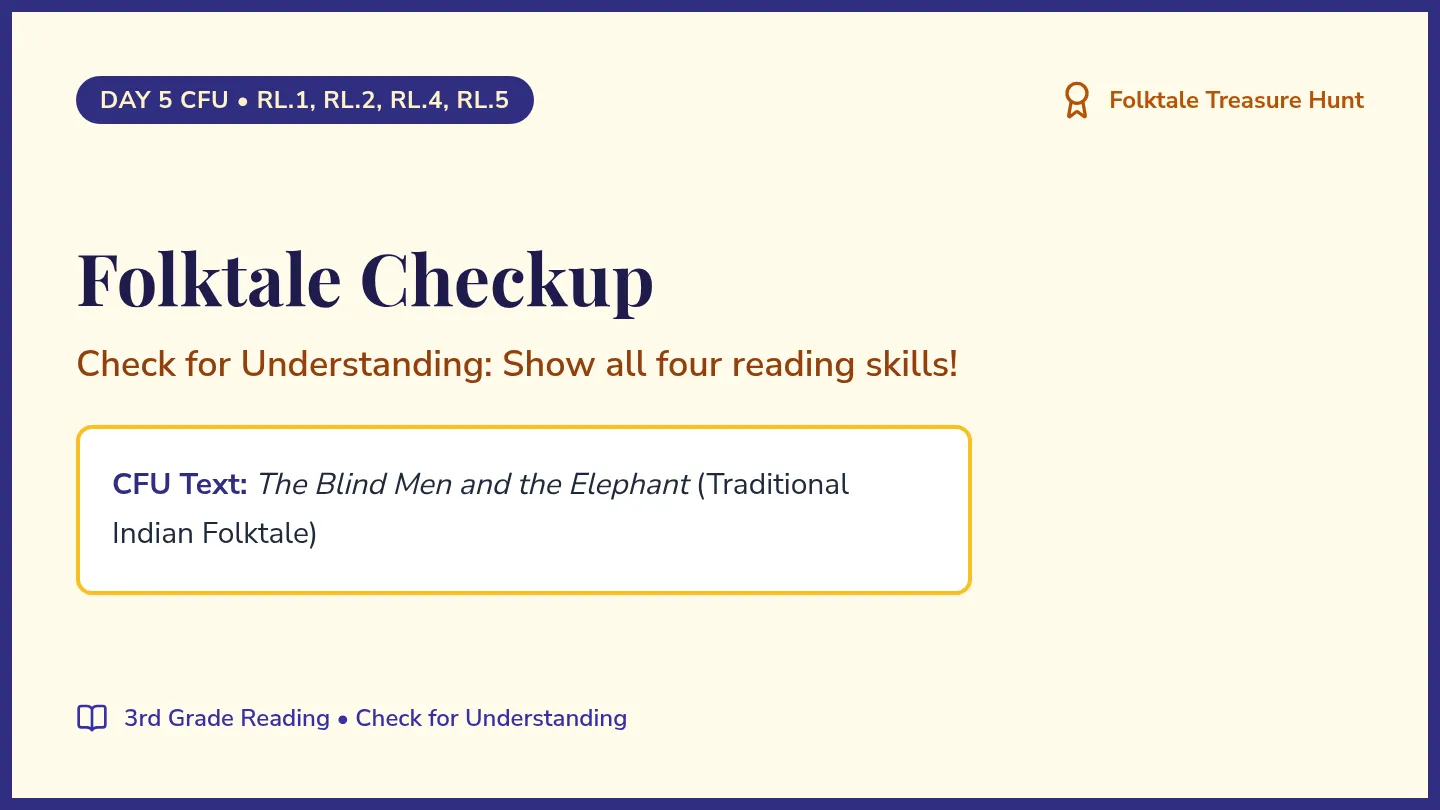
Folktale Checkup Slides DAY 5 CFU • RL.1, RL.2, RL.4, RL.5
Folktale Treasure Hunt
Folktale Checkup
Check for Understanding: Show all four reading skills!
CFU Text: The Blind Men and the Elephant (Traditional Indian Folktale)
3rd Grade Reading • Check for Understanding
What We Are Checking Today
3.RL.1 • Text Evidence
Can I point to exact words in the text to prove my answer?
3.RL.2 • Central Message
Can I recount key events and explain the moral using details?
3.RL.4 • Word Meaning
Can I tell literal language apart from nonliteral phrases?
3.RL.5 • Story Structure
Can I explain how each story Part builds on earlier Parts?
First, let's do two quick whole-class warm-up checks!
Quick Check #1: Finger Vote
CFU • 3.RL.4
[Part 2] Soon the six travelers could not see eye to eye . "It is a thick snake!" shouted one. "No, it is a sturdy tree trunk!" argued another.
Hold up 1, 2, or 3 fingers: What does "see eye to eye" mean?
1 = Look at the elephant's eyes | 2 = Agree with each other | 3 = Stand in a straight line
Be ready to explain which context clue helped you choose!
Quick Check #2: Turn & Prove
CFU • 3.RL.5
[Part 3] "Each man touched only one small part of the elephant. If you put your pieces together instead of arguing, you will finally see the whole creature."
Partner Check:
How does Part 3 build on what happened in Part 1 and Part 2?
Sentence Starter: "Part 3 builds on Parts 1 and 2 because earlier..."
Independent CFU Time
1. Folktale Checkup CFU
4-Standard Check
Read The Blind Men and the Elephant on your own and complete all four CFU questions—one for each standard!
2. CFU Exit Ticket
Self-Check & Reflect
Rate your confidence on each standard and share which reading strategy helped you most today.
Take your time, reread the text, and cite your Part numbers!
Blind Men Elephant Story Day 5 CFU Text • RL.1, RL.2, RL.4, RL.5
Name: _______________________ Date: ___________
The Blind Men and the Elephant
A Traditional Indian Folktale • Read carefully to complete your Day 5 CFU
Part 1: The Curious Travelers
Long ago in India, six blind travelers heard that a gentle elephant had arrived in their town. None of them had ever met an elephant before, so they asked the keeper if they could touch the animal to learn what it was like. Each man walked up to a different spot on the giant creature. The first man touched the elephant's wide, flat side. The second felt a smooth, curved tusk. The third held the wiggly trunk, while the fourth wrapped his arms around a thick, sturdy leg. The fifth touched a wide, flapping ear, and the sixth grabbed the thin, swishing tail.
Part 2: The Loud Argument
As soon as they stepped back, the six travelers began to share what they had discovered—and they could not see eye to eye ! "An elephant is just like a brick wall!" declared the first man. "No, it is sharp like a spear!" cried the second. "You are both wrong—it is a thick snake!" shouted the third. "Nonsense, it is a tall tree trunk!" argued the fourth. The fifth insisted it was a giant fan, and the sixth swore it was a piece of rope. Soon, all six men were stubborn as mules , shouting louder and louder without listening to one another.
Part 3: The Whole Picture
A wise woman passing by heard the commotion and stopped to listen. She smiled gently and said, "Every single one of you is partly right, yet all of you are missing the truth. Each man touched only one small part of the elephant. If you put your pieces together instead of arguing, you will finally see the whole creature." The six men grew quiet, listened to one another's descriptions, and realized how much more they could learn together.
Story Word Bank
sturdy: strong, solid, and hard to knock over
insisted: said something firmly and refused to change
commotion: noisy confusion and loud arguing
Folktale Checkup CFU Day 5 CFU • AZ 3.RL.1, 3.RL.2, 3.RL.4, 3.RL.5
Name: _______________________ Date: ___________
Folktale Checkup: 4-Standard CFU
Complete each question independently using The Blind Men and the Elephant .
1. (3.RL.1 • Text Evidence) According to Part 1, which part of the elephant did the fourth man touch, and what did he call it in Part 2?
A. The wide side; a brick wall
B. The sturdy leg; a tall tree trunk
C. The flapping ear; a giant fan
D. The curved tusk; a sharp spear
2. (3.RL.4 • Word Meaning) In Part 2, the men are described as "stubborn as mules." Is this literal or nonliteral, and what does it mean?
3. (3.RL.5 • Story Structure) How does Part 3 build on what happened in Part 1 and Part 2?
A. Part 3 solves the argument from Part 2 by explaining that each man only touched one part in Part 1.
B. Part 3 introduces a brand-new animal that the travelers never touched in Part 1.
C. Part 3 repeats the same argument from Part 2 without any change.
4. (3.RL.2 • Central Message) What is the central message of this folktale? Explain using one key detail from Part 3.
CFU Mastery Tracker (Teacher Use):
3.RL.1 [ ] 3.RL.2 [ ] 3.RL.4 [ ] 3.RL.5 [ ]
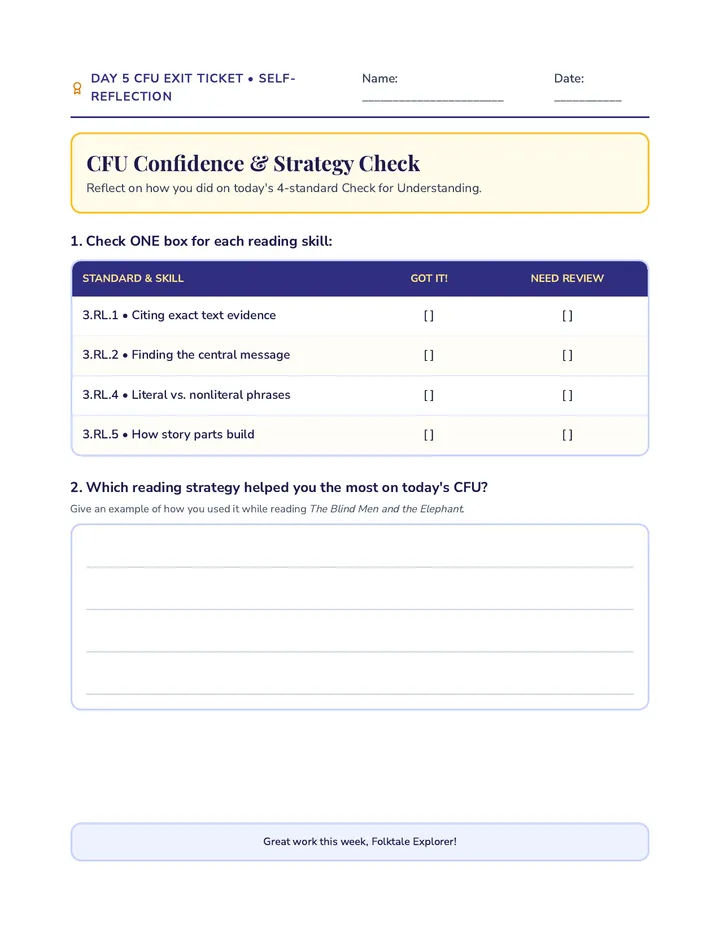
Folktale Checkup Exit Ticket Day 5 CFU Exit Ticket • Self-Reflection
Name: _______________________ Date: ___________
CFU Confidence & Strategy Check
Reflect on how you did on today's 4-standard Check for Understanding.
1. Check ONE box for each reading skill:
Standard & Skill
Got It!
Need Review
3.RL.1 • Citing exact text evidence
[ ]
[ ]
3.RL.2 • Finding the central message
[ ]
[ ]
3.RL.4 • Literal vs. nonliteral phrases
[ ]
[ ]
3.RL.5 • How story parts build
[ ]
[ ]
2. Which reading strategy helped you the most on today's CFU?
Give an example of how you used it while reading The Blind Men and the Elephant .
Great work this week, Folktale Explorer!