A targeted 6th-grade ELA lesson exploring how secondary characters steer plot progression and how author craft techniques—dialogue, sensory imagery, and figurative language—deepen reader comprehension.
D Grover is mad at Percy for asking too many questions about his watch.
Character & Craft Quiz • Supported Edition Page 1 of 2 • Turn Over →
Part II
Author Craft & Written Response
Student Name:
3
Author Craft: Sensory Imagery (Sight & Sound) In lines 1–2, the author describes the sky like a "bruised plum" and says the rain "slashed against the bus windows like sharp gravel." What kind of feeling does this description create?
A A stormy, spooky mood that shows danger is coming.
B A calm, peaceful mood that makes the boys want to take a nap.
C A cheerful mood that shows Percy is excited to eat fruit.
D A boring mood that shows nothing interesting will happen.
4
Author Craft: Simile (Comparing Two Things) In line 16, Percy says: "A cold dread settled inside me, heavy as an iron anchor." What does this comparison tell us about Percy's feeling?
A His fear is so heavy and strong that he cannot ignore it.
B Percy dropped a real metal anchor onto his own foot.
C Percy feels very cold because the bus air conditioner is on.
D He wishes he were riding on a ship instead of a city bus.
5
Short Answer Writing (8 Points)
How Characters & Author Craft Work Together
3–4 Sentences
Question: How does Grover (the secondary character) change the way Percy acts and thinks? Use at least ONE quote or example of author craft (dialogue, sensory imagery, or a simile) from the passage to support your answer.
Need help starting? You can use these sentence frames:
Grover changes Percy's thinking by...
In the text, the author uses (dialogue / imagery / a simile) when...
This detail shows the reader that...
Check Your Work Before Turning In:
I explained Grover's effect
I quoted dialogue or craft
I wrote complete sentences
Character & Craft Quiz • Supported Edition Page 2 of 2 • Great Job!
«Mi trabajo es protegerte»
A Grover es en secreto un protector, no solo un compañero débil que necesita ayuda.
B Grover ha decidido trabajar como guardia de seguridad para la empresa de autobuses.
C Grover quiere que Percy lo defienda de los bravucones en la cafetería.
D Grover está enfadado con Percy por hacerle tantas preguntas sobre su reloj.
Cuestionario de Personajes y Estilo • Edición con Apoyo Página 1 de 2 • Continúa en la página 2 →
Parte II
Recursos del Autor y Respuesta Escrita
Nombre del estudiante:
3
Recursos del Autor: Imágenes Sensoriales (Vista y Oído) En las líneas 1–2, el autor describe el cielo como una «ciruela oscura y magullada» y dice que la lluvia «azotaba las ventanillas del autobús como grava afilada». ¿Qué sensación produce esta descripción?
A Un ambiente tormentoso e inquietante que indica que se avecina peligro.
B Un ambiente pacífico y relajante que invita a los chicos a dormir una siesta.
C Un ambiente alegre que demuestra que Percy tiene ganas de comer fruta.
D Un ambiente aburrido que muestra que no va a pasar nada emocionante.
4
Recursos del Autor: Símil (Comparación) En la línea 16, Percy dice: «Una frialdad de temor profundo se me instaló en el pecho, pesada como un ancla de hierro». ¿Qué nos indica esta comparación sobre el miedo de Percy?
A Su miedo es tan pesado e intenso que no puede pasarlo por alto.
B Percy se golpeó el pie con una pesada ancla de metal de verdad.
C Percy tiene frío porque el aire acondicionado del autobús está demasiado alto.
D Prefiere viajar en un barco grande antes que en un autobús citadino.
5
Respuesta Escrita Breve (8 Puntos)
Cómo se combinan los personajes y el estilo del autor
3–4 Oraciones
Pregunta: ¿De qué manera Grover (el personaje secundario) cambia la forma en que Percy actúa y piensa? Utiliza al menos UNA cita o ejemplo de los recursos del autor (diálogo, imágenes sensoriales o un símil) del texto para respaldar tu respuesta.
¿Necesitas ayuda para comenzar? Puedes usar estas frases:
Grover cambia la forma de pensar de Percy cuando...
En el texto, el autor usa (diálogo / imágenes / un símil) cuando dice: «...»
Este detalle le demuestra al lector que...
Revisa tu trabajo antes de entregarlo:
Expliqué el impacto de Grover
Cité un diálogo o recurso
Escribí oraciones completas
Cuestionario de Personajes y Estilo • Edición con Apoyo Página 2 de 2 • ¡Excelente trabajo!
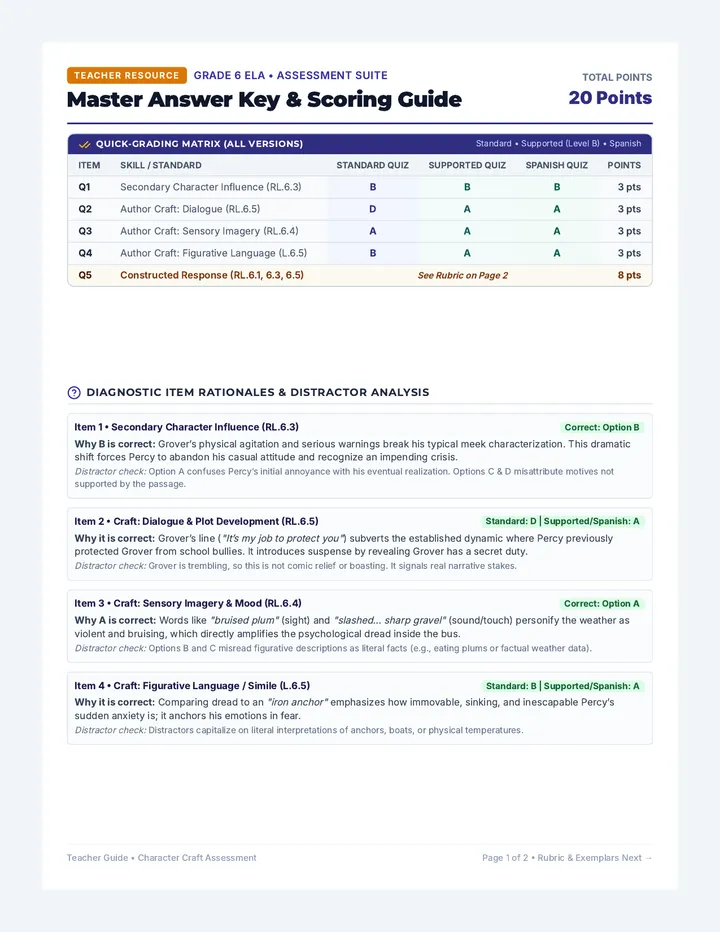
Item 4 • Craft: Figurative Language / Simile (L.6.5) Standard: B | Supported/Spanish: A
Why it is correct: Comparing dread to an "iron anchor" emphasizes how immovable, sinking, and inescapable Percy’s sudden anxiety is; it anchors his emotions in fear.
Distractor check: Distractors capitalize on literal interpretations of anchors, boats, or physical temperatures.
Teacher Guide • Character Craft Assessment Page 1 of 2 • Rubric & Exemplars Next →
Scoring Guide
Question 5 Analytic Rubric & Student Exemplars
Constructed Response (8 Pts)
Analytic Scoring Criteria (2 Points Each)
High-Scoring Exemplar (8/8) Standard
"In this scene, Grover acts as a catalyst because his sudden seriousness shatters Percy’s belief that they are just ordinary boys heading home. When Grover whispers, 'It’s my job to protect you,' the author uses urgent dialogue to reveal that Grover possesses secret knowledge about Percy’s identity. Furthermore, Rick Riordan uses the simile 'heavy as an iron anchor' to show how Grover’s unexpected courage instills an inescapable sense of dread in Percy. By changing Grover from a helpless friend into a vigilant protector, the author signals to the reader that the plot has reached a dangerous turning point."
Supported / Spanish Exemplar (8/8) Bilingual / Level B
"Grover changes Percy's thinking by acting like a brave protector instead of a nervous boy. In the text, the author uses dialogue when Grover whispers, 'It’s my job to protect you' and hands him an emergency card. This detail shows the reader that Grover is hiding a huge secret about danger. Also, the author uses a simile comparing Percy's fear to a 'heavy iron anchor,' which makes the reader understand that Percy finally realizes he is not safe."
Common Misconceptions & Reteaching Strategies
Confusing Plot Action with Craft: Students often retell what happened on the bus rather than analyzing how Riordan wrote it. Prompt students: "Why did the author use that exact sensory word or comparison instead of a plain sentence?"
Ignoring Secondary Character Function: Students may see Grover as just a "sidekick." Remind students that secondary characters act as mirrors, heralds, or catalysts that push the protagonist toward essential plot choices.
Teacher Guide • Character Craft Assessment Page 2 of 2 • End of Scoring Guide