Atomic Alchemy Slides Atomic Alchemy
Exploring the Power and Physics of Nuclear Decay, Fission, and Fusion
The Unstable Nucleus
Not all atoms are built to last. Some nuclei have an imbalance of protons and neutrons.
Energy Seeking Stability
α
Alpha Decay
A heavy nucleus ejects an Alpha Particle (\(_{2}^{4}\text{He}\)).
The Result:
Atomic Mass decreases by 4
Atomic Number decreases by 2
\[ _{92}^{238}\text{U} \rightarrow _{90}^{234}\text{Th} + _{2}^{4}\alpha \]
Penetration Power: LOW
Can be stopped by a single sheet of paper.
β
Beta Decay
A neutron converts into a proton and ejects a high-speed Electron (\(_{-1}^{0}e\)).
The Result:
Atomic Mass remains unchanged
Atomic Number increases by 1
\[ _{6}^{14}\text{C} \rightarrow _{7}^{14}\text{N} + _{-1}^{0}\beta \]
Penetration Power: MEDIUM
Can be stopped by aluminum foil.
γ
Gamma Decay
The nucleus releases Pure Energy (High-frequency EM waves).
The Result:
Atomic Mass: No change
Atomic Number: No change
Energy state is lowered.
Penetration Power: HIGH
Requires thick lead or concrete to stop.
Nuclear Reactions
Fission
Splitting a heavy nucleus into smaller pieces. Releases enormous energy and extra neutrons.
Example: Nuclear Power Plants
Fusion
Combining light nuclei to form a heavier one. Releases even more energy than fission!
Example: The Sun & Stars
Half-Life (\(t_{1/2}\))
The time required for half of the atoms in a sample to decay.
100% Sample 50% 25% 12.5%
Start 1 Half-life 2 Half-lives 3 Half-lives
The Math Strategy:
1
Find total time elapsed.
2
Divide by half-life duration to get n.
3
Divide initial amount by \(2^n\).
Quick Check
"A sample of Iodine-131 has a half-life of 8 days. If you start with 200g, how much is left after 24 days?"
A) 100g
B) 50g
C) 25g
D) 12.5g
Show your thinking!
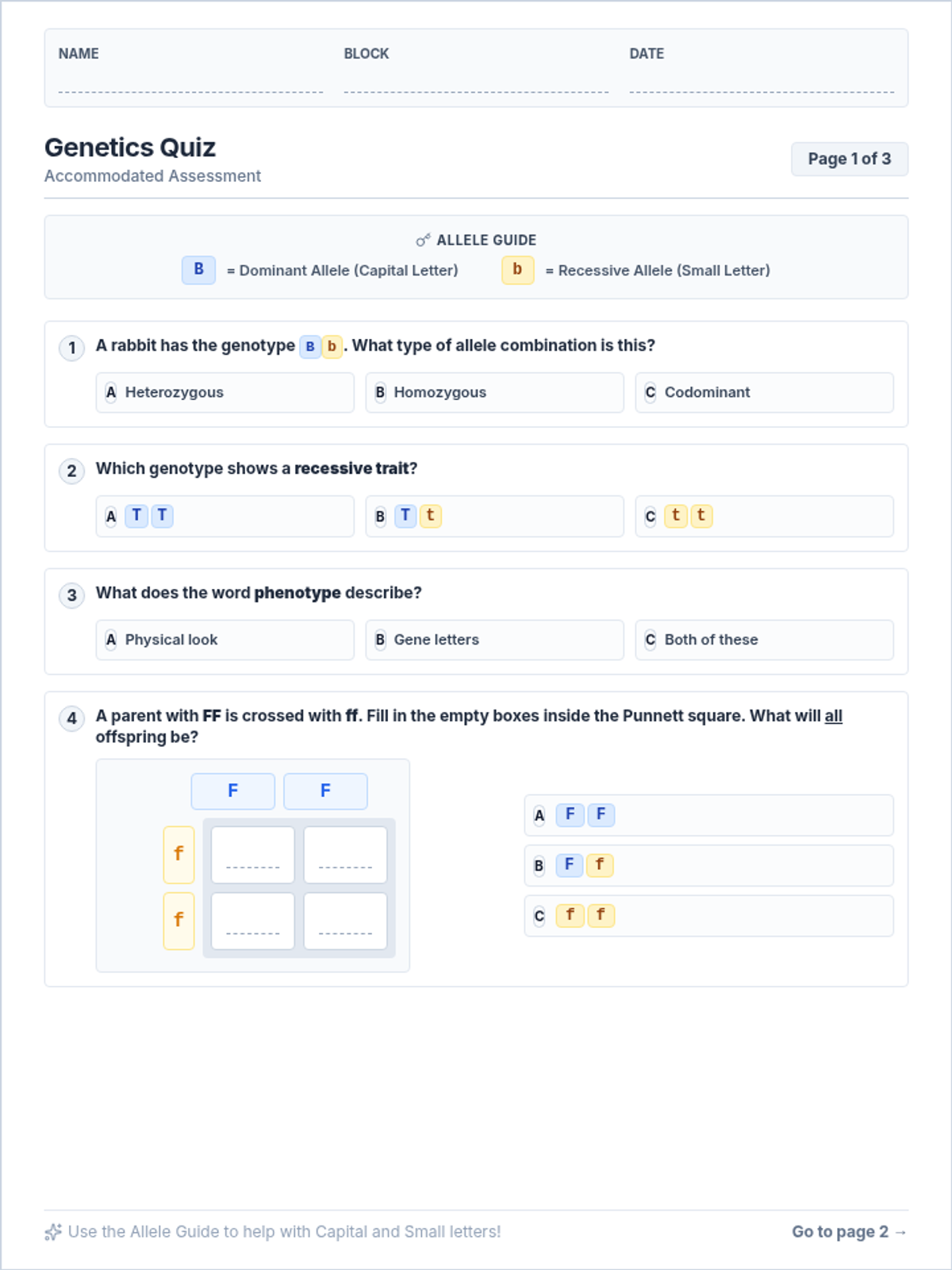
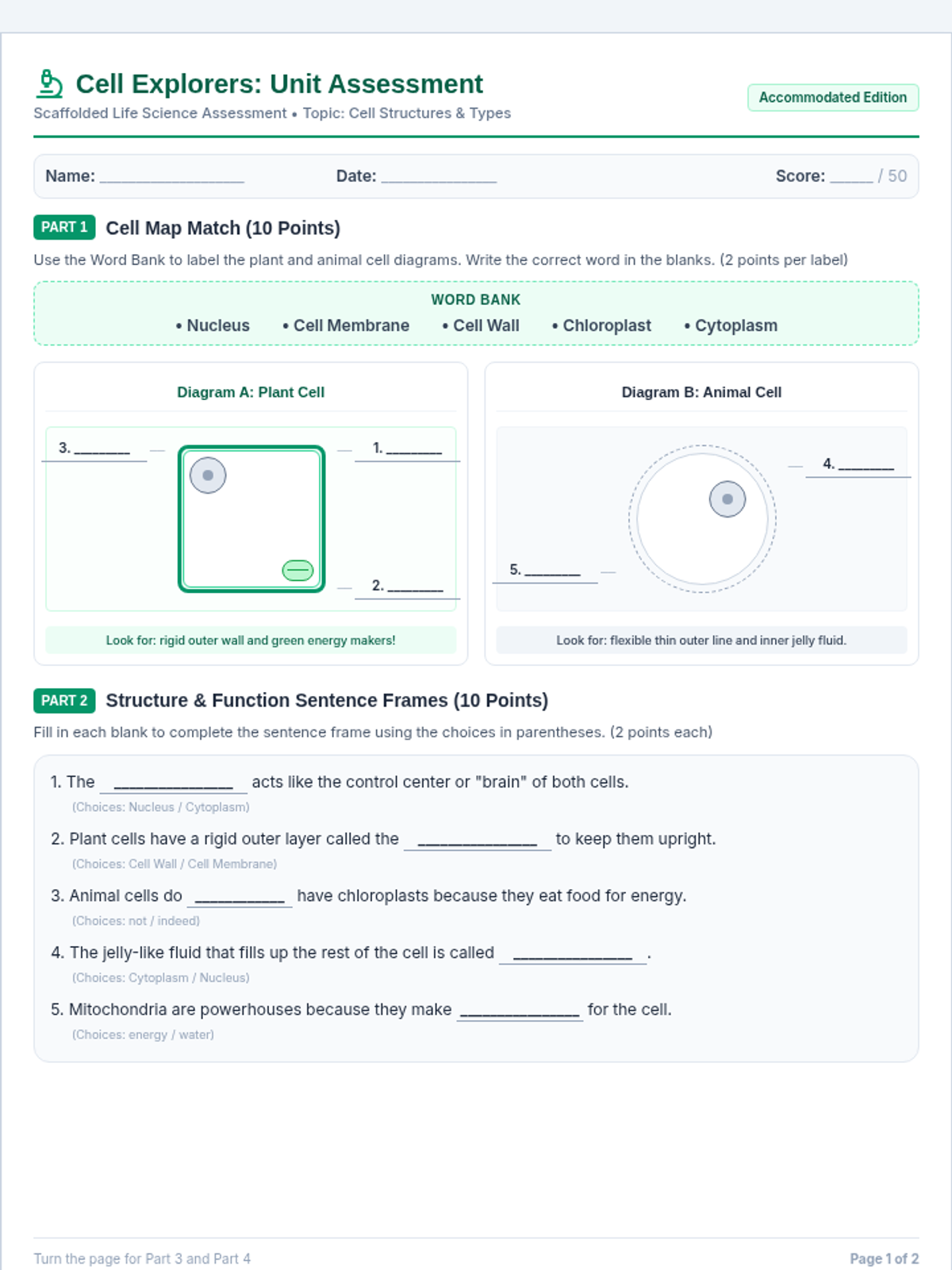
Atomic Alchemy Worksheet Advanced Particle Research Lab
Atomic Alchemy
Name:
Date:
Part 1: The Decay Dossier
Complete the table below based on the guided lecture slides. Define the particle, its notation, and its penetration power.
Type Particle Symbol Change in Mass Change in Z Penetration Alpha (α) Low (Paper) Beta (β) Gamma (γ)
Part 2: Balance the Reactions
Fill in the missing pieces for each nuclear reaction. Remember: the sum of mass numbers (top) and atomic numbers (bottom) must balance on both sides.
1. Alpha Decay of Radium-226
\( _{88}^{226}\text{Ra} \rightarrow \)
+ \( _{2}^{4}\alpha \)
2. Beta Decay of Iodine-131
\( _{53}^{131}\text{I} \rightarrow \) \( _{54}^{131}\text{Xe} + \)
3. Gamma Decay of Cobalt-60
\( _{27}^{60\text{m}}\text{Co} \rightarrow \)
+ \( \gamma \)
4. Mystery Decay of Thorium-234
\( _{90}^{234}\text{Th} \rightarrow \) \( _{91}^{234}\text{Pa} + \)
Part 3: Reaction Comparison
Fission
Description...
Real-world example...
Fusion
Description...
Real-world example...
Part 4: Half-Life Calculations
1. Phosphorus-32 has a half-life of 14.3 days. If you start with a 40.0g sample, how much will remain after 57.2 days?
Show Work Here:
Final Answer:
2. An unknown isotope decays from 200mg to 12.5mg in exactly 12 hours. What is the half-life of this isotope in hours?
Show Work Here:
Half-Life Value:
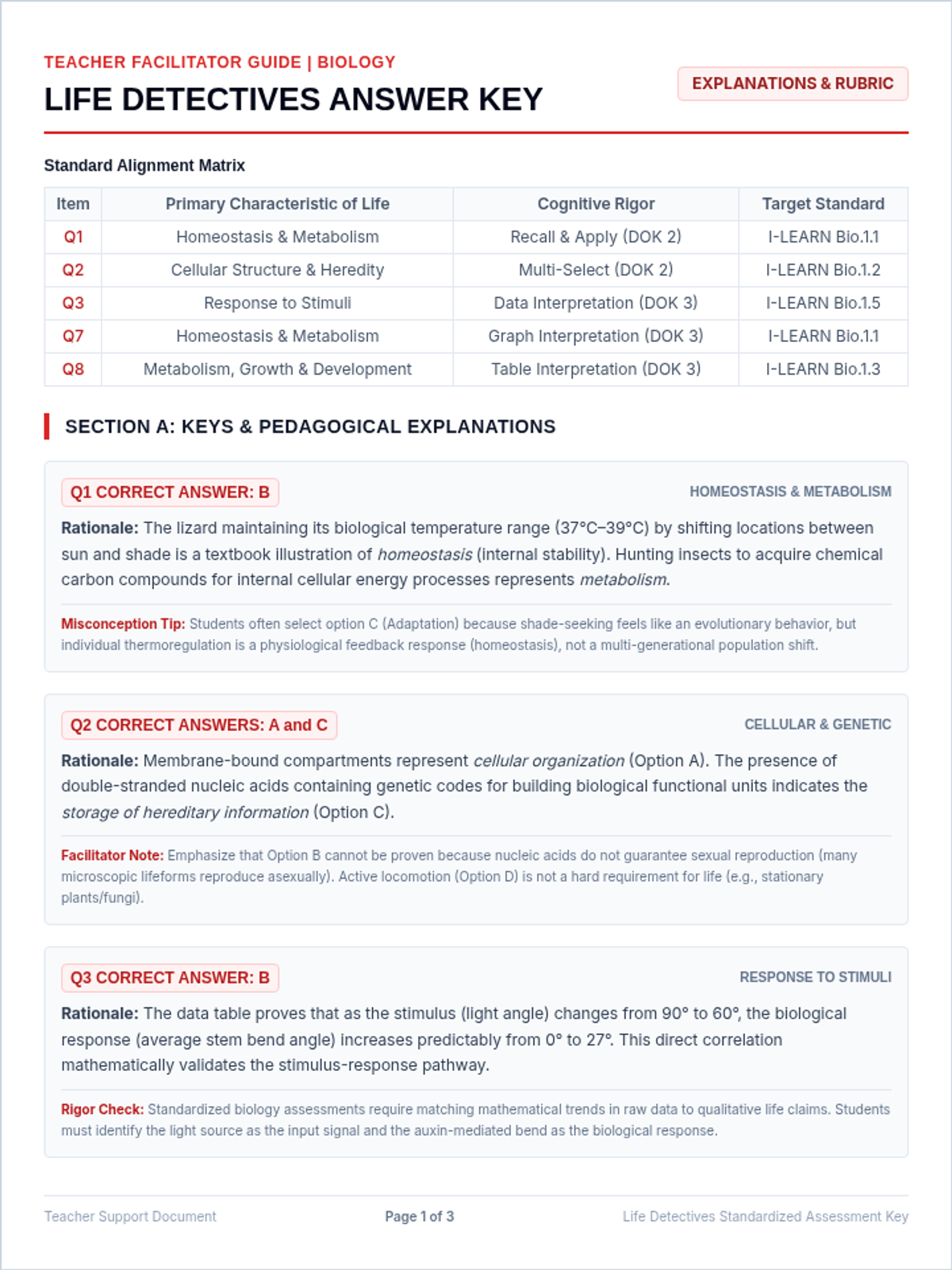
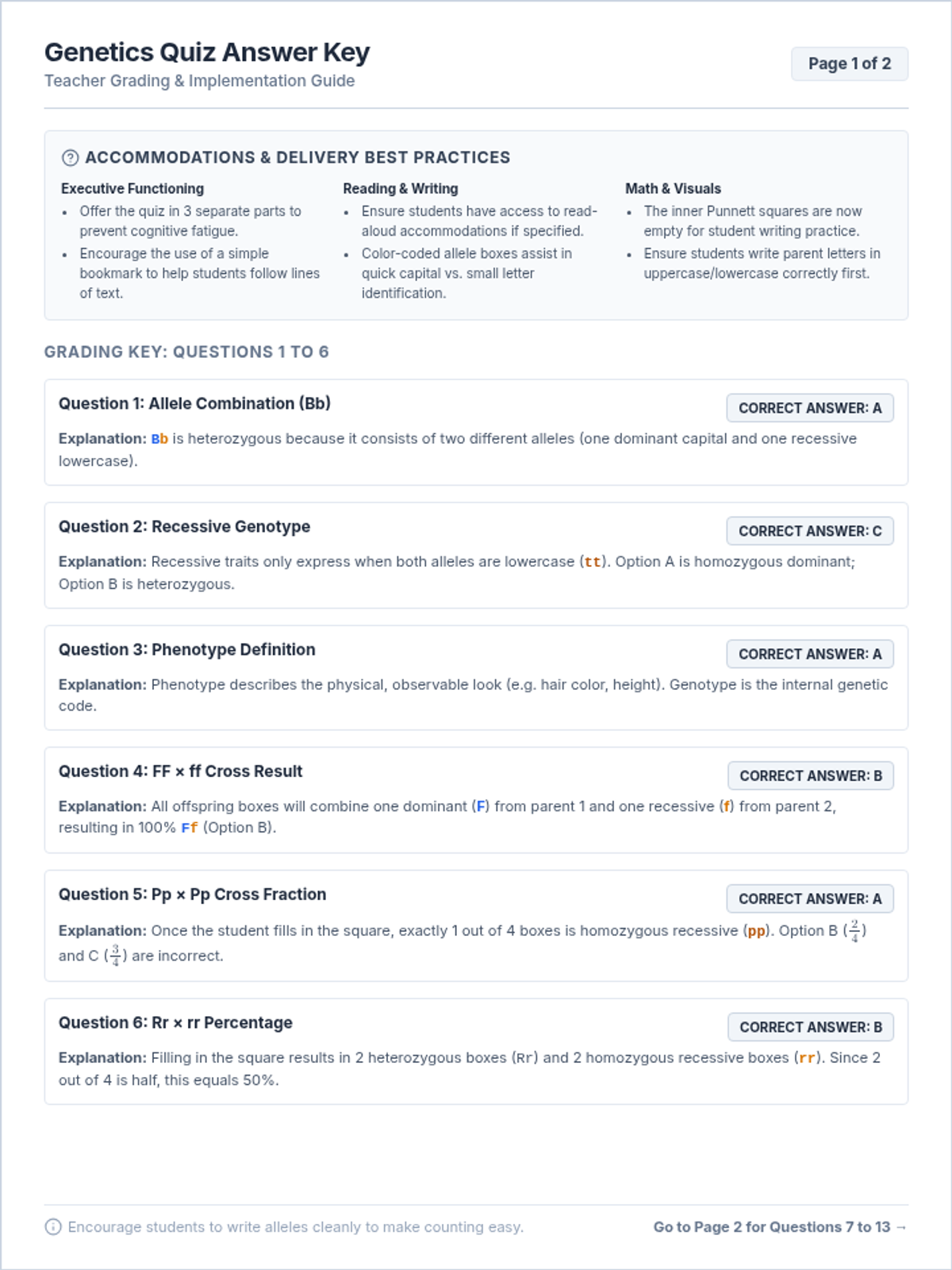
Atomic Alchemy Answer Key Teacher Resource Lab
Atomic Alchemy Key
Subject: Nuclear Chemistry
Answer Key Edition
Part 1: The Decay Dossier
Type Particle Symbol Change in Mass Change in Z Penetration Alpha (α) \(_{2}^{4}\text{He}\) or \(_{2}^{4}\alpha\) -4 -2 Low (Paper) Beta (β) \(_{-1}^{0}e\) or \(_{-1}^{0}\beta\) No change (0) +1 Medium (Aluminum) Gamma (γ) \(\gamma\) No change (0) No change (0) High (Lead/Concrete)
Part 2: Balance the Reactions
Alpha Decay of Ra-226
\( _{88}^{226}\text{Ra} \rightarrow \) \( _{86}^{222}\text{Rn} \) + \( _{2}^{4}\alpha \)
Beta Decay of I-131
\( _{53}^{131}\text{I} \rightarrow \) \( _{54}^{131}\text{Xe} + \) \( _{-1}^{0}\beta \)
Gamma Decay of Co-60
\( _{27}^{60\text{m}}\text{Co} \rightarrow \) \( _{27}^{60}\text{Co} \) + \( \gamma \)
Beta Decay of Th-234
\( _{90}^{234}\text{Th} \rightarrow \) \( _{91}^{234}\text{Pa} + \) \( _{-1}^{0}\beta \)
Part 3: Reaction Comparison
Fission
Splitting a heavy, unstable nucleus into two smaller ones. Induced by bombarding the nucleus with neutrons. Releases energy and more neutrons (chain reaction).
Nuclear power plants (Uranium-235), Atomic bombs.
Fusion
Combining two light nuclei (like Hydrogen) to form a heavier nucleus (Helium). Releases massive amounts of energy. Requires extreme heat/pressure.
The Sun, Stars, Hydrogen bombs.
Part 4: Half-Life Calculations
1. Phosphorus-32 problem
1. Find # of half-lives: 57.2 days / 14.3 days = 4
2. Cut initial amount in half 4 times:
40.0 → 20.0 (1) → 10.0 (2) → 5.0 (3) → 2.5 (4)
Final Answer:
2.5 g
2. Unknown isotope problem
1. Determine # of half-lives passed:
200 → 100 → 50 → 25 → 12.5 (4 half-lives)
2. Calculate time per half-life:
12 hours / 4 half-lives = 3 hours / half-life
Half-Life Value:
3 hours