Students will locate bold print words (law, government, respect) and use the text's glossary or captions to find their meanings.
• Introduce: "Welcome back, detectives! Today, we are using a powerful detective tool: Text Features. Nonfiction authors help us by making important words bold, coloring them, or listing them in a dictionary in the back of the book called a Glossary."
• Model: Open to page 12 of Being a Good Citizen. "I see a dark, heavy bold word here: law. I don't see a definition in this paragraph. But wait! Let me flip to the glossary in the back. Under 'L', I see: 'Law: a rule made by a government.' That was so easy! The glossary did the detective work for me."
Turn to page 14. Locate the bold word government. Model how to read the picture caption below it: "The government is the group of citizens who lead our city." Point out that picture captions are a wonderful text feature that explains nearby bold words. Write the definition of government on the board.
Distribute the Rule Makers Worksheet. Students analyze a mock page of a nonfiction text, locate bold words (law, government, respect), match them to their definitions using glossary cues, and answer feature-based questions.
Support: Provide a simplified glossary page matching just the three words.
Extend: Locate other bold words in class books and look them up.
Word Detectives Instructional Guide • Grade 2 ELA Page 2 of 5
DAY 3 OF 5
Lesson Focus: Matter Matters • Standard 2.RI.4 • Strategy: Sensory Adjectives
Target Words: matter, property, texture
HMH Anchor Text: Many Kinds of Matter
Strategy Focus: Adjectives & Examples
Students will determine the meaning of scientific terms (matter, property, texture) by looking for descriptive sensory adjectives and lists of examples in a scientific text.
• Introduce: "Today we shift our detective work to Science! Nonfiction science books are full of descriptive words like hard, soft, heavy, and wet. These sensory words are clues that explain a scientific word like property."
• Model: Open Many Kinds of Matter to page 3. "Let's read: 'Look around. Everything is made of matter. Rocks, water, and air are matter.' The author didn't give a formal dictionary definition, but gave us a list of examples: rocks, water, air. If these are all physical things around us, then matter must mean everything that makes up our physical world!"
Read aloud from page 6: "A physical property is how something looks, feels, smells, or tastes." Guide students to identify that a property is a describing feature. Point out adjectives on the page: "shiny metal coin", "rough wood block". "The words shiny and rough describe physical properties! Let's fill out the Matter property map together."
Distribute the Matter Matters Organizer. Students read a scientific paragraph about properties, identify sensory describing words, write down definitions based on examples, and sketch various properties (rough, smooth, hard).
Support: Provide physical objects (rock, sponge, balloon) for sensory matching.
Extend: List 5 properties of a school pencil.
Word Detectives Instructional Guide • Grade 2 ELA Page 3 of 5
DAY 4 OF 5
Lesson Focus: State Shifters & bull; Standard 2.RI.4 • Strategy: Cause & Effect Clues
Target Words: solid, liquid, gas, temperature
HMH Anchor Text: Many Kinds of Matter
Strategy Focus: Cause & Effect Context
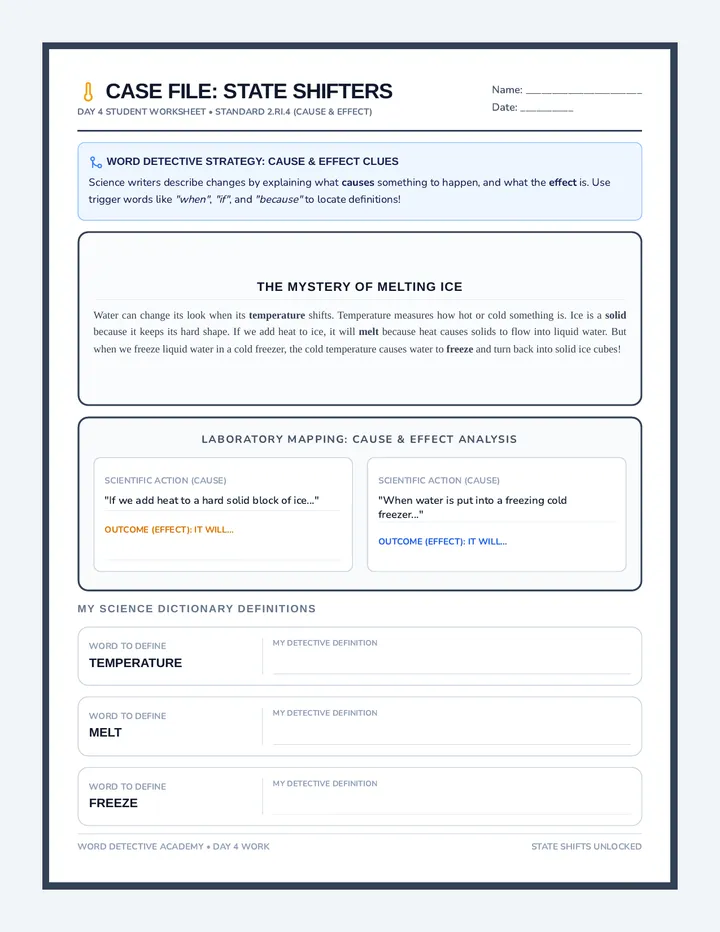
Students will use cause-and-effect clue words (e.g., "because", "so", "if... then") to define states of matter (solid, liquid, gas) and processes of temperature change.
• Introduce: "Hello, detectives! Today we are looking for a special kind of context clue: Cause and Effect. Authors show how one thing causes another using words like 'so', 'because', or 'when'. This tells us what words mean based on how they behave!"
• Model: Open Many Kinds of Matter to page 15. "Let's read: 'When heat is added, solids can melt into liquid.' See that clue? When heat is added is the cause, and solids melt into liquid is the effect. So 'melt' must mean to change from a solid to a liquid because of heat!"
Read from page 18: "If temperature goes below 32 degrees, water will freeze and turn solid." Ask: "What word tells us about hot and cold?" (temperature). "And what is the effect of the temperature getting very cold?" (it freezes/turns solid). Guide students to define temperature as the measurement of heat, and freeze as liquid turning solid.
Distribute the State Shifters Worksheet. Students analyze scientific sentences, match actions (cause) with outcomes (effect), and fill in a cause-and-effect graphic organizer that defines solid, liquid, melt, and freeze.
Support: Provide sentence frames: "When we freeze water, it becomes ______."
Extend: Explain how water shifts into a gas (steam) when boiled.
Word Detectives Instructional Guide • Grade 2 ELA Page 4 of 5
DAY 5 OF 5
Lesson Focus: Matter Mixers • Standard 2.RI.4 • Strategy: Word Parts & Review
Target Words: mix, dissolve, reversible, irreversible
HMH Anchor Text: Many Kinds of Matter
Strategy Focus: Word Parts (Prefixes/Suffixes)
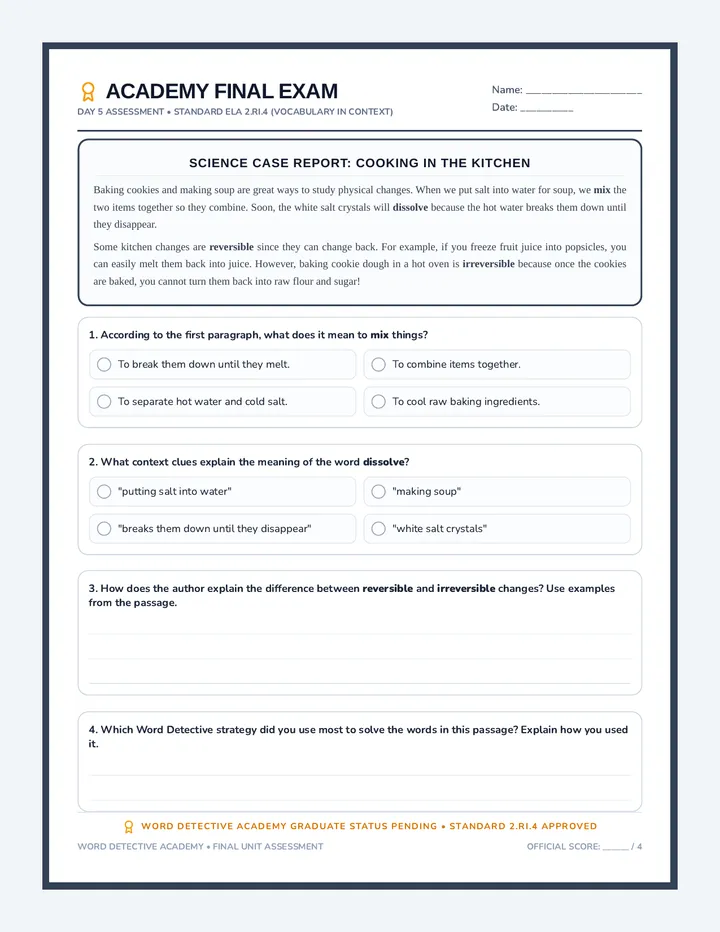
Students will apply word parts (prefixes like ir- and suffixes like -able) to determine scientific word meanings and complete a cumulative standard ELA assessment.
• Introduce: "Final day at the Academy, detectives! Today, we look at **Word Parts**. Prefixes go at the beginning of words, and suffixes go at the end. Breaking long words into parts helps us unlock their hidden codes!"
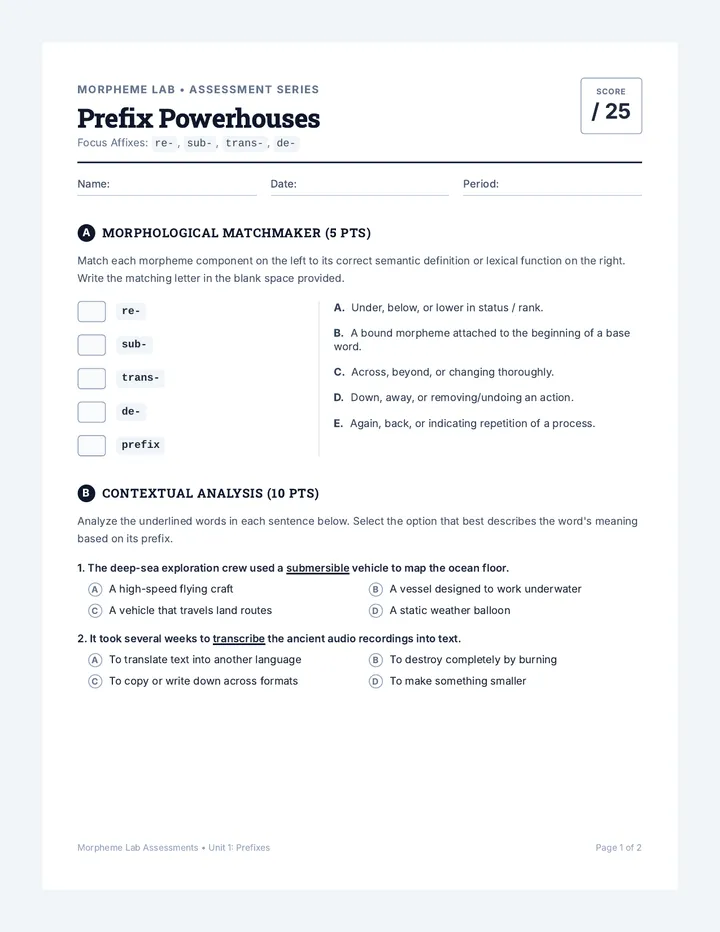
• Model: Open Many Kinds of Matter to page 22. Write reversible on the board. "Let's break this down: reverse means to turn back. -able means able to be. So reversible means able to be turned back! Now look at irreversible. The prefix ir- means NOT. So irreversible means NOT able to be turned back!"
Review the vocabulary card match from Day 1. Guide students through a whole-class review challenge. Give scenarios: "If I bake a cake, can I un-bake it?" (No, irreversible!). "If I fold a sheet of paper, can I unfold it?" (Yes, reversible!). Emphasize how word parts help us identify correct terms.
Distribute the **Matter Mixers Assessment**. This is an independent, graded assessment containing a short science reading passage integrated with standard 2.RI.4 questions. Instruct students to show their strategy markings (underlining clues).
Support: Read the assessment text and questions aloud to selected students.
Extend: Write a mini-paragraph explaining a scientific change.
Word Detectives Instructional Guide • Grade 2 ELA Page 5 of 5
Day 3: Matter Matters Strategy 3: Adjectives & Examples
In science, words are explained using sensory describing words (adjectives) or lists of clear examples!
Descriptive Adjectives:
Words like shiny, rough, smooth, sticky help us decode properties!
Matter Examples
Everything around you is matter! For example:
• Solid: Wooden Blocks, Hard Rocks
• Liquid: Wet Water, Cold Milk
• Gas: Invisible Air, Steam
Let's look at the science of properties next!
Day 3: Case Challenge Word: Property
Science Lab Report Case #SCI-03
"Each object has its own physical property. A rock's texture is rough, an apple is red and sweet, and a metal key is hard."
Adjectives (Clues) Found:
"rough", "red", "sweet", "hard"
What does 'Property' mean?
A special feature that describes how something looks, feels, or smells!
Excellent work! We successfully decoded scientific properties.
Day 4: State Shifters Strategy 4: Cause & Effect Clues
Scientific changes are explained through cause and effect. Words like when, because, and if tell you the action that caused a state shift!
States of Matter Shifting:
Temperature shifts cause matter to change from solid to liquid, or liquid to solid.
Cause and Effect Model
Cause: Adding high heat to an solid chocolate bar...
Effect: The chocolate bar will melt and become a soft liquid!
Let's test this strategy out right now!
Day 4: Case Challenge Word: Freeze
Cause & Effect Science Report Case #SCI-04
"When water drops below a freezing 32-degree temperature, it will freeze and become solid ice cubes."
What is the CAUSE?
Water drops below 32 degrees cold.
What is the EFFECT?
The liquid turns into solid ice cubes (freezes)!
Fantastic! You are reading like true science researchers!
Day 5: Academy Graduation Standard 2.RI.4 Complete
You have successfully trained your eyes to solve complex words using Context Clues, Picture Power, Text Features, and Word Parts!
Now, complete your final Case Report Assessment!
Go ahead and show what you have learned today!