Tools of the Trade Slides Dino Diggers: Lesson 1
Explorer Academy
Tools of the Trade
Step into the boots of a paleontologist! Today, we will learn how to use explorer tools and talk about our big discoveries.
Let's learn together as a team!
Explorer Vocabulary
Goal: Say these 4 words!
shovel
To dig up dirt and hard rocks.
/shov-el/
brush
To clean dust off fragile bones.
/bruh-sh/
pick
To break apart heavy, tough stone.
/pih-k/
lens
To look closely at tiny cracks.
/leh-nz/
Practice saying them out loud!
Let's Talk: Heavy Digging
Sentence Frame 1
Speaking Frame
"I can use a ______ to dig in the dirt."
Try it with your partner!
Stand tall like an explorer.
Use a clear, loud voice.
Which tool fits the frame?
A: shovel
B: lens
Say the completed sentence to your teammate!
Sentence Frame Practice
Let's Talk: Finding Details
Sentence Frame 2
Speaking Frame
"I can use a ______ to clean dust off the bone."
Keep the fossils safe!
Fossils are old and can crack easily. Choose the tool that brushes very softly.
Which tool fits the frame?
A: pick
B: brush
Tell your partner why you chose this tool!
Sentence Frame Practice
Partner Quest: Dig Site Challenge
Roleplay Time
Explorer A: The Discoverer
You just found a dinosaur fossil covered in sticky mud! Tell your partner:
"I see a fossil! I can use a ______ to get it out."
Explorer B: The Assistant
The fossil is safely out, but it's very dusty and has tiny cracks! Tell your partner:
"Great job! I can use a ______ to study the cracks."
Good job, Paleontologists! Let's work on our journals.
Explorer Tools Journal Lesson 1 Journal
Dino Digger Journal
Fossil Academy
Name:
Date:
1 Tool Match: Draw a line from the tool to its name!
We use this to scoop dirt
We use this to dust bones
We use this to chip hard stone
We use this to see closely
brush
lens
shovel
pick
2 Fill in the Blanks!
Word Bank: shovel / lens / brush
1. To look closely at a small fossil, I can use a:
"I can use a to look close."
2. To clear delicate dust off a fossil bone, I can use a:
"I can use a to brush dirt."
3 Draw a tool in action!
Draw yourself digging, brushing, or analyzing a dinosaur bone at your dig site.
I can identify paleontologist tools and talk about how to use them!
Great! Practicing
The Big Dig Slides Dino Diggers: Lesson 2
Phonics & Reading Adventure
The Big Dig
Let's decode short words, read an exciting story about a fossil discovery, and learn opposites to describe our bones!
Let's dig into phonics!
Phonics Sandbox
Skill: Tap and Blend CVC Words!
Action 1
d i g
dig
"We dig deep!"
Action 2
m u d
mud
"Wet, brown dirt."
Action 3
w e t
wet
"Rain makes it wet."
Tap the sounds with your fingers!
Let's Read: The Big Mud Dig
Choral Reading Time!
Tim can dig. The mud is wet. Look! A big, big bone! Is it a dog bone? No, it is not!
Reader Hunt
Find and read the word wet. What character is digging in the wet mud?
Sight Word Alert!
Can you spot high-frequency sight words: is, the, it?
Try reading it in a silly dinosaur voice next!
Describing Our Discoveries
Skill: Describing Opposites
Size
big
vs
small
"This is a big bone!"
Length
long
vs
short
"This rib bone is long!"
Texture
sharp
vs
flat
"This tooth bone is sharp!"
Use your hands to act out "big" and "small"!
Fossil Finder Log Lesson 2 Log
Fossil Finder Log
Fossil Academy
Name:
Date:
1 Read the Dig Site Story!
Read this story three times. Point to each word as you read!
Tim can dig.
Reading Tracker:
1
2
3
2 Word Builder: Break down and write the CVC words!
sound blocks
d + i + g
sound blocks
m + u + d
sound blocks
w + e + t
3 Describing Opposites: Draw a line to the opposite!
Discovery Word
big
long
sharp
Opposite Word
flat
small
short
4 True or False? Check the box!
1. Tim digs in wet mud.
Yes
No
2. Tim finds a small bone.
Yes
No
I can decode short CVC words and read a simple story about bones!
Great! Practicing
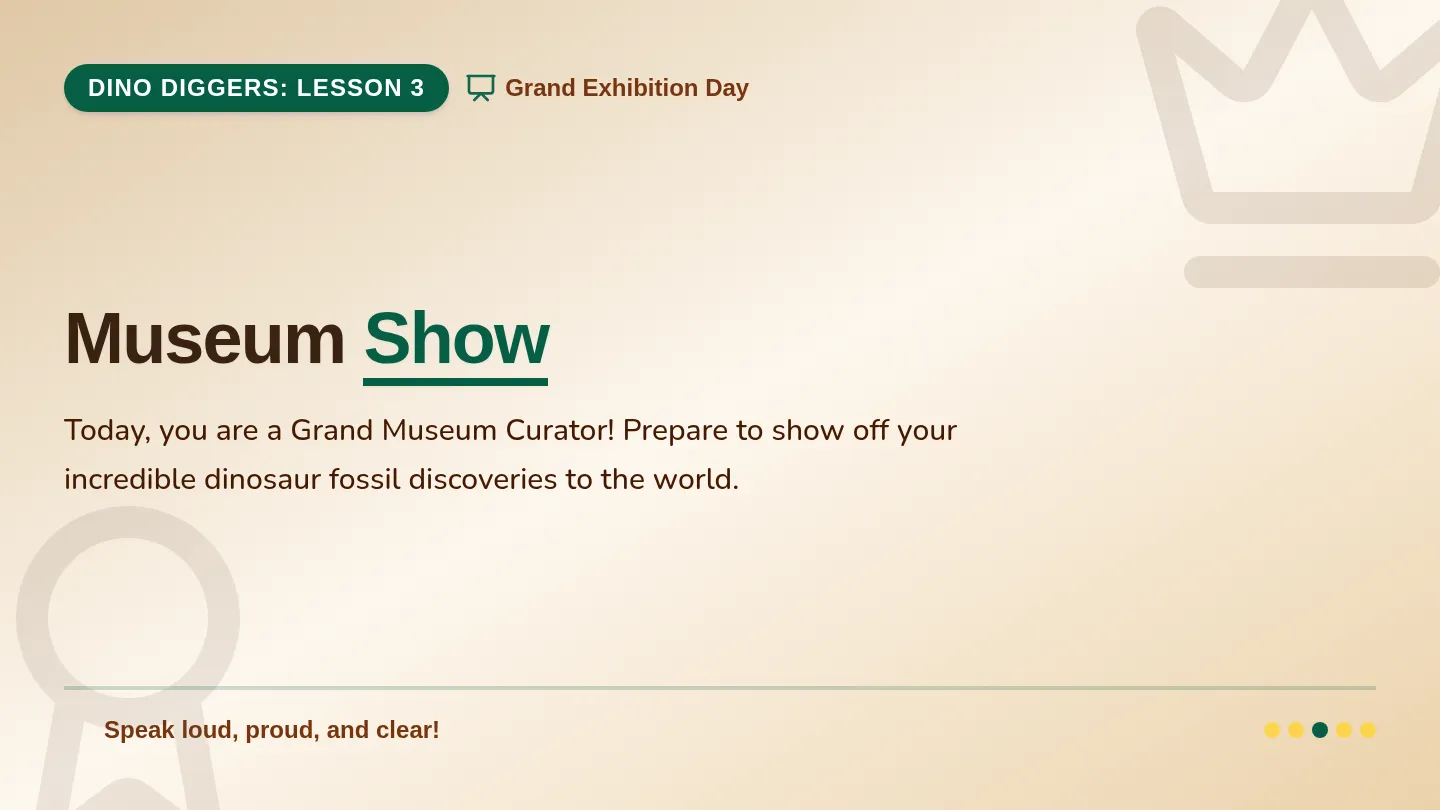
Museum Show Slides Dino Diggers: Lesson 3
Grand Exhibition Day
Museum Show
Today, you are a Grand Museum Curator! Prepare to show off your incredible dinosaur fossil discoveries to the world.
Speak loud, proud, and clear!
Meet the Curator
Curator /Coo-ray-tor/
What does a Curator do?
A curator is a fossil expert who looks after precious dinosaur bones and shares exciting secrets with visitors who visit the museum!
"Welcome, museum visitors! Follow me to see our newest, oldest fossil bones!"
Your Curator Duties
Label your fossils correctly.
Stand proudly next to your stage.
Answer curious visitor questions.
Welcome to Fossil Academy Museum!
Curator Speaking Frame
Present Like a Pro!
Speak this card:
"Hello! My name is
Word Bank Helpers
Sizes
big / small / long
Textures
sharp / flat / hard
Practice telling a friend nearby before presenting to the whole class!
Speak clearly so the audience can hear you!
Speaking Secrets
Body Language Checklist
1. Stand Tall
Keep your shoulders back and plants your feet firmly.
2. Look & Connect
Look at your wonderful friends when you speak!
3. Speak Loud
Use a strong, warm voice so everyone can hear.
Practice makes us confident superstars!
Curator Exhibition Card Lesson 3 Exhibition
Curator Exhibition Card
Fossil Museum
Name:
Date:
1 My Curator Speech Card
Fill in the blanks. You will read this card out loud to your visitors!
"Hello! My name is Curator ."
"Welcome to my fossil exhibition. Look at this bone!"
"It is a bone. (Examples: big, small, long, short)"
"And it is very ! (Examples: sharp, flat, hard)"
2 Draw your fossil bone to showcase!
Draw the fossil bone that you are describing in your speech. Make it look grand!
3 Active Listening: Peer Checklist!
I was a polite visitor:
I listened quietly
I clapped at the end
My partner presented well:
They stood tall
They spoke loud & clear
Teacher Assessment Rubric (Speaking & Vocabulary)
1. Pronunciation
2. Vocabulary Use
3. Body Language
I can prepare a formal speech and present like a confident museum curator!
Completed