Sound Steps Goal Bank
Sound Steps Goal Bank
Early Elementary Phonics & Phonemic Awareness Instructional Plan
Grades K–1 • Tier 1 / 2 / IEP
Foundational Sound Awareness
SMART Objective Blueprint: Every goal includes Condition (verbal prompt/visual), Learner Action, Performance Criteria (accuracy & speed), and Evaluation Method across 3 consecutive data probes.
Domain 1
Phonological & Phonemic Awareness (Oral & Auditory)
1
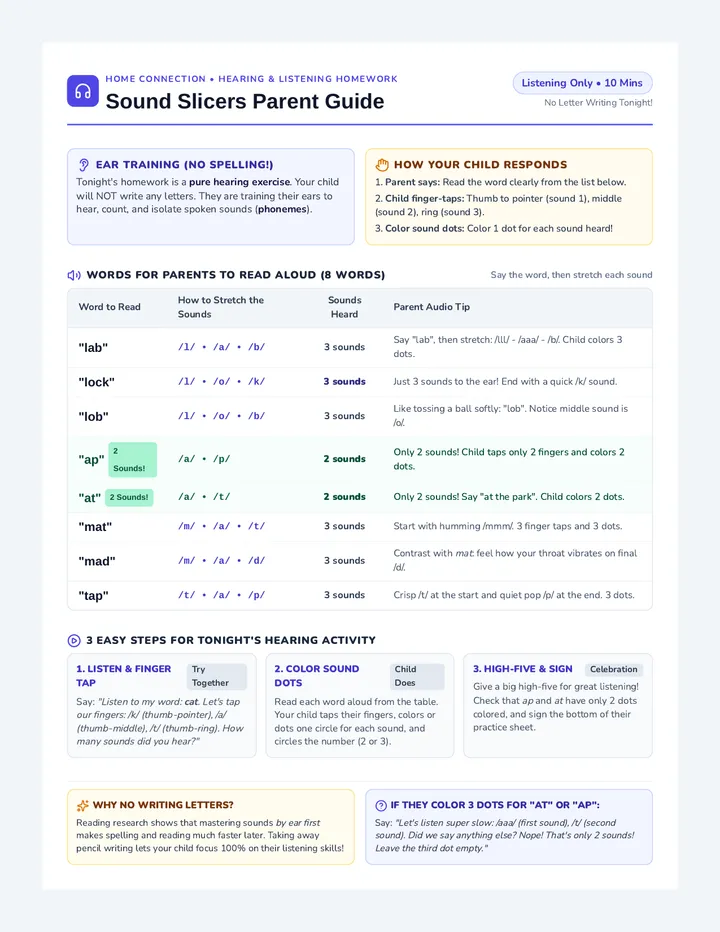
Phoneme Isolation in Spoken Monosyllabic Words
Standard: CCSS RF.K.2.D
Annual Goal Statement: Given 10 spoken monosyllabic CVC words presented orally by an educator, the student will correctly isolate and identify the target sound (initial, final, or medial) with at least 85% accuracy across 3 consecutive weekly assessment sessions.
Benchmark 1.1
Isolate initial phonemes in spoken CVC words with 80% accuracy (e.g., /m/ in mat).
Benchmark 1.2
Isolate final consonant phonemes in spoken CVC words with 80% accuracy (e.g., /t/ in cat).
Benchmark 1.3
Isolate and identify medial short vowels in spoken CVC words with 85% accuracy (e.g., /a/ in map).
2
Phonemic Blending & Segmentation
Standard: CCSS RF.K.2.C / RF.1.2.D
Annual Goal Statement: When presented with 10 orally segmented individual phonemes, the student will orally blend the sounds to pronounce the whole word, and conversely orally segment a spoken word into its constituent phonemes, achieving 90% accuracy (9/10 trials) across 4 consecutive progress probes.
Benchmark 2.1
Blend 2–3 spoken phonemes into whole words using Elkonin sound boxes (e.g., /s/-/u/-/n/ → sun).
Benchmark 2.2
Orally segment 3-phoneme spoken words into discrete sounds with 85% accuracy (e.g., fish → /f/-/i/-/sh/).
Benchmark 2.3
Segment 4-sound spoken words containing initial or final blends (e.g., clap → /k/-/l/-/a/-/p/) with 80% accuracy.
3
Phoneme Addition, Deletion & Substitution
Standard: CCSS RF.K.2.E / RF.1.2
Annual Goal Statement: Given a spoken one-syllable word and an auditory prompt to add, delete, or substitute an individual phoneme, the student will verbally produce the newly formed word with 80% accuracy across 3 consecutive trial sets.
Benchmark 3.1
Deletion: Delete initial sound (e.g., park without /p/ is ark) with 80% accuracy.
Benchmark 3.2
Addition: Add initial sound to a base (e.g., add /s/ to top = stop) with 80% accuracy.
Benchmark 3.3
Substitution: Change initial/vowel sound (e.g., change /h/ in hat to /c/ = cat) at 85% accuracy.
Instructional Plan Tool • Early Literacy Progression Page 1 of 2 • Foundational Sound Awareness
Beginning Decoding Goals
Print Correspondence & Word Recognition Objectives
Print Application
Grapheme-Phoneme Mastery
Domain 2
Grapheme-Phoneme Correspondence & Word Decoding
4
Letter-Sound Automaticity (Consonants & Short Vowels)
Standard: CCSS RF.K.3.A
Annual Goal Statement: Presented with an un-timed flashcard display of all 26 lowercase and uppercase letters in random order, the student will articulate the primary phoneme for each letter at a rate of at least 35+ correct letter sounds per minute with 95% accuracy on 3 bi-weekly probes.
Benchmark 4.1
Name sounds of 15 high-frequency consonants (m, s, t, b, etc.) at 90% accuracy.
Benchmark 4.2
Produce all 5 short vowel sounds (/ă/, /ĕ/, /ĭ/, /ŏ/, /ŭ/) consistently with 90% accuracy.
Benchmark 4.3
Automatic retrieval of all 26 grapheme-phoneme pairs with < 2-second latency.
5
Decoding Regular CVC Words & Nonsense Words
Standard: CCSS RF.K.3.B / RF.1.3.B
Annual Goal Statement: Given a printed list of 20 decodable CVC words (including real and pseudo/nonsense words), the student will accurately apply continuous blending techniques to read words aloud with 85% accuracy and a minimum of 30 Whole Words Read (WWR) per minute.
Benchmark 5.1
Decode short a and i CVC words in isolation with 80% accuracy (e.g., sat, pin).
Benchmark 5.2
Read 15 mixed-vowel CVC nonsense words (e.g., zut, fop) demonstrating true decoding.
Benchmark 5.3
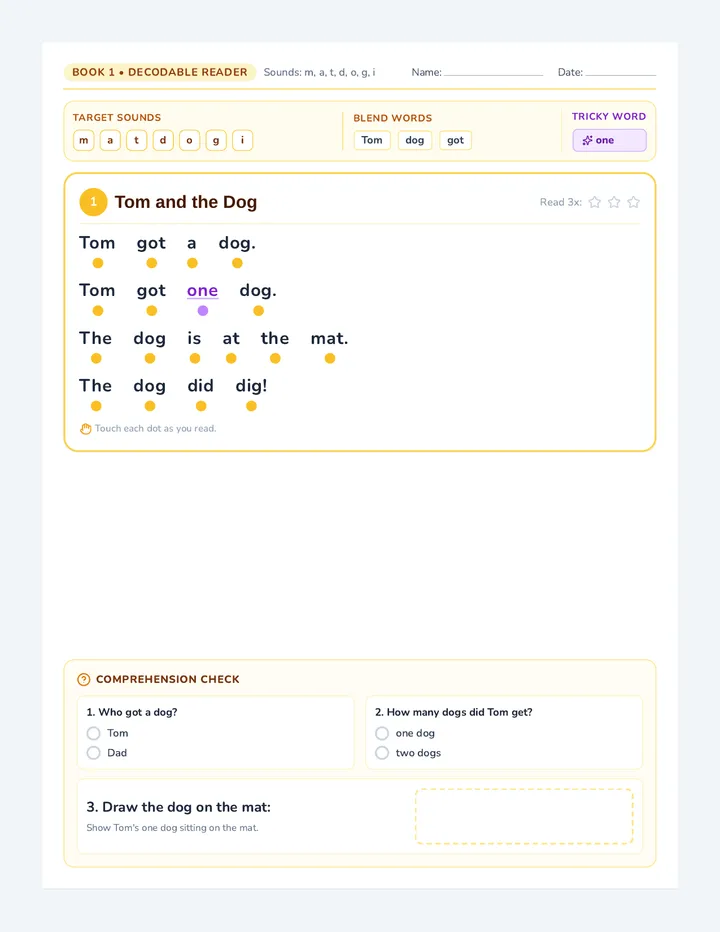
Read connected decodable sentences containing CVC words with 90% accuracy.
6
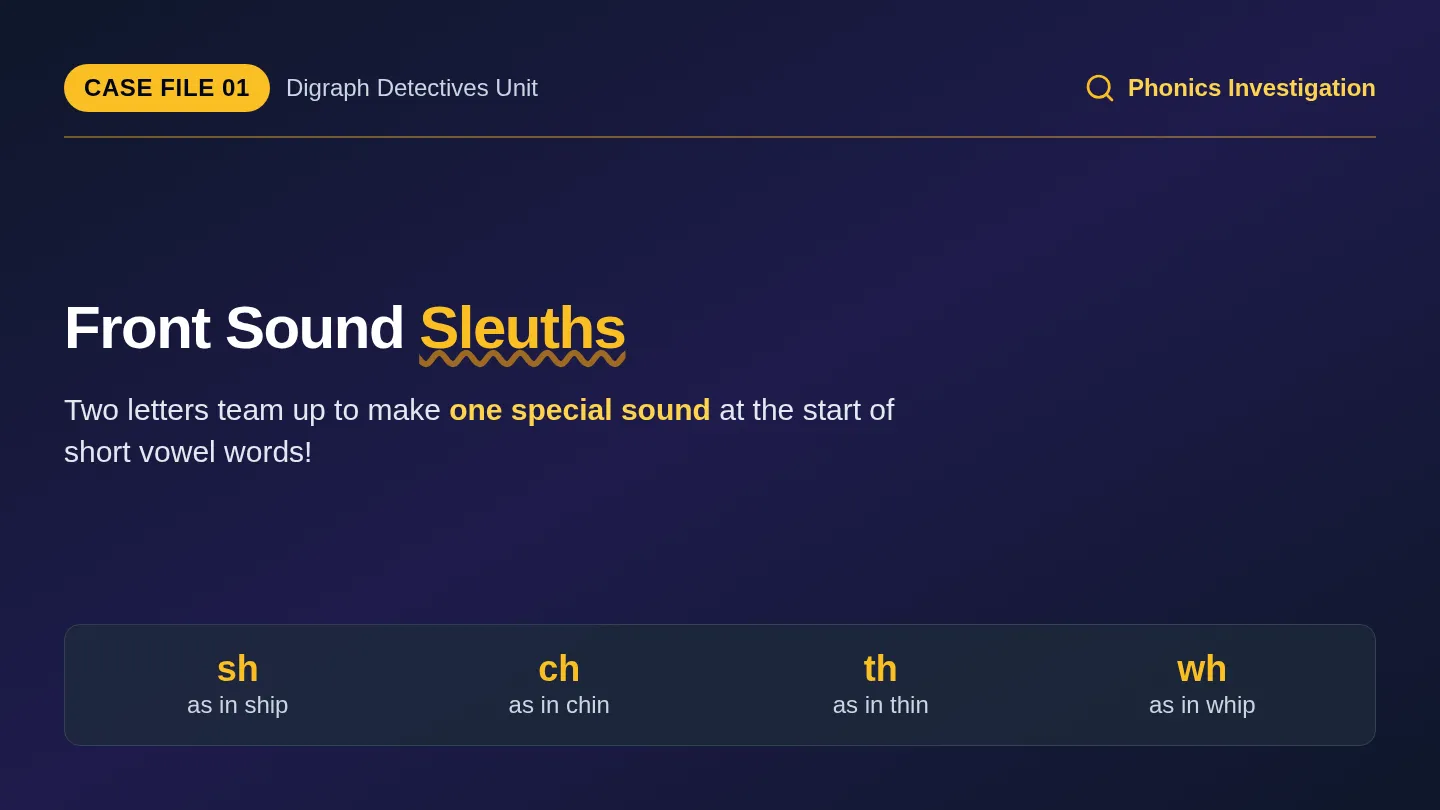
Consonant Digraphs & Initial/Final Blends
Standard: CCSS RF.1.3.A
Annual Goal Statement: Given a printed list of 15 words containing common consonant digraphs (sh, ch, th, wh, ck) and initial/final consonant blends (CCVC/CVCC), the student will accurately decode words with at least 80% accuracy across 3 out of 4 trials.
Benchmark 6.1 (Digraphs)
Decode words with sh, ch, th, ck in initial/final positions with 85% accuracy (e.g., ship, much, thick, duck).
Benchmark 6.2 (Blends)
Decode CCVC/CVCC words with l-blends, s-blends, and r-blends with 80% accuracy (e.g., flag, stop, jump).
Recommended Progress Monitoring Protocol
Science of Reading Aligned
Frequency
Bi-weekly (Tier 2) or weekly (Tier 3/IEP) 1-minute probes.
Assessment Tools
DIBELS 8th, Acadience, or decodable word inventory.
Mastery Rule
≥ 85% accuracy across 3 consecutive weekly data points.
Decision Rule
4 data points below aim line triggers instruction change.
Instructional Plan Tool • Early Literacy Progression Page 2 of 2 • Beginning Decoding & Print Correspondence