Paragraph Builder Baseline Assessment
Baseline Assessment Expository Writing • 3–4 Paragraphs
Page 1 of 5
Expository Writing Baseline Packet
Student:
Date:
Format: Handwritten Typed Speech-to-Text
1
Step 1: Choose Your Topic (Select One)
Pick a topic you know well and can explain easily
Option A: Amazing Animal
Explain how an animal survives, its special features, and why it is unique.
Option B: Favorite Sport or Game
Explain the rules, skills needed to succeed, and why people enjoy it.
Option C: A Special Place to Visit
Explain what makes this park, town, or place unique and exciting.
Option D: My Choice Topic
2
Step 2: Linear Planning Organizer (Paragraphs 1 & 2)
Target: Topic Sentence + 2 Details + Sub-Details + Conclusion
PARAGRAPH 1: Introduction & Topic Overview Hook • Main Idea • Preview
Topic Sentence:
• Detail 1 (Main Point):
↳ Sub-Detail (Fact/Why):
• Detail 2 (Next Point):
↳ Sub-Detail (Fact/Why):
Closing Sentence:
PARAGRAPH 2: First Key Subtopic Focus Focused Idea • Evidence • Explanation
Subtopic Sentence:
• Detail 1 (Example):
↳ Sub-Detail (Deep Dive):
• Detail 2 (Example):
↳ Sub-Detail (Deep Dive):
Wrap-up/Transition:
Objective 1: Linear Graphic Organizer (Boxes & Bullets Planning) Turn to Page 2 to organize Paragraphs 3 & 4 ➔
2
Linear Planning Organizer (Paragraphs 3 & 4)
Page 2 of 5
PARAGRAPH 3: Second Key Subtopic Focus New Angle • Supporting Facts • Expansion
Subtopic Sentence:
• Detail 1 (New Point):
↳ Sub-Detail (Why/Example):
• Detail 2 (New Point):
↳ Sub-Detail (Why/Example):
Wrap-up/Transition:
PARAGRAPH 4: Concluding Paragraph Restate Big Idea • Summary • Final Clincher
Restated Main Idea:
• Summary Point 1:
↳ Sub-Detail (Impact):
• Summary Point 2:
↳ Sub-Detail (Impact):
Final Strong Thought:
3
Writer's Toolbox: Transition Words & Starters
Use these words to link your thoughts smoothly
To Introduce & Order
- • To begin with,...
- • First of all,...
- • One key fact is...
- • Initially,...
- • Most importantly,...
To Add Details & Sub-Details
- • In addition,...
- • For example,...
- • Specifically,...
- • Another reason is...
- • Because of this,...
To Conclude & Wrap Up
- • In conclusion,...
- • Clearly,...
- • As you can see,...
- • Ultimately,...
- • All in all,...
Objective 2: Transition Words & Paragraph Hierarchy Support Turn to Page 3 to draft Paragraphs 1 & 2 ➔
4
Step 4: Writing Draft • Paragraphs 1 & 2
Page 3 of 5
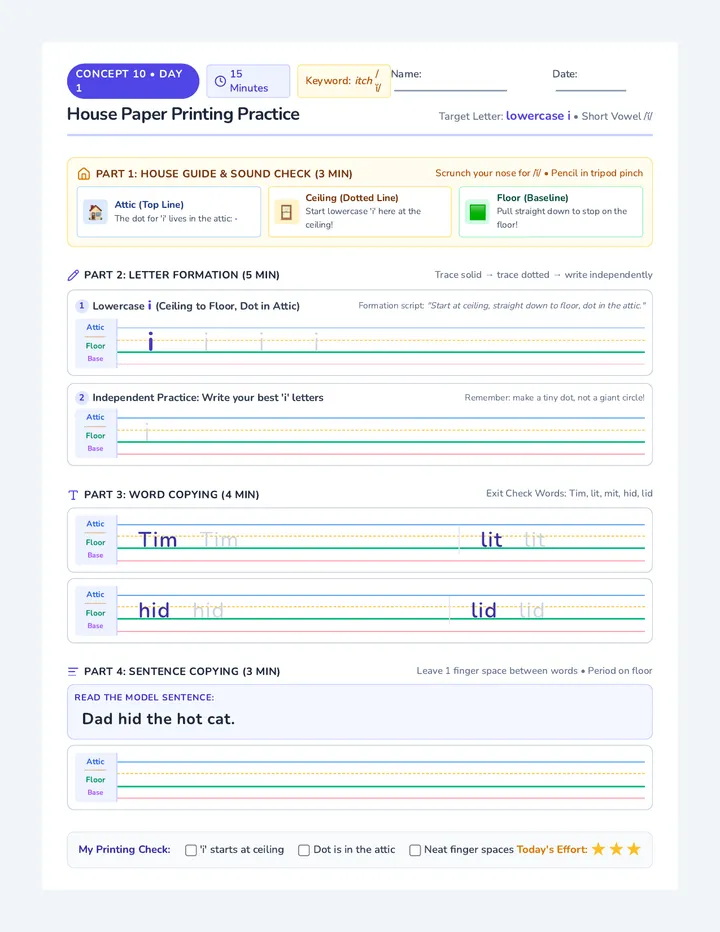
Writing Guides: Indent first line Two-finger space 5+ complete sentences
Letter Height: b d t (tall) | a c e (small) | g p y (tail)
Paragraph 1: Introduction & Topic Overview
[ ] Topic Sentence [ ] 2 Details + Sub-details [ ] Conclusion
indent ➔
Paragraph 2: First Key Subtopic Focus
[ ] Subtopic Sentence [ ] 2 Details + Sub-details [ ] Wrap-up
indent ➔
Objective 2 & 3: Combining topic sentences, details, sub-details, and transitions Turn to Page 4 to draft Paragraphs 3 & 4 ➔
4
Step 4 (Continued): Writing Draft • Paragraphs 3 & 4
Page 4 of 5
Transition Cue: Connect ideas smoothly using transition words (e.g., In addition, Specifically, Ultimately).
Aim for 5+ complete sentences
Paragraph 3: Second Key Subtopic Focus
[ ] Subtopic Sentence [ ] 2 Details + Sub-details [ ] Wrap-up
indent ➔
Paragraph 4: Concluding Paragraph
[ ] Restate Main Idea [ ] 2 Summaries + Sub-details [ ] Clincher
indent ➔
Complete Multi-Paragraph Expository Draft Turn to Page 5 for One-Skill-at-a-Time Editing & Scoring ➔
5
Step 5: Revise, Edit & Baseline Progress Tracker
Page 5 of 5
Objective 4 Strategy
One-Skill-at-a-Time Editing Passes
Goal: 3 or fewer errors per paragraph
C Pass 1: Capitalization Read 1st time
Check ONLY the first letter of each sentence, the word "I", and proper names.
Every sentence begins with a capital letter. Proper names and the pronoun "I" are capitalized.
P Pass 2: Punctuation Read 2nd time
Check ONLY the end of sentences and commas after transition words.
Every sentence ends with a period, exclamation, or question mark. Commas are placed after opening transition words.
S Pass 3: Spelling & Word Check Read 3rd time
Use spell-check, dictionary, or adult prompt to review tricky words.
High-frequency words and vocabulary are spelled correctly. Digital spell check or reference list was consulted.
S Pass 4: Sentence Structure Read 4th time
Read aloud or use speech-to-text to hear if every sentence is a complete thought.
Each sentence has a subject and a predicate (no fragments). Ideas flow clearly with no run-on sentences.
Educator Section
IEP Baseline Data & Scoring Rubric
Record baseline quantitative metrics
| IEP Target | Required Elements | Baseline Score | Status |
|---|
| Obj. 1: Organizer | Linear frame completed with topic, details, sub-details, and conclusions | ______ / 4 paras | [ ] Met [ ] Emerging |
| Obj. 2: Structure | Combines topic sentences, 2-3 details, 1-2 sub-details, transitions, conclusions | ______ / 4 paras | [ ] Met [ ] Emerging |
| Obj. 3: Length | Complete paragraph with at least 5 sentences using accommodations | ______ / 4 paras | [ ] Met [ ] Emerging |
| Obj. 4: Editing | Averages 3 errors or fewer per paragraph (Spelling, Capitalization, Punctuation, Structure) | Avg: _____ err/para | [ ] ≤3 err [ ] >3 err |
Accommodations Implemented During Baseline:
Double-lined paper Speech-to-text / Scribe Chunked / Breaks Sentence starters Word spacing tool Separate quiet setting
Teacher Baseline Notes & Observations:
Evaluator Signature: ___________________ Date: ____________
Baseline Assessment Protocol • Retain in Student IEP Assessment Folder Baseline Assessment Complete