Stated Signals Slides Day 1 Intervention Standard 6.RC.6.A
Stated Signals
Spotting explicit central ideas, tracing the details that build them, and writing opinion-free summaries.
1. Find the Signal
2. Trace the Details
3. Filter Out Opinions
Core Concept
Topic vs. Central Idea
THE TOPIC
1–3 words. Just the subject.
Example: Rooftop gardens
CENTRAL IDEA
A full sentence. The main point the author makes.
Example: Rooftop gardens solve food and heat problems in crowded cities.
Signal Check
Where Do Stated Signals Hide?
A stated central idea is written right in the text—no guessing required. Check these three spots first:
1. The Opening
Often the last sentence of paragraph 1.
2. The Ending
Restated clearly in the final paragraph.
3. Repeated Clues
Every paragraph connects back to this sentence.
Detail Development
How Do Details Develop a Central Idea?
Details are not random facts—they do a job to prove or explain the central idea.
FACT / NUMBER
Proves the idea with real measurements or data.
EXAMPLE
Shows what the central idea looks like in real life.
CAUSE & EFFECT
Explains how or why something happens.
Objective Summary
Use the Opinion Filter
Opinion Trap
"Rooftop farms are awesome and everyone should build one."
Watch out for: I think, best, cool, should, amazing.
Objective Summary
"Urban rooftop farms provide fresh produce, cool down hot buildings, and absorb heavy rainwater."
Just the central idea + key details from the text.
Mission Briefing
Today's Text: Skyline Gardens
As we read together, track 3 things:
Underline the stated central idea in Paragraph 1.
Circle 3 specific details that prove it.
Write a 3-sentence objective summary with zero opinions.
Stated Signals Worksheet Day 1 • Stated Signals
Case File: Skyline Gardens
Name: ___________________________
Date: _______________
Mission Directions: Read the passage carefully. Underline the stated central idea, then track three specific details that develop it.
Skyline Gardens: Farming Above the Streets
[1] In crowded cities where open land is scarce, empty rooftops are turning into thriving green spaces. Urban rooftop farms solve food, heat, and rainwater problems for busy city neighborhoods. Instead of sitting bare under the sun, flat roofs on schools, apartments, and warehouses are being covered with soil beds and rows of crops.
[2] First, rooftop farms bring fresh food closer to the people who eat it. Many city neighborhoods lack nearby grocery stores with affordable fruits and vegetables. One 15,000-square-foot rooftop farm in Chicago grows over 10,000 pounds of tomatoes, peppers, and leafy greens each year. Because the food is harvested just blocks from local markets, it arrives fresher and requires far less truck fuel.
[3] Second, rooftop soil and plants act like a natural shield against extreme summer heat. Dark tar roofs absorb sunlight and can reach 150°F in July, warming the apartments below. A planted roof stays up to 40°F cooler because plants release moisture into the air. As a result, buildings use less electricity for air conditioning.
[4] Finally, rooftop gardens help prevent street flooding during heavy storms. Normally, rain rushes off hard concrete roofs into city storm drains, overwhelming pipes. Deep beds of soil on a rooftop farm soak up as much as 70 percent of rainfall like a giant sponge, keeping streets drier and cleaner.
Part 1: Identify the Stated Central Idea
Copy the stated central idea sentence from Paragraph 1 in your own words or directly from the text:
Stated Signals • Page 2 Name: ___________________________
Part 2: How Details Develop the Central Idea
Record one specific detail from each body paragraph and explain how it proves the central idea.
Paragraph
Specific Detail from the Text
How It Develops the Central Idea
Paragraph 2
(Food)
Paragraph 3
(Heat)
Paragraph 4
(Rainwater)
Part 3: Spot the Objective Summary
Circle the summary below that is free of personal opinions.
A. Rooftop farms are the coolest way to fix cities, and every school should build one right away to grow tasty vegetables.
B. Urban rooftop farms help cities by producing fresh local food, cooling down hot buildings, and absorbing heavy rainwater.
C. I think rooftop gardens are amazing because they stop street flooding and make ugly tar roofs look much prettier.
Part 4: Write Your Own Objective Summary
In 3–4 sentences, summarize Skyline Gardens in your own words. Include the central idea and key details from each section. Do not include personal opinions.
Stated Signals Teacher Guide Teacher Guide • Day 1
Stated Signals Facilitation Plan
Standard: 6.RC.6.A
Duration: 35 Minutes
Intervention Objective
Students will distinguish a topic from a stated central idea, explain how specific details (numbers, examples, cause-and-effect) develop that central idea, and write a 3–4 sentence objective summary free of personal opinions.
35-Minute Pacing & Instruction
Time
Phase
Teacher Moves & Student Actions
0–8 min
Mini-Lesson
(Slides 1–4)
Contrast 1–3 word topics with full-sentence central ideas. Model how details "do a job" (fact, example, cause/effect) to support the central idea.
8–18 min
Shared Reading & Think-Aloud
(Worksheet p. 1)
Read Skyline Gardens aloud. Pause after Paragraph 1 to model spotting the stated central idea. Have students complete Part 1 and Paragraph 2's row together.
18–26 min
Partner Detail Trace
(Worksheet p. 2)
Pairs complete Paragraphs 3 and 4 in the Part 2 table. Circulate and prompt: "How does that number prove the rooftop farm solves a problem?"
26–35 min
Opinion Filter & Summary
(Slide 5 & Parts 3–4)
Review Slide 5's Opinion Filter. Students complete Part 3 independently, discuss why A and C fail, then draft their Part 4 objective summary.
Common Misconceptions
Topic Trap: Writing "rooftop farms" instead of a full claim. Prompt: "What does the author say rooftop farms do?"
Sneaky Opinions: Using words like cool, amazing, should, or helpful without tying to text evidence.
Detail Copying: Copying a fact without explaining how it supports the central idea.
Intervention Scaffolds
Sentence Frame (Part 2): "This detail develops the central idea by showing how rooftops solve the ____ problem."
Summary Starter (Part 4): "The passage explains that urban rooftop farms ____. For example, ____."
Highlighter Check: Have students highlight any adjective in their summary to verify it came from the text.
Stated Signals • Answer Key
Day 1 Reference
Part 1: Stated Central Idea
Exemplar: "Urban rooftop farms solve food, heat, and rainwater problems for busy city neighborhoods." (Accept accurate paraphrases that include all three problem areas or "multiple city problems.")
Part 2: How Details Develop the Central Idea
Paragraph
Acceptable Specific Detail
How It Develops the Central Idea
Paragraph 2
A 15,000-sq-ft Chicago rooftop farm grows over 10,000 lbs of produce each year near local markets.
Proves with real numbers that rooftop farms solve the lack of fresh, nearby food in city neighborhoods.
Paragraph 3
Planted roofs stay up to 40°F cooler than 150°F tar roofs because plants release moisture.
Explains the cause-and-effect process of how rooftop plants solve extreme summer heat and lower AC use.
Paragraph 4
Deep soil beds soak up as much as 70 percent of rainfall like a sponge.
Shows with a statistic how rooftop farms solve street flooding by keeping storm drains from overflowing.
Part 3: Spot the Objective Summary
Correct Answer: B. It states the central idea and three key details neutrally.
Why others are wrong: A uses opinion words (coolest, should, tasty). C uses first-person opinion (I think, amazing, ugly, prettier).
Part 4: Objective Summary Exemplar
Sample 3-Sentence Summary: Urban rooftop farms help cities solve food, heat, and flooding problems. By growing thousands of pounds of produce on buildings, they bring fresh food to neighborhoods without nearby grocery stores. In addition, rooftop plants cool buildings by up to 40°F and absorb up to 70 percent of heavy rainfall before it floods city streets.
Look-Fors: (1) States central idea, (2) Includes at least 2–3 key details in student's own words, (3) Zero personal opinions or judgments.
Hidden Threads Slides Day 2 Intervention Standard 6.RC.6.A
Hidden Threads
Inferring implied central ideas from recurring clues, explaining detail development, and revising opinionated summaries.
1. Gather the Clues
2. Connect the Thread
3. Strip Out Opinions
Signal Upgrade
Stated vs. Implied Central Idea
STATED (DAY 1)
The author writes the central idea directly in a sentence you can underline.
IMPLIED (DAY 2)
The author never says it in one sentence. You connect the clues to state the big point yourself.
Strategy
How to Uncover a Hidden Thread
1
Spot the Topic: Who or what is every paragraph about?
2
Ask "What's the Pattern?": What do all the details show about that topic?
3
Test Your Sentence: Does every paragraph fit under this umbrella?
Detail Analysis
Connect the Detail to the Thread
Don't just repeat a fact—explain what that fact proves about the central idea.
Sentence Frame
"The author includes the detail about [specific fact] to show that [central idea connection]."
Summary Surgery
Fix the Opinionated Summary
BEFORE (Has Opinions)
"Octopuses are the smartest, coolest sea creatures because they can amazingly change color and escape jars."
AFTER (Objective)
"Octopuses survive ocean predators by changing their skin color and using problem-solving skills to escape tight spaces."
Mission Briefing
Today's Text: Eight-Armed Escape Artists
Your 3 Investigation Tasks:
Collect 3 clues across the paragraphs to infer the implied central idea.
Explain how specific details develop that central idea.
Cross out opinions in a draft summary, then write your own clean summary.
Hidden Threads Worksheet Day 2 • Hidden Threads
Case File: Eight-Armed Escape Artists
Name: ___________________________
Date: _______________
Mission Directions: The author does not state the central idea directly. Read each paragraph, collect the clues, and infer the hidden central idea.
Eight-Armed Escape Artists
[1] A mimic octopus glides across a sandy ocean floor when a hungry damselfish swims nearby. Within half a second, the octopus tucks six of its arms behind its body and waves the remaining two in opposite directions. Its skin shifts from brown to black-and-white stripes, making it look just like a venomous sea snake. The fish darts away.
[2] Color-changing skin is only one trick in the octopus toolkit. Special cells called chromatophores allow an octopus to match bumpy coral, smooth rocks, or waving algae almost instantly. If a predator still gets too close, the octopus blasts a cloud of dark ink that blocks the hunter's view and numbs its sense of smell while the octopus jets backward.
[3] Beyond camouflage, octopuses use sharp problem-solving skills to outsmart barriers. Because they have no bones except a tiny beak, a 50-pound octopus can squeeze its soft body through a hole the size of a quarter. In aquariums, researchers have watched octopuses unscrew glass jar lids from the inside to reach a crab and slip through drainpipes back toward the sea.
Part 1: Connect the Clues to Infer the Implied Central Idea
Clue from Para. 1
Clue from Para. 2
Clue from Para. 3
Implied Central Idea (Write one complete sentence that covers all three clues):
Hidden Threads • Page 2 Name: ___________________________
Part 2: Explain How Details Develop the Central Idea
1. Why does the author include the detail about chromatophores and dark ink in Paragraph 2?
2. How does the detail about unscrewing glass jar lids in Paragraph 3 develop the central idea?
Part 3: Summary Surgery (Remove the Opinions)
Read the student draft below. Cross out the words or phrases that express personal opinions.
Octopuses are the coolest and creepiest animals in the ocean. They amazingly disguise themselves as sea snakes, blast ink to escape hungry predators, and use smart problem-solving to open jars. Everyone should study octopuses because they are way better at escaping than any other creature.
Part 4: Write Your Clean Objective Summary
Write a 3–4 sentence objective summary of Eight-Armed Escape Artists. Include the implied central idea and key details from all three paragraphs—no opinions!
Hidden Threads Teacher Guide Teacher Guide • Day 2
Hidden Threads Facilitation Plan
Standard: 6.RC.6.A
Duration: 35 Minutes
Intervention Objective
Students will infer an implied central idea by synthesizing recurring details across paragraphs, explain how specific details develop that idea, and revise opinionated language out of a summary.
35-Minute Pacing & Instruction
Time
Phase
Teacher Moves & Student Actions
0–7 min
Mini-Lesson
(Slides 1–4)
Contrast Day 1 (stated) with Day 2 (implied). Introduce the 3-Step Inference Formula: Topic → Pattern → Umbrella Test.
7–17 min
Guided Reading & Clue Map
(Worksheet p. 1)
Read Eight-Armed Escape Artists together. Have partners jot 1 clue per paragraph, then synthesize into an implied central idea sentence.
17–25 min
Detail Analysis
(Worksheet p. 2, Part 2)
Use Slide 4's sentence frame to help students explain how chromatophores, ink, and jar-opening prove octopus survival/escape abilities.
25–35 min
Summary Surgery & Draft
(Slide 5 & Parts 3–4)
Model crossing out opinion words on Slide 5. Students complete Part 3 ("Summary Surgery") and write their clean Part 4 objective summary.
Common Misconceptions
Too Narrow: Inferring "Octopuses change color" (only Para. 1–2). Remind students of the Umbrella Test—it must cover Para. 3 too!
Story Retell: Summarizing only the damselfish anecdote instead of the whole passage's key ideas.
Subtle Judgment: Leaving words like amazingly or coolest in Part 3.
Intervention Scaffolds
Umbrella Prompt: "All three paragraphs show octopuses using ____ and ____ to ____."
Detail Frame (Part 2): "The author includes this detail to show that octopuses can ____."
Partner Read-Back: Have partners read their Part 4 summary aloud and raise a hand if they hear any opinion word.
Hidden Threads • Answer Key
Day 2 Reference
Part 1: Clue Map & Implied Central Idea
Para. 1 Clue: Mimic octopus changes shape and stripes to look like a venomous sea snake and scare off a fish.
Para. 2 Clue: Chromatophores match surroundings; dark ink blinds and numbs predators' sense of smell.
Para. 3 Clue: Soft body squeezes through quarter-sized holes; octopuses unscrew jars and escape through pipes.
Implied Central Idea Exemplar: Octopuses survive predators and escape danger by combining instant camouflage, ink defenses, and clever problem-solving skills.
Part 2: How Details Develop the Central Idea
1. Chromatophores & Ink: These specific biological details explain how octopuses disguise themselves and distract hunters, proving they have multiple built-in defenses to survive predators.
2. Unscrewing Jar Lids: This real-world example proves that octopuses are not just good at hiding—they also use intelligence and problem-solving to escape physical barriers.
Part 3: Summary Surgery (Words to Cross Out)
Students should cross out:
the coolest and creepiest (personal judgment)
amazingly (opinion adverb)
Everyone should study octopuses because they are way better at escaping than any other creature. (entire final sentence is opinion/recommendation)
Part 4: Objective Summary Exemplar
Octopuses use both body adaptations and intelligence to escape danger and survive. They can mimic dangerous sea animals, change skin color with chromatophores, and spray dark ink to confuse predators. In addition, their boneless bodies and problem-solving abilities allow them to squeeze through tiny openings and even unscrew jar lids.
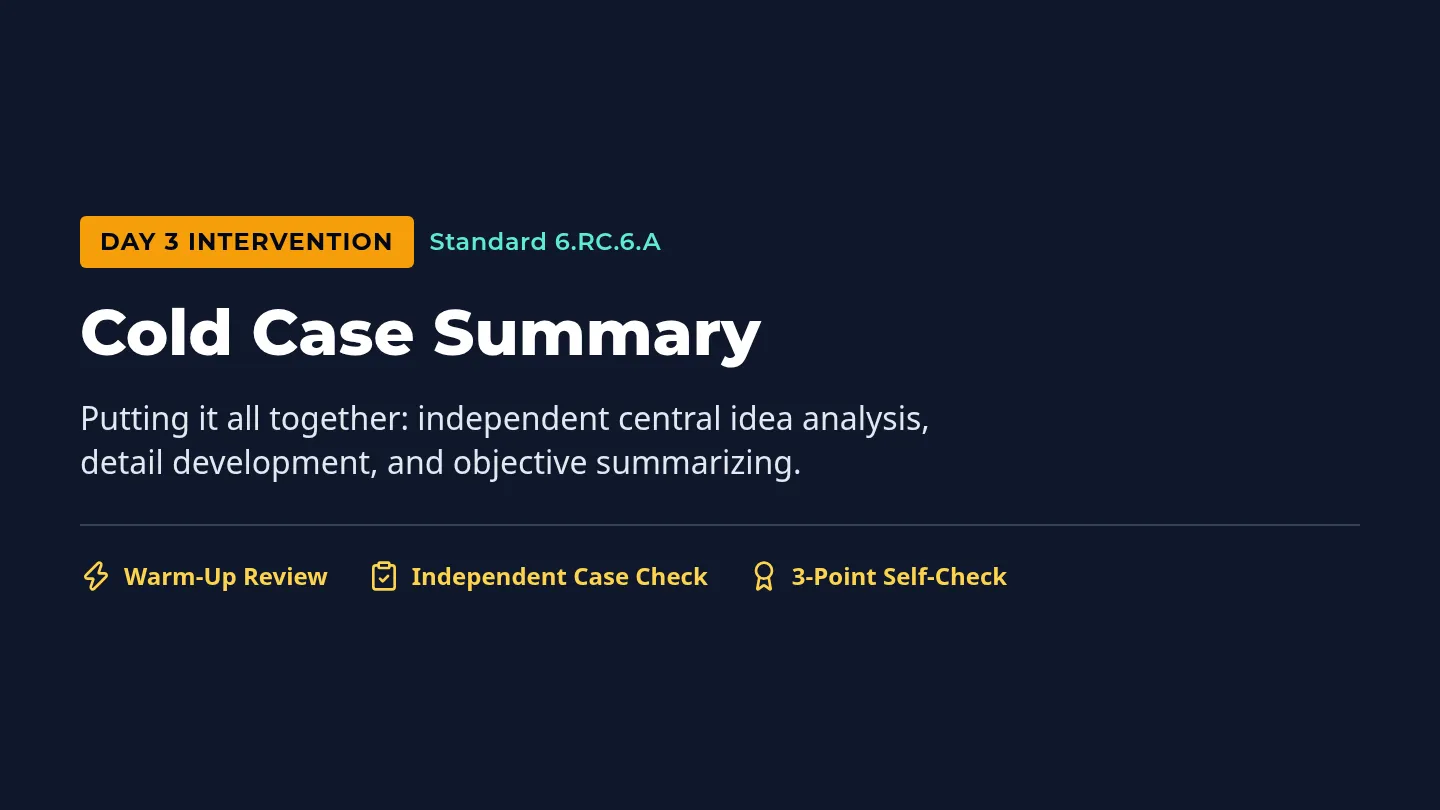
Cold Case Summary Slides Day 3 Intervention Standard 6.RC.6.A
Cold Case Summary
Putting it all together: independent central idea analysis, detail development, and objective summarizing.
Warm-Up Review
Independent Case Check
3-Point Self-Check
2-Minute Warm-Up
Which Sentence Belongs in a Summary?
A. Whales are the most magnificent creatures in the sea, and it is heartbreaking when ships disturb them.
B. Shipping noise interferes with whale echolocation, making it harder for whales to hunt and communicate.
C. Governments should immediately ban all cargo ships from whale habitats.
Toolkit Recap
Your 3-Part Checklist for 6.RC.6.A
1. Central Idea
Full sentence. Covers the whole passage (stated or implied).
2. Detail Job
Explain how a specific fact, number, or example proves the idea.
3. Clean Summary
Central idea + key details in your own words. Zero opinions.
Independent Check
Today's Text: Songs Beneath the Waves
Work independently to complete all 4 parts:
Read the passage twice and annotate key details in the margin.
Answer Questions 1–3 on central idea, detail development, and summary selection.
Write a 3–4 sentence objective summary and complete your self-check.
Case Closed
Audit Your Own Summary
Did I state the central idea in my first sentence?
Did I include key details from the beginning, middle, and end?
Did I remove every opinion word (best, sad, should, I think)?
Cold Case Summary Check Day 3 • Mastery Check
Cold Case: Songs Beneath the Waves
Name: ___________________________
Date: _______________
Independent Check: Read the passage carefully. Answer Questions 1–3, then write a 3–4 sentence objective summary on Page 2.
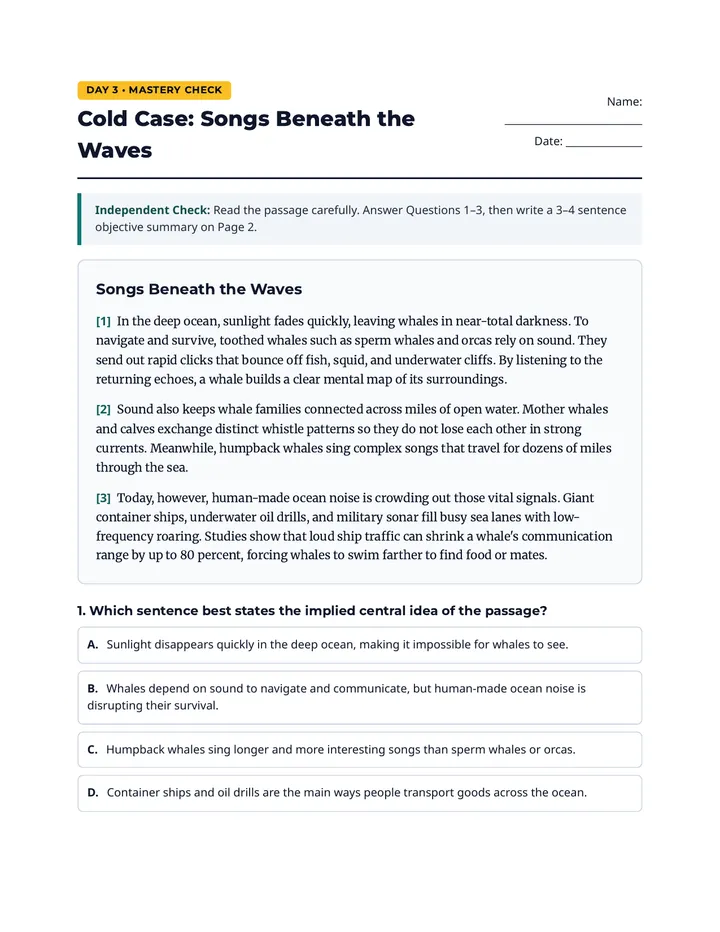
Songs Beneath the Waves
[1] In the deep ocean, sunlight fades quickly, leaving whales in near-total darkness. To navigate and survive, toothed whales such as sperm whales and orcas rely on sound. They send out rapid clicks that bounce off fish, squid, and underwater cliffs. By listening to the returning echoes, a whale builds a clear mental map of its surroundings.
[2] Sound also keeps whale families connected across miles of open water. Mother whales and calves exchange distinct whistle patterns so they do not lose each other in strong currents. Meanwhile, humpback whales sing complex songs that travel for dozens of miles through the sea.
[3] Today, however, human-made ocean noise is crowding out those vital signals. Giant container ships, underwater oil drills, and military sonar fill busy sea lanes with low-frequency roaring. Studies show that loud ship traffic can shrink a whale's communication range by up to 80 percent, forcing whales to swim farther to find food or mates.
1. Which sentence best states the implied central idea of the passage?
A. Sunlight disappears quickly in the deep ocean, making it impossible for whales to see.
B. Whales depend on sound to navigate and communicate, but human-made ocean noise is disrupting their survival.
C. Humpback whales sing longer and more interesting songs than sperm whales or orcas.
D. Container ships and oil drills are the main ways people transport goods across the ocean.
Cold Case Summary Check • Page 2 Name: ___________________________
2. How does the detail in Paragraph 3 about ship traffic shrinking a whale's communication range by up to 80 percent develop the central idea?
3. Which summary of Songs Beneath the Waves is completely free of personal opinions?
A. Whales use clicks and whistles to hunt and stay together, and it is terrible that noisy ships are ruining their peaceful ocean home.
B. Whales rely on echoes and songs to navigate dark waters and stay connected, but loud noise from ships and drills reduces their range.
C. People should stop using noisy container ships right away because whales are smart animals that deserve quiet water.
4. Write Your Own Objective Summary
In 3–4 sentences, summarize the passage in your own words. Include the central idea and key details from all three paragraphs. Do not include personal opinions.
Signal Hunter Self-Check (Check each box after reviewing your summary):
☐ States the central idea
☐ Includes key details
☐ Zero personal opinions
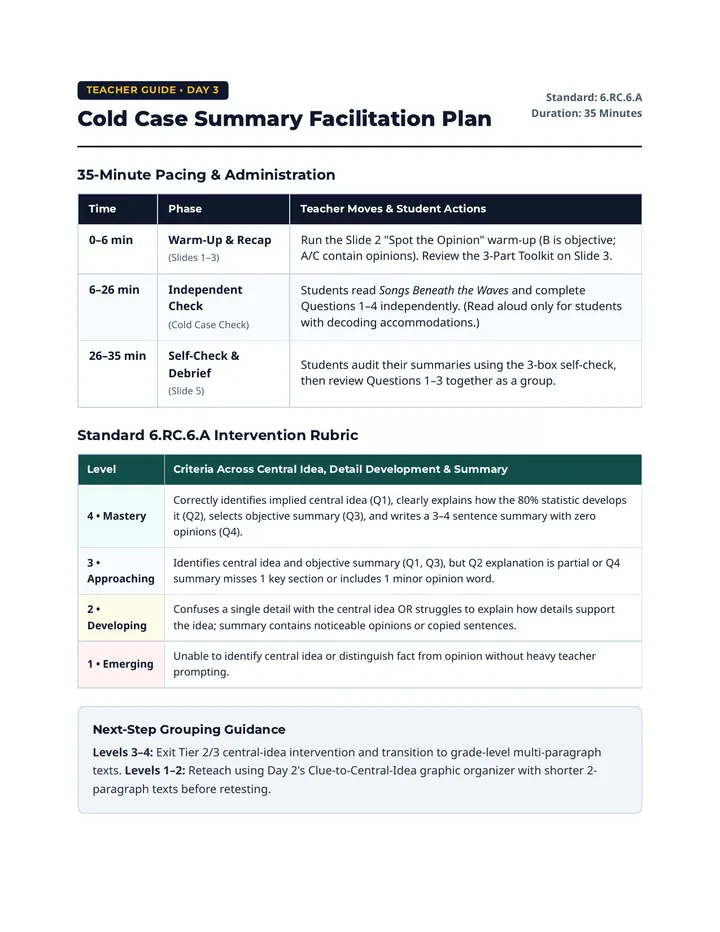
Cold Case Summary Teacher Guide Teacher Guide • Day 3
Cold Case Summary Facilitation Plan
Standard: 6.RC.6.A
Duration: 35 Minutes
35-Minute Pacing & Administration
Time
Phase
Teacher Moves & Student Actions
0–6 min
Warm-Up & Recap
(Slides 1–3)
Run the Slide 2 "Spot the Opinion" warm-up (B is objective; A/C contain opinions). Review the 3-Part Toolkit on Slide 3.
6–26 min
Independent Check
(Cold Case Check)
Students read Songs Beneath the Waves and complete Questions 1–4 independently. (Read aloud only for students with decoding accommodations.)
26–35 min
Self-Check & Debrief
(Slide 5)
Students audit their summaries using the 3-box self-check, then review Questions 1–3 together as a group.
Standard 6.RC.6.A Intervention Rubric
Level
Criteria Across Central Idea, Detail Development & Summary
4 • Mastery
Correctly identifies implied central idea (Q1), clearly explains how the 80% statistic develops it (Q2), selects objective summary (Q3), and writes a 3–4 sentence summary with zero opinions (Q4).
3 • Approaching
Identifies central idea and objective summary (Q1, Q3), but Q2 explanation is partial or Q4 summary misses 1 key section or includes 1 minor opinion word.
2 • Developing
Confuses a single detail with the central idea OR struggles to explain how details support the idea; summary contains noticeable opinions or copied sentences.
1 • Emerging
Unable to identify central idea or distinguish fact from opinion without heavy teacher prompting.
Next-Step Grouping Guidance
Levels 3–4: Exit Tier 2/3 central-idea intervention and transition to grade-level multi-paragraph texts. Levels 1–2: Reteach using Day 2's Clue-to-Central-Idea graphic organizer with shorter 2-paragraph texts before retesting.
Cold Case Summary • Answer Key
Day 3 Reference
Question 1: Implied Central Idea
Correct Answer: B. Whales depend on sound to navigate and communicate, but human-made ocean noise is disrupting their survival.
Distractor Analysis: A is a single detail from Para. 1; C adds an unsupported opinion ("more interesting"); D is an off-topic detail.
Question 2: How the Detail Develops the Central Idea
Exemplar Response: The 80 percent statistic proves how seriously human-made noise harms whales. Because Paragraphs 1 and 2 show that whales need sound to hunt and stay with family, losing 80 percent of their communication range explains why ocean noise threatens their survival.
Accept responses that connect the number (80%) to the harm/disruption of whale communication or survival.
Question 3: Objective Summary Selection
Correct Answer: B. It summarizes the central idea and key details from all paragraphs neutrally.
Distractor Analysis: A includes opinion words (terrible, ruining, peaceful). C makes a value judgment and recommendation (should stop, deserve).
Question 4: Objective Summary Exemplar
Sample 3-Sentence Summary: Whales rely on sound to navigate dark ocean waters and stay connected with their families, but human-made noise is interfering with those signals. Toothed whales use echolocation clicks to hunt, while mothers, calves, and humpback whales use whistles and songs to communicate over long distances. However, loud noise from container ships, oil drills, and sonar can cut a whale's communication range by up to 80 percent.
Look-Fors: (1) States central idea, (2) Covers navigation, communication, and noise disruption, (3) Written in student's own words with zero opinions.