Purpose Clues Slides Day 1 Refresher • Literary Toolkit
Why Did They Write That?
Decoding Author's Purpose through tone, word choice, and text evidence.
The P.I.E. Framework
Persuade
Convince the reader to think, feel, or act a certain way.
Clues: opinions, strong verbs, calls to action
Inform
Teach the reader facts, steps, or clear explanations.
Clues: data, dates, neutral tone, definitions
Entertain
Hook the reader with a story, humor, suspense, or emotion.
Clues: characters, dialogue, vivid imagery
Same Topic, Different Purpose
Topic: School Lunches
PERSUADE
"Every student deserves fresh, locally grown produce—sign our petition today!"
INFORM
"The cafeteria serves 450 meals daily, following USDA nutrition guidelines."
ENTERTAIN
"Leo stared at the mystery meat, convinced it had just blinked back at him."
Turn & Talk: Spot the Purpose
"Honeybees beat their wings 200 times per second, creating the familiar buzz we hear in summer gardens. Without their pollination, nearly one-third of our food crops would struggle to grow."
1. What is the main purpose?
Persuade, Inform, or Entertain?
2. What is your evidence?
Point to specific words or facts.
Independent Practice
Purpose Detective Lab
Read each short passage carefully.
Identify the author's primary purpose.
Quote text evidence that proves your choice.
Purpose Detective Worksheet Day 1 • Story Craft Reboot
Purpose Detective Worksheet
Name: ________________________
Date: ______________
Persuade: Convince the reader Inform: Teach facts or steps Entertain: Tell a story or amuse
Directions: Read each passage below. Circle the author's primary purpose, then write one piece of text evidence (a specific word, phrase, or fact) that proves your answer.
1. "Stop tossing plastic bottles into the regular trash! Every bottle you recycle saves enough energy to power a lightbulb for three hours. Join our school's Green Team this Friday and help protect our planet."
Purpose: ◯ Persuade ◯ Inform ◯ Entertain
Text Evidence:
2. "Octopuses have three hearts and blue blood. Two hearts pump blood to the gills, while the third circulates it through the rest of the body. When an octopus swims, that third heart actually stops beating."
Purpose: ◯ Persuade ◯ Inform ◯ Entertain
Text Evidence:
3. "Maya tiptoed past the creaking floorboards, clutching the brass key. Suddenly, a shadow darted across the hallway, and the grandfather clock chimed midnight—even though it had been broken for ten years."
Purpose: ◯ Persuade ◯ Inform ◯ Entertain
Text Evidence:
4. Writer's Challenge: Switch the Purpose!
Write 2–3 sentences about homework designed to PERSUADE your principal to give less of it.
Purpose Clues Teacher Guide Day 1 Teacher Guide & Answer Key
Purpose and Persuasion
Suggested Pacing (45–55 min)
0–10 min: Slides 1–3 (P.I.E. Framework & School Lunches comparison).10–15 min: Slide 4 Turn & Talk (Honeybees passage).15–30 min: Worksheet 1 (Purpose Detective Worksheet).30–50 min: Worksheet 2 (Purpose Remix Worksheet) & share-out.
Differentiation & Tips
Support: Have students highlight clue words (e.g., numbers vs. exclamation marks) before choosing P, I, or E.Extend: Ask early finishers to rewrite Passage 2 (Octopuses) as an entertaining mini-story.Common Misconception: Students often confuse Inform with Persuade when facts are used to support an argument. Emphasize looking for a call to action or opinion.
Slide 4 Turn & Talk Answer:
Inform. Evidence: Objective facts and statistics ("200 times per second", "nearly one-third of our food crops").
Worksheet 1: Purpose Detective — Answer Key
1. Persuade
Sample Evidence: Uses commands and calls to action ("Stop tossing...", "Join our school's Green Team", "help protect our planet").
2. Inform
Sample Evidence: Provides factual, scientific details in a neutral tone ("three hearts and blue blood", "circulates it through the rest of the body").
3. Entertain
Sample Evidence: Tells a suspenseful story with a named character ("Maya"), action ("tiptoed"), and mysterious imagery ("grandfather clock chimed midnight").
4. Writer's Challenge (Sample Response)
"Students already spend seven hours learning at school. Reducing nightly homework will give us time to rest, read for fun, and spend time with our families—please consider a homework-free Friday!"
Story Craft Reboot • Day 1 Page 1 of 2
Worksheet 2: Purpose Remix — Answer Key
Day 1 • Page 2
Part 1: Purpose, Audience & Tone
1. Inform
Audience: Gardeners, beginners, or students planting seeds.
Tone Word (Sample): Instructional, clear, straightforward, or helpful.
2. Persuade
Audience: Parents, students, or anyone who packs lunch.
Tone Word (Sample): Enthusiastic, urgent, or promotional.
Part 2: The Three-Way Remix (Sample Responses)
3. PERSUADE:
"Visit your local animal shelter this weekend and give a loyal dog a forever home—adoption saves lives!"
4. INFORM:
"Dogs have a sense of smell that is at least 10,000 times stronger than a human's, and each dog's nose print is unique."
5. ENTERTAIN:
"Barnaby the beagle zoomed across the kitchen floor, wearing my dad's left slipper like a proud trophy."
Story Craft Reboot • Day 1 Next Up: Day 2 — Metaphors and Meanings
Purpose Remix Worksheet Day 1 • Worksheet 2
Purpose Remix Worksheet
Name: ________________________
Date: ______________
Part 1: Purpose, Audience & Tone
Read each passage. Circle the primary purpose, then identify the intended audience and one word that describes the author's tone.
1. "To plant a sunflower seed, press it one inch into loose, sunny soil. Water lightly every other day until green sprouts appear in about one week."
Purpose: ◯ Persuade ◯ Inform ◯ Entertain
Audience:
Tone Word:
2. "Tired of soggy sandwiches? Try CrunchWrap Lunchboxes—the only insulated container guaranteed to keep crackers crisp until noon. Grab yours before Friday's sale ends!"
Purpose: ◯ Persuade ◯ Inform ◯ Entertain
Audience:
Tone Word:
Part 2: The Three-Way Remix
Write 1–2 sentences about dogs for each of the three purposes below.
3. PERSUADE (Convince someone to adopt a shelter dog):
4. INFORM (Share a factual detail about dogs):
5. ENTERTAIN (Write a funny or exciting moment with a dog):
Metaphors and Theme Slides Day 2 Refresher • Literary Toolkit
Metaphors & Meanings
Unlocking figurative language and discovering the deeper theme of a story.
Figurative Language Toolkit
Simile
Compares two things using like or as .
"Her laugh sparkled like fireworks."
Metaphor
Says one thing is another directly.
"The classroom was a buzzing beehive."
Personification
Gives human traits to non-human things.
"The old floorboards groaned in protest."
Hyperbole
Extreme exaggeration for emphasis.
"My backpack weighs a million pounds."
Topic vs. Theme
Topic (1–2 Words)
What the story is about
• Friendship
• Courage
• Honesty
Theme (Full Sentence)
The universal life lesson
• True friends stand by you in hard times.
• Courage means acting even when afraid.
• Telling the truth builds lasting trust.
3 Steps to Find Theme
1
Spot the Conflict
What big problem does the main character face?
2
Track the Change
How does the character grow or learn by the end?
3
State the Universal Message
Write a lesson that applies to anyone, anywhere—no character names!
Your Turn
Figurative & Theme Lab
Part 1: Identify and explain figurative language.
Part 2: Read the short story and uncover its theme.
Figurative Theme Lab Worksheet Day 2 • Story Craft Reboot
Figurative & Theme Lab
Name: ________________________
Date: ______________
Word Bank: Simile Metaphor Personification Hyperbole
Part 1: Decode the Figurative Language
Read each sentence. Identify the device used, then explain what the author literally means.
1. "The thunder roared angrily across the dark valley."
Device:
Literal Meaning:
2. "My little brother's bedroom is a disaster zone."
Device:
Literal Meaning:
3. "I have told you a thousand times to zip your backpack!"
Device:
Literal Meaning:
4. "The fresh snow covered the yard like a soft white blanket."
Device:
Literal Meaning:
Part 2: Uncover the Theme
Day 2 • Page 2
The Half-Built Bridge
Nora was determined to win the school engineering contest all by herself. She refused to join a team, insisting that partners only slowed her down. When the deadline arrived, her toothpick bridge looked tall and impressive—until the weight test began. Under the very first book, the unsupported center snapped in half.
Across the room, three classmates cheered as their bridge held five heavy textbooks. Nora sighed and walked over to ask how they reinforced the middle. To her surprise, they invited her to help test their next design. Working together, Nora realized that combining different ideas made every structure stronger.
5. What is a 1–2 word TOPIC for this story?
6. What is the THEME of the story? (Write a complete sentence that applies to anyone, without using Nora's name.)
7. What event or change in the story proves this theme?
8. Quick Create: Write your own SIMILE or METAPHOR about teamwork.
Metaphors and Theme Teacher Guide Day 2 Teacher Guide & Answer Key
Metaphors and Meanings
Suggested Pacing (45–55 min)
0–10 min: Slides 1–2 (Figurative Language Toolkit).10–18 min: Slides 3–4 (Topic vs. Theme & 3-Step Method).18–35 min: Worksheet 1 (Figurative & Theme Lab).35–55 min: Worksheet 2 (Theme Builder) & share-out.
Differentiation & Misconceptions
Common Pitfall: Writing a summary or a 1-word topic instead of a theme. Remind students: "No character names!"Support: Offer a theme sentence frame: "The author wants us to learn that..." Extend: Have students add a line of personification to "The Half-Built Bridge."
Worksheet 1, Part 1: Figurative Language
1. Personification
Thunder is given the human action/emotion of roaring angrily; it means the thunder was very loud.
2. Metaphor
Compares the bedroom directly to a disaster zone; it means the room is extremely messy.
3. Hyperbole
Exaggerates with "a thousand times"; it means the speaker has given the reminder many times.
4. Simile
Uses "like" to compare snow to a blanket; it means the snow covered the yard evenly and smoothly.
Worksheet 1, Part 2: Theme Analysis
5. Topic: Teamwork / Collaboration / Asking for help.
6. Theme: Working together and combining ideas often leads to stronger results than working alone.
7. Text Evidence: Nora's solo bridge collapses under one book, while the team's bridge holds five. When she joins them, she learns their combined ideas make structures stronger.
8. Quick Create (Sample): "A strong team is like a woven rope—many threads together can hold any weight."
Story Craft Reboot • Day 2 Page 1 of 2
Worksheet 2: Theme Builder — Answer Key
Day 2 • Page 2
Part 1: Figurative Language Hunt (Any Order)
Metaphor: "The summer carnival was a dazzling circus of color and sound."
Simile: "...stretched toward the clouds like a giant bicycle wheel made of neon stars."
Personification: "...the popcorn machine chattered excitedly to anyone walking past."
Hyperbole: "...I felt like I had walked ten thousand miles!"
Part 2: Two Stories, One Theme? — Sample Answers
5. Common Mistake: Both characters rushed through an important task and skipped careful preparation, causing their work to fail.
6. Shared Theme: Taking your time and preparing carefully helps prevent costly mistakes later.
7. Real-Life Connection (Sample): Rushing through a math test without checking your work often leads to careless errors, or skipping warm-ups in sports can cause injuries.
8. Theme Revision (Sample): "Baking" is just a topic. A true theme is: Patience and following steps carefully lead to better results than rushing.
Story Craft Reboot • Day 2 Next Up: Day 3 — Poetry Power Synthesis
Theme Builder Worksheet Day 2 • Worksheet 2
Theme Builder Worksheet
Name: ________________________
Date: ______________
Part 1: Figurative Language Hunt
Read the paragraph below. Find four examples of figurative language (one simile, one metaphor, one personification, and one hyperbole). Record each phrase and its type in the chart.
The summer carnival was a dazzling circus of color and sound. Overhead, the Ferris wheel stretched toward the clouds like a giant bicycle wheel made of neon stars. Below, the popcorn machine chattered excitedly to anyone walking past. By the end of the night, my feet hurt so much I felt like I had walked ten thousand miles!
1. Quoted Phrase from Text Device Type
2. Quoted Phrase from Text Device Type
3. Quoted Phrase from Text Device Type
4. Quoted Phrase from Text Device Type
Part 2: Two Stories, One Theme?
Day 2 • Worksheet 2 • Page 2
Story A: The Rushed Baker
Sam wanted to finish his birthday cake in ten minutes so he could play video games. He skipped measuring the flour and forgot to preheat the oven. When he pulled the pan out, the cake was flat and rubbery, and he had to start all over again.
Story B: The Tangled Kite
Priya hurried to unwind her kite string on a windy hill without checking for knots. A sudden gust snapped the tangled line, sending her kite drifting into the tall oak trees. She spent the rest of the afternoon untangling what was left.
5. What mistake do both Sam and Priya make?
6. Write a single universal THEME statement that applies to BOTH stories (no character names).
7. Real-Life Connection: Describe one situation in school or sports where this theme is also true.
8. Revise This "Theme":
A student wrote: "The theme of Story A is baking." Rewrite it as a true theme statement.
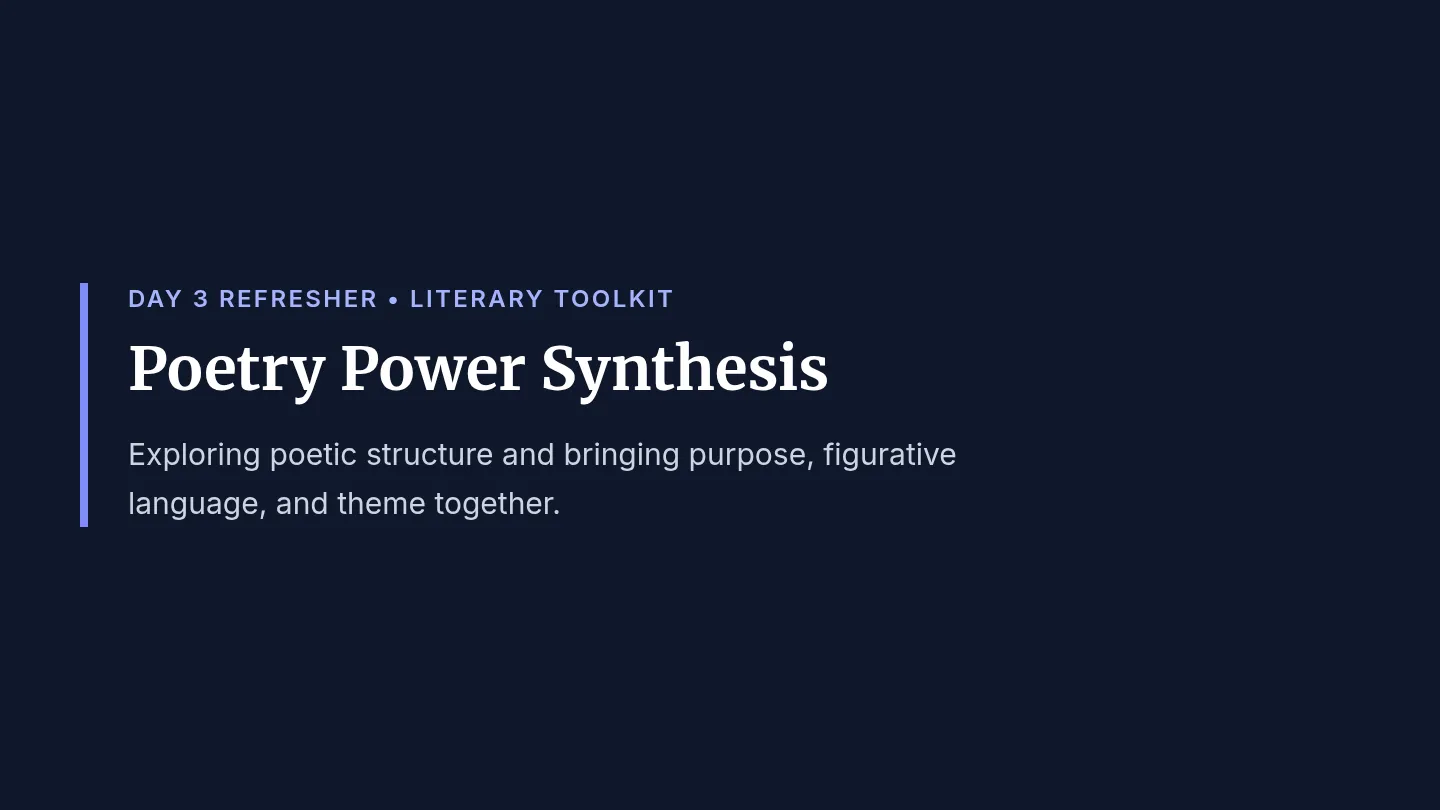
Poetry Power Slides Day 3 Refresher • Literary Toolkit
Poetry Power Synthesis
Exploring poetic structure and bringing purpose, figurative language, and theme together.
Anatomy of a Poem
Stanza & Line Break
A stanza is a group of lines (like a paragraph). Line breaks control rhythm and pause.
Rhyme Scheme
The pattern of end rhymes, labeled with letters like AABB or ABAB .
Imagery
Sensory details (sight, sound, touch, taste, smell) that paint a vivid picture.
Tone
The poet's attitude toward the subject (e.g., hopeful, playful, mysterious).
Spot the Rhyme Scheme
The silver moon begins to glow, (A)
Above the quiet town asleep, (B)
While gentle breezes softly blow, (A)
And stars their silent promises keep. (B)
Each new end sound gets a new letter.
Pattern: ABAB
Notice the calm, peaceful tone created by words like silver , quiet , and gentle .
Putting All 4 Skills Together
1. Poetry Structure
Count stanzas, label rhyme scheme, and notice imagery.
2. Figurative Language
Find similes, metaphors, or personification inside the lines.
3. Author's Purpose
Ask why the poet wrote it—to entertain, inspire, or reflect?
4. Theme
Uncover the universal life message behind the poem.
Culminating Challenge
Poetry Synthesis Lab
Analyze "The Paper Boat's Voyage" using all 4 toolkit skills.
Write your own 4-line poem with imagery and a rhyme scheme.
Poetry Synthesis Worksheet Day 3 • Story Craft Reboot
Poetry Synthesis Lab
Name: ________________________
Date: ______________
The Paper Boat's Voyage
Folded from a notebook page so thin and white,
I set my tiny vessel on the rain-filled street.
The gutter is a rushing river, wild and bright,
That carries off my paper sails beneath my feet.
The puddles swallow pebbles like a hungry sea,
And autumn leaves go racing past in golden fleets.
Though storms may toss my fragile craft relentlessly,
It dances over every wave it bravely meets.
A simple fold of paper cannot sail too far,
Yet still it dreams of oceans wide and skies of blue.
For even smallest journeys underneath a star
Can teach a timid heart what courage helps us do.
1. Poetry Structure: How many stanzas does this poem have, and what is the rhyme scheme of Stanza 1? (Example: AABB or ABAB)
2. Imagery: Copy one phrase from the poem that appeals to your sense of sight.
3. Figurative Language: Identify one SIMILE or METAPHOR in the poem and explain what it means.
Part 2: Purpose, Theme & Creation
Day 3 • Page 2
4. Author's Purpose: What is the poet's primary purpose in writing "The Paper Boat's Voyage"?
◯ To inform readers about how to fold paper boats
◯ To persuade readers to recycle notebook paper
◯ To entertain and inspire readers with a hopeful story in verse
5. Theme: What universal message does the poem share about small beginnings or courage? Write a complete sentence.
6. Tone: Which word best describes the tone of the final stanza? Explain why using one word or phrase from the text.
7. Poet's Corner: Write a 4-Line Stanza!
Choose any topic (a season, a sport, or an animal). Include one example of figurative language and use an AABB or ABAB rhyme scheme.
Poetry Power Teacher Guide Day 3 Teacher Guide & Answer Key
Poetry Power Synthesis
Suggested Pacing (45–55 min)
0–10 min: Slides 1–3 (Poetry Anatomy & ABAB Rhyme Scheme).10–15 min: Slide 4 (4-Skill Synthesis overview).15–35 min: Worksheet 1 (Poetry Synthesis Lab).35–55 min: Worksheet 2 (Verse Detective) & 3-day wrap-up.
Differentiation & Tips
Read Aloud: Read both poems aloud once for rhythm before students annotate.Support: Provide a rhyming word bank (e.g., day/play, bright/night, tree/free ) for Poet's Corner.Extend: Ask early finishers to add a second stanza to their original poem.
Worksheet 1: Poetry Synthesis Lab — Answer Key
1. Structure: 3 stanzas; Stanza 1 rhyme scheme is ABAB (white/bright, street/feet ).
2. Imagery (Sample): "autumn leaves go racing past in golden fleets" or "rain-filled street."
3. Figurative Language (Sample): Metaphor: "The gutter is a rushing river" (compares a rain-filled gutter to a fast river). Simile: "swallow pebbles like a hungry sea" (compares deep puddles to a devouring ocean). Personification ("dances over every wave") is also present.
4. Author's Purpose: To entertain and inspire readers with a hopeful story in verse.
5. Theme (Sample): Even small or fragile beginnings can lead to brave journeys when we have courage.
6. Tone (Sample): Hopeful / encouraging / determined, shown by words like "dreams of oceans wide" and "courage helps us do."
Story Craft Reboot • Day 3 Page 1 of 2
Worksheet 2: Verse Detective — Answer Key
Day 3 • Page 2
1. Rhyme Scheme: AABB (e.g., door/floor, wings/rings ).
2. Personification (Any two): "The books begin to whisper," "fairy tales are giggling to themselves," or "sleeping worlds awake and celebrate."
3. Metaphor: "Each quiet spine becomes an open gate." It compares book spines to gates, meaning opening a book lets you enter new worlds and adventures.
4. Tone & Purpose: Playful, magical, and whimsical tone. The poet wrote it to entertain readers and celebrate the magic of books.
5. Theme (Sample): Reading unlocks our imagination and allows us to explore endless new worlds.
6. Poet's Revision Challenge (Samples): Wind: "The fierce wind howled like a wolf through the trembling branches."City: "The city sparkled like a blanket of fallen stars against the midnight sky."
3-Day Sequence Wrap-Up:
Use Question 7 (3-Day Refresher Check-In) as an exit ticket to see which of the four skills students feel confident in and which may need a quick follow-up warm-up.
Story Craft Reboot • Day 3 Sequence Complete
Verse Detective Worksheet Day 3 • Worksheet 2
Verse Detective Worksheet
Name: ________________________
Date: ______________
The Midnight Library
When evening locks the heavy wooden door,
The books begin to whisper from the floor.
Old paper dragons stretch their dusty wings,
And tiny pirates hunt for golden rings.
A rocket blasts between the history shelves,
While fairy tales are giggling to themselves.
Each quiet spine becomes an open gate,
Where sleeping worlds awake and celebrate.
1. Rhyme Scheme: Label the rhyme scheme of Stanza 1 (e.g., AABB or ABAB) and list one pair of rhyming words.
2. Personification: Copy two examples where non-human things act like humans.
3. Metaphor: In Stanza 2, what are the book spines compared to, and what does that mean?
Part 2: Craft & Toolkit Wrap-Up
Day 3 • Worksheet 2 • Page 2
4. Tone & Purpose: What is the tone of "The Midnight Library," and why did the poet write it?
5. Theme: What message does this poem suggest about reading and imagination?
6. Poet's Revision Challenge
Rewrite each plain sentence below into a vivid poetic line using imagery or figurative language .
Plain: "The wind blew hard through the trees."
Plain: "The city was very bright at night."
7. 3-Day Refresher Check-In:
Which skill (Author's Purpose, Figurative Language, Theme, or Poetry) do you feel most confident about now, and why?