Sequence Steps Slides Day 1 • RI.3.8 Text Bridge Builders
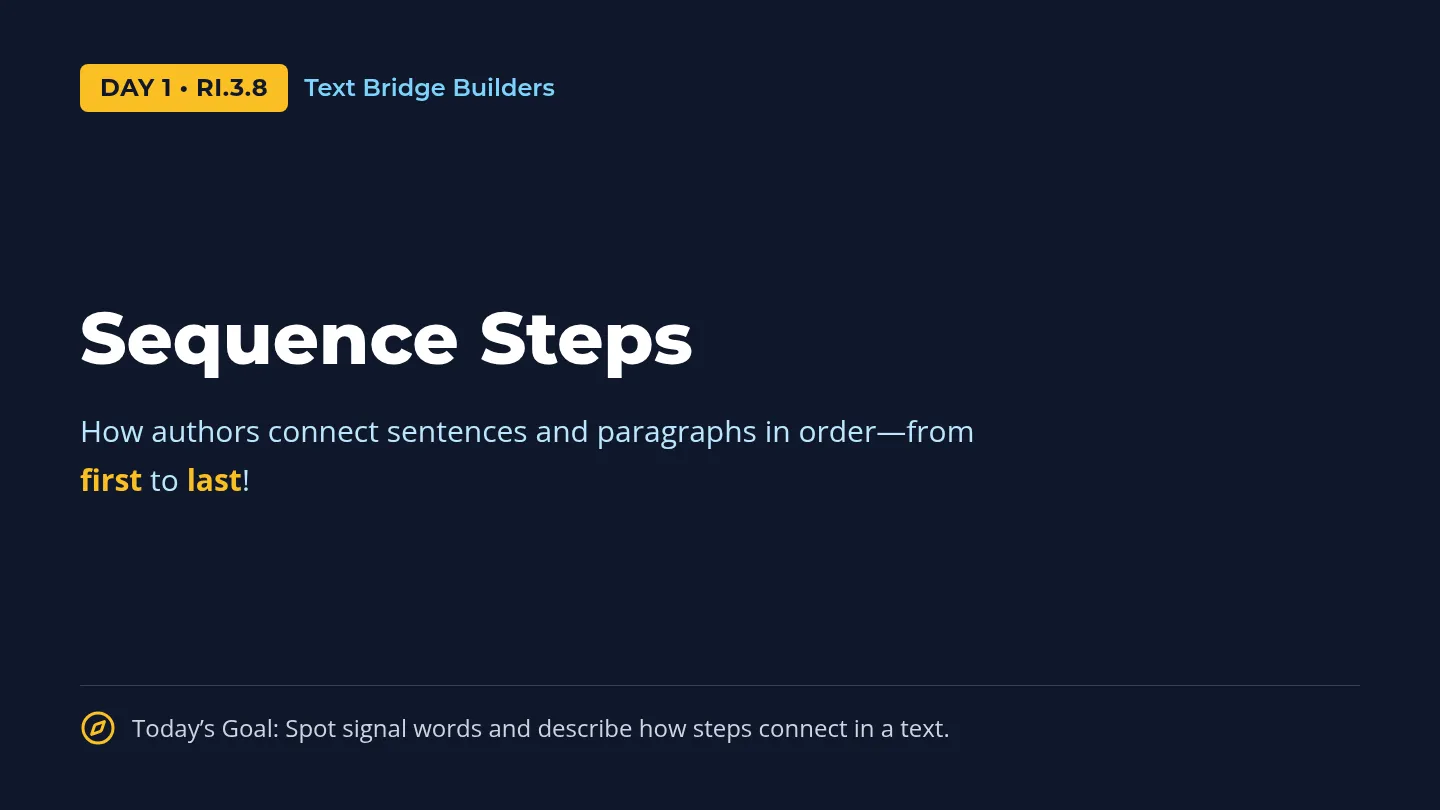
Sequence Steps
How authors connect sentences and paragraphs in order—from first to last!
Today’s Goal: Spot signal words and describe how steps connect in a text.
What Is an Idea Bridge?
Sentences in an informational text don’t just float alone. Authors build bridges between sentences and paragraphs so ideas make sense together!
1. Sequence
Steps in time order (Today!)
2. Cause & Effect
Why & what happened
3. Compare
Same & different
Sequence Signal Words
Look for these clue words—they act like bolts holding steps in order:
First
Next
Then
After that
Before
Finally
Ask yourself: Could I switch these sentences around? If not, it’s probably a sequence!
I DO • MODEL
How a Rainbow Forms
(1) First, sunlight shines through tiny drops of rain floating in the air.
(2) Next, each raindrop bends the white sunlight as it enters.
(3) Then, the light bounces off the back of the drop and splits into seven colors.
(4) Finally, those colors shine out to our eyes as a bright rainbow!
How Do Sentences 2 and 3 Connect?
Sentence 2
Next, each raindrop bends the white sunlight as it enters.
Sentence 3
Then, the light bounces off the back of the drop and splits into seven colors.
Bridge Description:
Sentence 3 shows the next step in the sequence. The light has to bend inside the drop before it can bounce and split into colors!
WE DO • TURN & TALK
Your Turn to Build the Bridge!
(1) First, a gardener digs a small hole in warm soil.
(2) Next, she drops a sunflower seed inside and covers it gently.
(3) After a few days of sun and water, a green sprout pushes up.
Partner Question:
How does Sentence 3 connect to Sentence 2? Use a sequence word in your answer!
Sequence Steps Lesson Plan Text Bridge Builders • Day 1 of 3
Sequence Steps Lesson Plan
Grade 3 ELA • 30 Minutes
Standard: CCSS RI.3.8
Learning Objective
Students will identify sequence signal words and describe how sentences and paragraphs connect in chronological order.
Materials Needed
Sequence Steps Slides (Slides 1–6)
Sequence Steps Worksheet (1 per student)
Highlighters or pencils for signal words
Mini-Lesson Pacing (30 Minutes)
Phase
Teacher Actions & Student Engagement
Hook & Intro
5 min (Slides 1–3)
Introduce the Idea Bridge metaphor: authors build bridges between sentences so ideas stick together. Review sequence signal words (first, next, then, after that, before, finally ) and introduce the "Switch Test."
I Do: Model
7 min (Slides 4–5)
Read How a Rainbow Forms aloud. Think aloud while circling signal words. Model answering: "Sentence 3 connects to Sentence 2 by showing the next step—light must bend before it can split."
We Do: Practice
5 min (Slide 6)
Students read the sunflower sentences with a partner and turn-and-talk to explain how Sentence 3 connects to Sentence 2. Call on 2 pairs to share using the frame: "Sentence ___ comes after Sentence ___ because..."
You Do: Apply
10 min (Worksheet)
Distribute the Sequence Steps Worksheet (How Honeybees Make Honey ). Students underline signal words, answer the connection questions, and complete the 3-step sequence strip.
Share & Wrap
3 min
Review Question 3 together. Ask: "What happens if we swap Paragraph 2 and Paragraph 3?" Preview Day 2 (Cause & Effect).
Common Misconceptions
Confusing topic with connection: Students may say "Both sentences are about bees" instead of explaining the order (e.g., "Sentence 2 happens right after Sentence 1").Missing hidden sequence: Remind students that not every step has a bold signal word—use the Switch Test!
Differentiation
Support: Provide a highlighter to mark signal words before reading questions. Offer sentence frame: "First ___, then ___." Extension: Challenge early finishers to add a 4th step to the honeybee sequence strip using Finally .
Teacher Tip: Keep the Sequence Signal Word Bank posted on the board for Day 2 and Day 3 so students can compare sequence words with cause/effect and compare/contrast words.
Sequence Steps Worksheet Day 1 • RI.3.8 Practice
Sequence Steps Worksheet
Name: ________________________
Date: ______________
Sequence Signal Word Bank
first • next • then • after that • before • finally
How Honeybees Make Honey
Directions: Read the passage. Underline any sequence signal words you find.
[Paragraph 1] Making sweet honey takes teamwork! (1) First, a worker bee flies from flower to flower to sip sweet liquid called nectar. (2) The bee stores the nectar in a special honey stomach and flies back to the hive.
[Paragraph 2] (3) Next, the worker bee passes the nectar to house bees inside the hive. (4) The house bees chew the nectar for about thirty minutes until it turns thicker.
[Paragraph 3] (5) Then, the bees spread the thick nectar into wax honeycomb cells and fan it with their wings to dry out extra water. (6) Finally, they seal each cell with a tiny wax cap to keep the fresh honey safe.
1. How does Sentence 3 connect to Sentence 2?
A. Sentence 3 explains why bees dislike flowers.
B. Sentence 3 tells the next step after the bee returns to the hive.
C. Sentence 3 compares honeybees to bumblebees.
D. Sentence 3 gives the final step of sealing the wax cap.
2. Which signal word in Paragraph 3 shows the very last step in making honey?
Sequence Steps Worksheet (Page 2)
Name: ________________________
3. Describe how Paragraph 2 and Paragraph 3 are connected. What happens in Paragraph 3 after Paragraph 2?
4. Could an author put Sentence 6 before Sentence 5? Explain why or why not.
5. Build the Sequence Bridge
Write the 3 main steps of making honey in order from the passage.
First
Next
Finally
Bridge Builder Check:
☐ I underlined sequence signal words.
☐ I explained how steps connect in order.
Sequence Steps Answer Key Teacher Resource • Day 1
Sequence Steps Answer Key
RI.3.8
Signal Words in Passage:
First (Sentence 1), Next (Sentence 3), Then (Sentence 5), Finally (Sentence 6).
1. How does Sentence 3 connect to Sentence 2?
Answer: B. Sentence 3 tells the next step after the bee returns to the hive.
2. Which signal word in Paragraph 3 shows the very last step in making honey?
Answer: Finally
3. Describe how Paragraph 2 and Paragraph 3 are connected.
Sample Response: They are connected in sequence order. In Paragraph 2, house bees chew the nectar to make it thick. In Paragraph 3, the bees take the next step by fanning the thick nectar in honeycomb cells and sealing it.
4. Could an author put Sentence 6 before Sentence 5? Explain why or why not.
Sample Response: No, because the bees have to put the nectar in the cells and dry it out (Sentence 5) before they can seal the cells shut with wax (Sentence 6).
5. Build the Sequence Bridge (Sample Responses):
First
Worker bees sip nectar from flowers and bring it to the hive.
Next
House bees chew the nectar until it gets thick.
Finally
Bees dry the nectar in cells and seal them with wax.
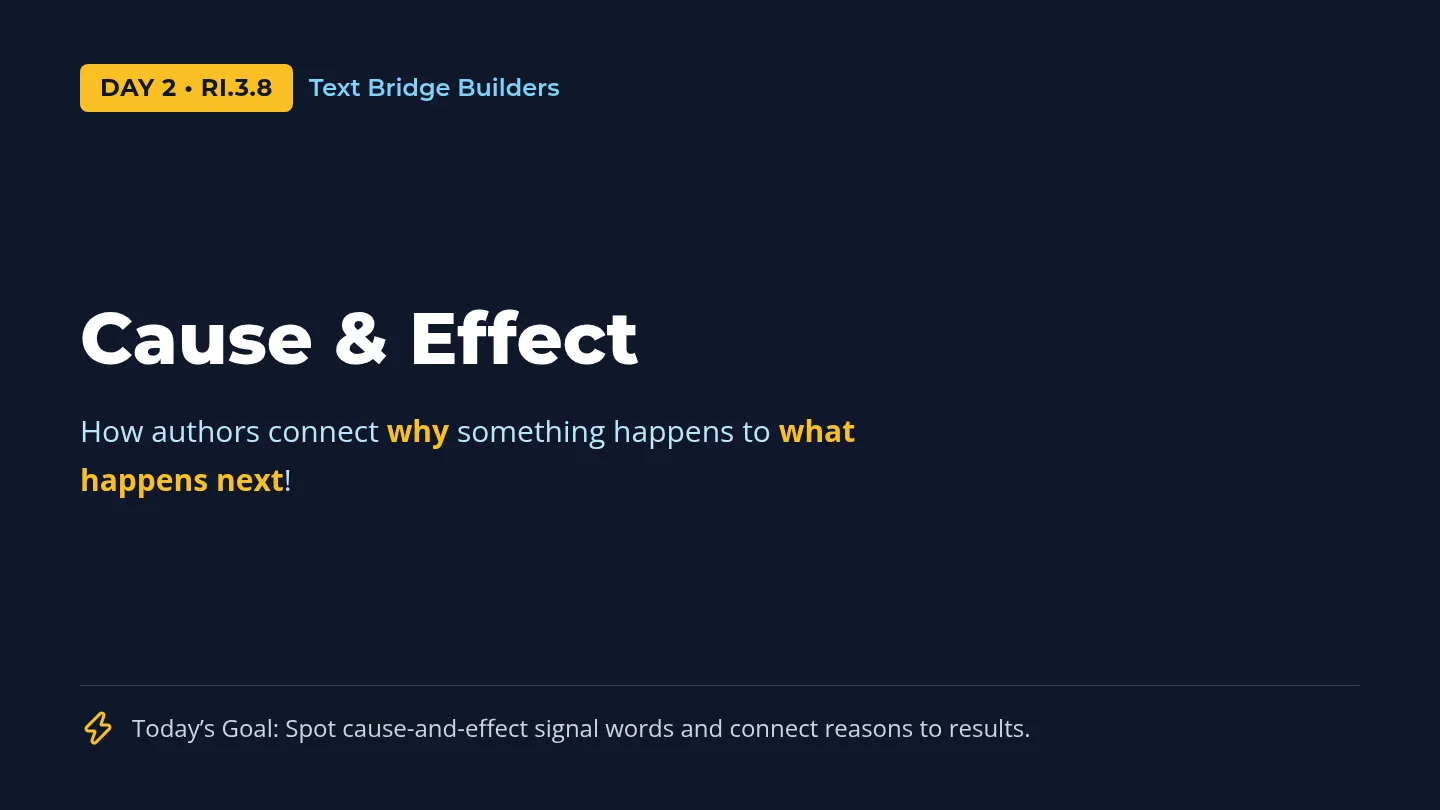
Cause Effect Slides Day 2 • RI.3.8 Text Bridge Builders
Cause & Effect
How authors connect why something happens to what happens next!
Today’s Goal: Spot cause-and-effect signal words and connect reasons to results.
Bridge #2: Cause & Effect
CAUSE
The reason why something happens.
Example: It rained all morning.
EFFECT
What happens as a result.
Example: The soccer field got muddy.
The Cause happens first in real life, even if the author writes the Effect first!
Cause & Effect Signal Words
Look for these clue words—they lock a reason to its result:
Because
So
Since
As a result
Therefore
That is why
Ask yourself: Did one sentence make the other sentence happen?
I DO • MODEL
Why Leaves Change Color
(1) In summer, tree leaves make green food using bright sunlight.
(2) When fall arrives, the days grow shorter and cooler.
(3) Because trees get less sunlight, they stop making green color.
(4) As a result, hidden yellow and orange colors finally show through!
How Do Sentences 3 and 4 Connect?
Sentence 3 (Cause)
Because trees get less sunlight, they stop making green color.
Sentence 4 (Effect)
As a result, hidden yellow and orange colors finally show through!
Bridge Description:
Sentence 3 gives the cause (less green color), and Sentence 4 shows the effect (yellow and orange colors appear).
WE DO • TURN & TALK
Your Turn to Build the Bridge!
(1) Desert nights are very cold, and desert days are scorching hot.
(2) Because the sun is so strong, most desert animals sleep underground all day.
(3) Therefore, they come out to hunt at night when the air cools down.
Partner Question:
What is the cause in Sentence 2, and what effect does Sentence 3 show?
Cause Effect Lesson Plan Text Bridge Builders • Day 2 of 3
Cause Effect Lesson Plan
Grade 3 ELA • 30 Minutes
Standard: CCSS RI.3.8
Learning Objective
Students will identify cause-and-effect signal words and explain how one sentence or paragraph causes another.
Materials Needed
Cause Effect Slides (Slides 1–6)
Cause Effect Worksheet (1 per student)
Two colored pencils/highlighters (optional)
Mini-Lesson Pacing (30 Minutes)
Phase
Teacher Actions & Student Engagement
Hook & Intro
5 min (Slides 1–3)
Review Day 1 (Sequence). Introduce Bridge #2: Cause & Effect . Clarify that the cause is WHY it happened and the effect is WHAT happened. Preview signal words (because, so, since, as a result, therefore ).
I Do: Model
7 min (Slides 4–5)
Read Why Leaves Change Color . Highlight Because and As a result . Model: "Sentence 3 explains why green fades, and Sentence 4 shows the effect—yellow and orange show up."
We Do: Practice
5 min (Slide 6)
Partners read the desert animal sentences and identify the cause in Sentence 2 and effect in Sentence 3. Share out using: "Because ___, therefore ___."
You Do: Apply
10 min (Worksheet)
Distribute the Cause Effect Worksheet (Beavers Build Big ). Students circle signal words, answer connection questions, and complete the Cause → Effect chart.
Share & Wrap
3 min
Review Question 3 as a class. Ask: "How is Cause & Effect different from Sequence?" Preview Day 3 (Compare & Contrast).
Common Misconceptions
Swapping Cause and Effect: Students often assume the first sentence is always the cause. Teach them to ask: "Which happened first in real life?" Confusing Sequence with Cause/Effect: Remind them that cause/effect shows why , not just when .
Differentiation
Support: Have students underline causes in blue and effects in yellow, or use the frame: "___ happened because ___." Extension: Ask early finishers to write one new cause-and-effect sentence about beavers on the back.
Teacher Tip: If students struggle with Therefore or As a result , have them replace the word with So to hear the connection more clearly.
Cause Effect Worksheet Day 2 • RI.3.8 Practice
Cause Effect Worksheet
Name: ________________________
Date: ______________
Cause & Effect Signal Word Bank
because • so • since • as a result • therefore • that is why
Beavers Build Big
Directions: Read the passage. Circle any cause-and-effect signal words you find.
[Paragraph 1] (1) Beavers are famous for chewing down trees with their strong front teeth. (2) They pile logs, mud, and rocks across a stream to build a sturdy dam. (3) Because the dam blocks the moving water, a deep pond forms behind it.
[Paragraph 2] (4) A deep pond helps beavers stay safe from predators like wolves. (5) Since beavers are clumsy on land, they build their stick homes right in the middle of the water. (6) As a result, hungry land animals cannot easily reach them!
[Paragraph 3] (7) Beaver ponds help other wildlife, too. (8) Frogs, fish, and ducks move into the calm water, so the whole neighborhood grows livelier.
1. How does Sentence 3 connect to Sentence 2?
A. Sentence 3 explains the effect of building a dam across the stream.
B. Sentence 3 compares beavers to wolves and ducks.
C. Sentence 3 tells what beavers eat for breakfast.
D. Sentence 3 explains why beavers have short tails.
2. In Sentence 5, why do beavers build their homes in the middle of the water?
Cause Effect Worksheet (Page 2)
Name: ________________________
3. How does Sentence 6 connect to Sentence 5? Use the signal words As a result in your explanation.
4. How does Paragraph 3 connect to Paragraph 1? Explain how the pond from Paragraph 1 affects other animals in Paragraph 3.
5. Build the Cause & Effect Bridge
Complete the missing Cause or Effect from the passage.
Cause (Why it happened)
A beaver dam blocks the moving stream water.
Effect (What happened)
Cause (Why it happened)
Effect (What happened)
The whole neighborhood grows livelier.
Bridge Builder Check:
☐ I circled cause-and-effect signal words.
☐ I matched each cause to its effect.
Cause Effect Answer Key Teacher Resource • Day 2
Cause Effect Answer Key
RI.3.8
Signal Words in Passage:
Because (Sentence 3), Since (Sentence 5), As a result (Sentence 6), so (Sentence 8).
1. How does Sentence 3 connect to Sentence 2?
Answer: A. Sentence 3 explains the effect of building a dam across the stream.
2. In Sentence 5, why do beavers build their homes in the middle of the water?
Answer: Because beavers are clumsy on land (and need to stay safe).
3. How does Sentence 6 connect to Sentence 5?
Sample Response: Sentence 6 shows the effect of Sentence 5. Because beavers build their homes in the water, as a result , hungry land animals cannot easily reach them.
4. How does Paragraph 3 connect to Paragraph 1?
Sample Response: Paragraph 1 explains how beavers create a deep pond (cause), and Paragraph 3 shows another effect of that pond—frogs, fish, and ducks move in.
5. Build the Cause & Effect Bridge (Sample Responses):
Row 1 Effect: A deep pond forms behind the dam.Row 2 Cause: Frogs, fish, and ducks move into the calm water. Compare Contrast Slides Day 3 • RI.3.8 Text Bridge Builders
Compare & Contrast
How authors connect ideas by showing how things are alike and different!
Today’s Goal: Spot comparison signal words and master all three Idea Bridges.
Bridge #3: Compare & Contrast
COMPARE
Shows how two things are alike or similar.
Both frogs and toads hatch from eggs.
CONTRAST
Shows how two things are different.
However, frogs have smooth skin while toads have bumpy skin.
Authors often use one paragraph to describe Thing A and the next paragraph to contrast Thing B!
Compare & Contrast Signal Words
Look for these clue words—they show similarities and differences:
Compare (Alike)
• Both
• Alike / Similar
• Just like
Contrast (Different)
• However
• Unlike
• On the other hand
Ask yourself: Is the author telling what is the same or what is different?
I DO • MODEL
Frogs and Toads
(1) Frogs and toads are both amphibians that catch insects with sticky tongues.
(2) Frogs spend most of their time near water and have smooth, wet skin.
(3) However, toads live mostly on dry land and have dry, bumpy skin.
(4) Unlike frogs, toads have short back legs made for hopping instead of leaping.
How Do Sentences 2 and 3 Connect?
Sentence 2
Frogs spend most of their time near water and have smooth, wet skin.
Sentence 3
However, toads live mostly on dry land and have dry, bumpy skin.
Bridge Description:
The word However signals a contrast. Sentence 3 shows how a toad’s home and skin are different from a frog’s!
WE DO • REVIEW
Your Three Idea Bridges
1. Sequence
Steps in time order
first, next, finally
2. Cause & Effect
Why & what happened
because, so, as a result
3. Compare
Alike & different
both, however, unlike
Ready for Your Worksheet!
Today you’ll compare alligators and crocodiles—and test all three bridges!
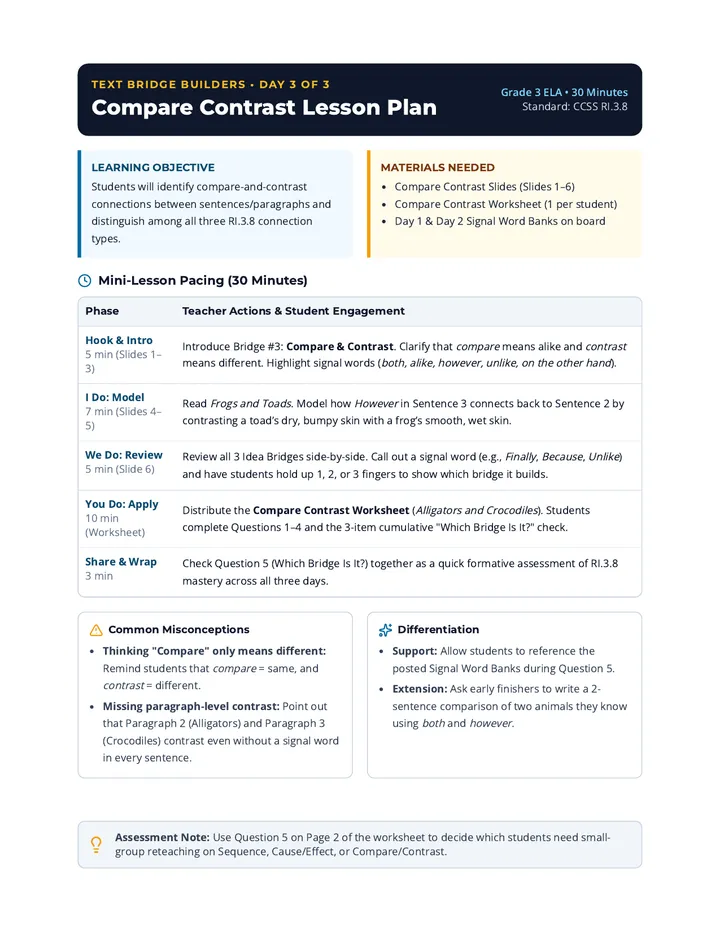
Compare Contrast Lesson Plan Text Bridge Builders • Day 3 of 3
Compare Contrast Lesson Plan
Grade 3 ELA • 30 Minutes
Standard: CCSS RI.3.8
Learning Objective
Students will identify compare-and-contrast connections between sentences/paragraphs and distinguish among all three RI.3.8 connection types.
Materials Needed
Compare Contrast Slides (Slides 1–6)
Compare Contrast Worksheet (1 per student)
Day 1 & Day 2 Signal Word Banks on board
Mini-Lesson Pacing (30 Minutes)
Phase
Teacher Actions & Student Engagement
Hook & Intro
5 min (Slides 1–3)
Introduce Bridge #3: Compare & Contrast . Clarify that compare means alike and contrast means different. Highlight signal words (both, alike, however, unlike, on the other hand ).
I Do: Model
7 min (Slides 4–5)
Read Frogs and Toads . Model how However in Sentence 3 connects back to Sentence 2 by contrasting a toad’s dry, bumpy skin with a frog’s smooth, wet skin.
We Do: Review
5 min (Slide 6)
Review all 3 Idea Bridges side-by-side. Call out a signal word (e.g., Finally , Because , Unlike ) and have students hold up 1, 2, or 3 fingers to show which bridge it builds.
You Do: Apply
10 min (Worksheet)
Distribute the Compare Contrast Worksheet (Alligators and Crocodiles ). Students complete Questions 1–4 and the 3-item cumulative "Which Bridge Is It?" check.
Share & Wrap
3 min
Check Question 5 (Which Bridge Is It?) together as a quick formative assessment of RI.3.8 mastery across all three days.
Common Misconceptions
Thinking "Compare" only means different: Remind students that compare = same, and contrast = different.Missing paragraph-level contrast: Point out that Paragraph 2 (Alligators) and Paragraph 3 (Crocodiles) contrast even without a signal word in every sentence.
Differentiation
Support: Allow students to reference the posted Signal Word Banks during Question 5.Extension: Ask early finishers to write a 2-sentence comparison of two animals they know using both and however .
Assessment Note: Use Question 5 on Page 2 of the worksheet to decide which students need small-group reteaching on Sequence, Cause/Effect, or Compare/Contrast.
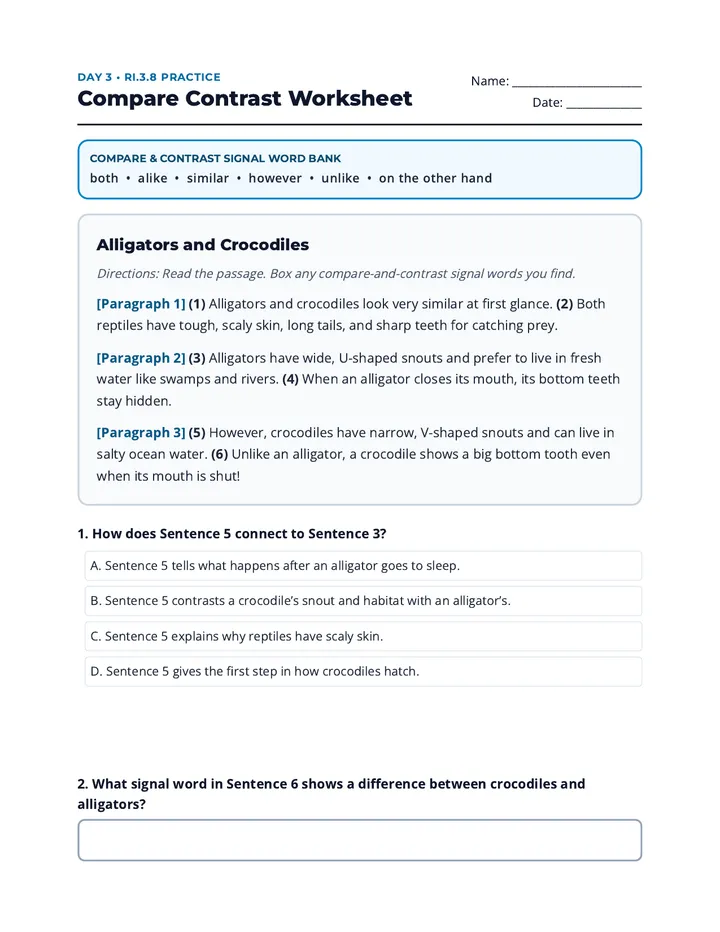
Compare Contrast Worksheet Day 3 • RI.3.8 Practice
Compare Contrast Worksheet
Name: ________________________
Date: ______________
Compare & Contrast Signal Word Bank
both • alike • similar • however • unlike • on the other hand
Alligators and Crocodiles
Directions: Read the passage. Box any compare-and-contrast signal words you find.
[Paragraph 1] (1) Alligators and crocodiles look very similar at first glance. (2) Both reptiles have tough, scaly skin, long tails, and sharp teeth for catching prey.
[Paragraph 2] (3) Alligators have wide, U-shaped snouts and prefer to live in fresh water like swamps and rivers. (4) When an alligator closes its mouth, its bottom teeth stay hidden.
[Paragraph 3] (5) However, crocodiles have narrow, V-shaped snouts and can live in salty ocean water. (6) Unlike an alligator, a crocodile shows a big bottom tooth even when its mouth is shut!
1. How does Sentence 5 connect to Sentence 3?
A. Sentence 5 tells what happens after an alligator goes to sleep.
B. Sentence 5 contrasts a crocodile’s snout and habitat with an alligator’s.
C. Sentence 5 explains why reptiles have scaly skin.
D. Sentence 5 gives the first step in how crocodiles hatch.
2. What signal word in Sentence 6 shows a difference between crocodiles and alligators?
Compare Contrast Worksheet (Page 2)
Name: ________________________
3. How does Paragraph 1 connect to Paragraphs 2 and 3? (Hint: What does Paragraph 1 show, and what do Paragraphs 2–3 show?)
4. Explain how Sentence 6 connects to Sentence 4.
5. Bridge Master Review: Which Bridge Is It?
Write Sequence , Cause & Effect , or Compare & Contrast next to each pair of sentences.
A. First, mix the flour and sugar in a bowl. Next, crack two eggs into the batter.
B. Because the winter storm knocked down power lines, our whole street lost electricity.
C. Both bicycles and scooters have two wheels. However, a bicycle has pedals you push.
Bridge Builder Check:
☐ I boxed compare-and-contrast signal words.
☐ I can name all three Idea Bridges!
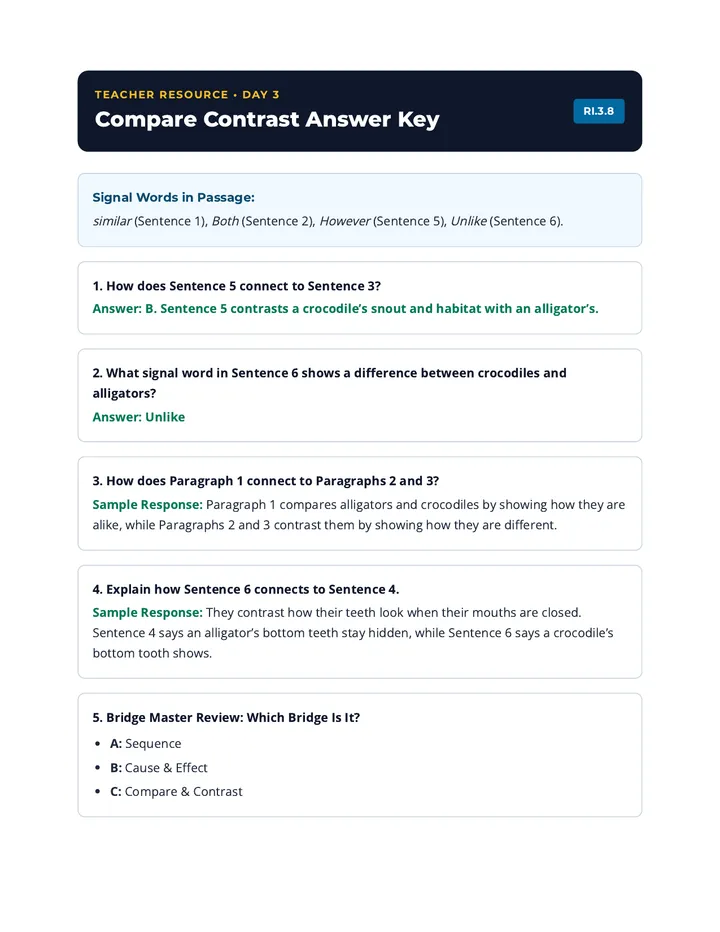
Compare Contrast Answer Key Teacher Resource • Day 3
Compare Contrast Answer Key
RI.3.8
Signal Words in Passage:
similar (Sentence 1), Both (Sentence 2), However (Sentence 5), Unlike (Sentence 6).
1. How does Sentence 5 connect to Sentence 3?
Answer: B. Sentence 5 contrasts a crocodile’s snout and habitat with an alligator’s.
2. What signal word in Sentence 6 shows a difference between crocodiles and alligators?
Answer: Unlike
3. How does Paragraph 1 connect to Paragraphs 2 and 3?
Sample Response: Paragraph 1 compares alligators and crocodiles by showing how they are alike, while Paragraphs 2 and 3 contrast them by showing how they are different.
4. Explain how Sentence 6 connects to Sentence 4.
Sample Response: They contrast how their teeth look when their mouths are closed. Sentence 4 says an alligator’s bottom teeth stay hidden, while Sentence 6 says a crocodile’s bottom tooth shows.
5. Bridge Master Review: Which Bridge Is It?
A: SequenceB: Cause & EffectC: Compare & Contrast