Evidence Explorers Packet
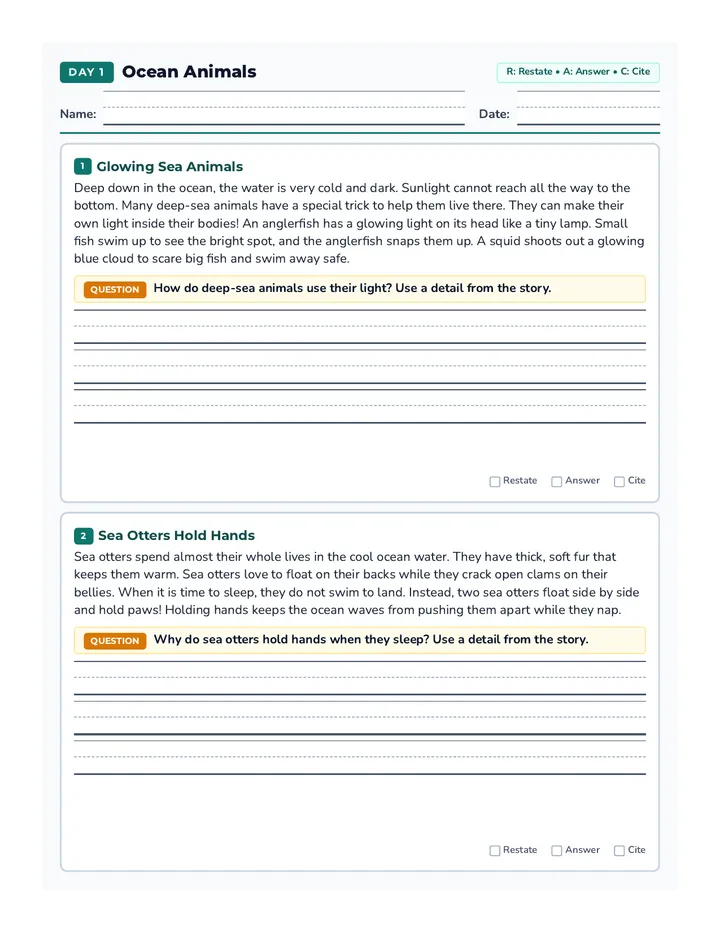
Day 1
Ocean Animals
R: Restate • A: Answer • C: Cite
Name:
Date:
1 Glowing Sea Animals
Deep down in the ocean, the water is very cold and dark. Sunlight cannot reach all the way to the bottom. Many deep-sea animals have a special trick to help them live there. They can make their own light inside their bodies! An anglerfish has a glowing light on its head like a tiny lamp. Small fish swim up to see the bright spot, and the anglerfish snaps them up. A squid shoots out a glowing blue cloud to scare big fish and swim away safe.
Question
How do deep-sea animals use their light? Use a detail from the story.
Restate Answer Cite
2 Sea Otters Hold Hands
Sea otters spend almost their whole lives in the cool ocean water. They have thick, soft fur that keeps them warm. Sea otters love to float on their backs while they crack open clams on their bellies. When it is time to sleep, they do not swim to land. Instead, two sea otters float side by side and hold paws! Holding hands keeps the ocean waves from pushing them apart while they nap.
Question
Why do sea otters hold hands when they sleep? Use a detail from the story.
Restate Answer Cite
Day 1
Ocean Animals (continued)
R: Restate • A: Answer • C: Cite
Name:
Date:
3 Octopus Arms
An octopus is a smart sea animal with no bones in its body. Because it has no bones, it can squeeze into tiny cracks in rocks. An octopus also has eight long, bendy arms. Each arm has rows of round suckers underneath. The sticky suckers help the octopus grab onto rocks so waves do not wash it away. They also help the octopus hold food and open hard clamshells!
Question
How do suckers help an octopus? Use a detail from the story.
Restate Answer Cite
4 Clownfish Homes
Clownfish are bright orange fish with white stripes. They live in warm ocean water near coral reefs. A clownfish makes its home inside a sea animal called a sea anemone. Sea anemones look like underwater flowers, but they have stinging arms. Those stings hurt other fish, yet they do not hurt clownfish at all. Living there keeps the clownfish safe from hungry predators!
Question
Why is a sea anemone a good home for a clownfish? Use a detail from the story.
Restate Answer Cite
Day 2
Cool Machines
R: Restate • A: Answer • C: Cite
Name:
Date:
1 Fast Roller Coasters
Click, click, click! A roller coaster goes slowly up a big hill. A strong chain pulls the cars all the way to the top. Most roller coasters do not have a motor on the cars at all. At the top of the hill, gravity pulls the cars down. The steep drop makes the coaster zoom super fast! That big speed pushes the cars up the next smaller hill.
Question
Why can a roller coaster go fast down a hill? Use a detail from the story.
Restate Answer Cite
2 Hot Air Balloons
A hot air balloon can float high up in the sky. People ride inside a big basket under the balloon. A burner shoots a flame to heat up the air inside the balloon. Warm air is lighter than the cool air outside. Because it is lighter, the warm air lifts the whole balloon up! When the pilot wants to land, the air cools down and the balloon floats gently back to the ground.
Question
What makes a hot air balloon rise into the sky? Use a detail from the story.
Restate Answer Cite
Day 2
Cool Machines (continued)
R: Restate • A: Answer • C: Cite
Name:
Date:
3 Fire Trucks
Fire trucks are built to help firefighters get to a fire fast. They have flashing lights and loud sirens so cars move out of the way. Fire trucks also carry lots of heavy gear. They have long ladders to reach high windows and rescue people. Big hoses on the truck spray strong streams of water onto flames. Every tool on a fire truck helps keep our town safe!
Question
How do fire trucks help firefighters do their job? Use a detail from the story.
Restate Answer Cite
4 Submarines
A submarine is a special ship that travels deep under the ocean. People live and work inside the submarine for weeks at a time. To sink down under the waves, the submarine fills its big tanks with heavy water. The heavy water pulls the ship down into the deep sea. When it is time to float back up, the ship pushes the water out. Then it fills the tanks with air so it rises to the top!
Question
How does a submarine go down under the water? Use a detail from the story.
Restate Answer Cite
Day 3
Long Ago
R: Restate • A: Answer • C: Cite
Name:
Date:
1 A Town Under Ash
Long ago, a volcano blew its top near a town called Pompeii. Thick, gray ash fell like snow and covered the whole town. The people ran away to stay safe. Many years later, workers dug away the ash. The dry ash had kept out air and rain, so things did not rot! Workers found bright wall art, stone roads, and even old loaves of bread inside ovens.
Question
How did the ash help save things in Pompeii? Use a detail from the story.
Restate Answer Cite
2 The Great Pyramids
Thousands of years ago, people in Egypt built giant stone pyramids. They made the pyramids as special tombs for their kings. Workers did not have big trucks or cranes back then. They cut and pulled millions of heavy stone blocks by hand! Each pyramid took many years to finish. Today, visitors from all over the world still travel to see them.
Question
Why did people in Egypt build the pyramids? Use a detail from the story.
Restate Answer Cite
Day 3
Long Ago (continued)
R: Restate • A: Answer • C: Cite
Name:
Date:
3 Living in Castles
Long ago, kings and queens lived in big stone castles. Castles were built on high hills so guards could see far away. They had thick stone walls to block enemies. Many castles also had a deep water moat all around them. People lowered a wooden drawbridge to cross the moat and pulled it up at night. All of these parts kept the people inside safe!
Question
How did castles keep people safe long ago? Use a detail from the story.
Restate Answer Cite
4 Dinosaur Fossils
Dinosaurs walked on Earth millions of years ago. No people were alive back then to take photos of them. Over time, mud and sand covered dinosaur bones and footprints. Slowly, that mud turned to hard rock and saved them as fossils. Today, scientists dig up fossils from the ground. Studying fossils helps them learn what dinosaurs looked like and how they lived!
Question
How do scientists learn about dinosaurs today? Use a detail from the story.
Restate Answer Cite
Day 4
Amazing Animals
R: Restate • A: Answer • C: Cite
Name:
Date:
1 City Falcons
A peregrine falcon is the fastest animal on Earth! In nature, these birds make nests high up on rocky cliffs. Now, many falcons live in big cities instead. To a falcon, a tall building looks just like a cliff. High window ledges keep their eggs safe from foxes and raccoons down below. Cities also have lots of pigeons for the falcons to eat!
Question
Why do falcons like to live on tall city buildings? Use a detail from the story.
Restate Answer Cite
2 Busy Honeybees
Honeybees live together in big groups inside a hive. Every bee has an important job to do. Worker bees fly out into sunny gardens all day long. They go from flower to flower to sip sweet nectar. Then they fly back home and put the nectar into wax cells. The bees fan the nectar with their wings to turn it into thick, golden honey!
Question
How do honeybees make honey? Use a detail from the story.
Restate Answer Cite
Day 4
Amazing Animals (continued)
R: Restate • A: Answer • C: Cite
Name:
Date:
3 Camels in the Desert
Camels live in hot, sandy deserts where few plants grow. Their bodies are built to handle tough desert weather. Camels have wide, flat feet so they do not sink into soft sand. They also have long eyelashes to keep blowing sand out of their eyes. Camels store fat in their humps for energy when food is hard to find. That helps them walk for days without a meal!
Question
How are camels built to live in the desert? Use a detail from the story.
Restate Answer Cite
4 Woodpeckers
Tap, tap, tap! If you walk in the woods, you might hear a woodpecker at work. This bird has a strong, sharp beak like a tiny hammer. It pecks holes right into hard tree bark. Next, the woodpecker sticks out its long, sticky tongue. It reaches deep inside the hole to pull out tasty bugs. Then it swallows the bugs for lunch!
Question
How does a woodpecker get bugs out of a tree? Use a detail from the story.
Restate Answer Cite
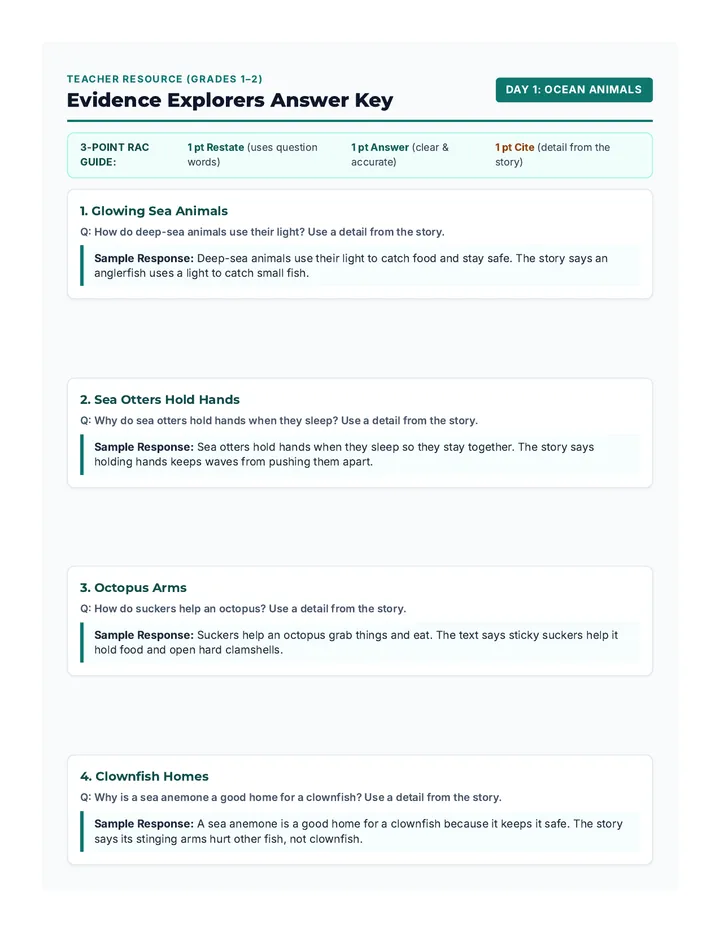
Evidence Explorers Answer Key
Teacher Resource (Grades 1–2)
Evidence Explorers Answer Key
Day 1: Ocean Animals
3-Point RAC Guide: 1 pt Restate (uses question words) 1 pt Answer (clear & accurate) 1 pt Cite (detail from the story)
1. Glowing Sea Animals
Q: How do deep-sea animals use their light? Use a detail from the story.
Sample Response: Deep-sea animals use their light to catch food and stay safe. The story says an anglerfish uses a light to catch small fish.
2. Sea Otters Hold Hands
Q: Why do sea otters hold hands when they sleep? Use a detail from the story.
Sample Response: Sea otters hold hands when they sleep so they stay together. The story says holding hands keeps waves from pushing them apart.
3. Octopus Arms
Q: How do suckers help an octopus? Use a detail from the story.
Sample Response: Suckers help an octopus grab things and eat. The text says sticky suckers help it hold food and open hard clamshells.
4. Clownfish Homes
Q: Why is a sea anemone a good home for a clownfish? Use a detail from the story.
Sample Response: A sea anemone is a good home for a clownfish because it keeps it safe. The story says its stinging arms hurt other fish, not clownfish.
Teacher Resource (Grades 1–2)
Evidence Explorers Answer Key
Day 2: Cool Machines
1. Fast Roller Coasters
Q: Why can a roller coaster go fast down a hill? Use a detail from the story.
Sample Response: A roller coaster can go fast down a hill because gravity pulls it down. The story says the steep drop makes the coaster zoom fast.
2. Hot Air Balloons
Q: What makes a hot air balloon rise into the sky? Use a detail from the story.
Sample Response: Warm air makes a hot air balloon rise into the sky. The text says warm air is lighter than cool air, so it lifts the balloon up.
3. Fire Trucks
Q: How do fire trucks help firefighters do their job? Use a detail from the story.
Sample Response: Fire trucks help firefighters work fast and put out fires. The story says they carry long ladders and big hoses to spray water.
4. Submarines
Q: How does a submarine go down under the water? Use a detail from the story.
Sample Response: A submarine goes down under the water by getting heavier. The story says it fills its tanks with heavy water to sink down.
Teacher Resource (Grades 1–2)
Evidence Explorers Answer Key
Day 3: Long Ago
1. A Town Under Ash
Q: How did the ash help save things in Pompeii? Use a detail from the story.
Sample Response: The ash helped save things in Pompeii so they did not rot. The story says the dry ash kept out air and rain.
2. The Great Pyramids
Q: Why did people in Egypt build the pyramids? Use a detail from the story.
Sample Response: People in Egypt built the pyramids for their kings. The story says they made them as special tombs for their kings.
3. Living in Castles
Q: How did castles keep people safe long ago? Use a detail from the story.
Sample Response: Castles kept people safe by stopping enemies. The text says castles had thick stone walls and a deep water moat all around them.
4. Dinosaur Fossils
Q: How do scientists learn about dinosaurs today? Use a detail from the story.
Sample Response: Scientists learn about dinosaurs today by studying fossils. The story says they dig up fossils of bones and footprints saved in rock.
Teacher Resource (Grades 1–2)
Evidence Explorers Answer Key
Day 4: Amazing Animals
1. City Falcons
Q: Why do falcons like to live on tall city buildings? Use a detail from the story.
Sample Response: Falcons like to live on tall city buildings because they are safe and have food. The story says high ledges keep eggs safe from foxes and raccoons.
2. Busy Honeybees
Q: How do honeybees make honey? Use a detail from the story.
Sample Response: Honeybees make honey using sweet nectar from flowers. The text says they fan the nectar with their wings at the hive to turn it into honey.
3. Camels in the Desert
Q: How are camels built to live in the desert? Use a detail from the story.
Sample Response: Camels are built for the desert with special feet and humps. The story says they have wide, flat feet so they do not sink into soft sand.
4. Woodpeckers
Q: How does a woodpecker get bugs out of a tree? Use a detail from the story.
Sample Response: A woodpecker gets bugs out of a tree with its beak and tongue. The story says it pecks holes in bark and uses its long, sticky tongue to pull out bugs.
Sentence Starters to Model: "The story says ..." • "In the text, ..." • "I read that ..."
Evidence Explorers Tracing Packet
Day 1
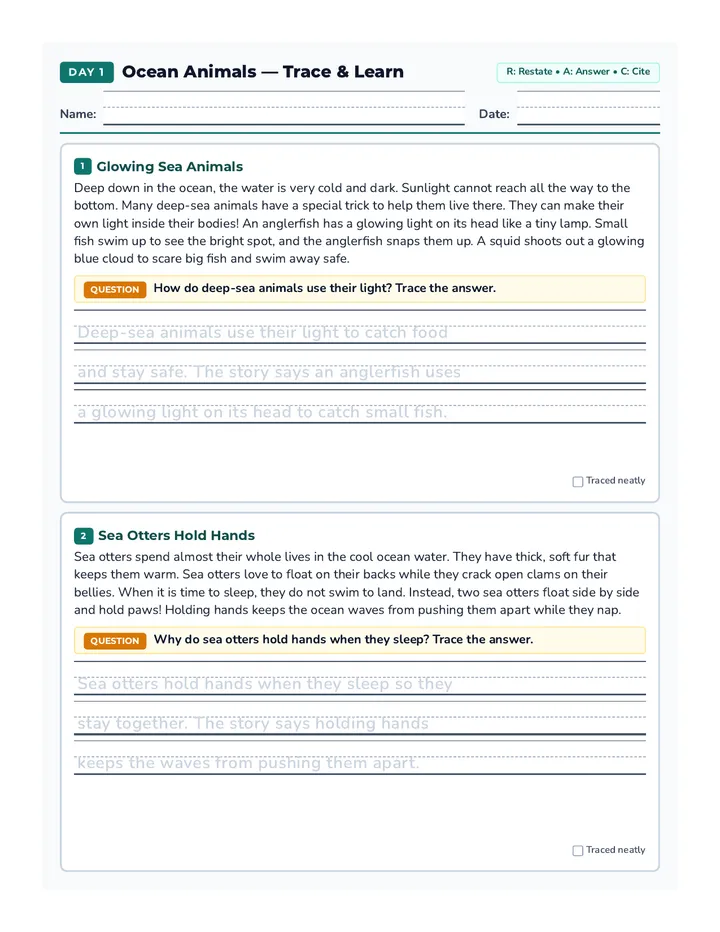
Ocean Animals — Trace & Learn
R: Restate • A: Answer • C: Cite
Name:
Date:
1 Glowing Sea Animals
Deep down in the ocean, the water is very cold and dark. Sunlight cannot reach all the way to the bottom. Many deep-sea animals have a special trick to help them live there. They can make their own light inside their bodies! An anglerfish has a glowing light on its head like a tiny lamp. Small fish swim up to see the bright spot, and the anglerfish snaps them up. A squid shoots out a glowing blue cloud to scare big fish and swim away safe.
Question
How do deep-sea animals use their light? Trace the answer.
Deep-sea animals use their light to catch food
and stay safe. The story says an anglerfish uses
a glowing light on its head to catch small fish.
Traced neatly
2 Sea Otters Hold Hands
Sea otters spend almost their whole lives in the cool ocean water. They have thick, soft fur that keeps them warm. Sea otters love to float on their backs while they crack open clams on their bellies. When it is time to sleep, they do not swim to land. Instead, two sea otters float side by side and hold paws! Holding hands keeps the ocean waves from pushing them apart while they nap.
Question
Why do sea otters hold hands when they sleep? Trace the answer.
Sea otters hold hands when they sleep so they
stay together. The story says holding hands
keeps the waves from pushing them apart.
Traced neatly
Day 1
Ocean Animals — Trace & Learn
R: Restate • A: Answer • C: Cite
Name:
Date:
3 Octopus Arms
An octopus is a smart sea animal with no bones in its body. Because it has no bones, it can squeeze into tiny cracks in rocks. An octopus also has eight long, bendy arms. Each arm has rows of round suckers underneath. The sticky suckers help the octopus grab onto rocks so waves do not wash it away. They also help the octopus hold food and open hard clamshells!
Question
How do suckers help an octopus? Trace the answer.
Suckers help an octopus grab things and eat.
The text says sticky suckers help it hold food
and open hard clamshells.
Traced neatly
4 Clownfish Homes
Clownfish are bright orange fish with white stripes. They live in warm ocean water near coral reefs. A clownfish makes its home inside a sea animal called a sea anemone. Sea anemones look like underwater flowers, but they have stinging arms. Those stings hurt other fish, yet they do not hurt clownfish at all. Living there keeps the clownfish safe from hungry predators!
Question
Why is a sea anemone a good home for a clownfish? Trace the answer.
A sea anemone is a good home because it keeps
clownfish safe. The story says its stinging arms
hurt other fish, not clownfish.
Traced neatly
Day 2
Cool Machines — Trace & Learn
R: Restate • A: Answer • C: Cite
Name:
Date:
1 Fast Roller Coasters
Click, click, click! A roller coaster goes slowly up a big hill. A strong chain pulls the cars all the way to the top. Most roller coasters do not have a motor on the cars at all. At the top of the hill, gravity pulls the cars down. The steep drop makes the coaster zoom super fast! That big speed pushes the cars up the next smaller hill.
Question
Why can a roller coaster go fast down a hill? Trace the answer.
A roller coaster goes fast down a hill because
gravity pulls it down. The story says the steep
drop makes the coaster zoom super fast.
Traced neatly
2 Hot Air Balloons
A hot air balloon can float high up in the sky. People ride inside a big basket under the balloon. A burner shoots a flame to heat up the air inside the balloon. Warm air is lighter than the cool air outside. Because it is lighter, the warm air lifts the whole balloon up! When the pilot wants to land, the air cools down and the balloon floats gently back to the ground.
Question
What makes a hot air balloon rise into the sky? Trace the answer.
Warm air makes a hot air balloon rise into the
sky. The text says warm air is lighter than cool
air outside, so it lifts the balloon up.
Traced neatly
Day 2
Cool Machines — Trace & Learn
R: Restate • A: Answer • C: Cite
Name:
Date:
3 Fire Trucks
Fire trucks are built to help firefighters get to a fire fast. They have flashing lights and loud sirens so cars move out of the way. Fire trucks also carry lots of heavy gear. They have long ladders to reach high windows and rescue people. Big hoses on the truck spray strong streams of water onto flames. Every tool on a fire truck helps keep our town safe!
Question
How do fire trucks help firefighters do their job? Trace the answer.
Fire trucks help firefighters work fast and put
out fires. The story says they carry long ladders
and big hoses to spray water onto flames.
Traced neatly
4 Submarines
A submarine is a special ship that travels deep under the ocean. People live and work inside the submarine for weeks at a time. To sink down under the waves, the submarine fills its big tanks with heavy water. The heavy water pulls the ship down into the deep sea. When it is time to float back up, the ship pushes the water out. Then it fills the tanks with air so it rises to the top!
Question
How does a submarine go down under the water? Trace the answer.
A submarine goes down by getting heavier.
The story says it fills its big tanks with
heavy water to pull the ship down.
Traced neatly
Day 3
Long Ago — Trace & Learn
R: Restate • A: Answer • C: Cite
Name:
Date:
1 A Town Under Ash
Long ago, a volcano blew its top near a town called Pompeii. Thick, gray ash fell like snow and covered the whole town. The people ran away to stay safe. Many years later, workers dug away the ash. The dry ash had kept out air and rain, so things did not rot! Workers found bright wall art, stone roads, and even old loaves of bread inside ovens.
Question
How did the ash help save things in Pompeii? Trace the answer.
The ash saved things in Pompeii so they did not
rot. The story says the dry ash kept out air
and rain from the town.
Traced neatly
2 The Great Pyramids
Thousands of years ago, people in Egypt built giant stone pyramids. They made the pyramids as special tombs for their kings. Workers did not have big trucks or cranes back then. They cut and pulled millions of heavy stone blocks by hand! Each pyramid took many years to finish. Today, visitors from all over the world still travel to see them.
Question
Why did people in Egypt build the pyramids? Trace the answer.
People in Egypt built the pyramids for their
kings. The story says they made the giant stone
pyramids as special tombs for their kings.
Traced neatly
Day 3
Long Ago — Trace & Learn
R: Restate • A: Answer • C: Cite
Name:
Date:
3 Living in Castles
Long ago, kings and queens lived in big stone castles. Castles were built on high hills so guards could see far away. They had thick stone walls to block enemies. Many castles also had a deep water moat all around them. People lowered a wooden drawbridge to cross the moat and pulled it up at night. All of these parts kept the people inside safe!
Question
How did castles keep people safe long ago? Trace the answer.
Castles kept people safe by blocking enemies.
The text says castles had thick stone walls
and a deep water moat all around them.
Traced neatly
4 Dinosaur Fossils
Dinosaurs walked on Earth millions of years ago. No people were alive back then to take photos of them. Over time, mud and sand covered dinosaur bones and footprints. Slowly, that mud turned to hard rock and saved them as fossils. Today, scientists dig up fossils from the ground. Studying fossils helps them learn what dinosaurs looked like and how they lived!
Question
How do scientists learn about dinosaurs today? Trace the answer.
Scientists learn about dinosaurs by studying
fossils. The story says they dig up fossils of
bones and footprints saved in rock.
Traced neatly
Day 4
Amazing Animals — Trace & Learn
R: Restate • A: Answer • C: Cite
Name:
Date:
1 City Falcons
A peregrine falcon is the fastest animal on Earth! In nature, these birds make nests high up on rocky cliffs. Now, many falcons live in big cities instead. To a falcon, a tall building looks just like a cliff. High window ledges keep their eggs safe from foxes and raccoons down below. Cities also have lots of pigeons for the falcons to eat!
Question
Why do falcons like to live on tall city buildings? Trace the answer.
Falcons like tall city buildings because they are
safe and have food. The story says high ledges
keep eggs safe from foxes and raccoons.
Traced neatly
2 Busy Honeybees
Honeybees live together in big groups inside a hive. Every bee has an important job to do. Worker bees fly out into sunny gardens all day long. They go from flower to flower to sip sweet nectar. Then they fly back home and put the nectar into wax cells. The bees fan the nectar with their wings to turn it into thick, golden honey!
Question
How do honeybees make honey? Trace the answer.
Honeybees make honey from sweet nectar.
The text says bees fan the nectar with their
wings to turn it into thick, golden honey.
Traced neatly
Day 4
Amazing Animals — Trace & Learn
R: Restate • A: Answer • C: Cite
Name:
Date:
3 Camels in the Desert
Camels live in hot, sandy deserts where few plants grow. Their bodies are built to handle tough desert weather. Camels have wide, flat feet so they do not sink into soft sand. They also have long eyelashes to keep blowing sand out of their eyes. Camels store fat in their humps for energy when food is hard to find. That helps them walk for days without a meal!
Question
How are camels built to live in the desert? Trace the answer.
Camels are built for the desert with special
bodies. The story says they have wide, flat feet
so they do not sink into soft sand.
Traced neatly
4 Woodpeckers
Tap, tap, tap! If you walk in the woods, you might hear a woodpecker at work. This bird has a strong, sharp beak like a tiny hammer. It pecks holes right into hard tree bark. Next, the woodpecker sticks out its long, sticky tongue. It reaches deep inside the hole to pull out tasty bugs. Then it swallows the bugs for lunch!
Question
How does a woodpecker get bugs out of a tree? Trace the answer.
A woodpecker gets bugs with its beak and
tongue. The story says it pecks holes and uses
its long, sticky tongue to pull out bugs.
Traced neatly