Harvest Perspectives Worksheet
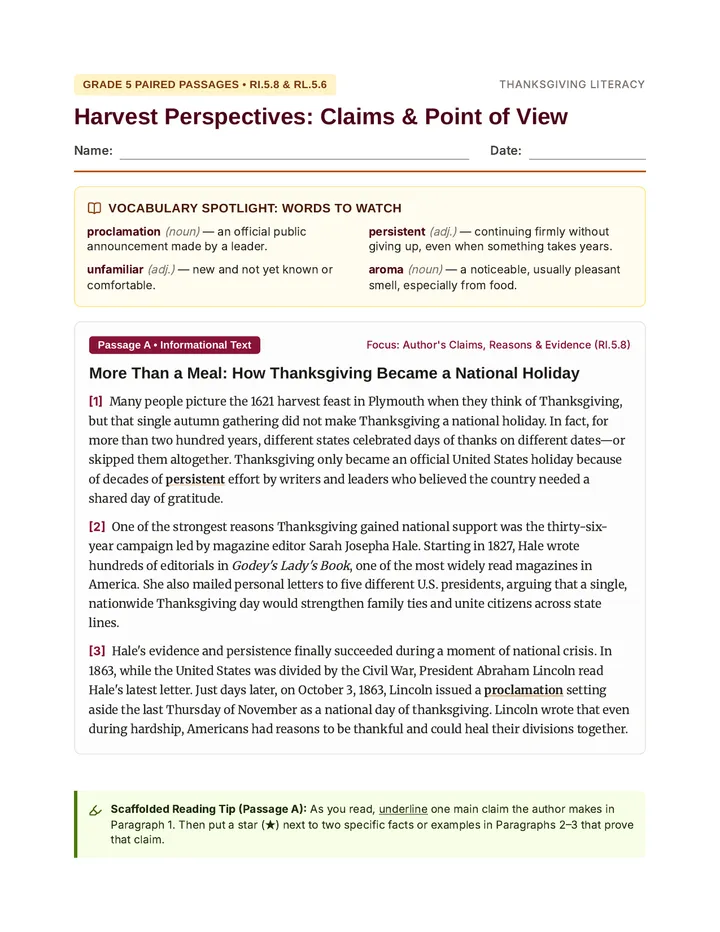
Grade 5 Paired Passages • RI.5.8 & RL.5.6 Thanksgiving Literacy
Harvest Perspectives: Claims & Point of View
Name:
Date:
Vocabulary Spotlight: Words to Watch
proclamation (noun) — an official public announcement made by a leader.
persistent (adj.) — continuing firmly without giving up, even when something takes years.
unfamiliar (adj.) — new and not yet known or comfortable.
aroma (noun) — a noticeable, usually pleasant smell, especially from food.
Passage A • Informational Text Focus: Author's Claims, Reasons & Evidence (RI.5.8)
More Than a Meal: How Thanksgiving Became a National Holiday
[1] Many people picture the 1621 harvest feast in Plymouth when they think of Thanksgiving, but that single autumn gathering did not make Thanksgiving a national holiday. In fact, for more than two hundred years, different states celebrated days of thanks on different dates—or skipped them altogether. Thanksgiving only became an official United States holiday because of decades of persistent effort by writers and leaders who believed the country needed a shared day of gratitude.
[2] One of the strongest reasons Thanksgiving gained national support was the thirty-six-year campaign led by magazine editor Sarah Josepha Hale. Starting in 1827, Hale wrote hundreds of editorials in Godey's Lady's Book, one of the most widely read magazines in America. She also mailed personal letters to five different U.S. presidents, arguing that a single, nationwide Thanksgiving day would strengthen family ties and unite citizens across state lines.
[3] Hale's evidence and persistence finally succeeded during a moment of national crisis. In 1863, while the United States was divided by the Civil War, President Abraham Lincoln read Hale's latest letter. Just days later, on October 3, 1863, Lincoln issued a proclamation setting aside the last Thursday of November as a national day of thanksgiving. Lincoln wrote that even during hardship, Americans had reasons to be thankful and could heal their divisions together.
Scaffolded Reading Tip (Passage A): As you read, underline one main claim the author makes in Paragraph 1. Then put a star (★) next to two specific facts or examples in Paragraphs 2–3 that prove that claim.
Passage B • Literary Text Focus: Narrator's Point of View (RL.5.6)
The Quiet Table on Maple Street
[1] This November, our dining table looked way too big and way too empty. Usually, Thanksgiving meant squeezing twelve cousins onto folding chairs at Grandma's house while laughter bounced off the kitchen walls. Instead, my parents and I were staring at three lonely plates in an unfamiliar dining room still half-filled with moving boxes. Even the turkey on the counter seemed smaller than usual, as if it missed the crowd too.
[2] "At least we don't have to fight over the last roll," Mom joked, trying to sound cheerful. I forced a polite smile, but my chest felt heavy. Through the front window, the bare oak trees looked gray and gloomy, and the quiet street outside only reminded me how far away our old neighborhood was.
[3] Then came a sharp knock at the door. Standing on our porch were Mr. and Mrs. Alvarez from next door, holding a warm ceramic dish wrapped in a checkered towel, along with their ten-year-old son, Leo. "We smelled your turkey from the driveway," Mrs. Alvarez laughed, "and we thought your first Thanksgiving on Maple Street needed some sweet plantains and extra company!"
[4] Within ten minutes, the rich aroma of spices filled our hallway. Leo and I set up folding chairs around the table, and suddenly the room didn't feel so oversized anymore. Looking out the window again, the oak trees didn't seem gloomy at all—their branches looked like arms stretching out to welcome us home.
Scaffolded Reading Tip (Passage B): Circle two words in Paragraphs 1–2 that show the narrator's homesick mood. Then circle two words in Paragraph 4 that show how her feelings changed.
Evidence & Perspective Map (Use the Sentence Starters)
Passage A: Claim & Evidence (RI.5.8)
Starter: "The author claims Thanksgiving became a national holiday because..."
Starter: "One piece of evidence that supports this is..."
Passage B: Narrator's Lens (RL.5.6)
Starter: "At first, the narrator feels ___, so she describes the room as..."
Starter: "After the neighbors arrive, her view changes, and she describes..."
Continue to Page 3 for comprehension questions →
Text Analysis Questions
Cite Paragraph Numbers
Part 1: Informational Text — Reasons & Evidence (RI.5.8)
1. Which reason best supports the author's claim in Passage A that Sarah Josepha Hale helped make Thanksgiving a national holiday?
A. She attended the original 1621 harvest feast in Plymouth with her family.
B. She wrote hundreds of magazine editorials and sent letters to five presidents over thirty-six years.
C. She traveled to every state to cook traditional Thanksgiving meals for governors.
D. She asked President Lincoln to move Thanksgiving to the first Monday in October.
2. How does the author use President Abraham Lincoln's 1863 proclamation as evidence in Paragraph 3?
Scaffolded Frame: The author includes Lincoln's 1863 proclamation to show that... According to Paragraph 3,...
Part 2: Literary Text — Narrator's Point of View (RL.5.6)
3. How does the narrator's point of view at the start of Passage B influence how she describes the turkey and the dining room?
A. Because she is excited to unpack, she describes the room as bright and full of adventure.
B. Because she misses her grandmother's crowded house, she describes the table as empty and the turkey as small.
C. Because she dislikes Thanksgiving food, she refuses to look at the plates on the table.
D. Because she is angry at her parents, she complains about having to set up folding chairs.
4. How does the narrator's description of the oak trees change from Paragraph 2 to Paragraph 4, and what causes this shift in perspective?
Scaffolded Frame: In Paragraph 2, the narrator describes the trees as ___, but in Paragraph 4 she sees them as ___ because...
Continue to Page 4 for Paired-Passage Connection & Vocabulary Practice →
Part 3: Paired-Passage Connection
RI.5.8 & RL.5.6
5. Both passages explore how Thanksgiving brings people together. Compare how the author of Passage A supports this idea with historical evidence to how the narrator of Passage B shows it through her personal perspective.
Writing Checklist: ☐ Cite one piece of evidence from Passage A ☐ Explain the narrator's shift in Passage B ☐ Use at least one Vocabulary Spotlight word
Sentence Starters: "In Passage A, the author proves that Thanksgiving unites people by giving the example of... Similarly, in Passage B, the narrator's perspective changes when..."
Vocabulary in Action
Choose two words from the Vocabulary Spotlight (proclamation, persistent, unfamiliar, aroma) and write an original sentence for each.
Word 1:
Word 2:
Self-Check: ☐ Did I underline a claim in Passage A? ☐ Did I circle mood words in Passage B? ☐ Did I use complete sentences?
Harvest Perspectives Answer Key
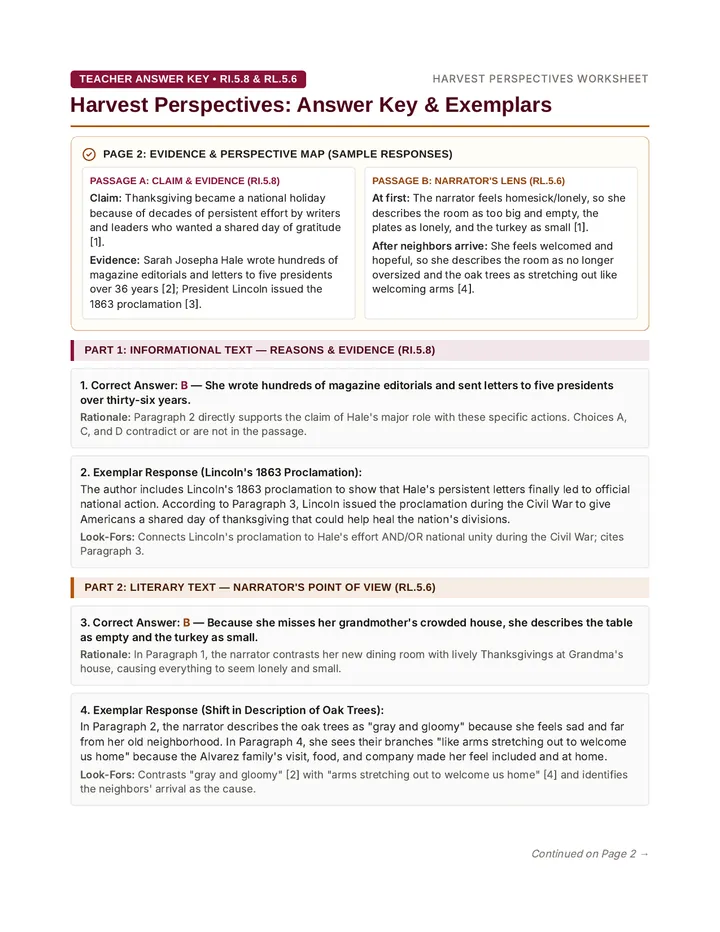
Teacher Answer Key • RI.5.8 & RL.5.6 Harvest Perspectives Worksheet
Harvest Perspectives: Answer Key & Exemplars
Page 2: Evidence & Perspective Map (Sample Responses)
Passage A: Claim & Evidence (RI.5.8)
Claim: Thanksgiving became a national holiday because of decades of persistent effort by writers and leaders who wanted a shared day of gratitude [1].
Evidence: Sarah Josepha Hale wrote hundreds of magazine editorials and letters to five presidents over 36 years [2]; President Lincoln issued the 1863 proclamation [3].
Passage B: Narrator's Lens (RL.5.6)
At first: The narrator feels homesick/lonely, so she describes the room as too big and empty, the plates as lonely, and the turkey as small [1].
After neighbors arrive: She feels welcomed and hopeful, so she describes the room as no longer oversized and the oak trees as stretching out like welcoming arms [4].
Part 1: Informational Text — Reasons & Evidence (RI.5.8)
1. Correct Answer: B — She wrote hundreds of magazine editorials and sent letters to five presidents over thirty-six years.
Rationale: Paragraph 2 directly supports the claim of Hale's major role with these specific actions. Choices A, C, and D contradict or are not in the passage.
2. Exemplar Response (Lincoln's 1863 Proclamation):
The author includes Lincoln's 1863 proclamation to show that Hale's persistent letters finally led to official national action. According to Paragraph 3, Lincoln issued the proclamation during the Civil War to give Americans a shared day of thanksgiving that could help heal the nation's divisions.
Look-Fors: Connects Lincoln's proclamation to Hale's effort AND/OR national unity during the Civil War; cites Paragraph 3.
Part 2: Literary Text — Narrator's Point of View (RL.5.6)
3. Correct Answer: B — Because she misses her grandmother's crowded house, she describes the table as empty and the turkey as small.
Rationale: In Paragraph 1, the narrator contrasts her new dining room with lively Thanksgivings at Grandma's house, causing everything to seem lonely and small.
4. Exemplar Response (Shift in Description of Oak Trees):
In Paragraph 2, the narrator describes the oak trees as "gray and gloomy" because she feels sad and far from her old neighborhood. In Paragraph 4, she sees their branches "like arms stretching out to welcome us home" because the Alvarez family's visit, food, and company made her feel included and at home.
Look-Fors: Contrasts "gray and gloomy" [2] with "arms stretching out to welcome us home" [4] and identifies the neighbors' arrival as the cause.
Continued on Page 2 →
Part 3: Paired-Passage Connection (Question 5)
RI.5.8 & RL.5.6
Exemplar Student Response
In Passage A, the author proves that Thanksgiving unites people by giving historical evidence, such as Sarah Josepha Hale's persistent letters arguing that one national holiday would unite citizens across states [2], and President Lincoln's 1863 proclamation inviting Americans to heal divisions during the Civil War [3]. In contrast, Passage B shows unity through a personal point of view. At first, the narrator feels lonely in an unfamiliar dining room [1], but when her neighbors bring sweet plantains and share the table, the warm aroma and company transform her gloomy mood into a feeling of belonging [3–4]. Together, both texts show that Thanksgiving brings people together—whether across an entire nation or across a neighborhood street.
Quick Scoring Guide (3-Point Check)
- RI.5.8 (1 pt): Accurately cites at least one historical reason/evidence from Passage A (Hale's campaign or Lincoln's proclamation).
- RL.5.6 (1 pt): Explains how the narrator's personal perspective shifts from lonely/homesick to welcomed in Passage B.
- Vocabulary & Conventions (1 pt): Correctly uses at least one Vocabulary Spotlight word in complete sentences.
Vocabulary in Action: Sample Sentences
Students choose any two words. Accept any original sentence that demonstrates the word's meaning clearly:
proclamation: The mayor read a proclamation declaring the first Saturday of May as Community Garden Day.
persistent: Even after missing three free throws, Maya was persistent and practiced until she made ten in a row.
unfamiliar: Walking into the unfamiliar library on his first day at a new school made Leo feel nervous.
aroma: As soon as we opened the oven, the sweet aroma of baked cinnamon apples filled the kitchen.
Differentiation Tip: For students needing extra support on Question 5, allow them to highlight their completed Graphic Organizer (Page 2) first and transfer one sentence from each column using the provided sentence starters.