Narrative Self Editing Guide
Grade 6 Narrative Writing • Unit 1
Narrative Self-Editing Guide
Part 1: Author's Review
Author:
Story Title:
Date:
Author's Strategy: Read aloud to yourself first to catch pacing and rhythm. Then rate each section using the 4-3-2-1 rubric.
1
Focus & Organization
My Rubric Score: 4 3 2 1
4 - Mastery Engaging intro; logical progress; effective conclusion.
3 - Proficient Mostly engaging intro; mostly logical; conclusion follows.
2 - Developing Somewhat engaging; somewhat logical; weak conclusion.
1 - Beginning No clear intro; disconnected events; missing conclusion.
Engaging Introduction: My introduction is engaging and appeals to readers right away. Logical Order: Events in my narrative progress in logical order without jumping around. Effective Conclusion: My conclusion effectively follows from the events of the narrative.
2
Evidence & Elaboration
My Rubric Score: 4 3 2 1
4 - Mastery Dialogue & description develop characters; precise details.
3 - Proficient Mostly includes dialogue & description; sensory details.
2 - Developing Some dialogue & details; words vary from vague to precise.
1 - Beginning No dialogue or descriptions; lacks sensory language.
Dialogue & Description: Techniques like dialogue and description develop characters and events. Sensory Details & Precise Words: I used precise phrases and sensory language to convey experiences. Descriptive Details: I included relevant, specific details so readers can clearly visualize scenes.
3
Conventions & Sentence Variety
My Rubric Score: 4 3 2 1
4 - Mastery Consistently accurate mechanics; varied sentence patterns.
3 - Proficient Mostly accurate mechanics; mostly varied sentence patterns.
2 - Developing Some accuracy in mechanics; occasionally varied patterns.
1 - Beginning Frequent mistakes in mechanics; repetitive sentence structure.
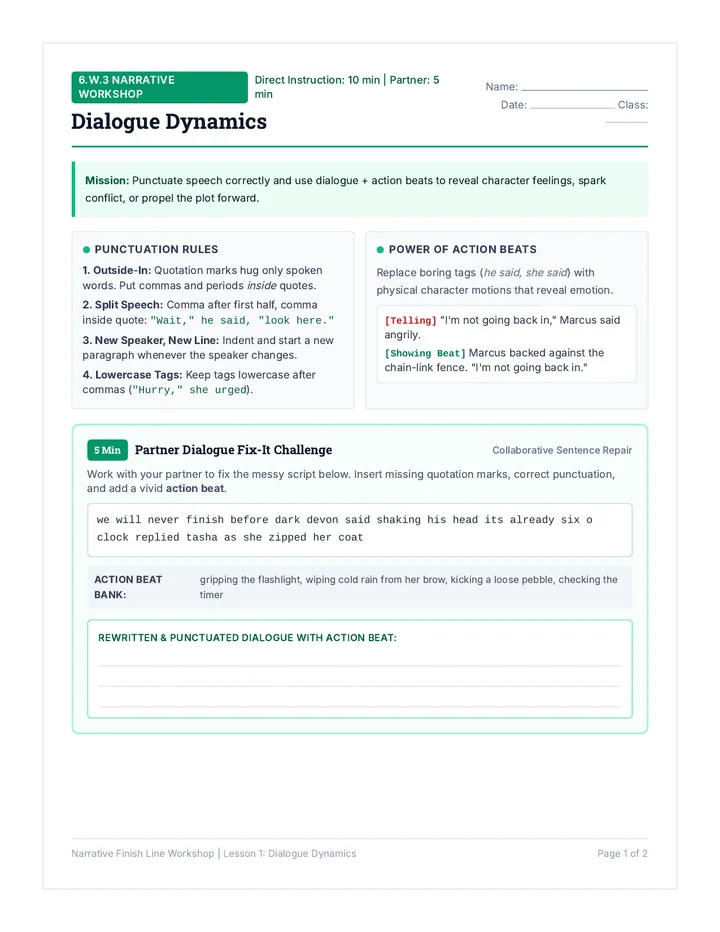
Sentence Variety: I varied sentence patterns for meaning, reader interest, and style. Usage & Mechanics: I checked for accurate capitalization, spelling, and grammar. Dialogue Punctuation: Quotes have opening/closing marks; commas and periods sit inside.
Author's Conference Notes (Complete before peer review)
The strongest scene or line in my story right now:
One specific thing I want my peer editor to give feedback on:
Grade 6 Narrative Writing • Unit 1
Narrative Peer-Editing Guide
Part 2: Partner's Review
Author Being Reviewed:
Peer Reviewer:
Date:
Peer Review Rules: Be Kind (encourage your classmate), Specific (point to exact lines), and Helpful (give ideas they can use).
A
Focus & Organization
Peer Rubric Score: 4 3 2 1
Introduction is engaging & appeals to readers Events progress in logical order Conclusion effectively follows from events
B
Evidence & Elaboration
Peer Rubric Score: 4 3 2 1
Dialogue & description develop characters Precise words & sensory language convey experiences Relevant descriptive details develop the plot
C
Conventions & Mechanics
Peer Rubric Score: 4 3 2 1
Consistently uses standard usage & mechanics Effectively varies sentence patterns for style Dialogue punctuation & quotation conventions
The Glow (What Worked Brilliantly)
Quote or describe a specific sentence, sensory detail, or dialogue line that effectively brought the narrative to life:
The Grow (Where to Add Detail or Polish)
Point to an area where additional description, dialogue, or sensory details could strengthen the narrative:
We held our 2-minute conference and talked through these notes together.
Author Sign-off: Reviewer Sign-off: