A dynamic Grade 2 spelling and phonics lesson covering the C/K/CK rule and Soft C/Soft G sounds. Includes a multi-activity student worksheet and a corresponding teacher answer key styled in a playful lab scientist theme.
Synthesizes comprehension and oral/written language. Students use cause-and-effect language ('because', 'consequently', 'as a result') and transitional sequencers to retell the story climax and analyze how the friendly bear saved the day.
Targets expressive grammar in context. Students map and describe the runaway camper's wild path using precise spatial prepositions (e.g., down, past, over, through) and dynamic action/movement verbs, constructing high-quality descriptive sentences.
Focuses on rich vocabulary from the book, helping students understand and expressively use words like 'scenic', 'teetering', 'rambled', and 'gourmet' through interactive reading, oral vocabulary routines, and descriptive writing.
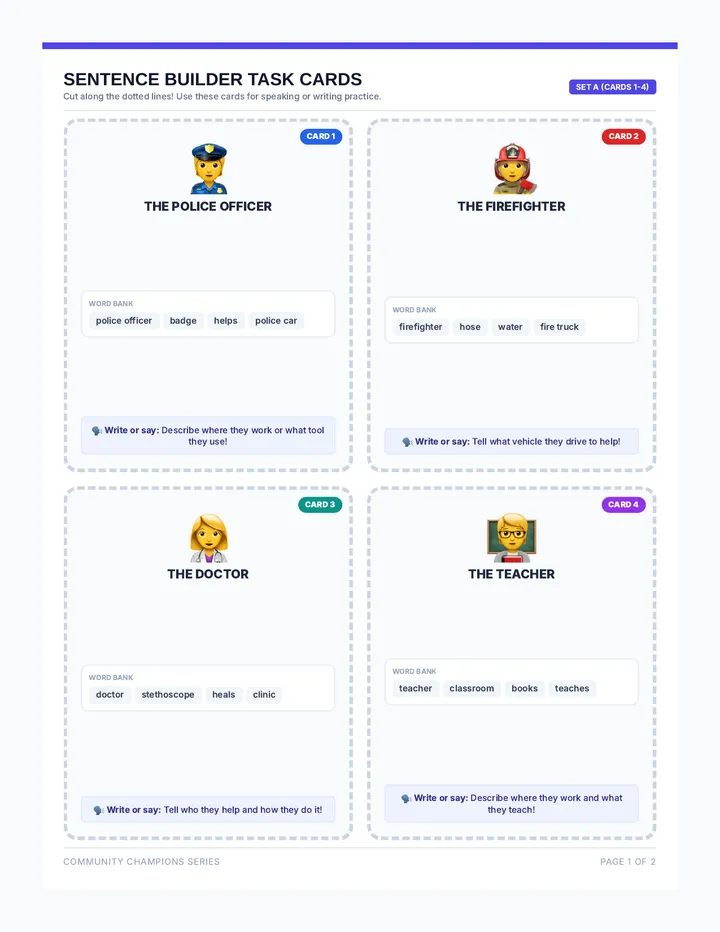
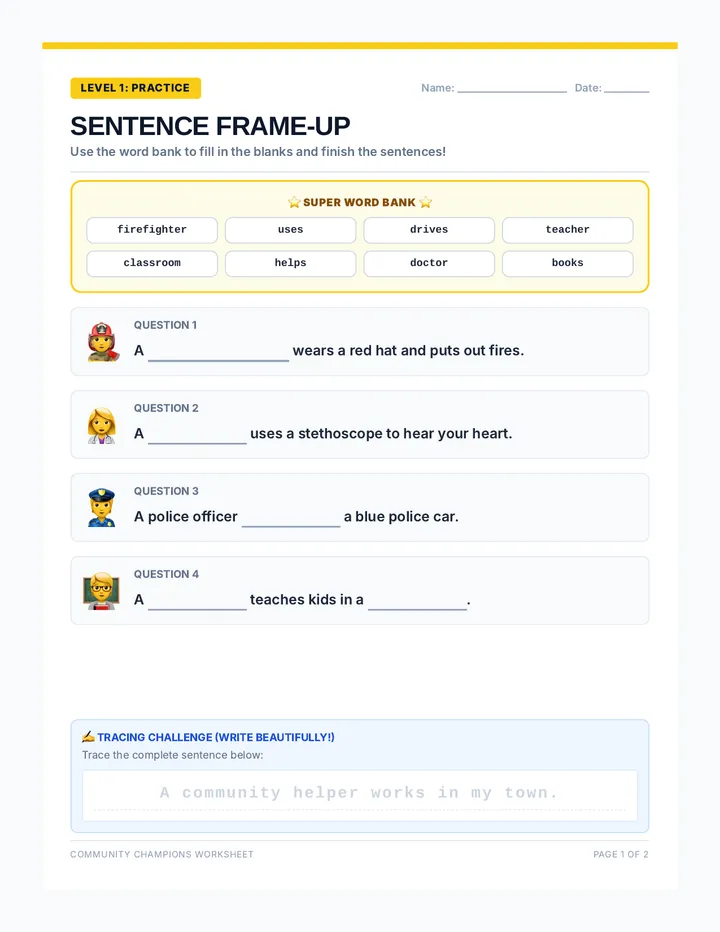
A sentence-building lesson for K-2 students. Using a tree-themed word bank, students write sentences on primary handwriting lines and color-code parts of speech to build foundational grammar and reading skills.
A high-intensity, evidence-based intervention lesson for rapidly teaching high-frequency words using orthographic mapping and phonetic grouping. Designed for daily 25-minute small group sessions with 1st and 2nd graders who have significant learning gaps.
A second-grade English Language Arts lesson exploring compound words through a combined theme of space and nature. Students practice breaking compound words into their two constituent words.
A highly visual and scaffolded sight word lesson focusing on Fry Words 225-250. Includes a multi-page student practice packet with picture clues and a complete teacher answer key and assessment guide.
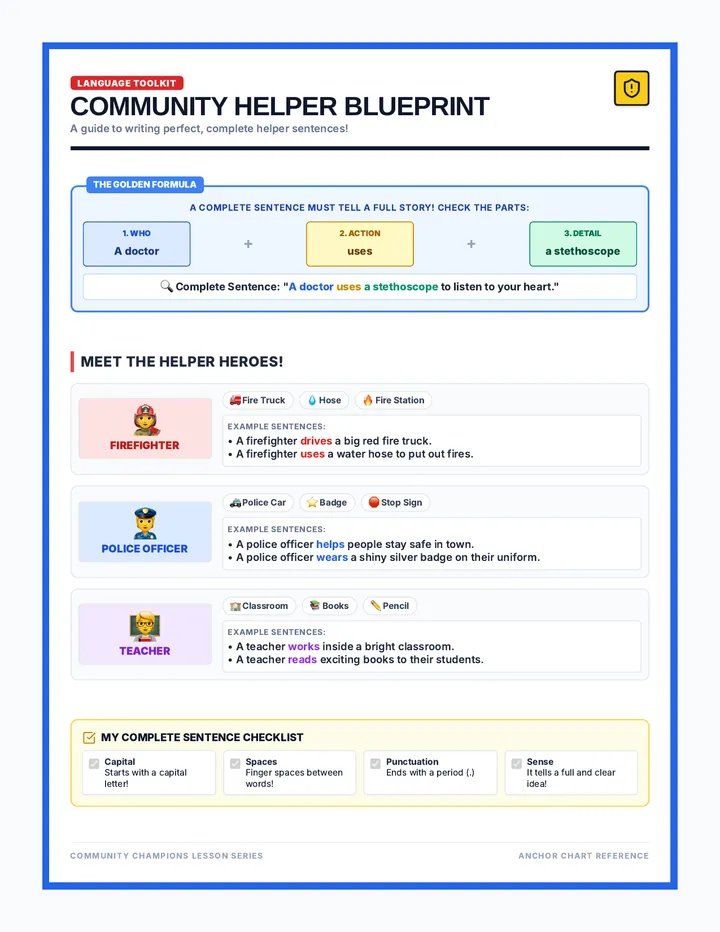
A colorful, K-2 sentence-building lesson where students use color-coded word cards to construct creative sentences. Students learn to identify and color-code nouns, verbs, adjectives, prepositions, sight words, and punctuation.
A primary sight word lesson focusing on mastering and distinguishing the high-frequency words 'were' and 'where' through highly visual classroom anchor charts and practice sheets.
A foundational lesson on compound words for early elementary students. It features an engaging visual presentation where students discover how two individual words join together to create a brand new word with a new meaning.
Weeks 10-12 focus on mnemonic devices, context clues, and tricky rule-breakers. Students help Keisha use her magical spellbook to crack homophones, sight words, and complex rules like 'i before e' and doubling final consonants.
Weeks 7-9 focus on tactile, kinesthetic, and auditory spelling strategies. Students assist Zoe, who can draw shields of light in the air to protect her neighborhood, while mastering plural rules, silent letters, and prefixes/suffixes.
Weeks 4-6 focus on visual word recognition and pattern finding. Students join Zariyah, who uses her magic camera to freeze time, helping her chunk letter combinations and solve community mysteries.
Weeks 1-3 focus on phonics and syllable division strategies. Students help Nia use closed, open, and r-controlled syllable rules to bring her magical drawings to life and solve neighborhood problems.
A hands-on, step-by-step writing lesson where students learn how to structure procedural paragraphs. Students act as pizza chefs to draft their own delicious sequential paragraphs.
A interactive phonics lesson targeting the three tricky broad vowel sounds: /a/ as in ball, /o/ as in do, and /u/ as in push. Students act as Sound Detectives to uncover and categorize these unusual spelling patterns.
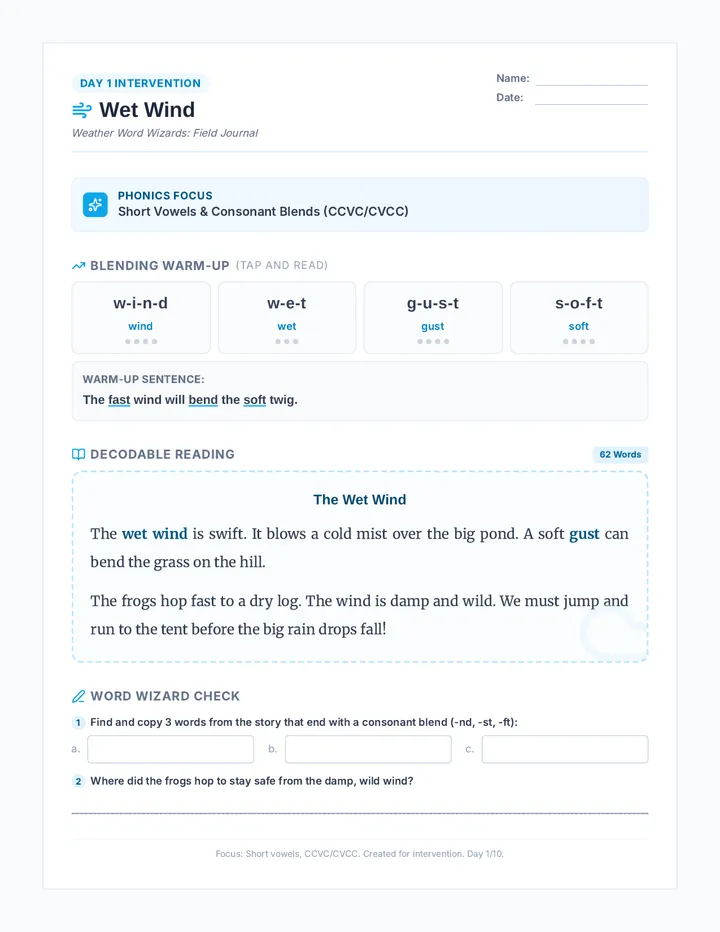
A high-impact CVC decoding intervention focusing on the contrast between short 'a' and short 'o' sounds. Includes structured minimal pair drills, 3-sentence decodable stories, and simple reading comprehension checks.
Blast off into space to navigate tricky celestial words with double meanings. Students apply their context clue mastery to outer space vocabulary, solving words like ruler, patient, plant, well, pitch, iron, note, and second.
Treasure hunt through the wild rainforest, tracking down words with multiple meanings in nature and daily life. Students decode words like stable, beam, pupil, chest, record, spring, bank, and band using sentence context clues.
Voyage into the ocean depths to investigate words that have dual meanings under the sea and on land. High-ability 2nd graders will analyze context clues to decode words like bill, seal, check, bolt, organ, racket, scale, and palm.
Students trek through a ancient jungle to evaluate an author's argument on archeological preservation, uncovering reasons and deciphering multiple-meaning words like ruler, patient, plant, and well.
Students travel to orbit to analyze an opinion piece about cleaning up space debris, identifying supporting reasons and tackling multiple-meaning words like stable, beam, pupil, and chest.
Students dive into an underwater adventure text to identify the author's claim about ocean conservation while exploring multiple-meaning words like bill, seal, check, and bolt.
Synthesize everything learned about characteristics, behaviors, and connections to create the ultimate character story map.
Establish "connections" between character traits and their behaviors, understanding why characters act the way they do in a narrative.
Investigate character "behavior," examining how actions, choices, and reactions drive a story forward.
Dive into the core term "characteristic" as students search for physical and personality traits that make a story character unique.
Introduce the concept of narrating and the key term "describe" as students join the Story Detective Agency to examine how storytellers share details about characters and settings.
A second-grade grammar lesson focused on mastering parts of speech (nouns, verbs, and adjectives) through hilarious word-fill activities. Students learn definitions, sort words, and complete a collaborative 3-page Mad Lib story.
A third-grade reading and grammar lesson focused on identifying and understanding common contractions. Students read an engaging 5-page story about Zorb, an alien visiting Earth, and complete practice activities that reinforce how contractions are formed.
Focuses on reading and writing 'ow' words in context with an adventure story, sentence-building activities, and camp graduation.
Focuses on encoding single-syllable 'ow' words with spelling dictation, word-building, and an interactive wilderness map-labeling task.
Focuses on decoding single-syllable 'ow' words through blend-and-read practices, card-matching, and a wilderness campfire read-aloud.
A mouth-watering introduction to paragraph writing using the classic Hamburger Model. Students learn to cook up perfect paragraphs with top buns (topic sentences), juicy fillings (supporting details), and bottom buns (concluding sentences), differentiated for grades 1-2 and 3-4.
An action-packed 10-week summer reading program styled as a Superhero Academy. Designed for rising second graders to supercharge their reading fluency, active retelling, and independent stamina.
A comprehensive 10-week summer reading program designed for rising second graders to boost fluency, comprehension retelling, and independent reading stamina through a camp-themed adventure.