Winter Return Review Plan
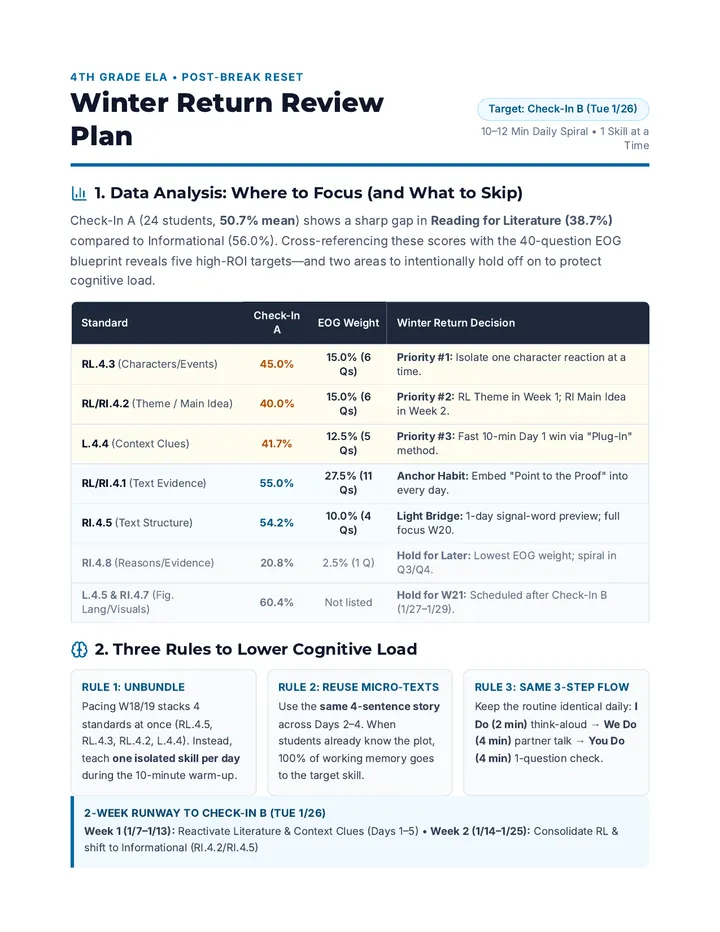
4th Grade ELA • Post-Break Reset
Winter Return Review Plan
Target: Check-In B (Tue 1/26)
10–12 Min Daily Spiral • 1 Skill at a Time
1. Data Analysis: Where to Focus (and What to Skip)
Check-In A (24 students, 50.7% mean) shows a sharp gap in Reading for Literature (38.7%) compared to Informational (56.0%). Cross-referencing these scores with the 40-question EOG blueprint reveals five high-ROI targets—and two areas to intentionally hold off on to protect cognitive load.
| Standard |
Check-In A |
EOG Weight |
Winter Return Decision |
| RL.4.3 (Characters/Events) |
45.0% |
15.0% (6 Qs) |
Priority #1: Isolate one character reaction at a time. |
| RL/RI.4.2 (Theme / Main Idea) |
40.0% |
15.0% (6 Qs) |
Priority #2: RL Theme in Week 1; RI Main Idea in Week 2. |
| L.4.4 (Context Clues) |
41.7% |
12.5% (5 Qs) |
Priority #3: Fast 10-min Day 1 win via "Plug-In" method. |
| RL/RI.4.1 (Text Evidence) |
55.0% |
27.5% (11 Qs) |
Anchor Habit: Embed "Point to the Proof" into every day. |
| RI.4.5 (Text Structure) |
54.2% |
10.0% (4 Qs) |
Light Bridge: 1-day signal-word preview; full focus W20. |
| RI.4.8 (Reasons/Evidence) |
20.8% |
2.5% (1 Q) |
Hold for Later: Lowest EOG weight; spiral in Q3/Q4. |
| L.4.5 & RI.4.7 (Fig. Lang/Visuals) |
60.4% |
Not listed |
Hold for W21: Scheduled after Check-In B (1/27–1/29). |
2. Three Rules to Lower Cognitive Load
Rule 1: Unbundle
Pacing W18/19 stacks 4 standards at once (RL.4.5, RL.4.3, RL.4.2, L.4.4). Instead, teach one isolated skill per day during the 10-minute warm-up.
Rule 2: Reuse Micro-Texts
Use the same 4-sentence story across Days 2–4. When students already know the plot, 100% of working memory goes to the target skill.
Rule 3: Same 3-Step Flow
Keep the routine identical daily: I Do (2 min) think-aloud → We Do (4 min) partner talk → You Do (4 min) 1-question check.
2-Week Runway to Check-In B (Tue 1/26)
Week 1 (1/7–1/13): Reactivate Literature & Context Clues (Days 1–5) • Week 2 (1/14–1/25): Consolidate RL & shift to Informational (RI.4.2/RI.4.5)
Week 1 Daily Spiral • Part 1
Days 1–2: Context Clues & Character Reaction
10–12 Min / Day
DAY 1 • Thu 1/7
L.4.4 Context Clues: "Plug-In" Warm-Up
Check-In A: 41.7%
Why Day 1: Zero passage stamina required. Gives students an immediate success coming back from break.
Micro-Text (Display on Board): "After waiting in the freezing rain for an hour, Maya felt exasperated and slammed her umbrella shut."
- I Do (2 min): Cover the underlined word. Ask: "What word makes sense here?" (frustrated/annoyed).
- We Do (4 min): Give 2 choices (relieved vs. frustrated). Partners plug each into the blank and explain why one fits the clue ("slammed her umbrella").
- You Do (4 min): Students write one clue word from a second sentence on a sticky note or whiteboard.
DAY 2 • Fri 1/8
RL.4.3 Character Reaction: One Moment
Check-In A: 45.0%
Why Day 2: Introduce one 4-sentence story we will reuse on Days 2–4 so students don't have to decode a new plot each day.
Shared 4-Sentence Story: "Leo stared at the broken science volcano on the kitchen floor. His sister Mia hid behind the couch, holding a roll of tape. Leo took a deep breath, grabbed a towel, and handed Mia the dustpan. 'We have twenty minutes before the bus comes—let's rebuild it together,' he said."
- I Do (2 min): Highlight the problem (broken volcano) and ask: "What did Leo do right after?"
- We Do (5 min): Complete the stem: "Because Leo ______, this shows he is ______." (Focus only on Leo's reaction—do not ask for theme yet.)
- You Do (5 min): Pick the best trait from 3 options (patient, careless, jealous) on fingers (1, 2, or 3).
Low-Cognitive-Load Rule: Keep the Day 2 shared story posted on an anchor chart or slide so it is ready to reuse on Days 3 and 4.
Week 1 Daily Spiral • Part 2
Days 3–4: Evidence & Theme (Same Story)
12 Min / Day
DAY 3 • Mon 1/11
RL.4.1 Text Evidence: "Point to the Proof"
EOG: 27.5% (RL/RI.1)
Why Day 3: Same volcano story, new lens. Students already know the plot, freeing mental space to hunt for exact proof.
Prompt: "How do we know Mia felt guilty about the volcano?" (Uses Day 2's shared story.)
- I Do (2 min): Show the difference between a guess and a quote/detail from the text.
- We Do (5 min): Partners put their finger on the exact 5 words that prove Mia felt guilty ("hid behind the couch").
- You Do (5 min): Students copy the exact proof phrase on a half-sheet or whiteboard—no full sentence required.
DAY 4 • Tue 1/12
RL.4.2 Theme: Problem + Reaction = Lesson
Check-In A: 40.0%
Why Day 4: Connects directly to your W18/19 pacing formula while still reusing the Day 2–3 volcano story.
Formula: \(\text{Problem} + \text{Character Reaction} = \text{Theme}\)
- I Do (2 min): Fill in the first two parts aloud: Volcano broke + Leo stayed calm & teamed up.
- We Do (5 min): Turn-and-talk: "What life lesson does Leo's reaction teach anyone, not just kids with a volcano?"
- You Do (5 min): Distinguish a Topic (volcanoes / teamwork) from a Theme (Working together solves big problems).
Teacher Tip: By Day 4, students have practiced 3 high-ROI literature skills (RL.4.3, RL.4.1, RL.4.2) on one familiar 4-sentence text—building confidence without fatigue.
Week 1 • Part 3 & Week 2 Bridge
Day 5 & Runway to Check-In B
Pacing Sync: W18–W20
DAY 5 • Wed 1/13
RI.4.5 Text Structure: Signal Word Spotter
Check-In A: 54.2%
Why Day 5: Gently shifts gears to Informational text before Week 20 without asking for a full summary yet.
Micro-Text (3 sentences): "Sea turtles often mistake floating plastic bags for jellyfish. As a result, many turtles become sick. Coastal towns are solving this by banning single-use plastic bags."
- I Do / We Do (5 min): Circle signal words first (As a result, solving this) before naming the structure.
- You Do (5 min): Match the paragraph to one structure card (Problem / Solution vs. Chronology).
Week 2 Bridge to Check-In B (Thu 1/14 – Tue 1/26)
Thu 1/14 – Fri 1/15 (End of W19)
Apply Days 1–4 routines to a short 2-paragraph story. Add RL.4.5 (turning point) only after students name the character reaction & theme.
Tue 1/19 – Mon 1/25 (W20 → Check-In B)
Shift daily 10-min spiral to RI.4.2 + RI.4.5 using "Chunk-Sum-Pic" margin notes and L.4.4 "Click or Clunk" on 1-page nonfiction texts.
Low-Pressure Accountability (No Grades, Just Data)
End every 10-minute spiral with a 1-question check (whiteboard flash, finger vote, or 1-line sticky note). Sort responses into two quick piles—"Got It" vs. "Pull for 3-Min Small Group"—so Check-In B prep stays calm, targeted, and predictable.
Check-In B Date: Tuesday, January 26 Spiral Time: 10–12 min/day • 1 skill per day
Winter Reset Lesson Plans
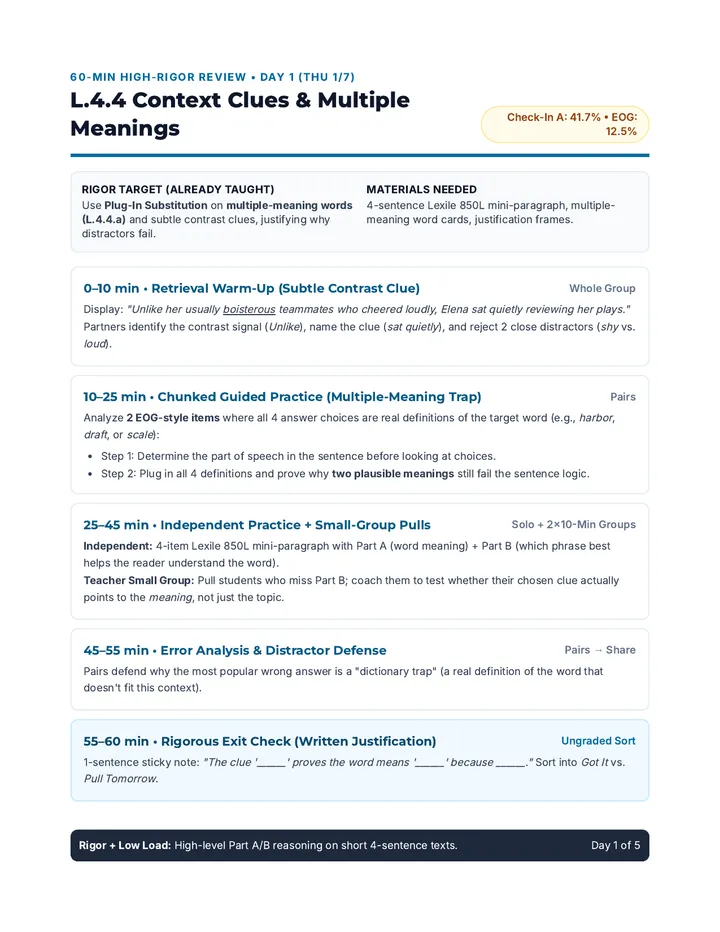
60-Min High-Rigor Review • Day 1 (Thu 1/7)
L.4.4 Context Clues & Multiple Meanings
Check-In A: 41.7% • EOG: 12.5%
Rigor Target (Already Taught)
Use Plug-In Substitution on multiple-meaning words (L.4.4.a) and subtle contrast clues, justifying why distractors fail.
Materials Needed
4-sentence Lexile 850L mini-paragraph, multiple-meaning word cards, justification frames.
0–10 min • Retrieval Warm-Up (Subtle Contrast Clue)
Whole Group
Display: "Unlike her usually boisterous teammates who cheered loudly, Elena sat quietly reviewing her plays." Partners identify the contrast signal (Unlike), name the clue (sat quietly), and reject 2 close distractors (shy vs. loud).
10–25 min • Chunked Guided Practice (Multiple-Meaning Trap)
Pairs
Analyze 2 EOG-style items where all 4 answer choices are real definitions of the target word (e.g., harbor, draft, or scale):
- Step 1: Determine the part of speech in the sentence before looking at choices.
- Step 2: Plug in all 4 definitions and prove why two plausible meanings still fail the sentence logic.
25–45 min • Independent Practice + Small-Group Pulls
Solo + 2x10-Min Groups
Independent: 4-item Lexile 850L mini-paragraph with Part A (word meaning) + Part B (which phrase best helps the reader understand the word).
Teacher Small Group: Pull students who miss Part B; coach them to test whether their chosen clue actually points to the meaning, not just the topic.
45–55 min • Error Analysis & Distractor Defense
Pairs → Share
Pairs defend why the most popular wrong answer is a "dictionary trap" (a real definition of the word that doesn't fit this context).
55–60 min • Rigorous Exit Check (Written Justification)
Ungraded Sort
1-sentence sticky note: "The clue '______' proves the word means '______' because ______." Sort into Got It vs. Pull Tomorrow.
Rigor + Low Load: High-level Part A/B reasoning on short 4-sentence texts. Day 1 of 5
60-Min High-Rigor Review • Day 2 (Fri 1/8)
RL.4.3 Character Shift & Cause-Effect
Check-In A: 45.0% • EOG: 15.0%
Rigor Target (Already Taught)
Analyze how one character's reaction shifts another character across a turning point, citing specific text details.
Materials Needed
Volcano 4-sentence anchor + 2-paragraph continuation, Part A/Part B EOG question stems.
0–12 min • Retrieval Warm-Up (Shared Volcano Story)
Whole Group
Read the 4-sentence Volcano story aloud. Push beyond basic traits: "How did Leo's calm reaction directly change what Mia did next?" Partners trace the cause-and-effect chain.
12–28 min • Chunked Guided Practice (Character Shift)
Pairs
Reveal Paragraph 2 (paint spills; Mia wants to quit, Leo splits the tasks):
- Compare Mia's Beginning reaction (defeated/hiding) vs. End reaction (determined/helpful).
- Identify the exact line of dialogue that triggered the turning point.
28–45 min • Independent Practice + Small-Group Pulls
Solo + 2x8-Min Groups
Independent: 2 EOG-level RL.4.3 questions (1 "How does Leo's action affect the events?" + 1 Part A/Part B character trait & quote pair).
Teacher Small Group: Pull students who pick traits true only in Paragraph 1; practice checking if the trait holds up after the turning point.
45–55 min • Partner Debrief ("Beginning vs. End Trap")
Pairs → Share
Analyze the #1 distractor: "Why is 'discouraged' right for Mia in paragraph 1, but wrong for the question asking about Mia at the end?"
55–60 min • Rigorous Exit Check
Written 1-Sentence Proof
"Explain how Leo's words changed Mia's actions, using one exact detail from Paragraph 2."
Rigor + Low Load: Deep cause-effect analysis on the same familiar Volcano story. Day 2 of 5
60-Min High-Rigor Review • Day 3 (Mon 1/11)
RL.4.1 Implicit Inference & Proof Synthesis
Check-In A: 55.0% • EOG: 27.5%
Rigor Target (Already Taught)
Defend an implicit inference by synthesizing 2 details and eliminating "true-but-irrelevant" quote distractors.
Materials Needed
Volcano 2-paragraph story (from Day 2), 3 EOG-style "Best Evidence" items.
0–12 min • Retrieval Warm-Up ("Two-Clue Inference")
Whole Group
Prompt on Volcano story: "Why was the science project so important to Leo?" Students must combine two separate clues (checking the clock + refusing to give up) rather than relying on one literal sentence.
12–28 min • Chunked Guided Practice ("True-But-Irrelevant" Trap)
Pairs
Give 1 inference and 3 real quotes from the Volcano story (all 3 are literally in the text!):
- Label each quote: Proves the Inference, True but Off-Topic, or Contradicts.
- Explain why EOG distractors use real quotes to trick students who only skim for matching words.
28–45 min • Independent Evidence Synthesis + Small Groups
Solo + 2x8-Min Groups
Independent: 3 EOG-level RL.4.1 questions ("Which two details best support..." and "What can the reader infer about...").
Teacher Small Group: Pull students who fall for word-matching traps; coach them to ask, "Does this quote actually answer the WHY in the question?"
45–55 min • Partner Error Analysis
Pairs → Share
Pairs examine a sample student response with a "true-but-irrelevant" quote and rewrite it with the strongest evidence.
55–60 min • Rigorous Exit Check
Evidence Ranking
Given 1 inference and 2 true quotes (A and B), circle the stronger proof and write 1 phrase explaining why the other is weaker.
Rigor + Low Load: High-level distractor evaluation on a story students already know cold. Day 3 of 5
60-Min High-Rigor Review • Day 4 (Tue 1/12)
RL.4.2 Theme Evaluation & Text Coverage
Check-In A: 40.0% • EOG: 15.0%
Rigor Target (Already Taught)
Evaluate competing themes to find the one supported by the entire story—ruling out partial-text lessons.
Materials Needed
Volcano story (wrap-up), 1 short fable (Lexile 820L), Competing Themes checklist.
0–12 min • Retrieval Warm-Up (Competing Themes)
Whole Group
Use \(\text{Problem} + \text{Reaction} = \text{Theme}\) on the Volcano story. Compare two real lessons: "Be careful with school projects" (too narrow) vs. "Staying calm and working together solves big problems" (covers the whole plot).
12–28 min • Chunked Guided Practice ("Whole-Text Coverage")
Pairs
Test 4 EOG-style theme choices against the 2-paragraph Volcano story:
- Eliminate Summary (has character names) and Topic (only 1–2 words).
- Eliminate the Partial-Text Theme (only fits Paragraph 1, not the resolution).
28–45 min • Independent Practice + Small-Group Pulls
Solo + 2x8-Min Groups
Independent: Read a 1-paragraph fable (820L). Answer 1 Part A/Part B theme-and-evidence pair + write a 2-sentence theme justification citing both the problem and resolution.
Teacher Small Group: Pull students who pick partial-text lessons; map Problem + Resolution before looking at choices.
45–55 min • Partner Debrief ("Cross-Text Theme")
Pairs → Share
Quick synthesis: "How is the theme of today's fable similar to—or different from—the Volcano story?"
55–60 min • Rigorous Exit Check
Written Justification
"Why is 'Never rush' a weaker theme for this fable than 'Honesty builds trust'?" (1-sentence response).
Rigor + Low Load: Evaluates competing themes & cross-text connections on a 1-paragraph fable. Day 4 of 5
60-Min High-Rigor Review • Day 5 (Wed 1/13)
RI.4.5 & RI.4.1: Structure & Author's Purpose
Check-In A: 54.2% • EOG: 10.0%
Rigor Target (Already Taught)
Identify text structure even without obvious signal words and explain how the structure supports the author's point.
Materials Needed
2 contrasting 4-sentence nonfiction paragraphs on the same topic (Cause/Effect vs. Problem/Solution).
0–10 min • Retrieval Warm-Up (Signal Word + Purpose)
Whole Group
Display the 3-sentence Sea Turtle text. After naming Problem/Solution, push rigor: "Why did the author organize it this way instead of Chronology?" (To show how towns fixed the danger, not just a timeline).
10–25 min • Chunked Guided Practice (Implicit Structure)
Pairs
Compare 2 short paragraphs on ocean plastic where obvious signal words are removed:
- Paragraph A explains why currents trap plastic (Cause/Effect without "because").
- Paragraph B explains how new nets capture plastic (Problem/Solution without "solve").
25–45 min • Independent Practice + Small-Group Pulls
Solo + 2x10-Min Groups
Independent: 3 EOG-level questions ("How does paragraph 2 contribute to the passage?" + 1 RI.4.1 inference + 1 Part B evidence match).
Teacher Small Group: Pull students who rely only on signal words; practice asking "What is the job of this paragraph?"
45–55 min • Partner Debrief ("Paragraph Job")
Pairs → Share
Partners defend why the author placed Paragraph A before Paragraph B (readers must understand the cause before the solution makes sense).
55–60 min • Rigorous Exit Check & Week 2 Preview
Ungraded Sort
1-sentence exit slip: "How does the structure of Paragraph B help the author support their main point?" Bridges directly into W20 (RI.4.2 + RI.4.5) on Tue 1/19.
Week 2 Bridge: Ready for full-passage RI.4.2 + RI.4.5 stamina in W20 before Check-In B (1/26). Day 5 of 5