Part 3 Analysis Slides
NYS ELA Regents • Part 3 Reading & Essay Protocol
Part 3 Essay (The MINIMUM):
“The Year of Silence”
Read with our Before–During–After protocol to find everything needed for your Part 3 template.
By Kevin Brockmeier • Exam pp. 38–41
Before • During • After
BEFORE Reading: Preview & Purpose
Step 1
1. Text Features (pp. 38–41)
Look at the Title (“The Year of Silence”), Author (Kevin Brockmeier), Line Numbers (5, 10, 15...), and Footnotes at the bottom.
2. Prior Knowledge
Think: What sounds do you hear every day in a busy city? Would you like total silence?
3. Make a Prediction
Based on the title, what do you think happens to the city during “The Year of Silence”?
4. Reading Purpose
Find the Central Idea, 1 Literary Element (Conflict, Characterization, or Setting), and 2 Quotes for our template!
DURING Reading: Our Class Protocol
Step 2
1. Teacher Model:
Listen & watch how I read Paragraph 1 (Lines 1–5) and annotate for our purpose.
2. Key Words:
Underline unfamiliar words and translate or define them on your own.
3. Silent Read & Annotate:
Read silently on your own during the timer and annotate quotes that fit our purpose.
4. Fluent Read-Aloud:
Follow along as the teacher reads the full text with fluency to check your annotations.
Tip: Underline quotes that show how the citizens’ feelings change!
AFTER Reading: Find the Central Idea
Step 3
Beginning (1–26)
Noise → Calm
The loud city stops. People feel peaceful and happy.
Middle (40–52)
Total Silence
The city bans all noise. Tiny sounds start to feel annoying.
End (63–73)
Missing Sound
People miss noise and open a secret “noise club” for joy.
Central Idea: Humans need a balance between peace and excitement—too much of either leaves us wanting the other.
AFTER Reading: Pick 1 Element & Quotes
Line Numbers: 5, 10, 15...
SETTING
Where & when the story happens (city sounds vs. silence).
Look at: Lines 1–5 or 55–60
CONFLICT
The struggle between noise and total silence.
Look at: Lines 33–38 or 50–52
CHARACTERIZATION
How the citizens feel, hunger for silence, and change.
Look at: Lines 24–27 or 72–73
For Quote 1 (Central Idea), check Lines 25–27 or Lines 63–64!
AFTER Reading: Fill In Your Template
Post-Reading Task
In the text “The Year of Silence” by Kevin Brockmeier, the author uses the literary element of (Conflict / Characterization / Setting) to develop the central idea that (central idea).
A quote that supports the central idea is “quote” (lines ___). This quote supports the central idea because (explain why).
The author uses (literary element) in the text, in the quote “quote” (lines ___). This quote represents (literary element) because (explain why).
The literary element helps the author develop the central idea because (connect them).
Part 3 Essay Template
NYS ELA Regents • ELL Writing Frame
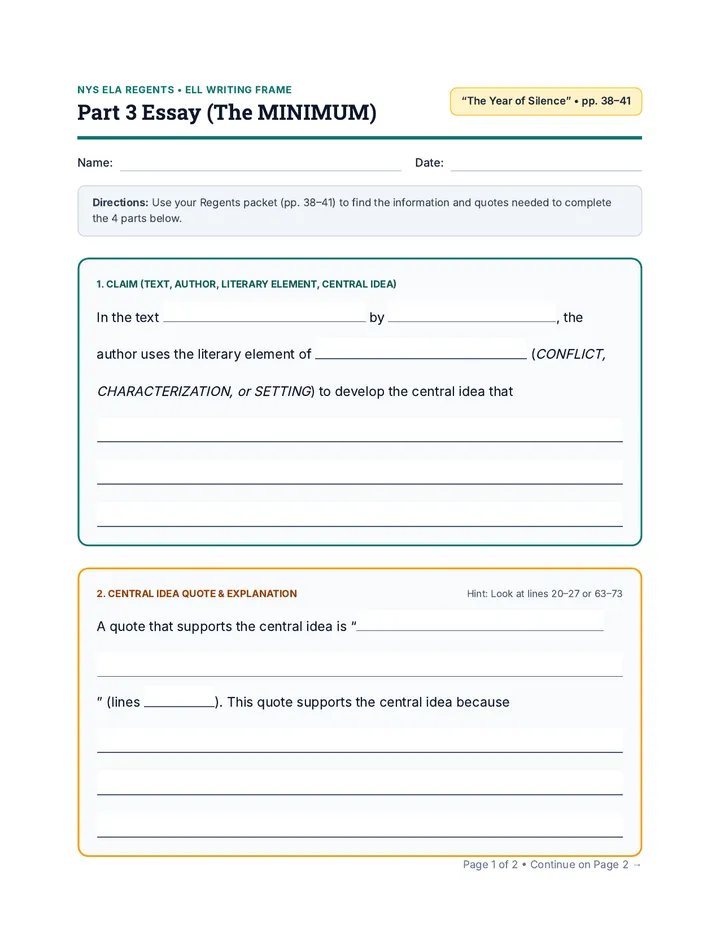
Part 3 Essay (The MINIMUM)
“The Year of Silence” • pp. 38–41
Name:
Date:
Directions: Use your Regents packet (pp. 38–41) to find the information and quotes needed to complete the 4 parts below.
1. Claim (Text, Author, Literary Element, Central Idea)
In the text by , the author uses the literary element of (CONFLICT, CHARACTERIZATION, or SETTING) to develop the central idea that
2. Central Idea Quote & Explanation Hint: Look at lines 20–27 or 63–73
A quote that supports the central idea is “
” (lines ). This quote supports the central idea because
Page 1 of 2 • Continue on Page 2 →
Part 3 Essay (The MINIMUM) — Continued
Page 2 of 2
3. Literary Element Quote & Explanation Hint: Setting (1–5), Conflict (50–52), Char. (24–31, 72–73)
The author uses in the text, in the quote “
” (lines ). This quote represents because
4. Final Connection
The literary element helps the author develop the central idea because
Filled in text name, author, & 1 element
Copied 2 exact quotes with (lines ___)
Explained both quotes after “because”
Connected element to central idea
Silence Analysis Teacher Guide
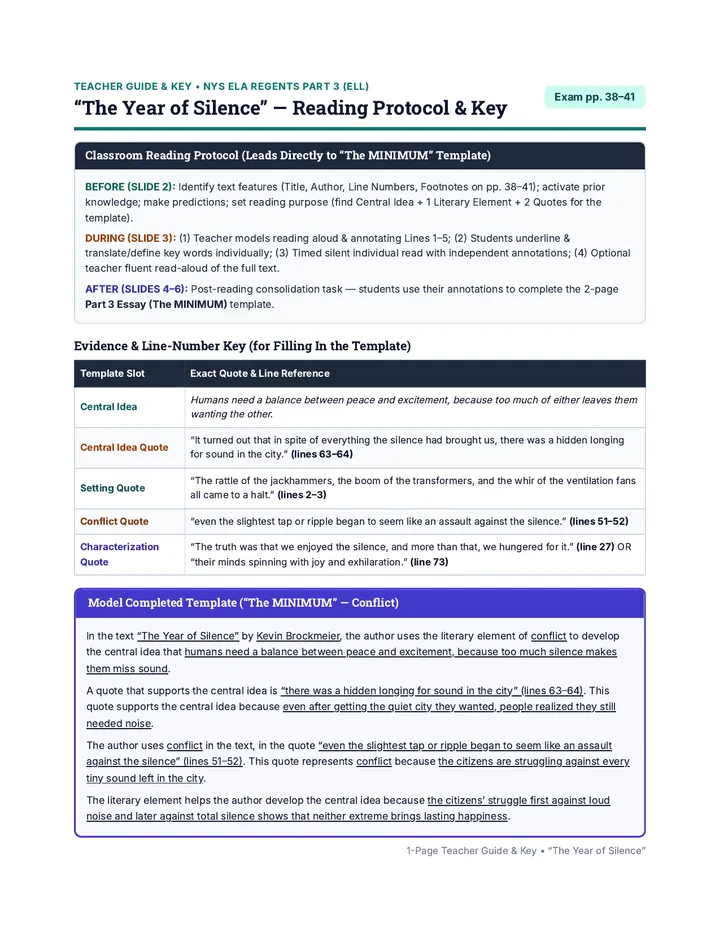
Teacher Guide & Key • NYS ELA Regents Part 3 (ELL)
“The Year of Silence” — Reading Protocol & Key
Exam pp. 38–41
Classroom Reading Protocol (Leads Directly to “The MINIMUM” Template)
BEFORE (Slide 2): Identify text features (Title, Author, Line Numbers, Footnotes on pp. 38–41); activate prior knowledge; make predictions; set reading purpose (find Central Idea + 1 Literary Element + 2 Quotes for the template).
DURING (Slide 3): (1) Teacher models reading aloud & annotating Lines 1–5; (2) Students underline & translate/define key words individually; (3) Timed silent individual read with independent annotations; (4) Optional teacher fluent read-aloud of the full text.
AFTER (Slides 4–6): Post-reading consolidation task — students use their annotations to complete the 2-page Part 3 Essay (The MINIMUM) template.
Evidence & Line-Number Key (for Filling In the Template)
| Template Slot |
Exact Quote & Line Reference |
| Central Idea |
Humans need a balance between peace and excitement, because too much of either leaves them wanting the other. |
| Central Idea Quote |
“It turned out that in spite of everything the silence had brought us, there was a hidden longing for sound in the city.” (lines 63–64) |
| Setting Quote |
“The rattle of the jackhammers, the boom of the transformers, and the whir of the ventilation fans all came to a halt.” (lines 2–3) |
| Conflict Quote |
“even the slightest tap or ripple began to seem like an assault against the silence.” (lines 51–52) |
| Characterization Quote |
“The truth was that we enjoyed the silence, and more than that, we hungered for it.” (line 27) OR “their minds spinning with joy and exhilaration.” (line 73) |
Model Completed Template (“The MINIMUM” — Conflict)
In the text “The Year of Silence” by Kevin Brockmeier, the author uses the literary element of conflict to develop the central idea that humans need a balance between peace and excitement, because too much silence makes them miss sound.
A quote that supports the central idea is “there was a hidden longing for sound in the city” (lines 63–64). This quote supports the central idea because even after getting the quiet city they wanted, people realized they still needed noise.
The author uses conflict in the text, in the quote “even the slightest tap or ripple began to seem like an assault against the silence” (lines 51–52). This quote represents conflict because the citizens are struggling against every tiny sound left in the city.
The literary element helps the author develop the central idea because the citizens’ struggle first against loud noise and later against total silence shows that neither extreme brings lasting happiness.
1-Page Teacher Guide & Key • “The Year of Silence”