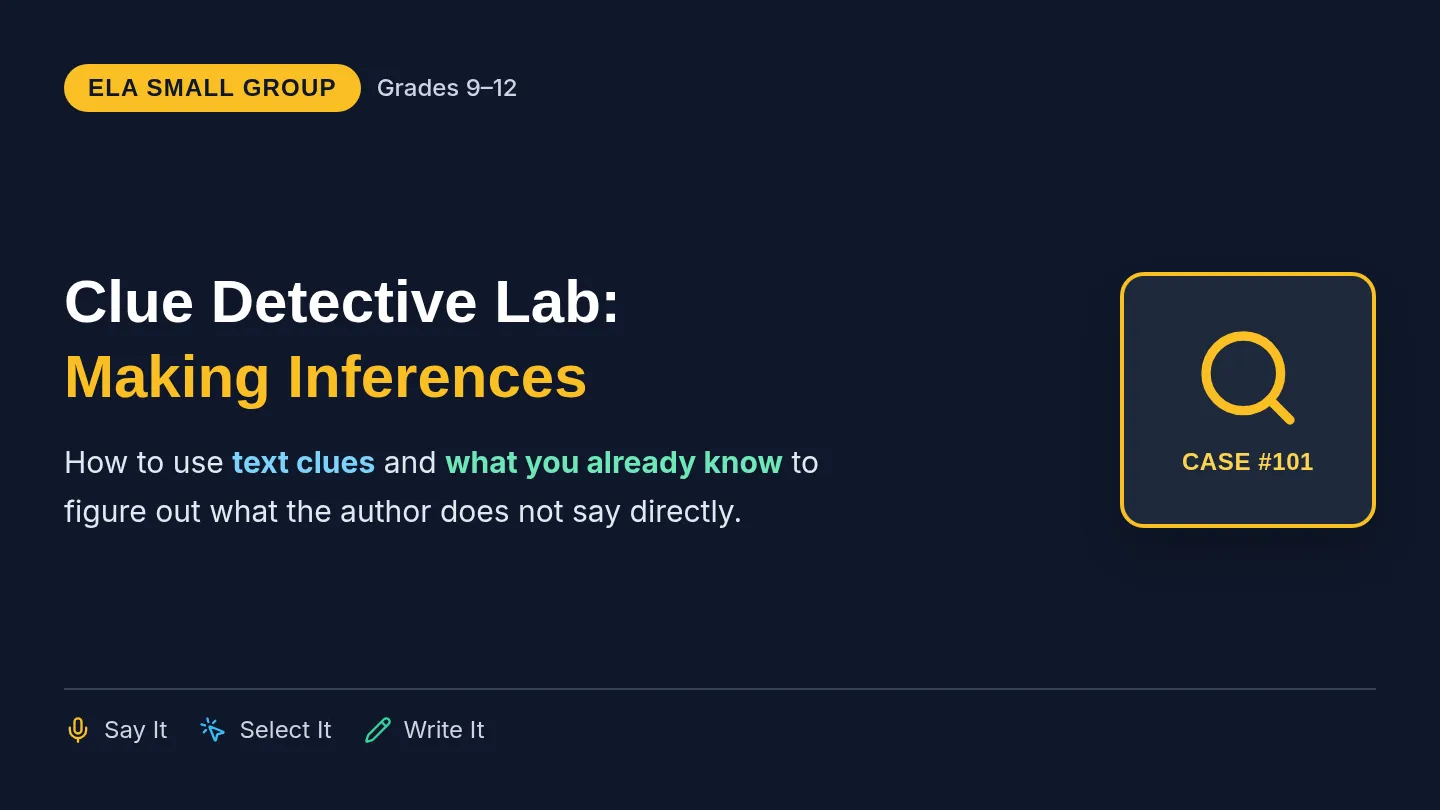
Inference Clues Slides ELA Small Group Grades 9–12
Clue Detective Lab:
Making Inferences
How to use text clues and what you already know to figure out what the author does not say directly.
CASE #101
Say It Select It Write It
What Is an Inference?
THE FORMULA
Authors do not tell us everything. An inference is a smart guess based on evidence.
Text Clues
What the words or picture actually show
My Brain
What I already know from real life
=
Inference
My smart guess about what is happening
Key Rule: Every inference must be backed up by a clue!
Warm-Up: Picture Clues
LOOK & INFER
What You See at the Front Door:
☂️ Dripping umbrella
💧 Water puddle
👟 Muddy shoes
Nobody said a word, but the clues tell a story.
Use the Sentence Frame:
I see ________________________.
I know _______________________.
So I infer ____________________.
Turn & tell a partner, or point to a clue!
Watch Me Model
I DO
“Maya stared at the team list on the gym wall. Her eyes stayed near the bottom, then she sighed, shoved her basketball jersey into her backpack, and walked out without saying goodbye.”
1. Text Clues
• Stared at team list
• Sighed
• Stuffed jersey away
2. My Brain
People sigh and put gear away when they get disappointing news about a tryout.
3. My Inference
Maya did not make the basketball team and feels upset.
Let’s Try Together
WE DO
“Marcus kept checking the classroom clock. He tapped his pencil fast against his desk and slid his blank worksheet under his binder when the teacher walked by.”
Which inference makes the most sense?
A. Marcus is excited to share his finished work.
B. Marcus is nervous because he is behind on his work.
C. Marcus wants to borrow a pencil from a friend.
Show Your Thinking
Say It: Share A, B, or C and one clue.
Select It: Hold up 1, 2, or 3 fingers.
Write It: Jot down the clue you spotted.
Sentence Frame Toolkit
SAY OR WRITE
Use any of these frames when you explain your evidence and inference:
“The text says ____________, and I know ____________, so I infer ____________.”
“I noticed ____________. That tells me ____________.”
“Based on ____________, the character probably feels ____________.”
Your Turn: Case File Practice
YOU DO
1. Select It
Check the inference that fits the clues best.
2. Organize It
Fill in the Text Clue and My Brain boxes.
3. Share It
Write your sentence frame OR say it out loud!
Remember: Look for the clues, connect what you know, and prove your inference.
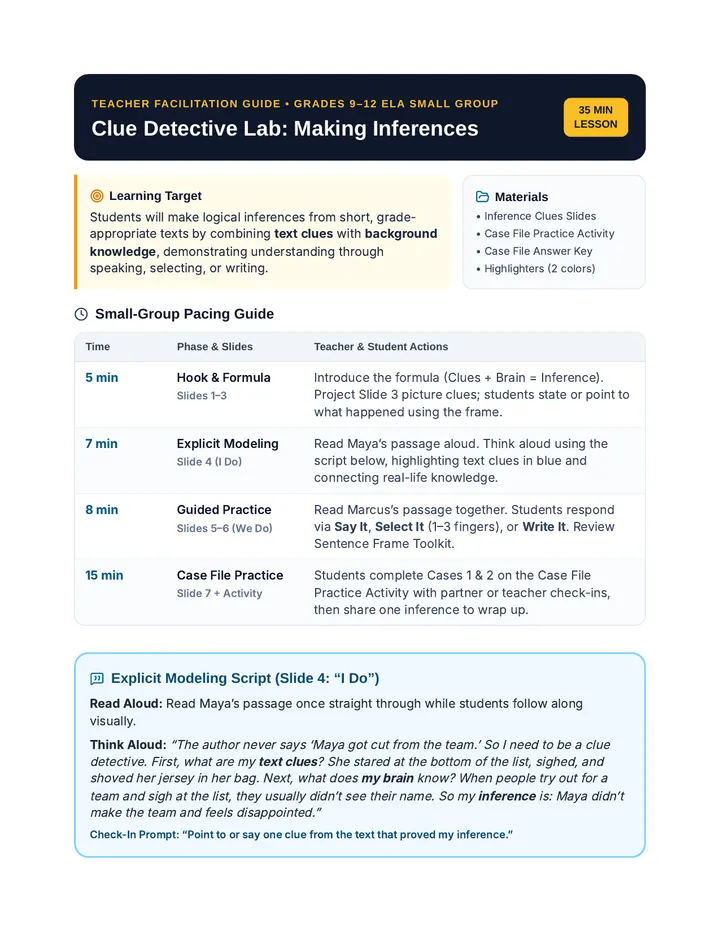
Clue Detective Teacher Guide Teacher Facilitation Guide • Grades 9–12 ELA Small Group
Clue Detective Lab: Making Inferences
35 MIN
Learning Target
Students will make logical inferences from short, grade-appropriate texts by combining text clues with background knowledge , demonstrating understanding through speaking, selecting, or writing.
Materials
• Inference Clues Slides
• Case File Practice Activity
• Case File Answer Key
• Highlighters (2 colors)
Small-Group Pacing Guide
Time
Phase & Slides
Teacher & Student Actions
5 min
Hook & Formula
Introduce the formula (Clues + Brain = Inference). Project Slide 3 picture clues; students state or point to what happened using the frame.
7 min
Explicit Modeling
Read Maya’s passage aloud. Think aloud using the script below, highlighting text clues in blue and connecting real-life knowledge.
8 min
Guided Practice
Read Marcus’s passage together. Students respond via Say It , Select It (1–3 fingers), or Write It . Review Sentence Frame Toolkit.
15 min
Case File Practice
Students complete Cases 1 & 2 on the Case File Practice Activity with partner or teacher check-ins, then share one inference to wrap up.
Explicit Modeling Script (Slide 4: “I Do”)
Read Aloud: Read Maya’s passage once straight through while students follow along visually.
Think Aloud: “The author never says ‘Maya got cut from the team.’ So I need to be a clue detective. First, what are my text clues ? She stared at the bottom of the list, sighed, and shoved her jersey in her bag. Next, what does my brain know? When people try out for a team and sigh at the list, they usually didn’t see their name. So my inference is: Maya didn’t make the team and feels disappointed.”
Check-In Prompt: “Point to or say one clue from the text that proved my inference.”
Scaffolds & Facilitation Strategies
PAGE 2 OF 2
Supporting Multiple Response Modes
Say It (Speaking)
Allow students with writing fatigue or dysgraphia to dictate their sentence frame to you or a partner. Keep Slide 6 visible as a visual anchor.
Select It (Point/Check)
Use the 3-choice “Select It” boxes on Slides and the Activity. Students can hold up 1–3 fingers, point, or circle the best inference before organizing clues.
Write It (Scaffolded)
Students may write short phrases or single words inside the graphic organizer boxes rather than full paragraphs. Sentence starters reduce cognitive load.
Reading & Writing Scaffolds
Echo or Read-Aloud Support: Read Case 1 and Case 2 passages aloud first so decoding barriers do not block comprehension. Have students track with a finger or highlighter.Color-Coding Clues: Give students two highlighters (e.g., blue for Text Clues , yellow for Feelings/Actions ) to physically mark evidence before filling in the organizer.Chunked Pacing: Complete Case 1 together as a supported bridge if students need extra modeling before attempting Case 2 independently.
Common Misconceptions & Corrective Prompts
If a student...
Try this prompt...
Makes a wild guess with no connection to the passage.
“Show me the exact words in the story that made you think that.”
Repeats a literal fact instead of making an inference.
“That’s a great text clue! Now add what your brain knows—what does that clue tell us?”
Struggles to put thoughts into a complete sentence.
“Let’s fill in the blanks together: ‘The text says ___, so I infer ___.’”
3-Minute Wrap-Up Debrief
Ask each student to share one thing they inferred today using any mode (point, speak, or read their frame): “What clue helped you most?”
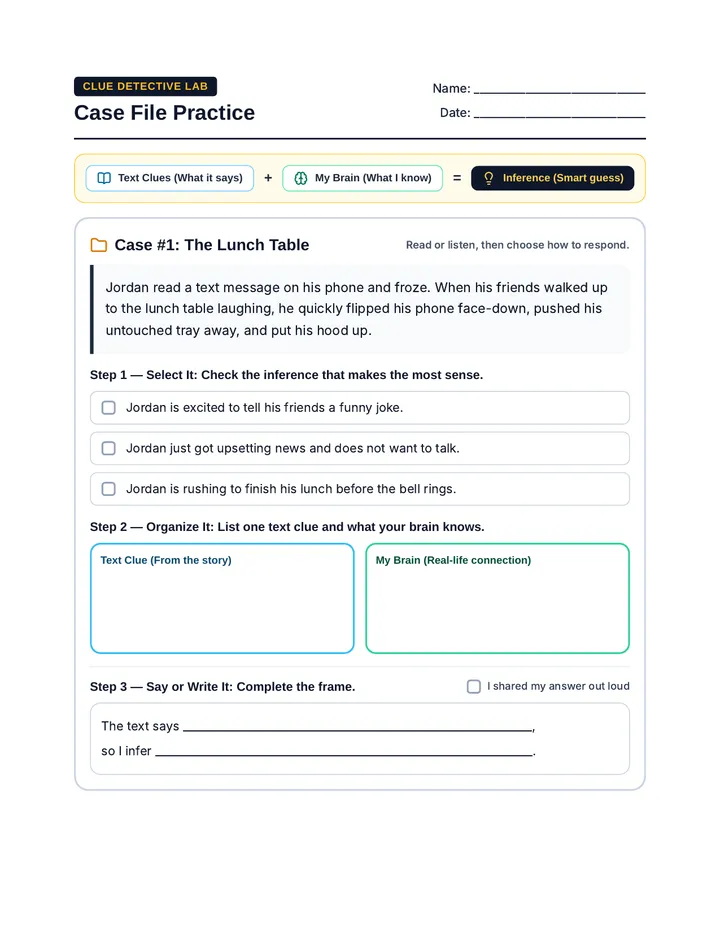
Case File Practice Activity Clue Detective Lab
Case File Practice
Name: ______________________________
Date: ______________________________
Text Clues (What it says)
My Brain (What I know)
=
Inference (Smart guess)
Case #1: The Lunch Table
Read or listen, then choose how to respond.
Jordan read a text message on his phone and froze. When his friends walked up to the lunch table laughing, he quickly flipped his phone face-down, pushed his untouched tray away, and put his hood up.
Step 1 — Select It: Check the inference that makes the most sense.
Jordan is excited to tell his friends a funny joke.
Jordan just got upsetting news and does not want to talk.
Jordan is rushing to finish his lunch before the bell rings.
Step 2 — Organize It: List one text clue and what your brain knows.
Text Clue (From the story)
My Brain (Real-life connection)
Step 3 — Say or Write It: Complete the frame.
I shared my answer out loud
The text says ______________________________________________________________,
so I infer ___________________________________________________________________.
Clue Detective Lab • Case File Practice PAGE 2 OF 2
Case #2: The Late Shift
Read or listen, then choose how to respond.
Elena yawned behind the store counter and rubbed her sore feet. It was 9:45 PM, and she still had math homework in her backpack. When her manager asked if she could stay an extra hour, Elena sighed and looked at the door.
Step 1 — Select It: Check the inference that makes the most sense.
Elena is hoping to work as late as possible tonight.
Elena is exhausted and wants to go home to rest and do homework.
Elena forgot where she put her backpack at school.
Step 2 — Organize It: List one text clue and what your brain knows.
Text Clue (From the story)
My Brain (Real-life connection)
Step 3 — Say or Write It: Complete the frame.
I shared my answer out loud
Based on ____________________________________________________________________,
Elena probably feels __________________________________________________________.
How did you show your thinking today? (Check all that apply)
I said it out loud
I selected / pointed
I wrote my clues
Case File Answer Key Teacher Reference • Clue Detective Lab
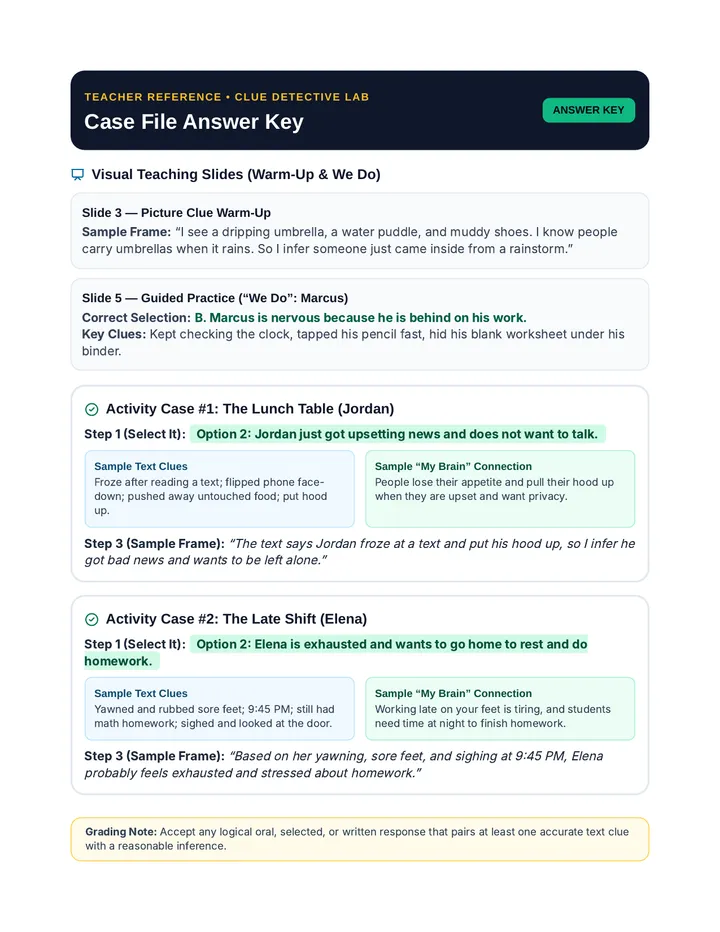
Case File Answer Key
ANSWER KEY
Visual Teaching Slides (Warm-Up & We Do)
Slide 3 — Picture Clue Warm-Up
Sample Frame: “I see a dripping umbrella, a water puddle, and muddy shoes. I know people carry umbrellas when it rains. So I infer someone just came inside from a rainstorm.”
Slide 5 — Guided Practice (“We Do”: Marcus)
Correct Selection: B. Marcus is nervous because he is behind on his work.Key Clues: Kept checking the clock, tapped his pencil fast, hid his blank worksheet under his binder.
Activity Case #1: The Lunch Table (Jordan)
Step 1 (Select It): Option 2: Jordan just got upsetting news and does not want to talk.
Sample Text Clues
Froze after reading a text; flipped phone face-down; pushed away untouched food; put hood up.
Sample “My Brain” Connection
People lose their appetite and pull their hood up when they are upset and want privacy.
Step 3 (Sample Frame): “The text says Jordan froze at a text and put his hood up, so I infer he got bad news and wants to be left alone.”
Activity Case #2: The Late Shift (Elena)
Step 1 (Select It): Option 2: Elena is exhausted and wants to go home to rest and do homework.
Sample Text Clues
Yawned and rubbed sore feet; 9:45 PM; still had math homework; sighed and looked at the door.
Sample “My Brain” Connection
Working late on your feet is tiring, and students need time at night to finish homework.
Step 3 (Sample Frame): “Based on her yawning, sore feet, and sighing at 9:45 PM, Elena probably feels exhausted and stressed about homework.”
Grading Note: Accept any logical oral, selected, or written response that pairs at least one accurate text clue with a reasonable inference.