Stormy Light Worksheet Regents ELA Part 3 • Practice Set 1 Focus: Setting & Sensory Imagery
Stormy Light
Name: ________________________ Date: ____________
Context: A coastal lighthouse protects ships from crashing into hidden rocks during fierce ocean storms.
Key Vocabulary (ELL Support)
relentless (adj.) — never stopping or getting weaker (syn: nonstop)
flicker (verb) — to shine unsteadily, going bright and dim (syn: blink)
steadfast (adj.) — firm, steady, and not giving up (syn: loyal, strong)
Excerpt from “The Lantern at Cape Jude”
Read carefully & annotate
1By October, the Atlantic no longer whispered against the base of Cape Jude; it hammered. Salt spray
2coated the narrow spiral stairs until every iron step gleamed like wet ice. Sixteen-year-old Mara
3gripped the cold railing and climbed, carrying the heavy brass oil can against her hip.
4Outside, a relentless wind howled through the shutters, rattling the thick glass panes of the
5lantern room. Far below, black waves swallowed the jagged reef, hiding the rocks that could tear
6a fishing boat apart in seconds. Mara’s fingers ached from the damp chill, and her father’s fever
7had kept him downstairs since dawn. For the first time, the tower’s lamp belonged to her alone.
8When she struck the match, the wick caught with a nervous flicker. A sudden gust pressed
9against the tower, and the flame shrank to a trembling blue dot. Mara cupped her bare hands
10around the glass chimney, shielding the tiny fire until it steadied into a bright, golden spear.
11Slowly, the great lens began to turn. A warm ribbon of light swept across the dark water,
12cutting through the fog like a steadfast promise. Mara exhaled, watching the beam reach the
13horizon, and tightened her grip on the railing for the long night ahead.
Active Reading Key: Underline sensory details (sight, sound, touch) Circle Mara’s actions Star (★) a big idea
Stormy Light • Part 2
Literary Element Lab & Evidence Builder
Name: ______________________
Choose Your Support Level (Mix & Match Anytime)
Level 1: Guided
Use the word bank & fill-in sentence frames.
Level 2: Starters
Use the sentence starters to guide your ideas.
Level 3: Independent
Write your analysis in your own academic words.
1 Identify the Central Idea
What big message about life or people does the story show?
L1 Word Bank: courage, responsibility, fear, calm, protect, storm → Frame: “Even when facing _____, a person can show _____ by _____.”
L2 Starter: “A central idea in ‘The Lantern at Cape Jude’ is that...”
2 Analyze the Author’s Strategy: Setting & Sensory Imagery
Setting: Time, place, and weather. Here, the dangerous storm creates pressure and tests Mara.
Sensory Imagery: Words that help you see, hear, or feel the scene (e.g., “wet ice,” “howled,” “golden spear” ).
Text Evidence (Quote + Line #)
How This Imagery / Setting Develops Central Idea
Evidence #1 (The Problem / Danger):
L1: This quote uses ___ imagery to show ___ because... | L2: The author describes... which emphasizes...
Evidence #2 (Mara’s Response / Light):
L1: Later, the image of ___ shows Mara is ___ because... | L2: By contrasting ___, the author develops...
Tip: Always include line numbers when citing quotes, such as (Line 5). Continue to Part 3 →
Stormy Light • Part 3
Regents Text-Analysis Response
Name: ______________________
Your Task
Closely read the excerpt from “The Lantern at Cape Jude.” Write a well-developed, text-based response of two paragraphs . Identify a central idea in the text and analyze how the author’s use of one writing strategy (setting or sensory imagery) develops this central idea. Use strong and thorough evidence from the text.
Level 1: Guided Frame
In “The Lantern at Cape Jude,” a central idea is that ______. The author develops this idea through imagery/setting . For example, in Line ___, the text states, “______” (Line ___). This shows ______ because ______.
Level 2: Starters
A central idea of the excerpt is...
The author uses [strategy] to show...
For instance, the narrator describes...
This detail develops the idea by...
Level 3: Independent
State a clear, specific central idea.
Name one writing strategy clearly.
Embed 2+ cited quotes smoothly.
Explain how the strategy creates meaning.
Self-Check: ☐ Clear central idea ☐ Setting or imagery analyzed ☐ 2+ quotes with line #s ☐ Explained how , not just summary
Stormy Light Answer Key Teacher Resource • Practice Set 1
Stormy Light Answer Key
Regents Part 3 • Setting & Imagery
Model Central Idea
Even in overwhelming or dangerous situations, quiet persistence and responsibility allow a person to protect others and overcome fear.
Part 2: Key Evidence & Analysis
Target Quote & Line #
Sample Analysis (How Strategy Develops Central Idea)
“every iron step gleamed like wet ice” (Line 2) / “a relentless wind howled” (Line 4)
Tactile and auditory imagery of the freezing, violent storm setting emphasizes the danger Mara faces alone, raising the stakes of her responsibility.
“shielding the tiny fire until it steadied into a bright, golden spear” (Line 10)
Visual imagery contrasts the fragile “trembling blue dot” with the “golden spear,” showing how Mara’s steady care transforms fear into strength.
Part 3: Model Regents Response (Proficient / Level 3)
In the excerpt from “The Lantern at Cape Jude,” a central idea is that steady determination helps people fulfill critical responsibilities even in frightening circumstances. The author develops this central idea primarily through vivid sensory imagery of the storm and the lighthouse flame.
At the beginning, auditory and tactile imagery establish the harsh threat of the ocean. The narrator explains that the sea “hammered” the tower and “a relentless wind howled” while “every iron step gleamed like wet ice” (Lines 1–4). These sensory details show that Mara is stepping into a genuinely dangerous environment while her father is ill. Later, the author shifts to visual imagery when Mara protects the match from the wind, “shielding the tiny fire until it steadied into a bright, golden spear” (Line 10). By contrasting the fragile flame with the powerful beam cutting through the dark water, the imagery proves that Mara’s calm persistence overcomes the storm’s threat.
ELL Differentiation & Conferencing Notes
Entering / Emerging (Level 1): Allow students to highlight 2 sensory phrases first, then plug them into the Level 1 frame. Accept brief explanations focusing on sight or sound .Transitioning (Level 2): Push students to replace “this shows” with stronger analytical verbs (reveals, emphasizes, contrasts ) from the word bank.Expanding / Commanding (Level 3): Challenge students to analyze the shift in imagery from cold/darkness (Lines 1–6) to warmth/light (Lines 10–12). Text Analysis Slides Regents ELA Part 3 Tutoring I Do • We Do • You Do
Text Analysis Studio
Mastering literary elements, central ideas, and text evidence across three stories—with support built for every learner.
1. I Do: Stormy Light
2. We Do: Unspoken Weight
3. You Do: Shifting Shadows
The Part 3 Formula
2 Paragraphs
Step 1
Central Idea
State a clear message about life or people shown in the text.
Step 2
Writing Strategy
Name one literary element: setting, imagery, symbolism, or irony.
Step 3
Cite & Analyze
Use 2+ quotes with line numbers and explain how they build meaning.
Key Rule: Don’t just summarize the plot—explain how the author’s craft creates the message.
Choose Your Support Level
Mix & Match
Level 1: Guided
Word Bank & Frames
Use key vocabulary cards and fill-in-the-blank sentence frames to structure your ideas.
Level 2: Starters
Sentence Starters
Use academic sentence beginnings to launch your claim, quote, and analysis.
Level 3: Independent
Full Challenge
Write your full 2-paragraph response in your own words using the self-check list.
You can switch levels anytime between Part 2 (Organizer) and Part 3 (Writing).
I Do • Teacher Model
Stormy Light: Imagery & Setting
Watch & Annotate
Excerpt (Lines 8–10)
“A sudden gust pressed against the tower, and the flame shrank to a trembling blue dot. Mara cupped her bare hands around the glass chimney, shielding the tiny fire until it steadied into a bright, golden spear.”
1. What do I notice?
The imagery shifts from weak (“trembling blue dot”) to strong (“golden spear”).
2. Central Idea?
Calm persistence helps us protect others during danger.
Think-Aloud: Highlight sensory words (sight, sound, touch) that show a change!
I Do • Teacher Model
Turning a Quote Into Analysis
Stormy Light
[Claim] The author uses visual imagery to show how Mara’s steady care overcomes fear.
[Quote] When the wind hits, she protects the flame “until it steadied into a bright, golden spear” (Line 10).
[Analysis] By contrasting the fragile dot with a powerful spear of light, the imagery proves that persistence turns weakness into strength.
Notice: Every quote is followed by a because / by explanation!
We Do • Guided Practice
Unspoken Weight: Symbolism
Let’s Discuss
Excerpt (Lines 13–14)
“A ship does not need an anchor in a closet, mijo. Put it in your pocket. And take the sandpaper, too—that hull still needs work.”
Turn & Talk Prompt
What does the brass compass symbolize for Mateo?
Frame to Use
“The compass symbolizes _____ because Abuelo wants Mateo to _____.”
Together: Fill in Part 2 of your Unspoken Weight Worksheet!
We Do • Build It Together
Co-Writing Our Analysis
Unspoken Weight
1. Central Idea: Family legacy continues when older generations pass _______ to _______.
2. Evidence: In Line 13, Abuelo tells Mateo, “_______” (Line 13).
3. Analysis: This symbol develops the central idea by showing that _______.
Tutor Check: Share one sentence aloud before you write your two paragraphs!
You Do • Independent Practice
Shifting Shadows: POV & Irony
Your Turn!
Your Mission
Read “Window Seat, 4B” and use the Active Reading Key.
Pick your ELL support tier (Level 1, 2, or 3).
Compare the narrator’s before and after thoughts.
Write a 2-paragraph Regents Part 3 response.
Look For the Shift
How does the narrator’s view of the stranger change from Line 4 to Line 14?
Strategy: Point of View or Situational Irony
Work independently on your Shifting Shadows Worksheet—ask for a check-in if needed!
Final Regents Check
Before You Finish
✓ I stated a clear central idea.
✓ I analyzed one literary element.
✓ I cited 2+ quotes with line #s.
✓ I explained how , not just plot.
Which literary element felt easiest today? Which one do you want more practice with?
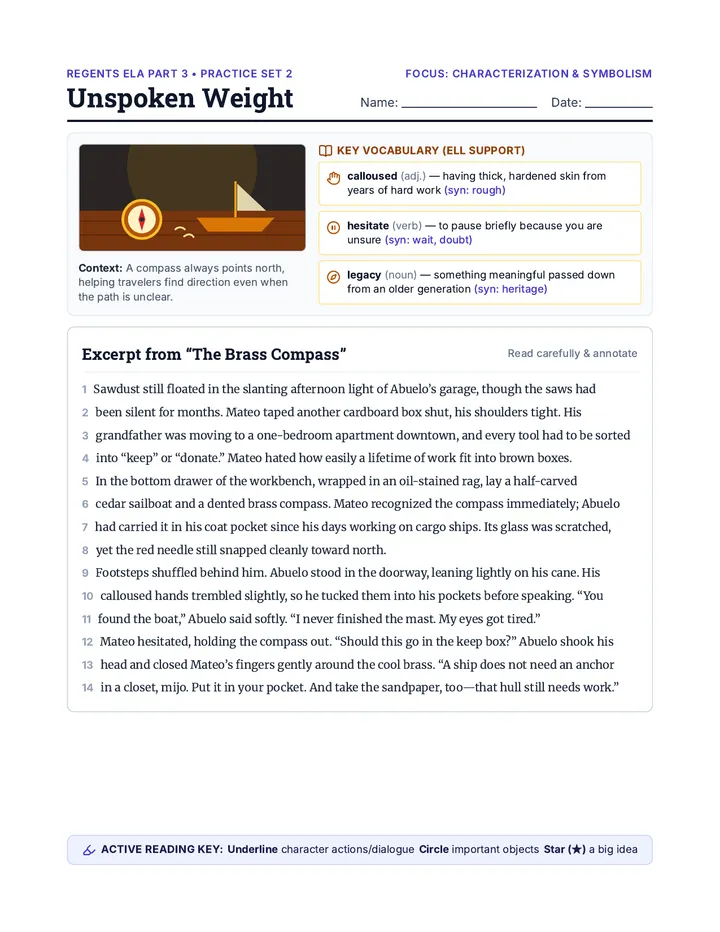
Unspoken Weight Worksheet Regents ELA Part 3 • Practice Set 2 Focus: Characterization & Symbolism
Unspoken Weight
Name: ________________________ Date: ____________
Context: A compass always points north, helping travelers find direction even when the path is unclear.
Key Vocabulary (ELL Support)
calloused (adj.) — having thick, hardened skin from years of hard work (syn: rough)
hesitate (verb) — to pause briefly because you are unsure (syn: wait, doubt)
legacy (noun) — something meaningful passed down from an older generation (syn: heritage)
Excerpt from “The Brass Compass”
Read carefully & annotate
1Sawdust still floated in the slanting afternoon light of Abuelo’s garage, though the saws had
2been silent for months. Mateo taped another cardboard box shut, his shoulders tight. His
3grandfather was moving to a one-bedroom apartment downtown, and every tool had to be sorted
4into “keep” or “donate.” Mateo hated how easily a lifetime of work fit into brown boxes.
5In the bottom drawer of the workbench, wrapped in an oil-stained rag, lay a half-carved
6cedar sailboat and a dented brass compass. Mateo recognized the compass immediately; Abuelo
7had carried it in his coat pocket since his days working on cargo ships. Its glass was scratched,
8yet the red needle still snapped cleanly toward north.
9Footsteps shuffled behind him. Abuelo stood in the doorway, leaning lightly on his cane. His
10calloused hands trembled slightly, so he tucked them into his pockets before speaking. “You
11found the boat,” Abuelo said softly. “I never finished the mast. My eyes got tired.”
12Mateo hesitated, holding the compass out. “Should this go in the keep box?” Abuelo shook his
13head and closed Mateo’s fingers gently around the cool brass. “A ship does not need an anchor
14in a closet, mijo. Put it in your pocket. And take the sandpaper, too—that hull still needs work.”
Active Reading Key: Underline character actions/dialogue Circle important objects Star (★) a big idea
Unspoken Weight • Part 2
Literary Element Lab & Evidence Builder
Name: ______________________
Choose Your Support Level (Mix & Match Anytime)
Level 1: Guided
Use the word bank & fill-in sentence frames.
Level 2: Starters
Use the sentence starters to guide your ideas.
Level 3: Independent
Write your analysis in your own academic words.
1 Identify the Central Idea
What message about family or growing up does the story show?
L1 Word Bank: legacy, guidance, pride, continue, generation, future → Frame: “Family _____ continues when older generations pass _____ to _____.”
L2 Starter: “A central idea in ‘The Brass Compass’ is that...”
2 Analyze the Author’s Strategy: Characterization & Symbolism
Characterization: How actions, body language, and dialogue reveal a character’s feelings (e.g., Abuelo hiding his trembling hands).
Symbolism: An object that represents a bigger idea (e.g., the compass = direction; the unfinished boat = work to continue).
Text Evidence (Quote + Line #)
How Characterization / Symbolism Develops Central Idea
Evidence #1 (Symbol or Character Action):
L1: This detail reveals that Abuelo feels ___ because... | L2: Through this action/symbol, the author shows...
Evidence #2 (Passing the Compass & Boat):
L1: The compass symbolizes ___ and shows Abuelo wants Mateo to... | L2: This moment develops the central idea by...
Tip: Choose ONE main strategy (characterization OR symbolism) to focus on in Part 3. Continue to Part 3 →
Unspoken Weight • Part 3
Regents Text-Analysis Response
Name: ______________________
Your Task
Closely read the excerpt from “The Brass Compass.” Write a well-developed, text-based response of two paragraphs . Identify a central idea in the text and analyze how the author’s use of one writing strategy (characterization or symbolism) develops this central idea. Use strong and thorough evidence from the text.
Level 1: Guided Frame
In “The Brass Compass,” a central idea is that ______. The author develops this idea through characterization/symbolism . For example, in Line ___, the text states, “______” (Line ___). This reveals ______ because ______.
Level 2: Starters
A central idea of the excerpt is...
The author uses [strategy] to reveal...
For instance, Abuelo says/does...
This detail develops the idea by...
Level 3: Independent
State a clear, specific central idea.
Name one writing strategy clearly.
Embed 2+ cited quotes smoothly.
Explain how the strategy creates meaning.
Self-Check: ☐ Clear central idea ☐ Characterization or symbolism analyzed ☐ 2+ quotes with line #s ☐ Explained how , not just summary
Unspoken Weight Answer Key Teacher Resource • Practice Set 2
Unspoken Weight Answer Key
Regents Part 3 • Characterization & Symbolism
Model Central Idea
Family legacy is not lost when circumstances change; instead, older generations pass purpose and guidance on to younger generations to carry forward.
Part 2: Key Evidence & Analysis
Target Quote & Line #
Sample Analysis (How Strategy Develops Central Idea)
“His calloused hands trembled slightly, so he tucked them into his pockets” (Lines 9–10)
Indirect characterization shows Abuelo’s pride and vulnerability: he hides his aging hands so Mateo sees his quiet dignity rather than his weakness.
“A ship does not need an anchor in a closet... Put it in your pocket. And take the sandpaper” (Lines 13–14)
Symbolism: the compass represents direction and Abuelo’s life experience, while the unfinished boat symbolizes the family craft Mateo is invited to continue.
Part 3: Model Regents Response (Proficient / Level 3)
In the excerpt from “The Brass Compass,” a central idea is that family legacy endures when older generations pass their guidance and unfinished work to younger ones. The author develops this central idea through symbolism, particularly using the compass and the half-carved sailboat.
At first, Mateo feels saddened by packing up his grandfather’s workshop, believing that “a lifetime of work” is being reduced to boxes (Line 4). However, the dented brass compass—whose “red needle still snapped cleanly toward north” despite scratched glass (Line 8)—symbolizes enduring direction and wisdom. When Abuelo refuses to pack it away and tells Mateo, “A ship does not need an anchor in a closet... Put it in your pocket” (Lines 13–14), he transfers that guidance directly to his grandson. By also urging Mateo to take the sandpaper for the unfinished hull, the author uses these symbolic objects to show that Abuelo’s legacy will continue through Mateo’s hands.
ELL Differentiation & Conferencing Notes
Entering / Emerging (Level 1): Clarify the Spanish term mijo (“my son / dear”) and connect the physical compass to the idea of “guidance.”Transitioning (Level 2): Encourage students to pair one quote about the object with a verb like symbolizes or represents .Expanding / Commanding (Level 3): Ask students how Mateo’s attitude shifts from Line 2 (“shoulders tight”) to the ending. Shifting Shadows Worksheet Regents ELA Part 3 • Practice Set 3 Focus: Point of View & Situational Irony
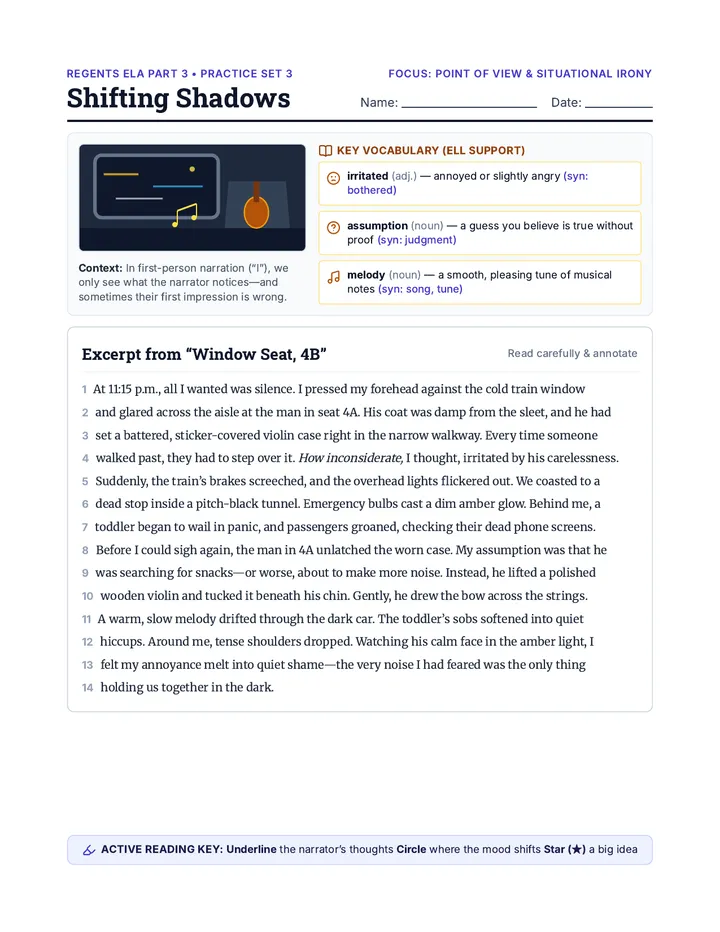
Shifting Shadows
Name: ________________________ Date: ____________
Context: In first-person narration (“I”), we only see what the narrator notices—and sometimes their first impression is wrong.
Key Vocabulary (ELL Support)
irritated (adj.) — annoyed or slightly angry (syn: bothered)
assumption (noun) — a guess you believe is true without proof (syn: judgment)
melody (noun) — a smooth, pleasing tune of musical notes (syn: song, tune)
Excerpt from “Window Seat, 4B”
Read carefully & annotate
1At 11:15 p.m., all I wanted was silence. I pressed my forehead against the cold train window
2and glared across the aisle at the man in seat 4A. His coat was damp from the sleet, and he had
3set a battered, sticker-covered violin case right in the narrow walkway. Every time someone
4walked past, they had to step over it. How inconsiderate, I thought, irritated by his carelessness.
5Suddenly, the train’s brakes screeched, and the overhead lights flickered out. We coasted to a
6dead stop inside a pitch-black tunnel. Emergency bulbs cast a dim amber glow. Behind me, a
7toddler began to wail in panic, and passengers groaned, checking their dead phone screens.
8Before I could sigh again, the man in 4A unlatched the worn case. My assumption was that he
9was searching for snacks—or worse, about to make more noise. Instead, he lifted a polished
10wooden violin and tucked it beneath his chin. Gently, he drew the bow across the strings.
11A warm, slow melody drifted through the dark car. The toddler’s sobs softened into quiet
12hiccups. Around me, tense shoulders dropped. Watching his calm face in the amber light, I
13felt my annoyance melt into quiet shame—the very noise I had feared was the only thing
14holding us together in the dark.
Active Reading Key: Underline the narrator’s thoughts Circle where the mood shifts Star (★) a big idea
Shifting Shadows • Part 2
Literary Element Lab & Evidence Builder
Name: ______________________
Choose Your Support Level (Mix & Match Anytime)
Level 1: Guided
Use the word bank & fill-in sentence frames.
Level 2: Starters
Use the sentence starters to guide your ideas.
Level 3: Independent
Write your analysis in your own academic words.
1 Identify the Central Idea
What lesson about judging others does the narrator learn?
L1 Word Bank: judge, appearances, kindness, empathy, surprise, connection → Frame: “Judging people by _____ can be wrong because _____ brings _____.”
L2 Starter: “A central idea in ‘Window Seat, 4B’ is that...”
2 Analyze the Author’s Strategy: Point of View & Situational Irony
Point of View (1st Person): The narrator’s private thoughts (“I”) let us see their initial judgment and how their attitude changes.
Situational Irony: When the opposite of what is expected happens (the “annoying” stranger actually brings peace).
Text Evidence (Quote + Line #)
How POV / Irony Develops the Central Idea
Evidence #1 (Before: Narrator’s Judgment):
L1: At first, the narrator’s POV shows they feel ___ because... | L2: Through first-person thoughts, the author reveals...
Evidence #2 (After: The Ironic Shift):
L1: This is ironic because the narrator expected ___, but instead... | L2: This contrast develops the central idea by...
Tip: Comparing the “before” and “after” thoughts makes your Part 3 analysis strong! Continue to Part 3 →
Shifting Shadows • Part 3
Regents Text-Analysis Response
Name: ______________________
Your Task
Closely read the excerpt from “Window Seat, 4B.” Write a well-developed, text-based response of two paragraphs . Identify a central idea in the text and analyze how the author’s use of one writing strategy (point of view or situational irony) develops this central idea. Use strong and thorough evidence from the text.
Level 1: Guided Frame
In “Window Seat, 4B,” a central idea is that ______. The author develops this idea through point of view/irony . For example, in Line ___, the narrator states, “______” (Line ___). Later, this changes when ______.
Level 2: Starters
A central idea of the excerpt is...
The author uses [strategy] to show...
At first, the narrator assumes...
However, this shifts when...
Level 3: Independent
State a clear, specific central idea.
Name one writing strategy clearly.
Embed 2+ cited quotes smoothly.
Explain how the strategy creates meaning.
Self-Check: ☐ Clear central idea ☐ POV or irony analyzed ☐ 2+ quotes with line #s ☐ Explained how , not just summary
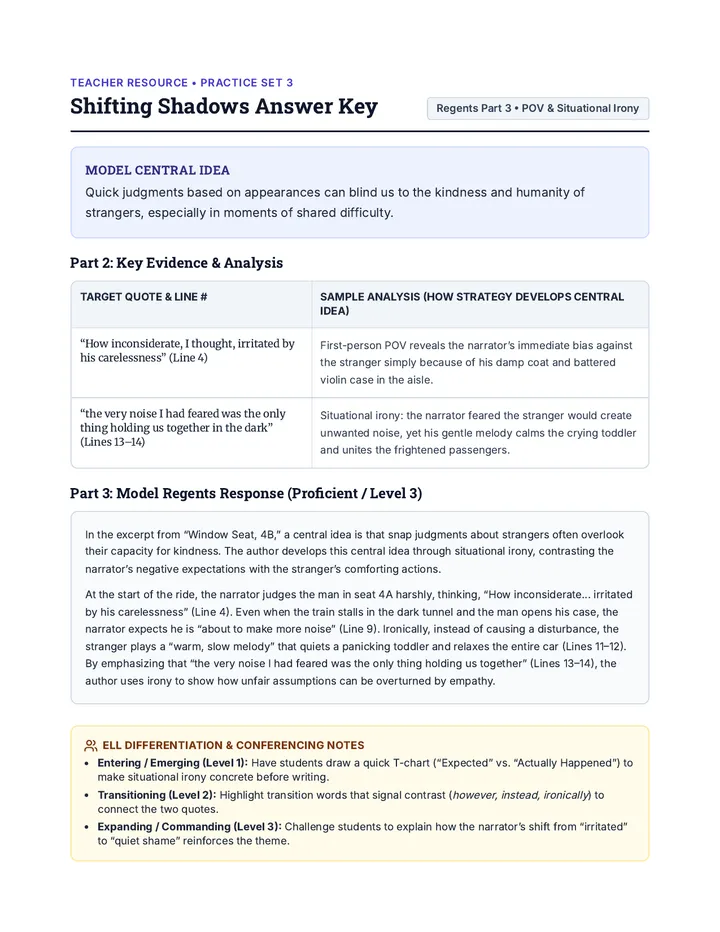
Shifting Shadows Answer Key Teacher Resource • Practice Set 3
Shifting Shadows Answer Key
Regents Part 3 • POV & Situational Irony
Model Central Idea
Quick judgments based on appearances can blind us to the kindness and humanity of strangers, especially in moments of shared difficulty.
Part 2: Key Evidence & Analysis
Target Quote & Line #
Sample Analysis (How Strategy Develops Central Idea)
“How inconsiderate, I thought, irritated by his carelessness” (Line 4)
First-person POV reveals the narrator’s immediate bias against the stranger simply because of his damp coat and battered violin case in the aisle.
“the very noise I had feared was the only thing holding us together in the dark” (Lines 13–14)
Situational irony: the narrator feared the stranger would create unwanted noise, yet his gentle melody calms the crying toddler and unites the frightened passengers.
Part 3: Model Regents Response (Proficient / Level 3)
In the excerpt from “Window Seat, 4B,” a central idea is that snap judgments about strangers often overlook their capacity for kindness. The author develops this central idea through situational irony, contrasting the narrator’s negative expectations with the stranger’s comforting actions.
At the start of the ride, the narrator judges the man in seat 4A harshly, thinking, “How inconsiderate... irritated by his carelessness” (Line 4). Even when the train stalls in the dark tunnel and the man opens his case, the narrator expects he is “about to make more noise” (Line 9). Ironically, instead of causing a disturbance, the stranger plays a “warm, slow melody” that quiets a panicking toddler and relaxes the entire car (Lines 11–12). By emphasizing that “the very noise I had feared was the only thing holding us together” (Lines 13–14), the author uses irony to show how unfair assumptions can be overturned by empathy.
ELL Differentiation & Conferencing Notes
Entering / Emerging (Level 1): Have students draw a quick T-chart (“Expected” vs. “Actually Happened”) to make situational irony concrete before writing.Transitioning (Level 2): Highlight transition words that signal contrast (however, instead, ironically ) to connect the two quotes.Expanding / Commanding (Level 3): Challenge students to explain how the narrator’s shift from “irritated” to “quiet shame” reinforces the theme.