Fact Finders Slides Session 1 of 4 • Step 1: Full Support
Fact Finders
Learning how informational writers teach true facts about a topic.
Fact Writers Studio • Beginners Informational Writing
What Is Informational Writing?
Informational Text
Teaches true facts about real things in our world.
Example:
"Sea turtles have flippers to help them swim."
Story Writing
Tells a made-up tale with characters and adventures.
Example:
"Timmy the Turtle wore sunglasses to the beach."
Today we are Fact Finders—we write true facts!
Fact Check: Real or Made-Up?
Class Discussion
1. Honeybees live together in a hive.
Fact or Story?
2. A bear baked a blueberry pie for his friends.
Fact or Story?
3. Frogs use their long, sticky tongues to catch bugs.
Fact or Story?
Give a thumbs-up for a TRUE FACT and hands-on-head for a MADE-UP STORY.
Let's Build Fact Sentences Together
Guided Practice
WORD BANK
ocean shell flippers
Sea turtles live in the .
They have a hard to stay safe.
They use their to swim fast.
Tip: Read the whole sentence to make sure the word makes sense!
Your Turn: Fact Finders Workbook
Use the Word Bank on your page to fill in the blanks and teach true facts about Honeybees!
1. Read each sentence frame carefully.
2. Pick the best word from the Word Bank.
3. Cross off each word as you use it.
Fact Finders Teacher Guide Session 1 Teacher Guide • Step 1: Full Support
Fact Finders
Focus: Topic & True Facts
Scaffold: Full Sentence Frames + Word Bank
Learning Objective
Learners will distinguish true informational facts from made-up stories and complete fill-in-the-blank fact sentences using a guided word bank.
Materials Needed
Fact Finders Slides
Fact Finders Workbook (1 per student)
Pencils & crayons for illustrating
Lesson Flow & Modeling Script (30–35 min)
1. Hook & Mini-Lesson (8 min) — Slides 1–3
I Do / We Do
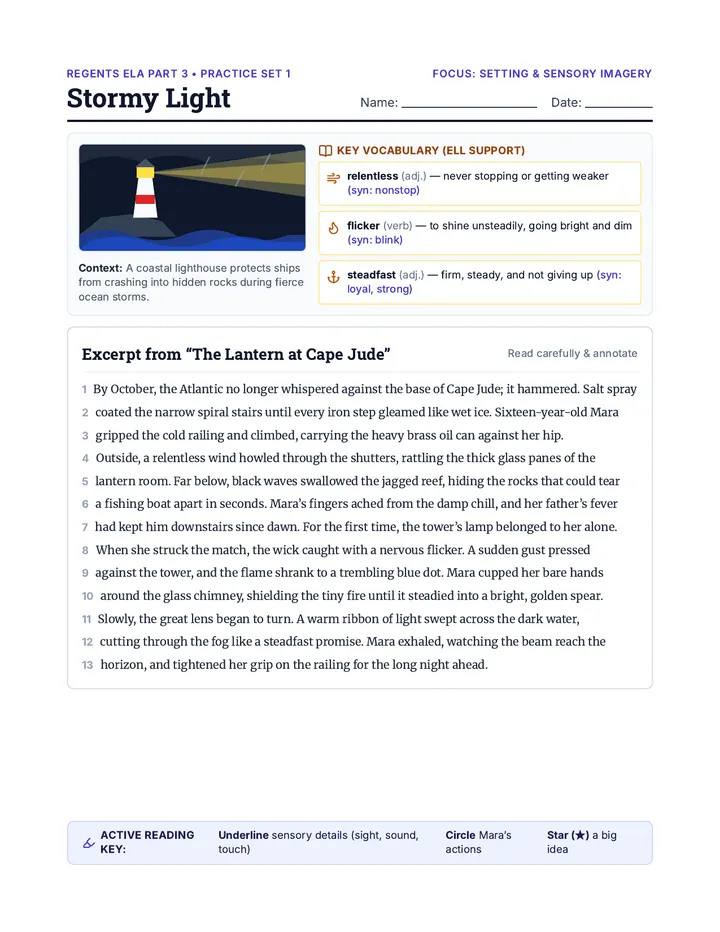
Introduce informational writing as writing that teaches true facts . Contrast the sea turtle fact with the silly story on Slide 2. Lead the thumbs-up/hands-on-head Fact Check on Slide 3.
2. Guided Modeling (8 min) — Slide 4
We Do Together
Model reading the first sentence aloud with a blank: "Sea turtles live in the ____." Think aloud: "Does 'flippers' make sense? No! 'Ocean' makes sense." Have students chorally read the completed sentences.
3. Guided Workbook Practice (12 min) — Slide 5
You Do (Supported)
Distribute the Fact Finders Workbook . Read the Word Bank words aloud together before students begin so decoding does not block writing. Encourage crossing off each word after using it.
4. Share & Wrap-Up (5 min)
Closing
Have partners read their completed Honeybees page to each other to check that every sentence sounds right and teaches a true fact.
Differentiation Tips
Extra Support: Pair students to read frames together, or highlight the first letter of each missing word.Ready for More: Ask early finishers to write one extra true fact about bees on the back.
Workbook Answer Key
Part 1 (Honeybees): 1. insects, 2. hive, 3. nectar, 4. honey, 5. flowers.Part 2 (Fact Check): A. Fact, B. Story, C. Fact.
Fact Finders Workbook Step 1: Full Support
Fact Finders: Honeybees
Name: ____________________________
Date: ___________________
Directions: Read the Word Bank. Write the best word in each blank to complete the true facts about honeybees.
Word Bank
flowers hive honey insects nectar
1. Honeybees are flying with six legs.
2. Thousands of bees live together in a .
3. Bees drink sweet from inside plants.
4. They use it to make yummy for food.
5. Bees help grow by moving yellow pollen.
Fact or Story? Circle One
A. Honeybees have two wings.
Fact / Story
B. A bee drove a yellow school bus.
Fact / Story
C. Bees live in a hive.
Fact / Story
Draw a Honeybee Fact
Draw a bee near a flower or hive.
Detail Builders Slides Session 2 of 4 • Step 2: Guided Starters
Detail Builders
Stretching our facts with teaching details so readers can picture our topic!
Fact Writers Studio • Beginners Informational Writing
Stretch Your Facts With Details
Plain Fact
"Penguins have wings."
True, but it leaves the reader wondering what those wings look like or do!
Detailed Fact
"Penguins have short, stiff wings that help them swim fast underwater."
Tells what it looks like AND how it helps!
Detail Builders ask: What does it look like? Where does it live? How does it work?
Finish the Sentence Starters
We Do Together
HELPER WORDS (Use these or your own!)
thick fur snowy warm fish
Polar bears live in .
They have to stay warm.
Notice: You get to finish the rest of the sentence with your own words!
Your Turn: Detail Builders Workbook
Write a teaching paragraph about Penguins using the sentence starters—then add one detail sentence of your own!
1. Finish each sentence starter with true details.
2. Use the Helper Words if you need ideas or spelling.
3. Add your own bonus fact at the bottom!
Detail Builders Teacher Guide Session 2 Teacher Guide • Step 2: Guided Starters
Detail Builders
Focus: Adding Teaching Details
Scaffold: Partial Sentence Starters
Learning Objective
Learners will expand plain facts with descriptive details (appearance, habitat, behavior) by completing partial sentence starters and writing one original detail sentence.
Materials Needed
Detail Builders Slides
Detail Builders Workbook (1 per student)
Pencils & crayons
Lesson Flow & Modeling Script (30–35 min)
1. Mini-Lesson: Plain vs. Detailed Facts (8 min) — Slides 1–2
I Do
Compare "Penguins have wings" with the detailed version. Explain that good informational writers answer what it looks like or how it helps so readers can picture it.
2. Shared Writing With Starters (8 min) — Slide 3
We Do Together
Show Slide 3. Point out that today's box is a Helper Word Box , not a strict 1-for-1 fill-in-the-blank. Brainstorm two different ways to finish "Polar bears live in ____." (e.g., "snowy places" or "the cold Arctic" ).
3. Guided Workbook Writing (14 min) — Slide 4
You Do (Partial Support)
Students complete the Detail Builders Workbook on Penguins. Circulate and prompt students who write one-word answers to stretch them (e.g., "What kind of feathers?" or "What do they eat?" ).
4. Partner Detail Check (5 min)
Closing
Partners read their penguin paragraph aloud and point to one detail word that helped them picture a penguin.
Differentiation Tips
Extra Support: Let students orally rehearse their ending with a partner before writing.Ready for More: Challenge writers to include two descriptive words in their bonus sentence.
Sample Student Responses
1. "...black and white birds that cannot fly."
Detail Builders Workbook Step 2: Guided Starters
Detail Builders: Penguins
Name: ____________________________
Date: ___________________
Directions: Finish each sentence starter with true details about penguins. Use the Helper Words for ideas, or write your own words!
Helper Words
black and white icy ocean short flippers swim fast fish warm feathers
1. Penguins are
2. They live in
3. Penguins have
4. Write your own bonus fact about penguins:
Draw & Label a Penguin
Writer Check
Capital letters
Ending periods
True details
Report Planners Slides Session 3 of 4 • Step 3: Light Prompts
Report Planners
Planning a complete mini-report with a beginning, middle facts, and a closing!
Fact Writers Studio • Beginners Informational Writing
Three Parts of a Mini-Report
1. Topic
Hook & Tell
Tell the reader what your report is all about.
"Frogs are amazing animals."
2. Facts
Teach 2–3 Facts
Share true details using your best teaching words.
"They use sticky tongues to catch bugs."
3. Closing
Wrap It Up
End with a strong final thought for your reader.
"Now you know why frogs are special!"
Every great report has a Topic, Facts, and a Closing!
Plan First With a Fact Web
We Do Together
Fact 1: Look
smooth, wet skin
MY TOPIC
Frogs
Fact 2: Food
catch bugs with tongue
Writers use short notes on a web first, then turn each note into a full sentence!
Your Turn: Report Planners Workbook
Pick a topic you know a lot about! Plan your facts on the Fact Web, then write your draft using light starters.
1. Choose a topic and fill in your Fact Web.
2. Write a Topic, 2–3 Facts, and a Closing.
3. Use your own words—no word bank today!
Report Planners Teacher Guide Session 3 Teacher Guide • Step 3: Light Prompts
Report Planners
Focus: Structure & Planning
Scaffold: Fact Web + Light Prompts
Learning Objective
Learners will organize an informational mini-report with a topic sentence, 2–3 supporting facts, and a closing sentence using a graphic organizer and light prompts.
Materials Needed
Report Planners Slides
Report Planners Workbook (2-page packet)
Pencils & highlighters
Lesson Flow & Modeling Script (35–40 min)
1. Teach Report Structure (8 min) — Slides 1–2
I Do
Introduce the 3 parts: Topic (tells what it's about), Facts (teaches true information), and Closing (wraps it up). Have students count the 3 parts on their fingers.
2. Model the Fact Web (8 min) — Slide 3
We Do Together
Show how to write short notes (2–3 words, not full sentences) in the Fact Web bubbles. Then model turning one bubble note ("smooth, wet skin" ) into a full sentence aloud.
3. Plan & Draft Workbook (16 min) — Slide 4
You Do (Light Support)
Students pick a familiar topic on Page 1 (Frogs, Firetrucks, Elephants, or their own choice), complete the Fact Web, and then draft on Page 2 using the light section prompts. Point out there is no word bank today—encourage brave spelling!
4. Closing Sentence Share (5 min)
Closing
Invite 3–4 volunteers to read just their Topic Sentence and Closing Sentence aloud to celebrate how they frame their facts.
Differentiation Tips
Extra Support: Let students draw a quick sketch in each web bubble before writing their 2-word note.Ready for More: Encourage writers to add a 3rd fact or skip the starter prompts and write their own openings.
Quick Conference Questions
"Tell me your topic—does your first sentence name it?"
"Which fact from your web are you writing next?"
"How can you wrap up your report at the end?"
Report Planners Workbook Step 3: Light Prompts • Page 1 of 2
Report Planners: Fact Web
Name: ____________________________
Date: ___________________
1. Circle a Topic (or write your own!)
Frogs Firetrucks Elephants Volcanoes My Topic: ________________
2. Plan Your Facts: Write short notes (2–4 words) in the boxes below.
Fact 1 (What does it look like?)
Fact 2 (Where is it or what does it do?)
My Report Topic
Fact 3 (One more cool fact!)
Closing Idea (Wrap it up!)
Step 3: Light Prompts • Page 2 of 2
My Mini-Report Draft
Name: ____________________________
Directions: Turn your Fact Web notes into full sentences. You may use the light starters or write your own!
1. Topic Sentence (Introduce your topic)
Idea: "Have you ever learned about ___?" or "___ are amazing!"
2. Fact Sentences (Teach 2–3 true facts)
Ideas: "First, ___." • "Also, ___." • "Another fact is ___."
3. Closing Sentence (Wrap it up!)
Idea: "Now you know all about ___!"
Independent Authors Slides Session 4 of 4 • Step 4: Independent Writer
Independent Authors
No more blanks! You are ready to plan, write, and publish your own informational report.
Fact Writers Studio • Beginners Informational Writing
Our Writing Journey
Step 1
Fact Finders
Full blanks + Word Bank
Step 2
Detail Builders
Sentence starters + Helper words
Step 3
Report Planners
Fact Web + Light prompts
Step 4
Independent!
All your own words!
You practiced every tool you need to be an independent informational author!
Before You Finish: Author's Check
Self-Check
Title & Topic Sentence
Did I tell my reader what my report is about?
2–3 True Facts + Details
Did I teach real facts with describing words?
Closing Sentence
Did I wrap up my report at the end?
Capitals, Spaces & Periods
Is my writing neat and easy to read?
Read your report whisper-quiet to yourself to check every sentence!
Time to Publish & Share!
Plan your topic on Page 1, write and illustrate your report on Page 2, and get ready for Author's Chair!
Authors read with a proud, clear voice.
Listeners share one true fact they learned!
Independent Authors Teacher Guide Session 4 Teacher Guide • Step 4: Independent Writer
Independent Authors
Focus: Independent Publishing
Scaffold: Checklist Only (No Blanks)
Learning Objective
Learners will independently plan, draft, illustrate, and self-check a complete informational report (title, topic sentence, 2–3 detailed facts, closing) without fill-in-the-blank frames.
Materials Needed
Independent Authors Slides
Independent Authors Workbook (2-page packet)
Pencils & colored pencils/crayons
Workshop Flow (40–45 min)
1. Celebrate the Gradual Release (5 min) — Slides 1–2
Launch
Walk through the 4-step journey on Slide 2. Celebrate that today there are no fill-in-the-blanks—students are full authors!
2. Independent Planning & Writing (25 min) — Slides 3–4
You Do (Independent)
Students choose a topic they are an expert on (using the Page 1 Idea Bank or their own), jot quick plan notes, and write their report on Page 2. Circulate for 1-on-1 conferences. Remind writers to use the Author's Check at the bottom of Page 2.
3. Author's Chair Sharing (10 min)
Celebrate
Invite students to share in small groups or whole-class Author's Chair. Listeners name one true fact they learned from the author's report.
Quick Independent Writing Rubric
Skill
Growing
Ready / Independent
Topic & Closing
Missing topic or closing sentence
Clear topic sentence and closing sentence
True Facts
1 fact or includes made-up ideas
2–3+ true facts with descriptive details
Conventions
Needs reminders for capitals/periods
Mostly accurate capitals, spaces, and periods
Independent Authors Workbook Step 4: Independent Writer • Page 1 of 2
Independent Author: My Plan
Name: ____________________________
Date: ___________________
Need a Topic Idea? Pick one you know about, or choose your own!
Sharks Butterflies Soccer Dinosaurs Space / Planets Dogs or Cats Trees
My Report Topic:
Quick Plan: Jot down your ideas before you write your published report on Page 2.
Beginning: How will I introduce my topic?
Middle: 3 True Facts I Will Teach
Ending: How will I wrap up my report?
Step 4: Independent Writer • Page 2 of 2
My Informational Report
By: ____________________________
Title:
Illustration
Author's Self-Check (Check off when done!)
I wrote a title and topic sentence.
I taught 2–3 true facts with details.
I wrote a closing sentence.
I used capitals, spaces, and periods.