Truth and Ink Guided Notes Prentice Hall Literature • Grade 10 • Unit 3 Types of Nonfiction
Truth and Ink Guided Notes
Name:
Date:
Period:
Directions: Complete these guided notes as you read the Unit 3 Introduction (Types of Nonfiction ). Fill in the blanks using the word banks and your textbook.
Part 1: What Is Nonfiction?
Word Bank: factual • knowledge • perspective • purpose • real
1. Nonfiction is prose writing that deals with people, actual events, and ideas rather than imaginary ones.
2. Every nonfiction writer has a clear —such as to inform, to persuade, to entertain, or to reflect on an experience.
3. Unit 3 explores the Big Question: “What kind of changes our lives?” Reading nonfiction can challenge our thinking and help us see the world from another .
Part 2: Types of Nonfiction
Fill in the key features for each category of nonfiction and list at least two examples.
Type of Nonfiction
Purpose & Key Features
Examples
Literary (Narrative) Nonfiction
| Tells a true story using literary elements such as , , and . | |
|
Expository Nonfiction
| Explains a topic, gives , or presents in a clear, organized way. | |
|
Persuasive Nonfiction
| Uses and to convince readers to adopt a viewpoint or take action. | |
Truth and Ink Guided Notes
Name:
Part 3: Key Vocabulary & Craft Terms
Word Bank: attitude • bias • convince • facts • inform • main point • opinions • reflect • word choice
Author’s Purpose
The reason an author writes—to , persuade, entertain, or .
Central Idea
The or key message of a text, supported by facts and examples.
Tone & Diction
Tone is the writer’s toward the subject; diction is the author’s .
Rhetoric
The art of using language effectively to or influence an audience.
Objective Writing
Presents and verifiable details without personal feelings or .
Subjective Writing
Expresses personal feelings, , or experiences (e.g., a memoir or personal essay).
Part 4: Check for Understanding
Summarize what you learned in complete sentences.
1. How does an author’s purpose influence the structure, supporting details, and tone of a nonfiction text?
2. Thinking about the Unit 3 Big Question (“What kind of knowledge changes our lives?” ), what is one way reading nonfiction can change how a person thinks or acts?
Truth and Ink Answer Key Prentice Hall Literature • Grade 10 • Unit 3 Teacher Resource • Answer Key
Truth and Ink Answer Key
Teacher Note: Highlighted terms show expected fill-in-the-blank responses. Accept reasonable synonyms or textbook-aligned examples where noted.
Part 1: What Is Nonfiction?
1. Nonfiction is prose writing that deals with real people, actual events, and factual ideas rather than imaginary ones.
2. Every nonfiction writer has a clear purpose—such as to inform, to persuade, to entertain, or to reflect on an experience.
3. Unit 3 explores the Big Question: “What kind of knowledge changes our lives?” Reading nonfiction can challenge our thinking and help us see the world from another perspective.
Part 2: Types of Nonfiction
Type of Nonfiction
Purpose & Key Features
Sample Examples
Literary (Narrative) Nonfiction
| Tells a true story using literary elements such as character, plot, and setting (also accept: conflict, theme, imagery) . | Autobiography, biography, memoir, personal essay |
|
Expository Nonfiction
| Explains a topic, gives information, or presents facts in a clear, organized way. | Informational article, analytical essay, research report |
|
Persuasive Nonfiction
| Uses reasons and evidence (or logic/rhetoric) to convince readers to adopt a viewpoint or take action. | Speech, editorial, persuasive essay, letter to the editor |
Truth and Ink Answer Key Page 2
Part 3: Key Vocabulary & Craft Terms
Author’s Purpose
The reason an author writes—to inform, persuade, entertain, or reflect.
Central Idea
The main point or key message of a text, supported by facts and examples.
Tone & Diction
Tone is the writer’s attitude toward the subject; diction is the author’s word choice.
Rhetoric
The art of using language effectively to convince or influence an audience.
Objective Writing
Presents facts and verifiable details without personal feelings or bias.
Subjective Writing
Expresses personal feelings, opinions, or experiences (e.g., a memoir or personal essay).
Part 4: Check for Understanding (Model Responses)
1. How does an author’s purpose influence the structure, supporting details, and tone of a nonfiction text?
Model Answer: An author’s purpose determines how information is organized and presented. For example, an author writing to inform uses clear, logical structure, objective facts, and a neutral tone, whereas an author writing to persuade selects compelling reasons, emotional or logical appeals, and a more urgent or passionate tone.
2. Thinking about the Unit 3 Big Question (“What kind of knowledge changes our lives?” ), what is one way reading nonfiction can change how a person thinks or acts?
Model Answer: Reading nonfiction exposes readers to real-world experiences, historical events, and new perspectives they might not encounter otherwise. Learning about another person’s struggles or a pressing social issue can build empathy, challenge assumptions, and inspire readers to make informed decisions or take action in their own communities.
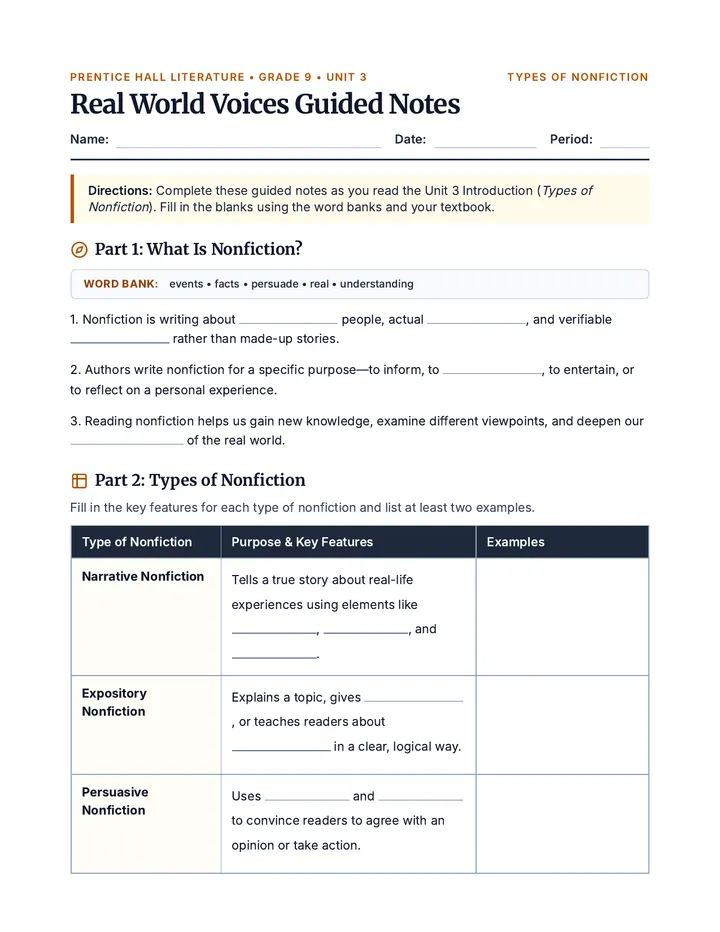
Real World Voices Guided Notes Prentice Hall Literature • Grade 9 • Unit 3 Types of Nonfiction
Real World Voices Guided Notes
Name:
Date:
Period:
Directions: Complete these guided notes as you read the Unit 3 Introduction (Types of Nonfiction ). Fill in the blanks using the word banks and your textbook.
Part 1: What Is Nonfiction?
Word Bank: events • facts • persuade • real • understanding
1. Nonfiction is writing about people, actual , and verifiable rather than made-up stories.
2. Authors write nonfiction for a specific purpose—to inform, to , to entertain, or to reflect on a personal experience.
3. Reading nonfiction helps us gain new knowledge, examine different viewpoints, and deepen our of the real world.
Part 2: Types of Nonfiction
Fill in the key features for each type of nonfiction and list at least two examples.
Type of Nonfiction
Purpose & Key Features
Examples
Narrative Nonfiction
| Tells a true story about real-life experiences using elements like , , and . | |
|
Expository Nonfiction
| Explains a topic, gives , or teaches readers about in a clear, logical way. | |
|
Persuasive Nonfiction
| Uses and to convince readers to agree with an opinion or take action. | |
Real World Voices Guided Notes
Name:
Part 3: Key Vocabulary & Literary Terms
Word Bank: attitude • judgment • main idea • perspective • prove • reason • support • voice • word choice
Author’s Purpose
The an author writes a text (to inform, persuade, entertain, or reflect).
Central Idea
The or most important point a writer wants readers to understand.
Point of View & Voice
Point of view is the author’s ; is their distinct personality on the page.
Tone & Diction
Tone is the writer’s toward the subject; diction is the author’s .
Fact vs. Opinion
A fact is a statement you can ; an opinion is a personal belief or .
Persuasive Appeals
Techniques writers use—such as logic, emotion, or expert credibility—to their claims.
Part 4: Check for Understanding
Summarize what you learned in complete sentences.
1. How can you tell the difference between narrative nonfiction and expository nonfiction when you begin reading a text?
2. Why is it important for a reader to separate facts from opinions when reading persuasive or informational nonfiction?
Real World Voices Answer Key Prentice Hall Literature • Grade 9 • Unit 3 Teacher Resource • Answer Key
Real World Voices Answer Key
Teacher Note: Highlighted terms show expected fill-in-the-blank responses. Accept reasonable synonyms or textbook-aligned examples where noted.
Part 1: What Is Nonfiction?
1. Nonfiction is writing about real people, actual events, and verifiable facts rather than made-up stories.
2. Authors write nonfiction for a specific purpose—to inform, to persuade, to entertain, or to reflect on a personal experience.
3. Reading nonfiction helps us gain new knowledge, examine different viewpoints, and deepen our understanding of the real world.
Part 2: Types of Nonfiction
Type of Nonfiction
Purpose & Key Features
Sample Examples
Narrative Nonfiction
| Tells a true story about real-life experiences using elements like characters, setting, and plot (also accept: conflict, theme, dialogue) . | Autobiography, biography, memoir, personal essay |
|
Expository Nonfiction
| Explains a topic, gives information, or teaches readers about facts (or ideas) in a clear, logical way. | News article, informational essay, how-to guide, research report |
|
Persuasive Nonfiction
| Uses reasons and evidence to convince readers to agree with an opinion or take action. | Speech, editorial, persuasive essay, opinion column |
Real World Voices Answer Key Page 2
Part 3: Key Vocabulary & Literary Terms
Author’s Purpose
The reason an author writes a text (to inform, persuade, entertain, or reflect).
Central Idea
The main idea or most important point a writer wants readers to understand.
Point of View & Voice
Point of view is the author’s perspective; voice is their distinct personality on the page.
Tone & Diction
Tone is the writer’s attitude toward the subject; diction is the author’s word choice.
Fact vs. Opinion
A fact is a statement you can prove; an opinion is a personal belief or judgment.
Persuasive Appeals
Techniques writers use—such as logic, emotion, or expert credibility—to support their claims.
Part 4: Check for Understanding (Model Responses)
1. How can you tell the difference between narrative nonfiction and expository nonfiction when you begin reading a text?
Model Answer: Narrative nonfiction reads like a story with real people, a setting, and events unfolding over time, while expository nonfiction is organized around explanations, facts, and headings or examples meant to inform the reader about a topic.
2. Why is it important for a reader to separate facts from opinions when reading persuasive or informational nonfiction?
Model Answer: Separating facts from opinions helps readers evaluate whether an author’s claims are backed by reliable evidence rather than personal bias, allowing readers to form their own informed conclusions.
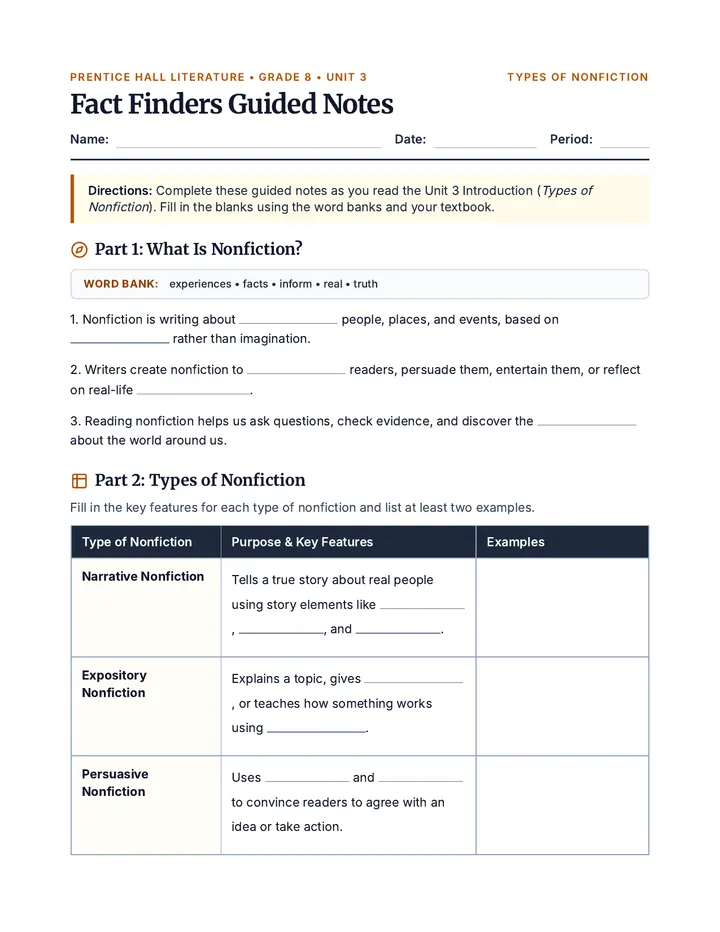
Fact Finders Guided Notes Prentice Hall Literature • Grade 8 • Unit 3 Types of Nonfiction
Fact Finders Guided Notes
Name:
Date:
Period:
Directions: Complete these guided notes as you read the Unit 3 Introduction (Types of Nonfiction ). Fill in the blanks using the word banks and your textbook.
Part 1: What Is Nonfiction?
Word Bank: experiences • facts • inform • real • truth
1. Nonfiction is writing about people, places, and events, based on rather than imagination.
2. Writers create nonfiction to readers, persuade them, entertain them, or reflect on real-life .
3. Reading nonfiction helps us ask questions, check evidence, and discover the about the world around us.
Part 2: Types of Nonfiction
Fill in the key features for each type of nonfiction and list at least two examples.
Type of Nonfiction
Purpose & Key Features
Examples
Narrative Nonfiction
| Tells a true story about real people using story elements like , , and . | |
|
Expository Nonfiction
| Explains a topic, gives , or teaches how something works using . | |
|
Persuasive Nonfiction
| Uses and to convince readers to agree with an idea or take action. | |
Fact Finders Guided Notes
Name:
Part 3: Key Vocabulary & Literary Terms
Word Bank: attitude • autobiography • biography • details • main idea • opinion • perspective • prove • reason
Author’s Purpose
The an author writes a text (to inform, persuade, entertain, or reflect).
Central Idea & Details
The is the big point; supporting back it up with examples.
Biography vs. Autobiography
A is written by another person; an is written by the person themselves.
Tone
The writer’s toward the subject or audience (such as serious, humorous, or hopeful).
Fact vs. Opinion
A fact can be checked to it is true; an is a personal belief or feeling.
Point of View
The from which a nonfiction text is told (such as first-person I or third-person he/she ).
Part 4: Check for Understanding
Summarize what you learned in complete sentences.
1. What is the main difference between a biography and an autobiography ?
2. Why is it helpful to know an author’s purpose before you finish reading a nonfiction article or speech?
Fact Finders Answer Key Prentice Hall Literature • Grade 8 • Unit 3 Teacher Resource • Answer Key
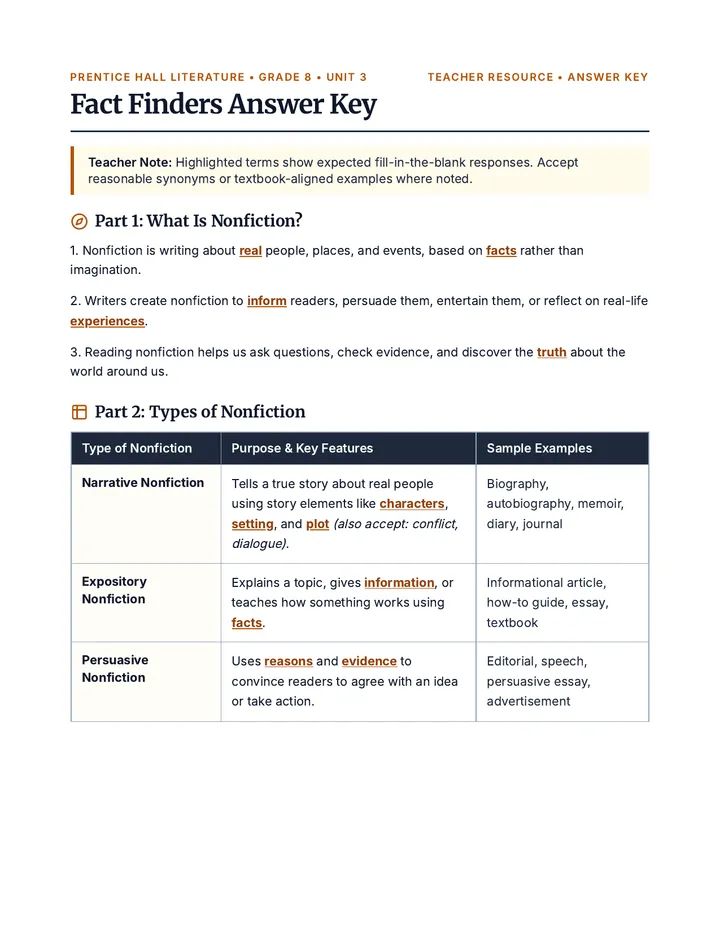
Fact Finders Answer Key
Teacher Note: Highlighted terms show expected fill-in-the-blank responses. Accept reasonable synonyms or textbook-aligned examples where noted.
Part 1: What Is Nonfiction?
1. Nonfiction is writing about real people, places, and events, based on facts rather than imagination.
2. Writers create nonfiction to inform readers, persuade them, entertain them, or reflect on real-life experiences.
3. Reading nonfiction helps us ask questions, check evidence, and discover the truth about the world around us.
Part 2: Types of Nonfiction
Type of Nonfiction
Purpose & Key Features
Sample Examples
Narrative Nonfiction
| Tells a true story about real people using story elements like characters, setting, and plot (also accept: conflict, dialogue) . | Biography, autobiography, memoir, diary, journal |
|
Expository Nonfiction
| Explains a topic, gives information, or teaches how something works using facts. | Informational article, how-to guide, essay, textbook |
|
Persuasive Nonfiction
| Uses reasons and evidence to convince readers to agree with an idea or take action. | Editorial, speech, persuasive essay, advertisement |
Fact Finders Answer Key Page 2
Part 3: Key Vocabulary & Literary Terms
Author’s Purpose
The reason an author writes a text (to inform, persuade, entertain, or reflect).
Central Idea & Details
The main idea is the big point; supporting details back it up with examples.
Biography vs. Autobiography
A biography is written by another person; an autobiography is written by the person themselves.
Tone
The writer’s attitude toward the subject or audience (such as serious, humorous, or hopeful).
Fact vs. Opinion
A fact can be checked to prove it is true; an opinion is a personal belief or feeling.
Point of View
The perspective from which a nonfiction text is told (such as first-person I or third-person he/she ).
Part 4: Check for Understanding (Model Responses)
1. What is the main difference between a biography and an autobiography ?
Model Answer: A biography is the true story of a person’s life written by someone else (usually in third-person point of view), whereas an autobiography is written by the person themselves (in first-person point of view) to share their own life experiences.
2. Why is it helpful to know an author’s purpose before you finish reading a nonfiction article or speech?
Model Answer: Knowing the author’s purpose helps you understand whether the writer is simply sharing facts to inform you or trying to persuade you to agree with a specific opinion, which helps you read more critically.