Soundstage Proofreading Worksheet ACT English Prep • Full Mix
Soundstage Proofreading Worksheet
11th Grade ELA
Conventions & Rhetoric
Name: _____________________________
Date: ______________
Period: ______
Directions: Read the passage below. For each numbered, underlined portion, choose the best revision (or NO CHANGE) and briefly write the grammar rule or rhetorical reason in the space provided.
The Invisible Orchestra
When a detective creeps down a dark alley on screen, every footstep and rustling coat feels effortless. Behind that illusion stands a Foley artist: a sound specialist who performs everyday noises in sync with the film. In a dark studio, a sound designer might crunch frozen celery to mimic snapping bones, [1] however, the audience only hears a chilling crack.
Named after Jack Foley, a pioneer of early radio and film, this craft has been [2] around in existence since the late 1920s. Even with modern digital libraries, directors still hire Foley teams because live performance adds human timing. A single pair of leather gloves, combined with a tray of damp gravel, produce [3] the unmistakable crunch of boots on a forest trail.
Foley artists rarely rely on the actual objects seen on screen. Consequently, [4] a coconut shell tapped against a wooden board sounds far more convincing on a microphone than a real horse’s hooves. In a typical studio—known as a Foley stage—every [5] surface is designed to absorb unwanted echoes. Many modern studios also feature comfortable break rooms where actors can grab coffee between takes. [6]
Success in Foley work depends on curiosity and careful listening. Each prop has their [7] own acoustic signature, requiring artists to audition dozens of items before recording. When done well, the audience never notices the trick, yet the story feels undeniably real.
Conventions
A. NO CHANGE
B. bones; however, the
C. bones, however the
D. bones; however the
Rule / Reasoning:
Rhetorical Skills
F. NO CHANGE
G. has existed since
H. has been in existence from the time of
J. existed continuously since the start of
Rule / Reasoning:
Soundstage Proofreading Worksheet Questions 3–6 • Conventions & Rhetorical Skills
3. “...combined with a tray of damp gravel, produce the unmistakable crunch...” Conventions
A. NO CHANGE
B. are producing
C. produces
D. have produced
Rule / Reasoning:
4. “Consequently, a coconut shell tapped against a wooden board sounds far more convincing...” Rhetorical Skills
F. NO CHANGE
G. For instance,
H. Meanwhile,
J. Nevertheless,
Rule / Reasoning:
5. “In a typical studio—known as a Foley stage—every surface is designed...” Conventions
A. NO CHANGE
B. stage, every
C. stage; every
D. stage every
Rule / Reasoning:
6. The writer is considering deleting the underlined sentence at [6]. Should the sentence be kept or deleted? Rhetorical Skills
F. Kept, because it illustrates the daily routine of professionals working in a sound studio.
G. Kept, because it explains why Foley artists need long breaks during recording sessions.
H. Deleted, because it introduces an irrelevant detail that distracts from the paragraph’s focus on studio acoustics.
J. Deleted, because it contradicts the earlier claim that Foley stages are quiet workspaces.
Rule / Reasoning:
Soundstage Proofreading Worksheet Questions 7–8 & Passage-Based Editing
7. “Each prop has their own acoustic signature, requiring artists to audition dozens of items...” Conventions
A. NO CHANGE
B. its
C. it’s
D. one’s
Rule / Reasoning:
8. Question 8 asks about the preceding passage as a whole. Rhetorical Skills
Suppose the writer’s primary purpose had been to trace the technological evolution of digital sound-editing software. Would this essay accomplish that purpose?
F. Yes, because it mentions how microphones capture acoustic details more clearly than live recordings.
G. Yes, because it traces Foley art from the 1920s to modern studio practices.
H. No, because it focuses on physical prop techniques and studio acoustics rather than digital software.
J. No, because it argues that traditional Foley art has been completely replaced by computer effects.
Rule / Reasoning:
9. Passage-Based Editing Challenge
Synthesis & Revision
The writer drafted the sentence below as a closing note for Paragraph 4, but it is wordy and contains a comma splice. Rewrite it into one clear, concise, grammatically correct sentence.
“Audiences who are watching a movie in a theater rarely ever think about sound effects, however, those subtle noises shape every single emotional moment on the screen.”
Your Revised Sentence:
Self-Check Focus: Which skill needs more practice?
Punctuation
Agreement
Conciseness
Rhetoric
Soundstage Proofreading Answer Key Teacher Resource • Answer Key
Soundstage Proofreading Answer Key
11th Grade ELA
ACT English Prep
1. B — bones; however, the Conventions • Punctuation
Explanation: Two independent clauses joined by a conjunctive adverb (however) require a semicolon before the adverb and a comma after it. Choices A and C create comma splices, and D omits the required comma after however.
2. G — has existed since Rhetorical Skills • Conciseness
Explanation: Has existed since conveys the exact meaning in three words without redundancy. Choice F repeats around and in existence, while H and J add unnecessary wordiness (from the time of, continuously since the start of).
3. C — produces Conventions • Subject-Verb Agreement
Explanation: The core subject is the singular noun pair (A single pair ... produces). Phrases set off by commas (combined with a tray of damp gravel) do not change the number of the subject. Choices A, B, and D are plural verbs.
4. G — For instance, Rhetorical Skills • Transitions
Explanation: The second sentence provides a concrete illustration (using a coconut shell instead of real hooves) of the general claim in the first sentence. Consequently (cause/effect), Meanwhile (simultaneity), and Nevertheless (contrast) do not fit the logical relationship.
5. A — NO CHANGE (stage—every) Conventions • Punctuation Pairs
Explanation: The nonessential appositive phrase known as a Foley stage opens with an em-dash after studio, so it must close with a matching em-dash after stage. Mixing a dash with a comma (B), semicolon (C), or no punctuation (D) breaks the pair.
Soundstage Proofreading Answer Key Questions 6–8 & Editing Challenge Rubric
6. H — Deleted, irrelevant detail Rhetorical Skills • Relevance
Explanation: Paragraph 3 focuses on how Foley artists choose props and how studio surfaces control acoustics. Mentioning actors’ coffee break rooms shifts away from both Foley work and acoustic design, making H the best choice.
7. B — its Conventions • Pronoun Agreement
Explanation: The antecedent Each prop is singular and non-human, requiring the singular possessive pronoun its. Their (A) is plural, it’s (C) means “it is,” and one’s (D) refers to people.
8. H — No, focuses on physical props & acoustics Rhetorical Skills • Purpose
Explanation: The essay explains how Foley artists create live sound effects with physical props in acoustically treated studios. It only mentions digital libraries briefly as a contrast, so it does not trace digital editing software.
9. Passage-Based Editing Challenge — Scoring Guide
Synthesis & Revision
Sample Strong Revisions
“Movie audiences rarely notice sound effects; however, those subtle noises shape every emotional moment on screen.”
“Although moviegoers rarely think about sound effects, those subtle noises shape every emotional moment on screen.”
Check Student Responses For:
1. Comma Splice Fixed
Uses a semicolon before however, a subordinating conjunction (Although), or a coordinating conjunction (yet/but).
2. Conciseness
Trims filler such as who are watching a movie in a theater, ever, and single.
3. Meaning & Tone
Preserves the contrast between audiences’ unawareness and the emotional impact of sound design.
Skyline Hives Worksheet ACT English Prep • Passage 2
Skyline Hives Worksheet
11th Grade ELA
Conventions & Rhetoric
Name: _____________________________
Date: ______________
Period: ______
Directions: Read the passage below. For each numbered item, choose the best revision (or NO CHANGE) and briefly write the grammar rule or rhetorical reason in the space provided.
Skyline Hives
Looking out over Manhattan’s concrete grid, a wooden beehive [1] sits tucked beside a rooftop water tower. While rural colonies often forage across monoculture fields, urban bees hang out in [2] diverse botanical gardens, window boxes, and street trees.
In 2010, New York City lifted its decades-old ban on beekeeping, and within five years, hundreds of rooftop apiaries appear [3] across all five boroughs. Rooftop beekeepers must prepare for unique urban challenges, [4] high winds, summer heat radiating off tar roofs, and curious neighbors.
City honey often tastes remarkably complex. Because bees sample dozens of neighborhood plant species, [5] a single jar from Brooklyn can carry notes of linden, clover, and backyard lavender. The city’s apiary inspectors, whom [6] check hives for disease each summer, report that urban colonies frequently outperform suburban ones.
[1] Despite their small footprint, rooftop hives deliver measurable ecological benefits. [2] Pollinators boost fruit and vegetable yields in nearby community gardens. [3] In addition, monitoring hive health gives city scientists early data on local environmental shifts. [4] In fact, tomato harvests in several Brooklyn plots rose sharply after nearby hives were installed. [Q7]
Conventions
A. NO CHANGE
B. a wooden beehive is spotted
C. a visitor can spot a wooden beehive
D. there is a wooden beehive
Rule / Reasoning:
Rhetorical Skills
F. NO CHANGE
G. visit
H. mess around with
J. crash into
Rule / Reasoning:
Skyline Hives Worksheet Questions 3–6 • Conventions & Rhetorical Skills
3. “...within five years, hundreds of rooftop apiaries appear across all five boroughs.” Conventions
A. NO CHANGE
B. had appeared
C. appeared
D. will appear
Rule / Reasoning:
4. “...prepare for unique urban challenges, high winds, summer heat... and curious neighbors.” Conventions
F. NO CHANGE
G. challenges;
H. challenges:
J. challenges
Rule / Reasoning:
5. Which choice at [5] best supports the claim made in the preceding sentence? Rhetorical Skills
A. NO CHANGE
B. Although beekeeping equipment can be expensive to purchase online,
C. Since most city residents prefer buying honey at local farmers’ markets,
D. Even though rooftop hives require regular inspection during spring,
Rule / Reasoning:
6. “The city’s apiary inspectors, whom check hives for disease each summer, report...” Conventions
F. NO CHANGE
G. who
H. which
J. whose
Rule / Reasoning:
Skyline Hives Worksheet Questions 7–8 & Passage-Based Editing
7. For the sake of logic and coherence in Paragraph 4, Sentence 4 should be placed: Rhetorical Skills
A. where it is now.
B. before Sentence 1.
C. after Sentence 1.
D. after Sentence 2.
Rule / Reasoning:
8. Which sentence, if added to the end of Paragraph 4, best concludes the essay? Rhetorical Skills
F. Bees can fly up to three miles from their hives in search of nectar.
G. Ultimately, rooftop beekeeping proves that even dense cities can buzz with unexpected life.
H. Honeybees were first brought to North America by European colonists in the seventeenth century.
J. Many restaurants now print the exact neighborhood of their honey on dessert menus.
Rule / Reasoning:
9. Passage-Based Editing Challenge
Modifiers & Conciseness
The draft sentence below contains a misplaced modifier and unnecessary wordiness. Rewrite it into one clear, concise, grammatically correct sentence.
“Buzzing above the crowded avenues, the rooftop hives are tended by volunteers who wear protective mesh veils that cover their faces.”
Your Revised Sentence:
Self-Check Focus: Which skill needs more practice?
Modifiers
Tense & Pronouns
Organization
Tone
Skyline Hives Answer Key Teacher Resource • Answer Key
Skyline Hives Answer Key
11th Grade ELA
ACT English Prep
1. C — a visitor can spot a wooden beehive Conventions • Modifiers
Explanation: The introductory participial phrase Looking out over Manhattan’s concrete grid requires a human observer as the grammatical subject immediately after the comma. A beehive (A, B) or dummy there (D) cannot look out over the city.
2. G — visit Rhetorical Skills • Tone & Precision
Explanation: Visit matches the informative, journalistic register of the essay. Hang out in (F), mess around with (H), and crash into (J) are overly casual slang or inaccurate.
3. C — appeared Conventions • Verb Tense
Explanation: The sentence describes a completed historical event anchored in 2010 (lifted), so the simple past tense appeared is required for consistency. Appear (A) and will appear (D) shift tense, while had appeared (B) wrongly places the action before 2010.
4. H — challenges: Conventions • Punctuation
Explanation: An independent clause (Rooftop beekeepers must prepare for unique urban challenges) introducing a list of examples takes a colon. A comma (F) creates a run-on/unclear appositive, a semicolon (G) cannot introduce a noun list, and omitting punctuation (J) fuses the list into the clause.
5. A — NO CHANGE Rhetorical Skills • Supporting Evidence
Explanation: Explaining that bees sample dozens of neighborhood plant species directly accounts for why city honey tastes remarkably complex. Choices B, C, and D introduce unrelated details about equipment costs, farmers’ markets, or spring inspections.
Skyline Hives Answer Key Questions 6–8 & Editing Challenge Rubric
6. G — who Conventions • Relative Pronouns
Explanation: Inside the nonessential clause, the pronoun serves as the subject of the verb check, requiring the subject form who. Whom (F) is an object pronoun, which (H) refers to things rather than people, and whose (J) shows possession.
7. D — after Sentence 2 Rhetorical Skills • Organization
Explanation: Sentence 4 (In fact, tomato harvests in several Brooklyn plots rose sharply...) provides a specific example of the claim in Sentence 2 (Pollinators boost fruit and vegetable yields...). Placing it after Sentence 2 keeps the gardening example together before transitioning to Sentence 3 (In addition, monitoring hive health...).
8. G — Ultimately, rooftop beekeeping proves... Rhetorical Skills • Conclusion
Explanation: Choice G synthesizes the essay’s central idea—that dense urban environments can support thriving ecological communities. Choices F, H, and J introduce isolated trivia that does not wrap up the passage.
9. Passage-Based Editing Challenge — Scoring Guide
Modifiers & Conciseness
Sample Strong Revisions
“Wearing protective mesh veils, volunteers tend the rooftop hives buzzing above the crowded avenues.”
“Buzzing above the crowded avenues, honeybees fill rooftop hives tended by volunteers in protective mesh veils.”
Check Student Responses For:
1. Modifier Repaired
Ensures Buzzing above the crowded avenues modifies bees/hives logically, or restructures around volunteers.
2. Conciseness
Condenses who wear protective mesh veils that cover their faces into a crisp phrase.
3. Active & Clear
Uses clear, active phrasing while preserving all key details from the draft sentence.
Proofreading Prep Teacher Guide Teacher Guide • Facilitation & Pacing
Proofreading Prep Teacher Guide
11th Grade ELA
ACT English Mix
Lesson Goal & Materials
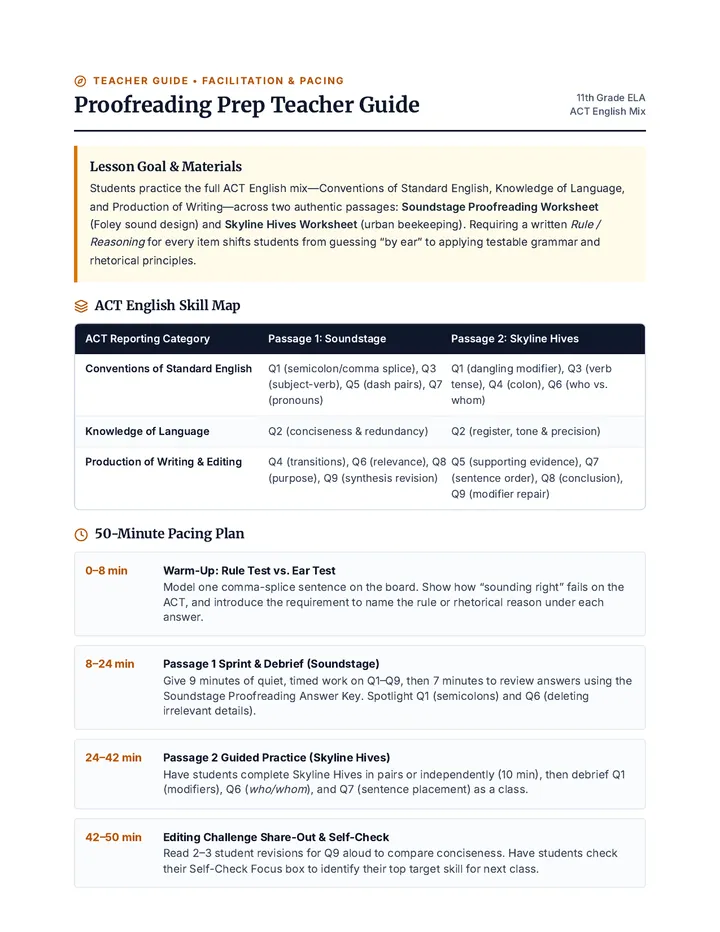
Students practice the full ACT English mix—Conventions of Standard English, Knowledge of Language, and Production of Writing—across two authentic passages: Soundstage Proofreading Worksheet (Foley sound design) and Skyline Hives Worksheet (urban beekeeping). Requiring a written Rule / Reasoning for every item shifts students from guessing “by ear” to applying testable grammar and rhetorical principles.
ACT English Skill Map
ACT Reporting Category
Passage 1: Soundstage
Passage 2: Skyline Hives
Conventions of Standard English
Q1 (semicolon/comma splice), Q3 (subject-verb), Q5 (dash pairs), Q7 (pronouns)
Q1 (dangling modifier), Q3 (verb tense), Q4 (colon), Q6 (who vs. whom)
Knowledge of Language
Q2 (conciseness & redundancy)
Q2 (register, tone & precision)
Production of Writing & Editing
Q4 (transitions), Q6 (relevance), Q8 (purpose), Q9 (synthesis revision)
Q5 (supporting evidence), Q7 (sentence order), Q8 (conclusion), Q9 (modifier repair)
50-Minute Pacing Plan
0–8 min
Warm-Up: Rule Test vs. Ear Test
Model one comma-splice sentence on the board. Show how “sounding right” fails on the ACT, and introduce the requirement to name the rule or rhetorical reason under each answer.
8–24 min
Passage 1 Sprint & Debrief (Soundstage)
Give 9 minutes of quiet, timed work on Q1–Q9, then 7 minutes to review answers using the Soundstage Proofreading Answer Key. Spotlight Q1 (semicolons) and Q6 (deleting irrelevant details).
24–42 min
Passage 2 Guided Practice (Skyline Hives)
Have students complete Skyline Hives in pairs or independently (10 min), then debrief Q1 (modifiers), Q6 (who/whom), and Q7 (sentence placement) as a class.
42–50 min
Editing Challenge Share-Out & Self-Check
Read 2–3 student revisions for Q9 aloud to compare conciseness. Have students check their Self-Check Focus box to identify their top target skill for next class.
Proofreading Prep Teacher Guide Objectives, Standards & Instructional Support
Learning Objectives & Standards Alignment
Students Will Be Able To:
Diagnose and fix conventions errors (comma splices, subject-verb agreement, dangling modifiers, verb tense, and pronoun case) in passage context.
Evaluate rhetorical choices for conciseness, tone, logical transitions, supporting evidence, and sentence placement.
Revise flawed draft sentences into clear, concise prose while preserving original meaning.
Aligned Standards (11th Grade):
CCSS.L.11-12.1 & L.11-12.2: Command of standard English grammar, usage, and punctuation.
CCSS.L.11-12.3: Apply language knowledge for effective style, tone, and conciseness.
CCSS.W.11-12.5: Strengthen writing through targeted revising and editing.
ACT CCRS (English): CSE 401–602, KLA 401–601, POW 401–602.
Common Student Misconceptions & Quick Fixes
1. “However” as a Conjunction (Soundstage Q1)
Trap: Treating however like but and using only a comma.
Quick Fix: Apply the “FANBOYS Test”—if it isn’t for, and, nor, but, or, yet, so, a comma cannot join two clauses.
2. Agreement Across Phrases (Soundstage Q3)
Trap: Matching the verb to the closest noun (gloves or gravel).
Quick Fix: Cross out comma-set-off phrases (combined with...) to reveal A single pair ... produces.
3. Dangling Modifiers (Skyline Hives Q1 & Q9)
Trap: Accepting Looking out..., a beehive sits because meaning feels clear.
Quick Fix: Ask, “Who is doing the -ing action?” That exact noun must follow the comma.
4. “Who” vs. “Whom” (Skyline Hives Q6)
Trap: Picking whom simply because it sounds more formal.
Quick Fix: Use the they/them swap inside the clause: they check hives → subject form who.
Differentiation & Scaffolding
Support (Emerging Readers & ELLs)
Provide a 4-item “Rule Bank” on the board (comma splice, subject-verb, conciseness, transition) for rationale lines.
Pre-teach key domain terms (apiary, acoustics, monoculture, appositive) before starting.
Split into two 25-minute sessions across consecutive days instead of a single 50-minute block.
Extension (Honors & Fast Finishers)
Have students write a 3-choice ACT-style distractor set for their Q9 revision and label why each wrong choice fails.
Tighten the Passage 2 sprint to 6 minutes to mirror official ACT pacing (~36 seconds per question).
Have pairs write a 4-sentence paragraph with one colon error and one modifier error to swap and edit.
ACT English Timing Benchmark
The official ACT English section includes 75 questions in 45 minutes (5 passages, ~9 minutes per passage). Using these 8-question + 1-revision sets builds both rule-based accuracy and test-day pacing.
~36s
Per Question