Festive Traditions Passage Worksheet
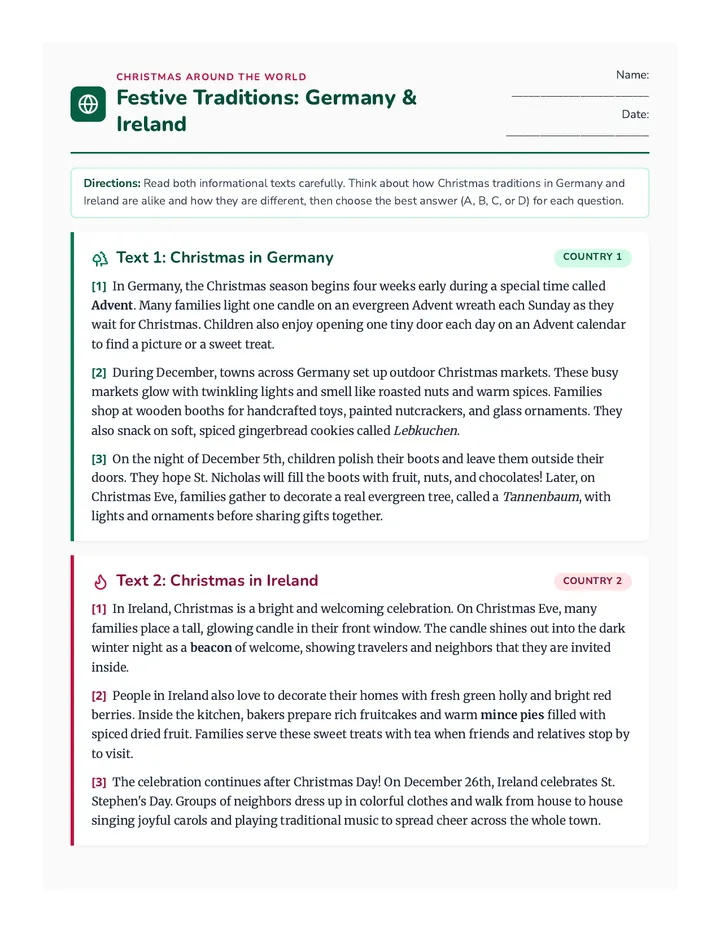
Christmas Around the World
Festive Traditions: Germany & Ireland
Name: ________________________
Date: _________________________
Directions: Read both informational texts carefully. Think about how Christmas traditions in Germany and Ireland are alike and how they are different, then choose the best answer (A, B, C, or D) for each question.
Text 1: Christmas in Germany
Country 1
[1] In Germany, the Christmas season begins four weeks early during a special time called Advent. Many families light one candle on an evergreen Advent wreath each Sunday as they wait for Christmas. Children also enjoy opening one tiny door each day on an Advent calendar to find a picture or a sweet treat.
[2] During December, towns across Germany set up outdoor Christmas markets. These busy markets glow with twinkling lights and smell like roasted nuts and warm spices. Families shop at wooden booths for handcrafted toys, painted nutcrackers, and glass ornaments. They also snack on soft, spiced gingerbread cookies called Lebkuchen.
[3] On the night of December 5th, children polish their boots and leave them outside their doors. They hope St. Nicholas will fill the boots with fruit, nuts, and chocolates! Later, on Christmas Eve, families gather to decorate a real evergreen tree, called a Tannenbaum, with lights and ornaments before sharing gifts together.
Text 2: Christmas in Ireland
Country 2
[1] In Ireland, Christmas is a bright and welcoming celebration. On Christmas Eve, many families place a tall, glowing candle in their front window. The candle shines out into the dark winter night as a beacon of welcome, showing travelers and neighbors that they are invited inside.
[2] People in Ireland also love to decorate their homes with fresh green holly and bright red berries. Inside the kitchen, bakers prepare rich fruitcakes and warm mince pies filled with spiced dried fruit. Families serve these sweet treats with tea when friends and relatives stop by to visit.
[3] The celebration continues after Christmas Day! On December 26th, Ireland celebrates St. Stephen's Day. Groups of neighbors dress up in colorful clothes and walk from house to house singing joyful carols and playing traditional music to spread cheer across the whole town.
Reading Comprehension Questions (Part 1)
Questions 1–4
1. According to Text 1, what do children in Germany leave outside on December 5th for St. Nicholas?
A. A tall candle
B. Polished boots
C. Gingerbread cookies
D. Holly wreaths
2. In Text 1, paragraph 3, what does the German word Tannenbaum mean?
A. An outdoor market
B. A wooden nutcracker
C. A Christmas tree
D. A holiday calendar
3. What is the main focus of paragraph 2 in Text 2 (Christmas in Ireland)?
A. Why families put a glowing candle in the front window
B. How people decorate their homes and what sweet treats they bake
C. What neighbors do together on St. Stephen's Day
D. How children count down the four weeks before Christmas
4. Why did the author most likely write Text 1 and Text 2?
A. To persuade readers to visit Europe during the winter
B. To teach readers how to bake gingerbread and mince pies
C. To describe how two different countries celebrate Christmas
D. To tell a made-up story about St. Nicholas and carolers
Reading Comprehension Questions (Part 2)
Questions 5–7
5. Read this sentence from Text 2:
"The candle shines out into the dark winter night as a beacon of welcome..."
What does the word beacon mean in this sentence?
A. A guiding light that can be seen from far away
B. A sweet pie baked for visiting guests
C. A joyful song sung by neighbors in the street
D. A green plant decorated with red berries
6. In Text 2, why do families in Ireland put a candle in their front window on Christmas Eve?
A. To help St. Nicholas find their polished boots outside
B. To light up the evergreen branches on their Christmas tree
C. To shine as a welcome sign for travelers and neighbors
D. To keep the mince pies warm while guests are visiting
7. Based on BOTH texts, how are Christmas decorations in Germany and Ireland ALIKE?
A. Both countries place wooden nutcrackers in their front windows.
B. Both countries use candles or glowing lights as part of their traditions.
C. Both countries hang holly wreaths on their doors on December 5th.
D. Both countries shop at outdoor markets for painted glass ornaments.
Reading Comprehension Questions (Part 3)
Questions 8–10
8. Which statement BEST compares and contrasts the holiday treats described in both texts?
A. Both countries bake mince pies for guests, while only Germany has fruitcake.
B. Both countries enjoy sweet, spiced treats, though Germany has Lebkuchen cookies and Ireland has fruitcakes and mince pies.
C. Germany only eats roasted nuts at outdoor markets, while Ireland only eats chocolates left in boots.
D. Neither country shares food with visitors because treats are saved only for December 26th.
9. Look at paragraph 3 in both texts. How are the celebrations in Germany and Ireland DIFFERENT?
A. In Germany, families celebrate at home with boots and a tree, while in Ireland, neighbors walk from house to house singing carols on St. Stephen's Day.
B. In Germany, people go caroling on December 26th, while in Ireland, children leave polished boots outside on December 5th.
C. In Germany, families only celebrate after Christmas Day, while in Ireland, families only celebrate four weeks before Christmas.
D. In Germany, neighbors dress in colorful clothes to play music, while in Ireland, families stay indoors to open Advent calendars.
10. Both authors want to show that Christmas is a time for welcoming and sharing with others. Which pair of details from Text 1 and Text 2 BEST supports this big idea?
A. Text 1 mentions counting down four weeks of Advent, and Text 2 mentions fresh green holly with red berries.
B. Text 1 mentions polishing boots on December 5th, and Text 2 mentions dressing up in colorful clothes.
C. Text 1 mentions townspeople gathering at markets and families sharing gifts, and Text 2 mentions welcoming travelers with a candle and serving treats to guests.
D. Text 1 mentions wooden nutcrackers and glass ornaments, and Text 2 mentions dark winter nights in December.
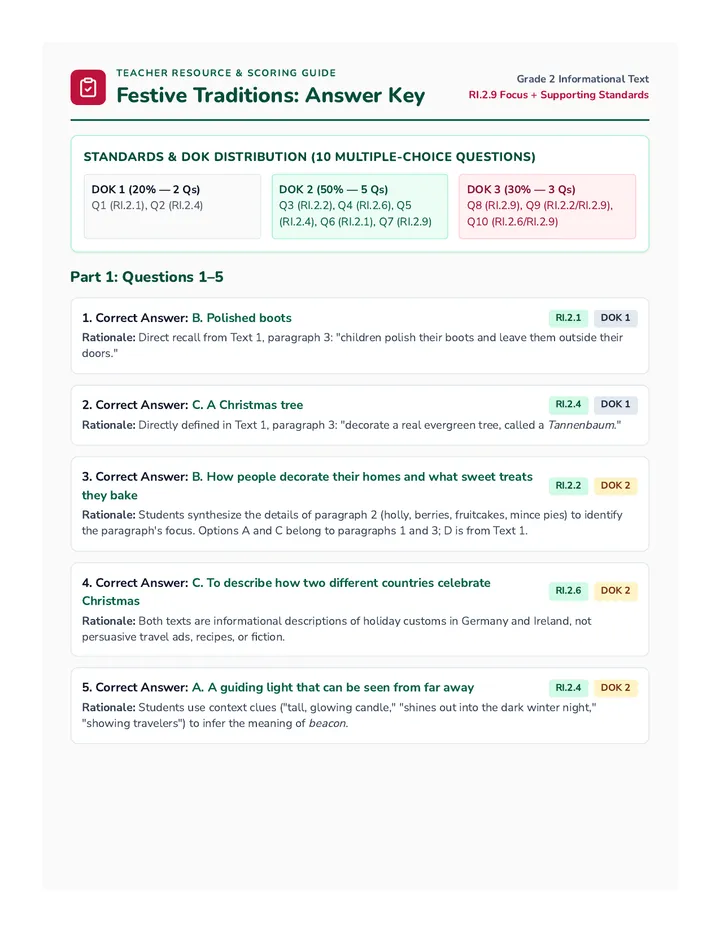
Festive Traditions Answer Key
Teacher Resource & Scoring Guide
Festive Traditions: Answer Key
Grade 2 Informational Text
RI.2.9 Focus + Supporting Standards
Standards & DOK Distribution (10 Multiple-Choice Questions)
DOK 1 (20% — 2 Qs)
Q1 (RI.2.1), Q2 (RI.2.4)
DOK 2 (50% — 5 Qs)
Q3 (RI.2.2), Q4 (RI.2.6), Q5 (RI.2.4), Q6 (RI.2.1), Q7 (RI.2.9)
DOK 3 (30% — 3 Qs)
Q8 (RI.2.9), Q9 (RI.2.2/RI.2.9), Q10 (RI.2.6/RI.2.9)
Part 1: Questions 1–5
1. Correct Answer: B. Polished boots
RI.2.1 DOK 1
Rationale: Direct recall from Text 1, paragraph 3: "children polish their boots and leave them outside their doors."
2. Correct Answer: C. A Christmas tree
RI.2.4 DOK 1
Rationale: Directly defined in Text 1, paragraph 3: "decorate a real evergreen tree, called a Tannenbaum."
3. Correct Answer: B. How people decorate their homes and what sweet treats they bake
RI.2.2 DOK 2
Rationale: Students synthesize the details of paragraph 2 (holly, berries, fruitcakes, mince pies) to identify the paragraph's focus. Options A and C belong to paragraphs 1 and 3; D is from Text 1.
4. Correct Answer: C. To describe how two different countries celebrate Christmas
RI.2.6 DOK 2
Rationale: Both texts are informational descriptions of holiday customs in Germany and Ireland, not persuasive travel ads, recipes, or fiction.
5. Correct Answer: A. A guiding light that can be seen from far away
RI.2.4 DOK 2
Rationale: Students use context clues ("tall, glowing candle," "shines out into the dark winter night," "showing travelers") to infer the meaning of beacon.
Part 2: Questions 6–10
Cross-Text & Higher-Order Analysis
6. Correct Answer: C. To shine as a welcome sign for travelers and neighbors
RI.2.1 DOK 2
Rationale: Text 2, paragraph 1 explains that the candle is a "beacon of welcome, showing travelers and neighbors that they are invited inside."
7. Correct Answer: B. Both countries use candles or glowing lights as part of their traditions.
RI.2.9 DOK 2
Rationale: Germany lights Advent wreath candles and twinkling tree/market lights; Ireland places a glowing candle in the front window.
8. Correct Answer: B. Both countries enjoy sweet, spiced treats, though Germany has Lebkuchen cookies and Ireland has fruitcakes and mince pies.
RI.2.9 DOK 3
Rationale: Requires synthesizing food details across both texts to identify both the shared category (sweet, spiced treats) and the country-specific differences.
9. Correct Answer: A. In Germany, families celebrate at home with boots and a tree, while in Ireland, neighbors walk from house to house singing carols on St. Stephen's Day.
RI.2.2 & RI.2.9 DOK 3
Rationale: Students must locate paragraph 3 in both texts, determine the focus of each, and contrast the home-centered German customs with the community-wide Irish caroling.
10. Correct Answer: C. Text 1 mentions townspeople gathering at markets and families sharing gifts, and Text 2 mentions welcoming travelers with a candle and serving treats to guests.
RI.2.6 & RI.2.9 DOK 3
Rationale: Students evaluate four pairs of cross-text evidence and select the pair that directly demonstrates the shared theme of welcoming and sharing.
RI.2.9 Instructional Tip: Color-Coding Evidence
Before students answer Questions 7–10, have them underline similarities between Germany and Ireland in green and differences in red directly on Page 1. This visual scaffold helps Grade 2 readers keep track of evidence from both texts!