Trimester Reading Assessment
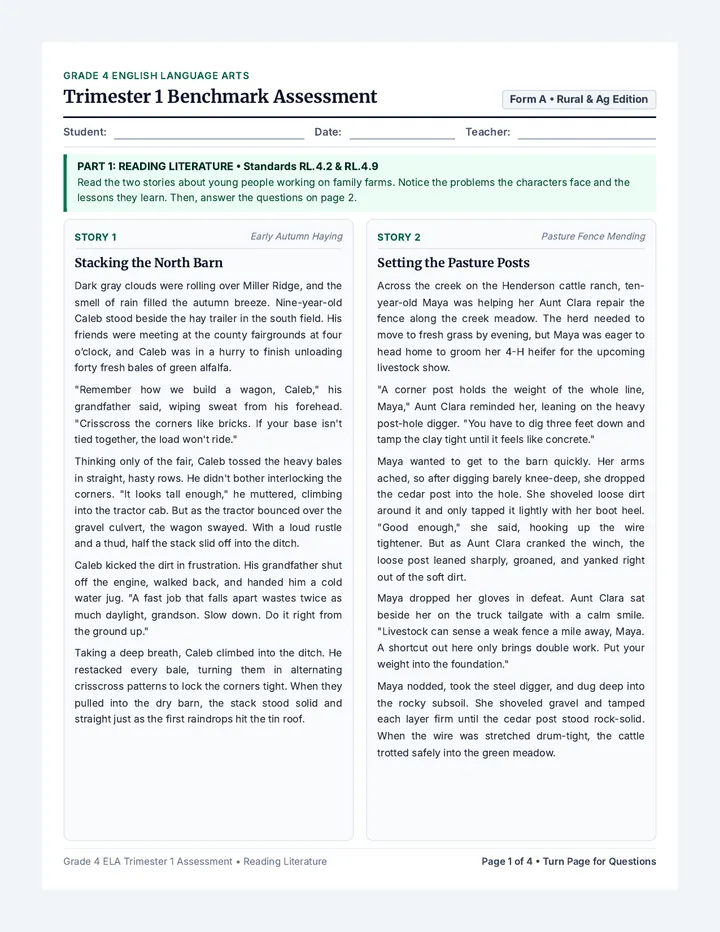
Grade 4 English Language Arts
Trimester 1 Benchmark Assessment
Form A • Rural & Ag Edition
Student:
Date:
Teacher:
PART 1: READING LITERATURE • Standards RL.4.2 & RL.4.9
Read the two stories about young people working on family farms. Notice the problems the characters face and the lessons they learn. Then, answer the questions on page 2.
Story 1 Early Autumn Haying
Stacking the North Barn
Dark gray clouds were rolling over Miller Ridge, and the smell of rain filled the autumn breeze. Nine-year-old Caleb stood beside the hay trailer in the south field. His friends were meeting at the county fairgrounds at four o’clock, and Caleb was in a hurry to finish unloading forty fresh bales of green alfalfa.
"Remember how we build a wagon, Caleb," his grandfather said, wiping sweat from his forehead. "Crisscross the corners like bricks. If your base isn't tied together, the load won't ride."
Thinking only of the fair, Caleb tossed the heavy bales in straight, hasty rows. He didn't bother interlocking the corners. "It looks tall enough," he muttered, climbing into the tractor cab. But as the tractor bounced over the gravel culvert, the wagon swayed. With a loud rustle and a thud, half the stack slid off into the ditch.
Caleb kicked the dirt in frustration. His grandfather shut off the engine, walked back, and handed him a cold water jug. "A fast job that falls apart wastes twice as much daylight, grandson. Slow down. Do it right from the ground up."
Taking a deep breath, Caleb climbed into the ditch. He restacked every bale, turning them in alternating crisscross patterns to lock the corners tight. When they pulled into the dry barn, the stack stood solid and straight just as the first raindrops hit the tin roof.
Story 2 Pasture Fence Mending
Setting the Pasture Posts
Across the creek on the Henderson cattle ranch, ten-year-old Maya was helping her Aunt Clara repair the fence along the creek meadow. The herd needed to move to fresh grass by evening, but Maya was eager to head home to groom her 4-H heifer for the upcoming livestock show.
"A corner post holds the weight of the whole line, Maya," Aunt Clara reminded her, leaning on the heavy post-hole digger. "You have to dig three feet down and tamp the clay tight until it feels like concrete."
Maya wanted to get to the barn quickly. Her arms ached, so after digging barely knee-deep, she dropped the cedar post into the hole. She shoveled loose dirt around it and only tapped it lightly with her boot heel. "Good enough," she said, hooking up the wire tightener. But as Aunt Clara cranked the winch, the loose post leaned sharply, groaned, and yanked right out of the soft dirt.
Maya dropped her gloves in defeat. Aunt Clara sat beside her on the truck tailgate with a calm smile. "Livestock can sense a weak fence a mile away, Maya. A shortcut out here only brings double work. Put your weight into the foundation."
Maya nodded, took the steel digger, and dug deep into the rocky subsoil. She shoveled gravel and tamped each layer firm until the cedar post stood rock-solid. When the wire was stretched drum-tight, the cattle trotted safely into the green meadow.
Grade 4 ELA Trimester 1 Assessment • Reading Literature Page 1 of 4 • Turn Page for Questions
Part 1 Questions: Reading Literature
Total: 15 Points
1. [RL.4.2] What central theme or lesson is shared by BOTH "Stacking the North Barn" and "Setting the Pasture Posts"?
(2 pts)
A Working alone is always faster than working with family members.
B Rushing through farm work causes mistakes, while patience and careful effort build lasting results.
C Modern tractors and machinery are more dependable than old cedar fence posts.
D Bad weather will always ruin outdoor farm chores no matter what you do.
2. [RL.4.2] Write one specific sentence or detail from EACH story that proves the main character learned this lesson.
(4 pts)
Key Detail from Story 1 (Caleb):
Key Detail from Story 2 (Maya):
3. [RL.4.9] Compare how Caleb and Maya handle their farm chores by completing the chart below.
(4 pts)
| Story Element | Caleb ("Stacking the North Barn") | Maya ("Setting the Pasture Posts") |
|---|
| Why the character rushed their work | | |
| What advice the elder mentor gave | | |
4. [RL.4.9] Extended Response: Both authors use different farm settings and chores to deliver their message. How do the setting and the chore in each story show why doing things right the first time is so important in farming? Use details from BOTH stories.
(5 pts)
Grade 4 ELA Trimester 1 Assessment • Reading Literature Page 2 of 4 • Turn Page for Part 2
PART 2: READING INFORMATIONAL TEXT • Standards RI.4.2 & RI.4.5 & RI.4.1
Read the article about agricultural science below. As you read, pay attention to the main idea, how paragraphs connect, and the text evidence the author provides.
Agricultural Science Article Reading Level: Grade 4 Informational
The Living Soil: How Farmers Protect the Land
When people look across a freshly plowed field, they often see plain brown dirt. But to farmers, that topsoil is the most precious treasure on earth. Healthy farm soil is alive. A single spoonful of rich dirt contains billions of helpful bacteria, microscopic fungi, and earthworms that break down old stalks into minerals that feed new crops.
However, keeping soil healthy is hard work. If a farmer plants the same crop—such as field corn—in the exact same field year after year, problems begin. Corn is a hungry plant that guzzles huge amounts of nitrogen from the ground. Over time, the soil becomes depleted and tired. In addition, when fields sit bare all winter, prairie winds and heavy rains can blow or wash away inches of irreplaceable topsoil.
To solve these challenges, farmers use a smart method called crop rotation. Instead of planting corn every spring, a farmer might rotate and plant soybeans or clover the following season. Soybeans are special plants called legumes. They have tiny nodules on their roots that work with soil bacteria to pull nitrogen straight from the air and store it back into the earth. When the soybeans are harvested, the ground is naturally fertilized and ready for corn again.
Farmers also protect their fields by planting cover crops in the late fall. After harvesting corn or wheat, they sow winter rye, oats, or hairy vetch across the stubble. These green cover crops grow like a living winter blanket over the fields. Their thick root webs hold the soil tightly in place against harsh winter winds. When spring arrives, farmers till the green plants back into the ground, adding rich organic compost. By rotating crops and planting cover crops, farming communities ensure their land will feed families for generations to come.
Questions: Text Structure & Text Evidence
(6 Points)
5. [RI.4.5] How does the author connect the ideas in paragraph 4 to the ideas in paragraph 3?
(2 pts)
A By contrasting why cover crops are harmful while crop rotation is helpful.
B By providing another important practice farmers use to care for and protect soil.
C By explaining the chronological order of how to operate a combine harvester.
D By showing why winter weather prevents any kind of crop from surviving.
6. [RI.4.1] Explain how planting soybeans helps replenish farm soil after a corn harvest. Support your answer with TWO specific pieces of evidence from the text.
(4 pts)
Grade 4 ELA Trimester 1 Assessment • Informational Text Page 3 of 4 • Turn Page for Summary Task
Part 2 Questions: Main Idea & Summary Writing
Total: 15 Points
7. [RI.4.2] Which statement BEST states the central main idea of "The Living Soil: How Farmers Protect the Land"?
(2 pts)
A Earthworms and microscopic bacteria live in dirt and break down corn stalks.
B Corn uses large amounts of nitrogen from the ground every single summer.
C Farmers protect healthy soil and prevent erosion by rotating crops and planting winter cover crops.
D Prairie winds always blow dry topsoil into creeks whenever winter arrives.
8. [RI.4.2] Select TWO key details from the article that support the main idea chosen in question 7.
(4 pts)
A. Legume crops like soybeans return nitrogen into the ground through root nodules.
B. When people look across a field, they often just see plain brown dirt.
C. Cover crops create a living blanket whose root webs hold topsoil against wind and rain.
D. Caleb restacked forty bales of alfalfa on the flatbed trailer.
E. Cedar posts hold the corner wire of the pasture fence drum-tight.
9. [RI.4.2] Summary Writing Task: Write an objective summary of "The Living Soil: How Farmers Protect the Land." State the central main idea and include at least three key supporting details in your own words.
(9 pts)
Summary Checklist: • Stated main idea • 3 key supporting details • In your own words • No personal opinions
Teacher Scoring & Trimester 1 Standards Conversion Summary Score Range: 0–30 Points
RL.4.2 Theme & Details ____ / 6 pts
RL.4.9 Compare Stories ____ / 9 pts
RI.4.2 Main Idea & Summary ____ / 11 pts
RI.4.5 & RI.4.1 Evidence ____ / 4 pts
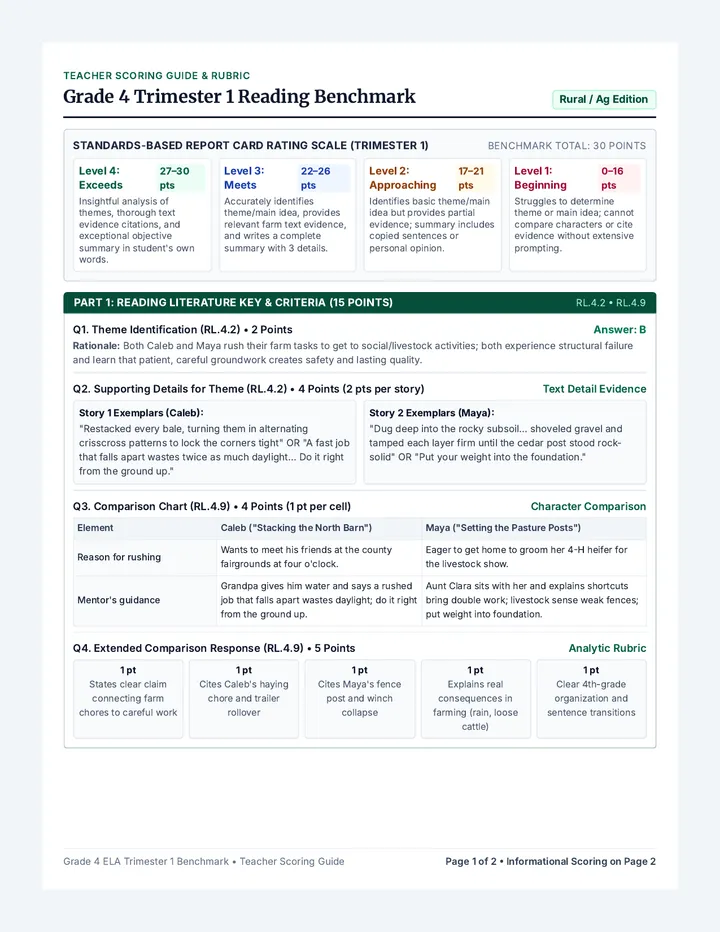
Reading Benchmark Teacher Guide
Teacher Scoring Guide & Rubric
Grade 4 Trimester 1 Reading Benchmark
Rural / Ag Edition
Standards-Based Report Card Rating Scale (Trimester 1) Benchmark Total: 30 Points
Level 4: Exceeds 27–30 pts
Insightful analysis of themes, thorough text evidence citations, and exceptional objective summary in student's own words.
Level 3: Meets 22–26 pts
Accurately identifies theme/main idea, provides relevant farm text evidence, and writes a complete summary with 3 details.
Level 2: Approaching 17–21 pts
Identifies basic theme/main idea but provides partial evidence; summary includes copied sentences or personal opinion.
Level 1: Beginning 0–16 pts
Struggles to determine theme or main idea; cannot compare characters or cite evidence without extensive prompting.
Part 1: Reading Literature Key & Criteria (15 Points) RL.4.2 • RL.4.9
Q1. Theme Identification (RL.4.2) • 2 Points Answer: B
Rationale: Both Caleb and Maya rush their farm tasks to get to social/livestock activities; both experience structural failure and learn that patient, careful groundwork creates safety and lasting quality.
Q2. Supporting Details for Theme (RL.4.2) • 4 Points (2 pts per story) Text Detail Evidence
Story 1 Exemplars (Caleb): "Restacked every bale, turning them in alternating crisscross patterns to lock the corners tight" OR "A fast job that falls apart wastes twice as much daylight... Do it right from the ground up."
Story 2 Exemplars (Maya): "Dug deep into the rocky subsoil... shoveled gravel and tamped each layer firm until the cedar post stood rock-solid" OR "Put your weight into the foundation."
Q3. Comparison Chart (RL.4.9) • 4 Points (1 pt per cell) Character Comparison
<table class="w-full mt-1 border border-slate-200 text-[10.5px]"><tbody><tr class="bg-slate-100 font-semibold text-slate-700"><td class="p-1 border border-slate-200 w-1/4">Element</td><td class="p-1 border border-slate-200 w-3/8">Caleb ("Stacking the North Barn")</td><td class="p-1 border border-slate-200 w-3/8">Maya ("Setting the Pasture Posts")</td></tr><tr><td class="p-1 border border-slate-200 font-medium bg-slate-50">Reason for rushing</td><td class="p-1 border border-slate-200">Wants to meet his friends at the county fairgrounds at four o'clock.</td><td class="p-1 border border-slate-200">Eager to get home to groom her 4-H heifer for the livestock show.</td></tr><tr><td class="p-1 border border-slate-200 font-medium bg-slate-50">Mentor's guidance</td><td class="p-1 border border-slate-200">Grandpa gives him water and says a rushed job that falls apart wastes daylight; do it right from the ground up.</td><td class="p-1 border border-slate-200">Aunt Clara sits with her and explains shortcuts bring double work; livestock sense weak fences; put weight into foundation.</td></tr></tbody></table>