Text Architecture Slides
Ohio Learning Standards • RI.6.5
6th Grade Reading Informational Text
Text Architecture Series
Informational Text Blueprint
Text Architecture:
How Authors Build Ideas
Every building has a blueprint. Every author has a structure. Learn to inspect the framework behind non-fiction texts.
5 Core Structures
Signal Word Clues
Author Purpose Analysis
Overview
The 5 Informational Blueprints
Architectural Frameworks
Description
Paints a sensory portrait of a person, place, thing, or idea.
Organizer: Web
Sequence
Arranges events in time order or step-by-step procedures.
Organizer: Timeline
Compare
Examines similarities and contrasts differences between items.
Organizer: Venn
Cause/Effect
Shows how an action or condition produces specific results.
Organizer: Arrows
Problem/Solution
States a challenge and offers one or more practical remedies.
Organizer: Puzzle
Architectural Principle: Good readers look for the author's primary goal before choosing an organizer. Ohio RI.6.5 Focus
Blueprint 1
Description (Spatial / Sensory)
Goal: Visualize & Detail
Architectural Purpose
The author paints a complete picture by describing characteristics, attributes, physical features, or examples of a topic.
Key Signal Words & Phrases
for example characteristics include such as specifically to illustrate features
Field Observation Sample Ohio Wildlife
"The Ohio buckeye tree (specifically known as Aesculus glabra) is recognizable by its distinct five-fingered leaflets. In spring, pale yellow-green blossoms blanket the canopy. By autumn, its thick, prickly brown capsules split open to reveal smooth, glossy dark brown nuts with a light circular eye."
Why the author chose this: Gives readers precise sensory details to accurately identify the official state tree in nature.
Mental Check: If you can draw a labeled diagram with arrows pointing to parts, it is likely descriptive.
Blueprint 2
Sequence & Chronological Order
Goal: Follow the Timeline
Architectural Purpose
The author organizes events by when they happened in time, or organizes directions by numerical steps that must be done in exact order.
Key Signal Words & Phrases
first, next, then meanwhile dates (1903, 1920) previously subsequently eventually
Historical Timeline Sample Dayton Inventors
"In 1899, Dayton bicycle makers Orville and Wilbur Wright began testing unpowered kites. By 1902, they perfected aerodynamic gliders in their workshop. Finally, on December 17, 1903, their engine-powered Flyer sustained 12 seconds in the air."
Why the author chose this: Shows the progression of engineering trials and persistence over consecutive years.
Mental Check: If you can arrange facts on a horizontal timeline, the structure is chronological.
Blueprint 3
Compare & Contrast
Goal: Match & Differentiate
Architectural Purpose
The author evaluates two or more concepts, showing how they share fundamental qualities while highlighting critical differences.
Key Signal Words & Phrases
similarly / likewise in contrast on the other hand whereas both share unlike
Engineering Comparison Roller Coasters
"Both wooden and steel coasters rely on gravity to complete their circuits. However, unlike wooden tracks that flex and limit inversions, modern steel coasters utilize tubular rails that allow loops, barrel rolls, and significantly higher velocity."
Why the author chose this: Clarifies coaster mechanics by weighing traditional wood coasters against modern steel thrills.
Mental Check: If ideas split into a Venn diagram (Same in middle, Different on sides), it is Compare & Contrast.
Blueprint 4
Cause & Effect
Goal: Trace the Chain Reaction
Architectural Purpose
The author explains why something happened (the cause) and what occurred as a result (the effects).
Key Signal Words & Phrases
because / since as a result consequently due to leads to / triggers therefore
Ecosystem Case Study Lake Erie Ecology
"Because heavy springtime rains washed excess fertilizer off farm fields, high levels of phosphorus entered Lake Erie. As a consequence, toxic cyanobacteria multiplied rapidly, triggering widespread water bans in northern Ohio."
Why the author chose this: Demonstrates scientific cause-and-effect so the public understands how farm runoff directly impacts drinking water.
Mental Check: Ask "What happened?" and "Why did it happen?" If both are answered, it is Cause & Effect.
Blueprint 5
Problem & Solution
Goal: Diagnose & Resolve
Architectural Purpose
The author introduces a troubling obstacle, danger, or mystery, and then proposes or evaluates one or more solutions to solve it.
Key Signal Words & Phrases
the problem is issue / challenge one solution is to resolve this proposed remedy fix / remedy
Conservation Report Great Lakes Action
"Invasive quagga mussels represent a severe threat to Lake Erie's municipal water pipelines by clogging intake pipes. To resolve this dilemma, engineers implemented a solution: installing copper-coated screening barriers that repel mussel larvae."
Why the author chose this: Frames the issue around an active dilemma and rallies support for an innovative technological remedy.
Crucial Difference: Cause/Effect explains why; Problem/Solution presents an action to fix it.
Critical Thinking Alert
The Signal Word Trap: Look Deeper!
RI.6.5 Skill Focus
The Rookie Mistake
"I see the word because, so the entire passage must be Cause and Effect!"
Why this fails: A single signal word can appear in any sentence. A chronological text or problem/solution text frequently uses words like "first" or "since".
The Master Architect Method
Always ask yourself: What is the overall blueprint? How is the author organizing the entire body of ideas?
The Golden Rule: Signal words are helpful breadcrumbs, but the author's central purpose decides the structure.
Step 1: Identify the central idea. Step 2: Highlight repeating clue words. Step 3: Test which visual organizer holds the complete passage.
Ohio Standard RI.6.5
Analyzing Author's Choice: Why Structure Matters
The "So What?" Question
1. Connect to Purpose
Why didn't the author just tell a story or list random facts? Why did they choose this specific framework?
"The author used cause-and-effect to persuade readers that..."
2. Inspect Key Paragraphs
How does paragraph 3 support paragraph 2? Does it provide the root cause, a contrast, or a resolution?
"This section shifts from the obstacle to the engineering fix..."
3. Evaluate Reader Impact
How does this organization help the reader understand complex facts easily and clearly?
"By comparing side-by-side, readers see key advantages instantly."
Ohio State Test Tip: RI.6.5 questions often ask: "How does paragraph 4 contribute to the overall development of ideas in the passage?"
Comparison Challenge
One Topic • Two Different Blueprints
Topic: Roller Coaster G-Forces
Author A's Blueprint Cause & Effect
"When a coaster plunges 300 feet at Cedar Point, gravity accelerates the train to 90 mph. Consequently, riders experience intense positive G-forces pushing them into their seats. Because blood pulls toward the feet, heart rates spike dramatically."
Author's Goal: Explain the physiological physics reactions that occur during high-speed acceleration.
Author B's Blueprint Problem & Solution
"Extreme G-forces created a dangerous safety dilemma: riders risked temporary blackouts on tight loops. To resolve this hazard, ride engineers designed teardrop-shaped clothoid loops, which gradually distribute gravitational load safely."
Author's Goal: Highlight an engineering obstacle and describe the mathematical innovation that solved it.
Key Takeaway: The topic is identical (roller coaster G-forces), but each author's distinct purpose required a completely different structure!
Architectural Mission
Interactive Notes & Practice Application
Ready for Action
1
Complete Notes
Record the definitions, sketch organizers, and map key signal words in your guided blueprint organizer.
2
Hunt Clues
Annotate real-world Ohio science & history passages: circle transitions and deduce the architectural blueprint.
3
Analyze Choice
Answer the Ohio RI.6.5 prompt: explain why the author built the passage using that structure.
Remember: Form follows function. Authors choose blueprints that make their message undeniable. Open your Guided Notes to begin!
Text Blueprint Guided Notes
Text Architecture Guided Notes
Ohio Learning Standard RI.6.5 • Analyzing Informational Frameworks
Student Study Sheet Blueprint Reading System
Name:
Date:
Class Period:
1
The Foundation: What is Text Structure?
• Text Structure is the way an author and patterns information within a text.
• Just like an architect uses a blueprint to build a house, authors choose structures to support their and achieve their .
• Ohio RI.6.5 Skill: Good readers analyze how individual sentences and paragraphs into the overall structure to develop the central idea.
2
The Master Blueprint Matrix (Part I)
Fill in definitions, key signal clues, and sketch the mental organizer
Blueprint 1: Description Visualizes Details
Purpose: Describes characteristics, features, or examples of a .
Question: "What does it look like, do, or consist of?"
Top Signal Words:
for example, characteristics include, such as, specifically, to illustrate
Sketch Organizer (Web)
Blueprint 2: Sequence & Chronology Tracks Time / Order
Purpose: Orders events in order or step-by-step procedures.
Question: "In what order did these events take place?"
Top Signal Words:
first, next, subsequently, dates/times, previously, finally, meanwhile
Sketch Organizer (Timeline)
Blueprint 3: Compare & Contrast Same vs. Different
Purpose: Highlights and differences between two or more items.
Question: "How are these similar, and how are they distinct?"
Top Signal Words:
similarly, in contrast, on the other hand, unlike, whereas, both share
Sketch Organizer (Venn)
Text Architecture Guided Notes • Grade 6 ELA Ohio Learning Standards: RI.6.5 Page 1 of 2
Text Architecture Guided Notes (Page 2) Student Name:
2
The Master Blueprint Matrix (Part II)
Blueprint 4: Cause & Effect Action & Outcome
Purpose: Explains an event occurs and what happened because of it.
Question: "What caused this, and what chain reaction followed?"
Top Signal Words:
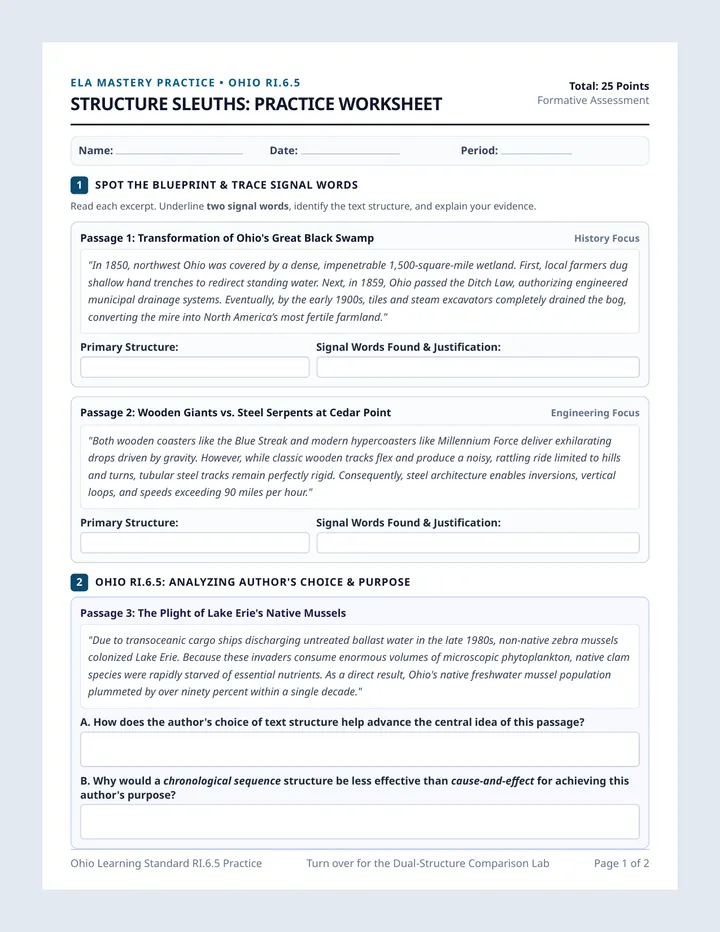
Structure Sleuths Practice Worksheet
ELA Mastery Practice • Ohio RI.6.5
Structure Sleuths: Practice Worksheet
Total: 25 Points
Formative Assessment
Name:
Date:
Period:
1
Spot the Blueprint & Trace Signal Words
Read each excerpt. Underline two signal words, identify the text structure, and explain your evidence.
Passage 1: Transformation of Ohio's Great Black Swamp History Focus
"In 1850, northwest Ohio was covered by a dense, impenetrable 1,500-square-mile wetland. First, local farmers dug shallow hand trenches to redirect standing water. Next, in 1859, Ohio passed the Ditch Law, authorizing engineered municipal drainage systems. Eventually, by the early 1900s, tiles and steam excavators completely drained the bog, converting the mire into North America’s most fertile farmland."
Primary Structure:
Signal Words Found & Justification:
Passage 2: Wooden Giants vs. Steel Serpents at Cedar Point Engineering Focus
"Both wooden coasters like the Blue Streak and modern hypercoasters like Millennium Force deliver exhilarating drops driven by gravity. However, while classic wooden tracks flex and produce a noisy, rattling ride limited to hills and turns, tubular steel tracks remain perfectly rigid. Consequently, steel architecture enables inversions, vertical loops, and speeds exceeding 90 miles per hour."
Primary Structure:
Signal Words Found & Justification:
2
Ohio RI.6.5: Analyzing Author's Choice & Purpose
Passage 3: The Plight of Lake Erie's Native Mussels
"Due to transoceanic cargo ships discharging untreated ballast water in the late 1980s, non-native zebra mussels colonized Lake Erie. Because these invaders consume enormous volumes of microscopic phytoplankton, native clam species were rapidly starved of essential nutrients. As a direct result, Ohio's native freshwater mussel population plummeted by over ninety percent within a single decade."
A. How does the author's choice of text structure help advance the central idea of this passage?
B. Why would a chronological sequence structure be less effective than cause-and-effect for achieving this author's purpose?
Ohio Learning Standard RI.6.5 Practice Turn over for the Dual-Structure Comparison Lab Page 1 of 2
Part 3: The Blueprint Comparison Lab Student Name:
Same Topic • Different Architectural Blueprints
Both passages below examine Garrett Morgan, the legendary African American inventor who operated a bustling workshop in Cleveland, Ohio. Read both texts carefully and examine how each author organizes their information.
Text Blueprint Teacher Guide
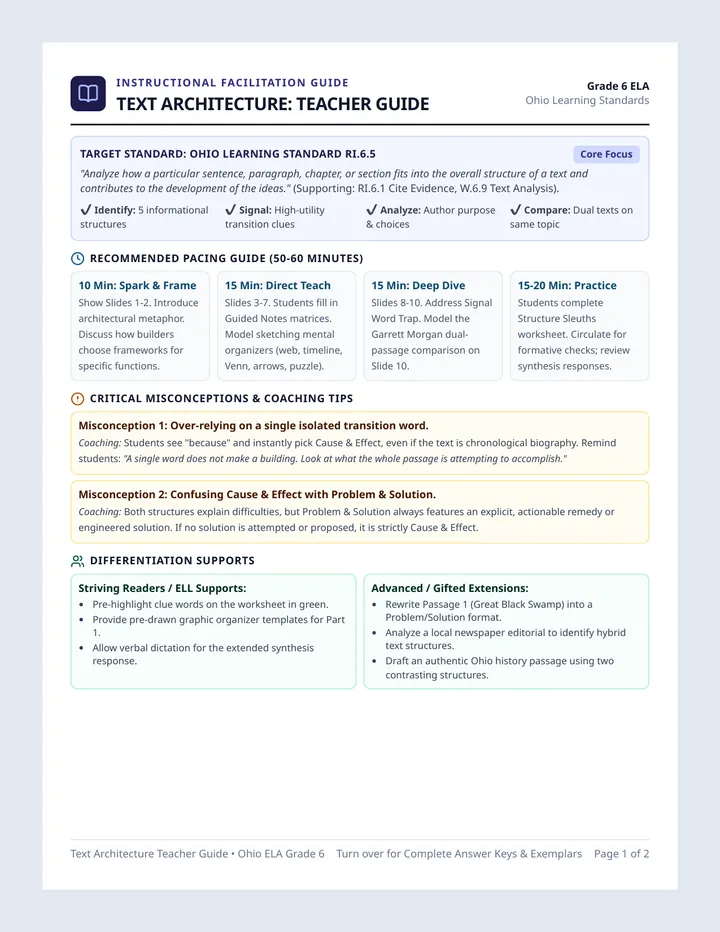
Instructional Facilitation Guide
Text Architecture: Teacher Guide
Grade 6 ELA
Ohio Learning Standards
Target Standard: Ohio Learning Standard RI.6.5 Core Focus
"Analyze how a particular sentence, paragraph, chapter, or section fits into the overall structure of a text and contributes to the development of the ideas." (Supporting: RI.6.1 Cite Evidence, W.6.9 Text Analysis).
✔ Identify: 5 informational structures ✔ Signal: High-utility transition clues ✔ Analyze: Author purpose & choices ✔ Compare: Dual texts on same topic
Recommended Pacing Guide (50-60 Minutes)
10 Min: Spark & Frame
Show Slides 1-2. Introduce architectural metaphor. Discuss how builders choose frameworks for specific functions.
15 Min: Direct Teach
Slides 3-7. Students fill in Guided Notes matrices. Model sketching mental organizers (web, timeline, Venn, arrows, puzzle).
15 Min: Deep Dive
Slides 8-10. Address Signal Word Trap. Model the Garrett Morgan dual-passage comparison on Slide 10.
15-20 Min: Practice
Students complete Structure Sleuths worksheet. Circulate for formative checks; review synthesis responses.
Critical Misconceptions & Coaching Tips
Misconception 1: Over-relying on a single isolated transition word.
Coaching: Students see "because" and instantly pick Cause & Effect, even if the text is chronological biography. Remind students: "A single word does not make a building. Look at what the whole passage is attempting to accomplish."
Misconception 2: Confusing Cause & Effect with Problem & Solution.
Coaching: Both structures explain difficulties, but Problem & Solution always features an explicit, actionable remedy or engineered solution. If no solution is attempted or proposed, it is strictly Cause & Effect.
Differentiation Supports
Striving Readers / ELL Supports:
- Pre-highlight clue words on the worksheet in green.
- Provide pre-drawn graphic organizer templates for Part 1.
- Allow verbal dictation for the extended synthesis response.
Advanced / Gifted Extensions:
- Rewrite Passage 1 (Great Black Swamp) into a Problem/Solution format.
- Analyze a local newspaper editorial to identify hybrid text structures.
- Draft an authentic Ohio history passage using two contrasting structures.