Lenny.com
Explore
Create
ActivitiesNewMathEnglish Language ArtsScience & EngineeringSocial StudiesGlobal LanguagesHealth & Physical EducationSpecial EducationCounseling & Life SkillsArts & CreativityESL
Lenny.com
Lenny.com
Explore
Create
ActivitiesNewMathEnglish Language ArtsScience & EngineeringSocial StudiesGlobal LanguagesHealth & Physical EducationSpecial EducationCounseling & Life SkillsArts & CreativityESL
Lenny.com
Lenny.com

Solutions

Lenny for EducatorsLenny for SchoolsLenny for Districts

Product

ExploreSign inCreateSupportAbout

Resources

Getting startedMTSS Acceleration Program

© 2026 Lenny Learning Inc.

TermsPrivacyAccessibility
LinkedInInstagramX
Lenny
English Language ArtsPhonics & Reading FoundationsLetter IdentificationLearn Letters A-ZLowercase and Uppercase LettersConsonants and VowelsLetter-Sound AssociationsLetter-Sound Associations: LowercaseLetter-Sound Associations: UppercaseBeginning and Ending SoundsRhymingBlending And SegmentingShort VowelsShort Vowel SoundsConsonant BlendsConsonant DigraphsBlends, Digraphs, and TrigraphsDigraphs, Blends, and Silent LettersLong Vowel SoundsLong Vowel PatternsShort and Long VowelsShort and Long Vowel PatternsSilent EVowel SoundsVowel TeamsR-Controlled VowelsDiphthongs: Oi, Oy, Ou, OwVariant VowelsVariant, Diphthong, And R Vowel PatternsSoft G And CSight WordsIrregular WordsWord RecognitionSyllablesSyllable TypesTwo-Syllable WordsMultisyllabic WordsPhoneme ManipulationDecodable TextsVocabularyAction WordsQuestion WordsNouns and AdjectivesClassify WordsCompound WordsSynonyms and AntonymsHomophonesHomophones and HomonymsShades of MeaningContext CluesPrefixes and SuffixesGreek and Latin RootsAnalogiesIdioms and AdagesForeign Words and ExpressionsWord Choice and UsageReference SkillsReading ComprehensionRead-Along Literary TextsRead-Along Informational TextsReality vs. FictionStory ElementsCharacterSequenceMain IdeaCause And EffectCompare And ContrastReading StrategiesText StructureAuthor's PurposeAuthor's Purpose And ToneAuthor's PerspectivePoint Of ViewThemeInference And ThemeInference And AnalysisPoetry ElementsLiterary DevicesAnalyzing LiteratureAnalyzing Informational TextsComparing TextsAudience, Purpose, And ToneBusiness DocumentsNovel StudyNonfiction Book StudyGrammar & MechanicsSentencesNounsVerbsAdjectivesPronounsCapitalizationPunctuationContractionsConjunctionsPrepositionsArticlesAdjectives And AdverbsVerb TypesVerb TensePronouns And AntecedentsPronoun TypesSubject-Verb AgreementDirect And Indirect ObjectsSentences, Fragments, And Run-OnsPhrases And ClausesCommasSemicolons, Colons, And CommasDashes, Hyphens, And EllipsesSpellingAbbreviationsFormattingVerb Tense And MoodMisplaced ModifiersWritingDescriptive DetailsCreative WritingOpinion WritingTopic SentencesOrganizing WritingLinking WordsSentence VarietyIntroductions And ConclusionsPersuasive And Opinion WritingExpository WritingPersuasive StrategiesDeveloping And Supporting ArgumentsTopic Sentences And Thesis StatementsSummarizingResearch SkillsEditing And RevisingActive And Passive Voice=Writing Clearly And ConciselyDebate & Public SpeakingPublic Speaking BasicsPersuasive TechniquesClaims and EvidenceTypes of ArgumentsReasoning TypesLogical FallaciesTopic ResearchOrganizing EvidenceDebate Speech OrganizationAttacking and Defending ArgumentsClash and EngagementImpact CalculusQuestioning and Cross-ExaminationCritical ThinkingInformal LogicFormal LogicInductive Reasoning

Syllable Code Breakers

A 50-minute foundational phonics lesson on dividing 1- and 2-syllable words using open and closed syllable patterns. Students learn to spot vowel markers, divide syllables between consonants or after open vowels, and decode short and long vowel sounds with accuracy.

LSLaurel Sviatko
Does it sound real?
Final Syllables & Vowel 1 Sound
r o b o tr o / b o t✓ Yes! ("rō-bot")ro / bot • Vowel 1 is Long ō
t i g e r_________________[   ] Yes   [   ] FlexSyllables: _____________ • [   ] Long [   ] Short
l e m o n_________________[   ] Yes   [   ] FlexSyllables: _____________ • [   ] Long [   ] Short
m u s i c_________________[   ] Yes   [   ] FlexSyllables: _____________ • [   ] Long [   ] Short
c a b i n_________________[   ] Yes   [   ] FlexSyllables: _____________ • [   ] Long [   ] Short
p l a n e t_________________[   ] Yes   [   ] FlexSyllables: _____________ • [   ] Long [   ] Short

5

Sentence Clue Decoder

Slice the bold word and mark the vowel in Syllable 1.

1. The fluffy rabbit hopped over the green fence.

Syllable Division:

First Vowel: [   ] Short ă   [   ] Long ā

2. We stayed at a cozy cabin near the pine river.

Syllable Division:

First Vowel: [   ] Short ă   [   ] Long ā

3. The bright silver robot blinked its yellow eyes.

Syllable Division:

First Vowel: [   ] Short ŏ   [   ] Long ō

Exit Ticket: Master Code Lock

Solo Assessment

Code Explanation Prompt:

Explain to a rookie detective why the word go has a long vowel, but the word got has a short vowel:

Mystery Word Chop Challenge:

Divide the word magnet and label each syllable (Closed or Open) and vowel sound (Short or Long):

Syllable Code Breakers • Mission Document Page 2 of 2 Turn in completed Field Report to HQ

Counting Silent Letters: Counting silent 'e' at the end of a word. Fix: "Did your chin drop on that 'e'? No sound means no syllable!"

Rigid VCV Decoding: Reading VCV words as always long without checking context. Fix: "Try Open/Long first. If it's nonsense, flex the slash to make it closed and short!"

Syllable Code Breakers • Teacher Guide Page 1 of 2 Turn over for Instructional Script, Differentiation, & Complete Answer Key →

Instructional Script, Differentiation & Answer Key

Teacher Reference Page 2

Teacher Think-Aloud Scripts

1. Teaching What a Syllable Is & The 3 Detection Tests

"Agents, words are made of sound beats called syllables. Every single syllable has exactly ONE vowel sound. Put your hand flat under your chin. Say: 'cat'. Your chin dropped one time! Now say: 'nap-kin'. Your chin dropped twice! That means 'cat' has 1 syllable and 'napkin' has 2 syllables. You can also clap the beat (nap-kin!) or hum with your lips closed (Mmm-Mmm!)."

2. Modeling VCCV & VCV Flex

"For VCCV (muffin): Underline vowels 'u' and 'i'. Twin consonants in the middle! Chop right down the center: 'muf / fin'. The doors are locked, so both vowels are short: /mŭf-fĭn/! For VCV (lemon): Only 1 consonant! Try open first: /lē-mon/. Is that a word? No! So we flex the chop after the 'm': /lĕm-on/! Real word unlocked!"

Multi-Tiered Differentiation

Tier 1: Intervention

Use physical counters or unifix cubes. Push one cube forward for each chin drop before writing. Color-code vowels with yellow highlighters.

Tier 2: English Learners

Emphasize jaw drop differences between short /ă/, /ĕ/, /ĭ/. Connect to cognates (robot, música, planeta) where syllable breaks align.

Tier 3: Extension

Challenge advanced decoders with 3-syllable compound or multi-syllabic words: fan-tas-tic (closed/closed/closed) and vol-ca-no (closed/open/open).

Master Worksheet Answer Key

Field Report Solutions

Worksheet Parts 1, 2, & 3 (Page 1)

Part 1 (Beat Detector): cat: 1 drop (1 Syllable) • napkin: 2 drops (2 Syllables) • bed: 1 drop (1 Syllable) • robot: 2 drops (2 Syllables)

Part 2 (1-Syllable Inspection): 1. she (Open, Long ē) • 2. stop (Closed, Short ŏ) • 3. go (Open, Long ō) • 4. jump (Closed, Short ŭ)

Part 3 (VCCV Chop): muf/fin (muf: Short ŭ, fin: Short ĭ) • cac/tus (cac: Short ă, tus: Short ŭ) • pic/nic (pic: Short ĭ, nic: Short ĭ) • sun/set (sun: Short ŭ, set: Short ĕ)

Worksheet Parts 4, 5, & 6 (Page 2)

Part 4 (VCV Table): tiger: ti / ger → Yes → Vowel 1: Long ī • lemon: le / mon → Flex to lem / on → Vowel 1: Short ĕ • music: mu / sic → Yes → Vowel 1: Long ū • cabin: ca / bin → Flex to cab / in → Vowel 1: Short ă • planet: pla / net → Flex to plan / et → Vowel 1: Short ă

Part 5 (Sentences): 1. rab/bit • First vowel: Short ă • 2. cab/in • First vowel: Short ă • 3. ro/bot • First vowel: Long ō

Part 6 (Exit Ticket): Prompt 1: In go, no consonant blocks the vowel, making it open to say its long name (/ō/). In got, the consonant 't' locks the vowel in, making it closed with a short sound (/ŏ/). Prompt 2: mag/net • mag (Closed, Short ă) • net (Closed, Short ĕ).

Syllable Code Breakers • Teacher Guide Page 2 of 2 Phonics Instructional Resource • Standards: CCSS.ELA-LITERACY.RF.2.3 & RF.3.3
You might also like

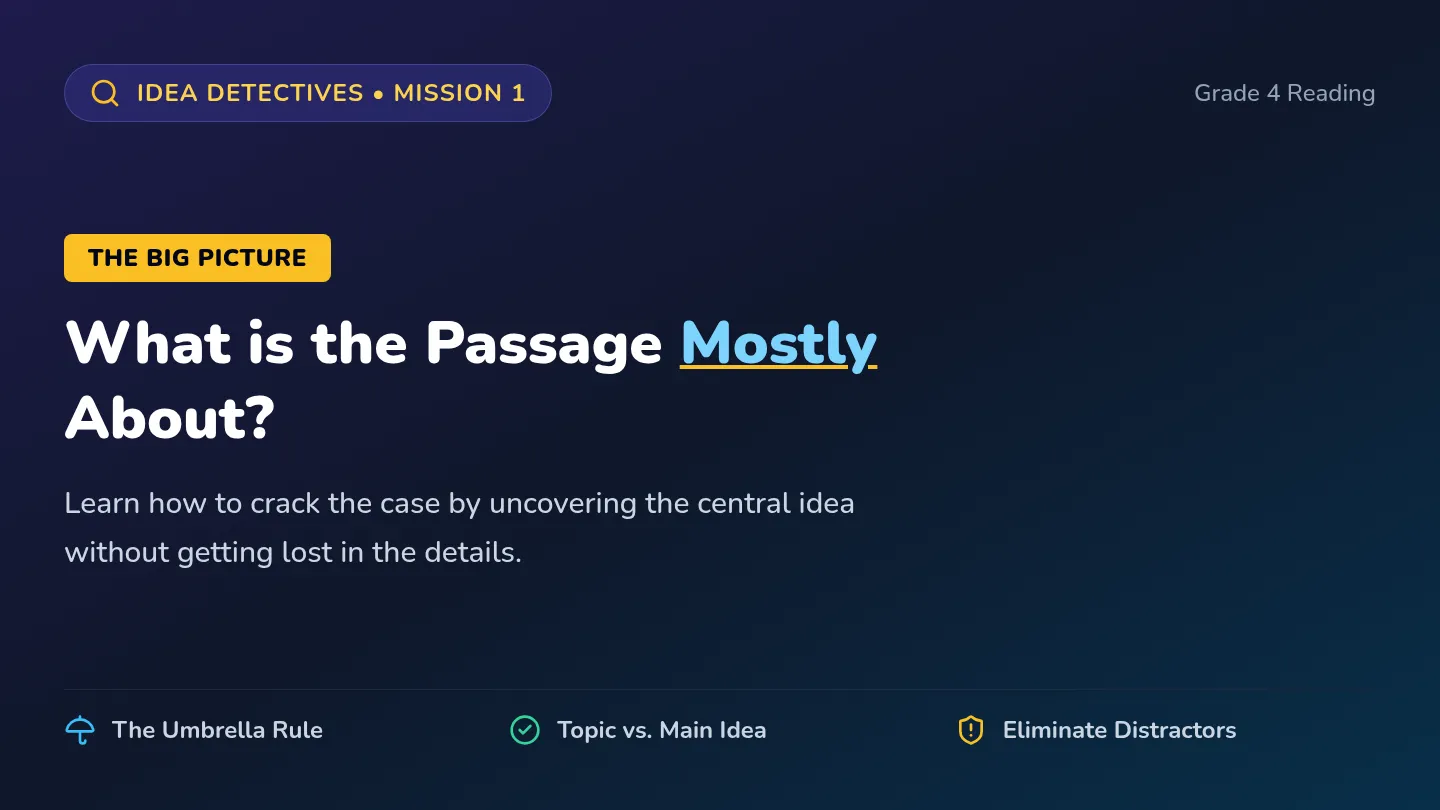
Big Picture Slides

Idea Detectives

A scaffolded, multi-day reading comprehension sequence aligned to Texas TEKS 4.9(D)(i) and designed for fourth-grade special education students. Across three focused lessons, students learn to recognize the characteristics of informational text by distinguishing topics from central ideas, connecting supporting details, and citing text evidence using structured visual frameworks.

G

gonzalezs

10
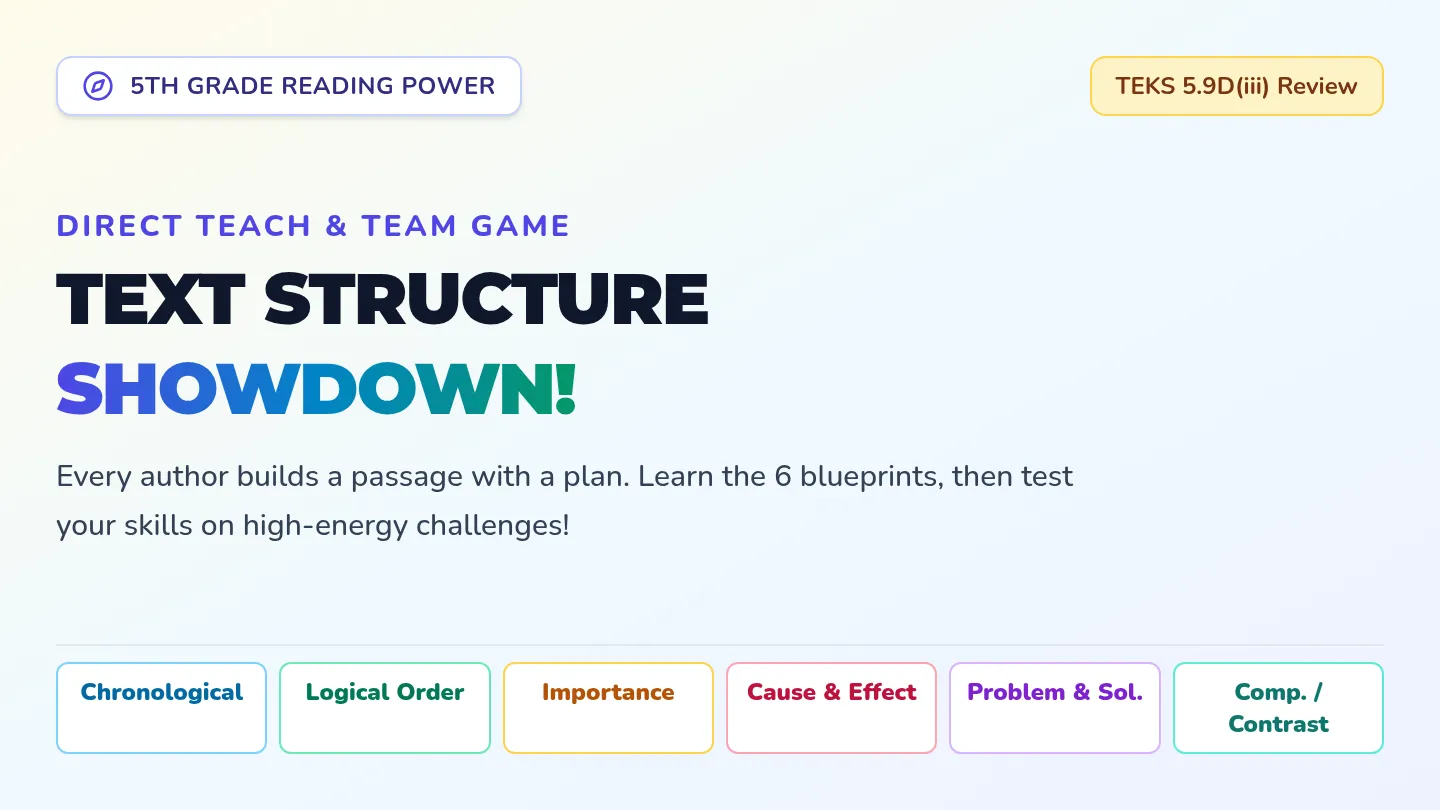
Structure Showdown Slides

Text Structure Showdown

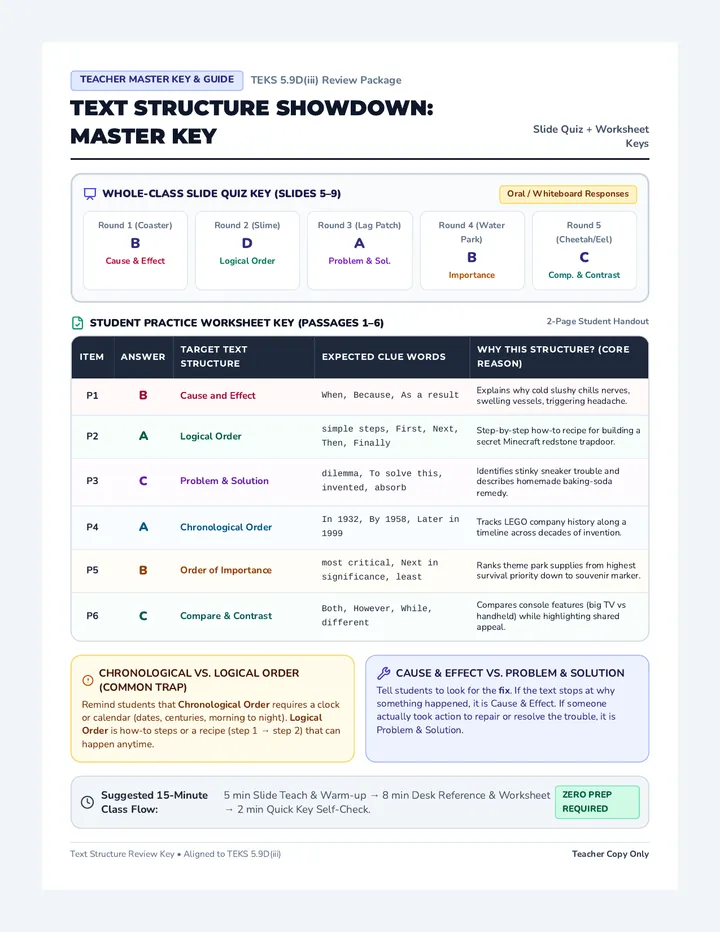
A high-energy, targeted review lesson designed to prepare fifth-grade students for assessments on informational text structures. Students analyze real-world informational passages across six TEKS 5.9D(iii) organizational patterns through interactive team quiz slides, a hands-on detective sorting challenge, and a teacher reference key.

ED

Emily Denson

3
Text Structure Sort Key

Text Structure Sort Key

Complete teacher answer key and instructional guide for the 12 case cards, featuring highlighted signal words, structural rationales, and common TEKS 5.9D(iii) student misconceptions.

ED

Emily Denson

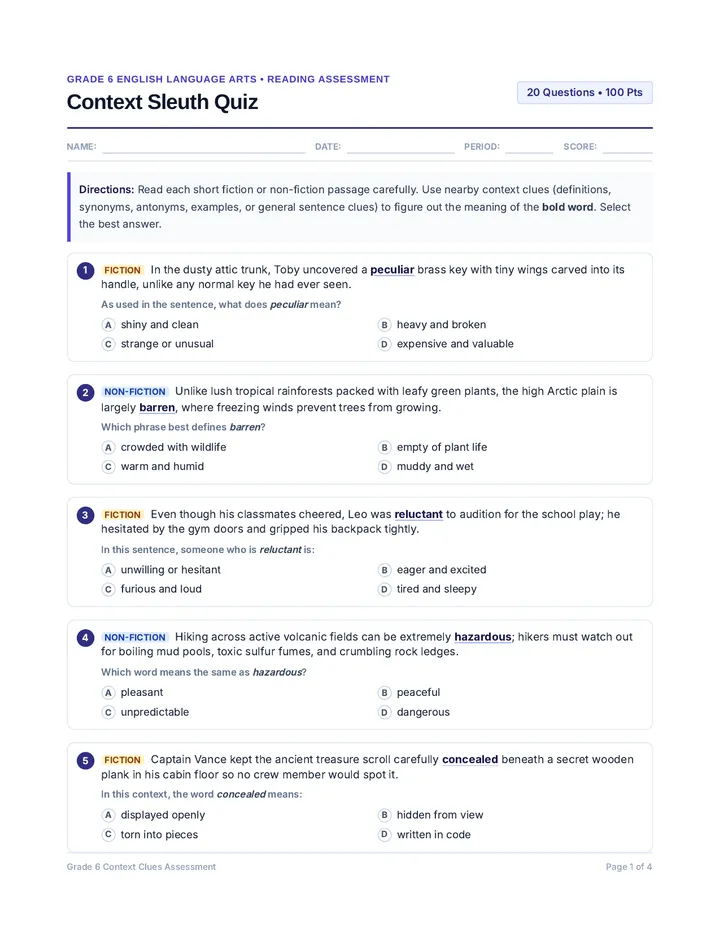
Context Sleuth Quiz

Reading Skill Arsenal

A comprehensive 6th-grade ELA assessment unit focused on foundational reading comprehension, vocabulary acquisition, and literary and informational text analysis across fiction and non-fiction.

SH

Sarah Hunter

6
Essay Architecture Slides

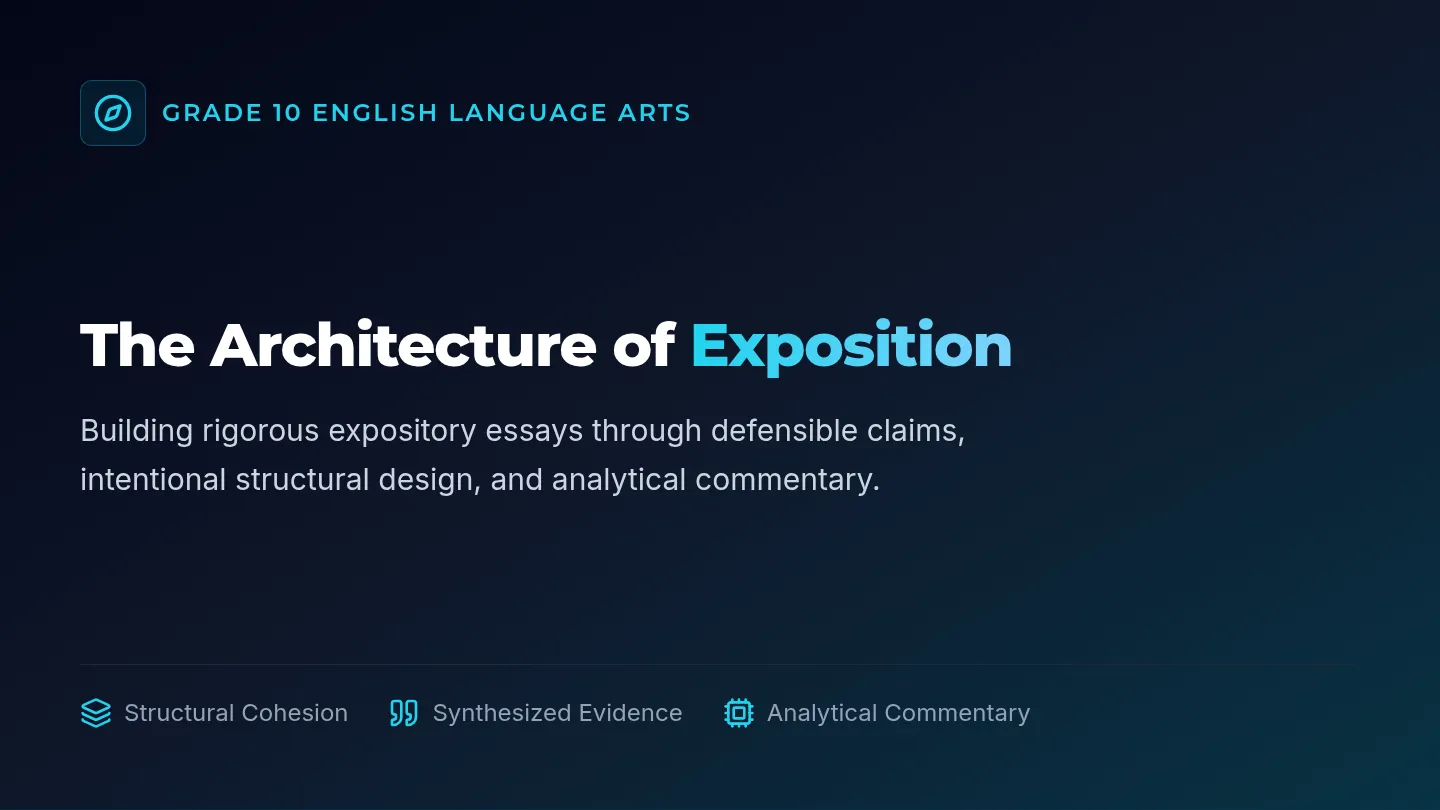
Essay Architecture

A comprehensive 10th-grade expository writing and analysis unit where students dissect high-caliber mentor texts, master defensible thesis construction, weave textual evidence with fidelity, and craft rigorous analytical commentary.

Lenny Avatar
Lenny
4
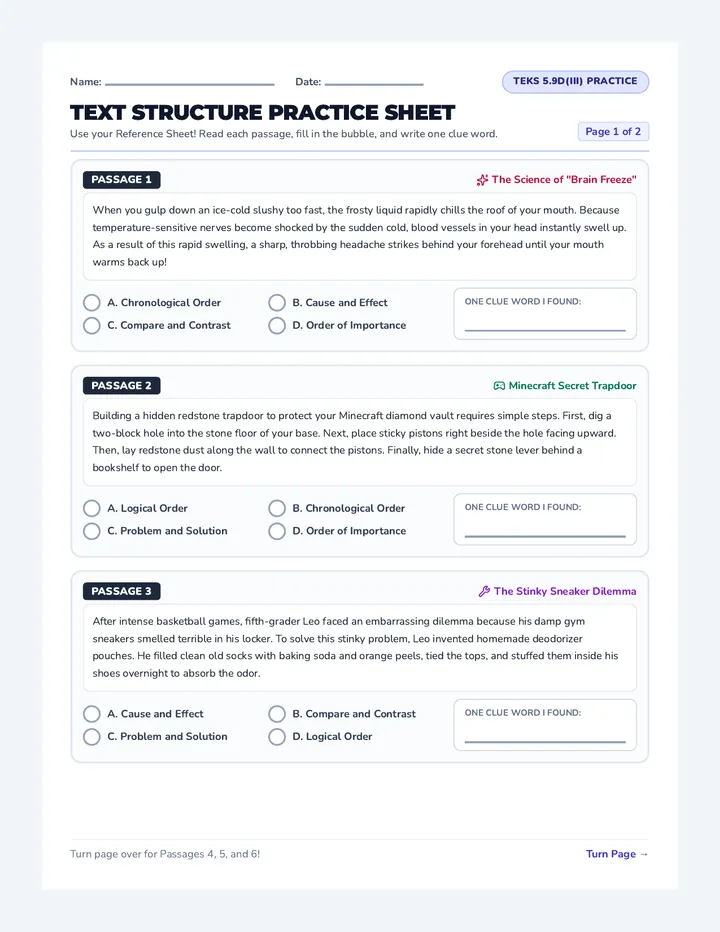
Text Structure Sort Activity

Text Structure Sort Activity

A hands-on student sorting challenge featuring an organizational detective mat and twelve real-world informational case cards covering all six TEKS 5.9D(iii) text structures.

ED

Emily Denson

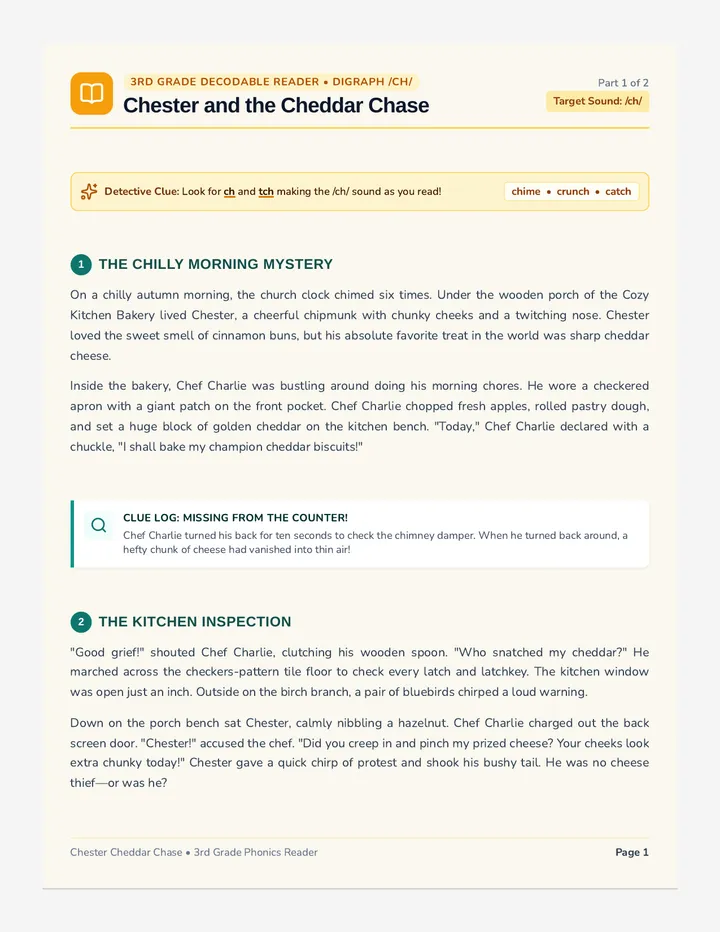
Chester Cheddar Chase Story

Chester Mystery Unit

A comprehensive multi-day third-grade reading, phonics, and writing unit focused on the digraph /ch/, narrative story progression, and mystery dialogue conventions.

V

victoria.lesniak

7
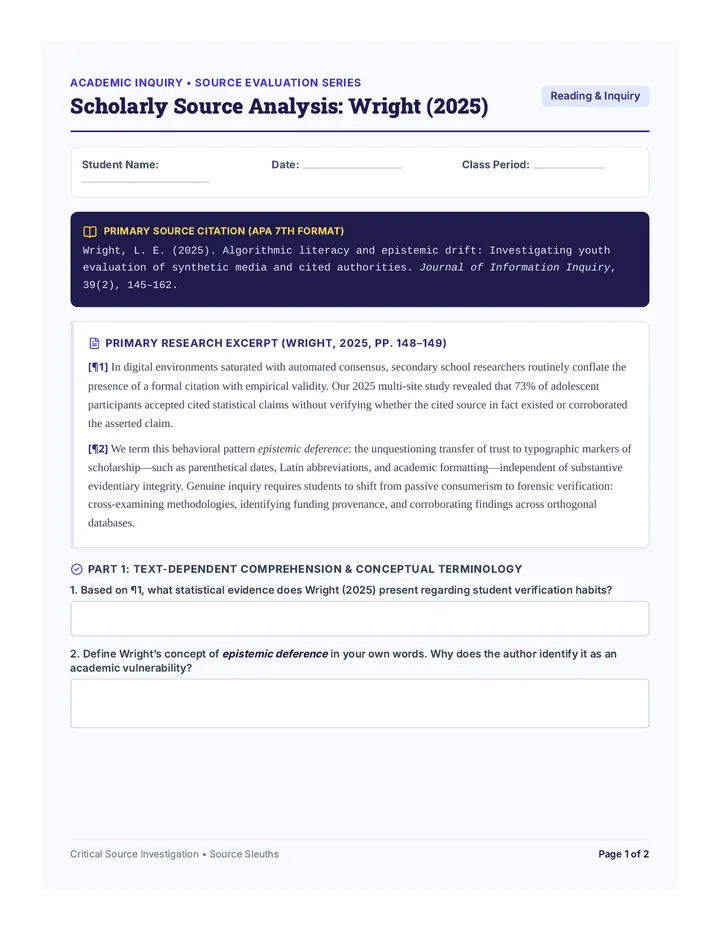
Wright Study Worksheet

Source Sleuths

A rigorous academic inquiry lesson examining Dr. Wright's 2025 research on algorithmic literacy and digital source verification. Students deconstruct scholarly claims, evaluate methodology, and practice proper academic citation.

Lenny Avatar
Lenny
3
Structure Showdown Slides

Structure Showdown Slides

Interactive whole-class presentation slides reviewing the six TEKS 5.9D(iii) informational text structures through visual pattern anchors, signal word guides, and lightning-round team quiz challenges.

ED

Emily Denson

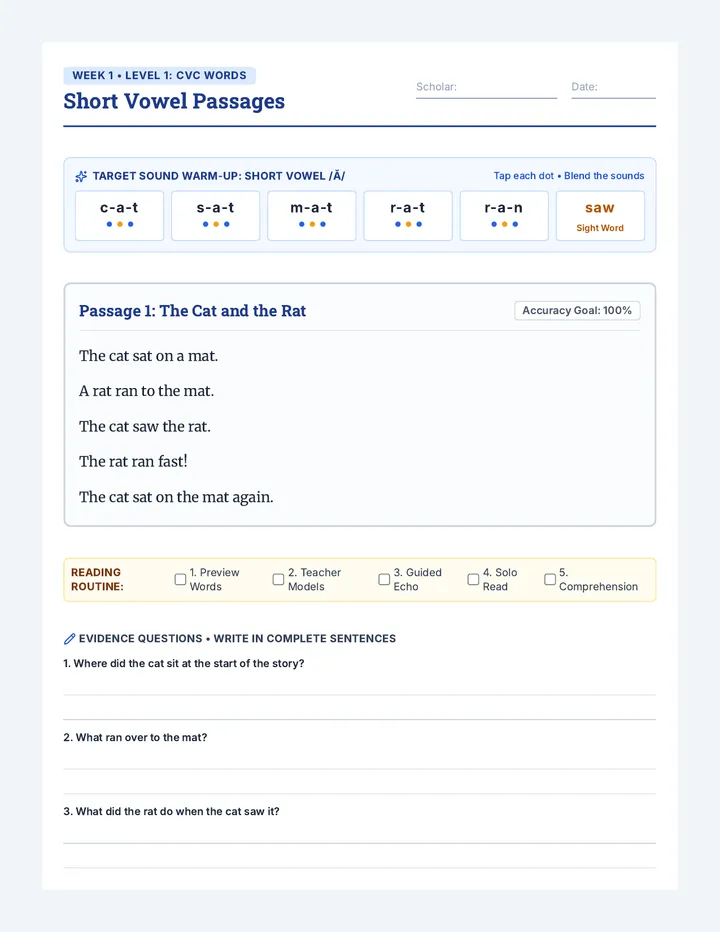
Short Vowel Passages Worksheet

Phonics Scholar Pathway

An eight-week tier-two reading intervention sequence guiding elementary scholars from decodable CVC short vowels through complex multisyllabic words and fluent comprehension. Each week provides structured decodable passages, targeted word banks, text-dependent comprehension questions, and systematic fluency tracking.

B

Bhoovaragavaswamym

8
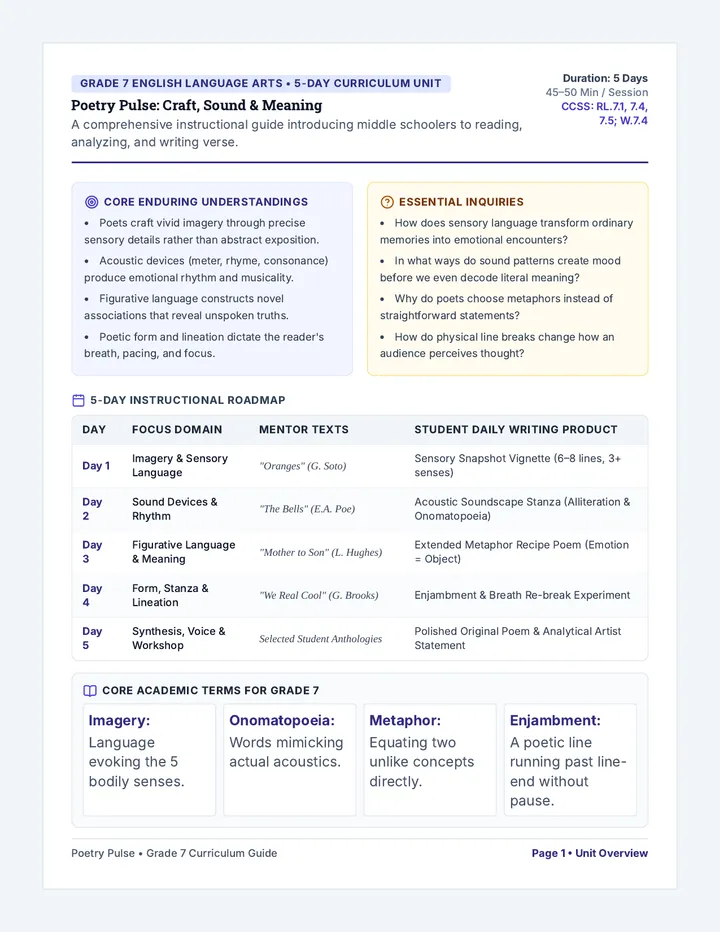
Poetry Pulse Lesson Plan

Poetry Pulse

A 5-day introductory poetry unit for 7th grade students exploring imagery, sound devices, figurative language, and poetic structure through analysis and creative writing.

AC

Anaissa Carrillo

3
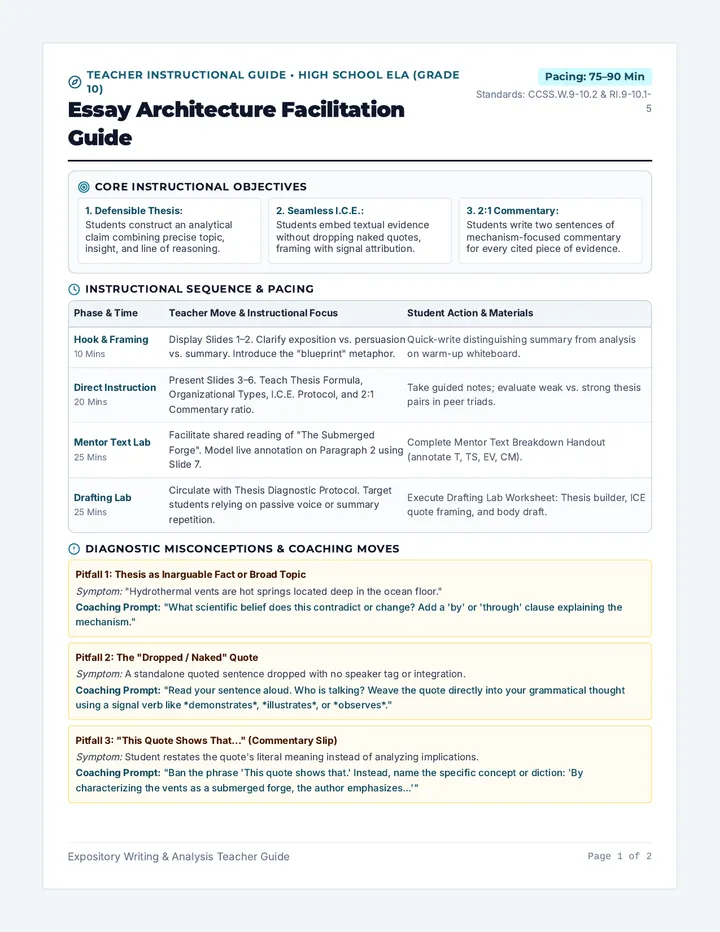
Essay Architecture Teacher Guide

Essay Architecture Teacher Guide

A 2-page teacher facilitation guide featuring pacing blueprints, mentor text answer keys, diagnostic coaching moves for common misconceptions, and an analytical writing rubric.

Lenny Avatar
Lenny