Lenny.com
Explore
Create
ActivitiesNewMathEnglish Language ArtsScience & EngineeringSocial StudiesGlobal LanguagesHealth & Physical EducationSpecial EducationCounseling & Life SkillsArts & CreativityESL
Lenny.com
Lenny.com
Explore
Create
ActivitiesNewMathEnglish Language ArtsScience & EngineeringSocial StudiesGlobal LanguagesHealth & Physical EducationSpecial EducationCounseling & Life SkillsArts & CreativityESL
Lenny.com
Lenny.com

Solutions

Lenny for EducatorsLenny for SchoolsLenny for Districts

Product

ExploreSign inCreateSupportAbout

Resources

Getting startedMTSS Acceleration Program

© 2026 Lenny Learning Inc.

TermsPrivacyAccessibility
LinkedInInstagramX
Lenny
English Language ArtsPhonics & Reading FoundationsLetter IdentificationLearn Letters A-ZLowercase and Uppercase LettersConsonants and VowelsLetter-Sound AssociationsLetter-Sound Associations: LowercaseLetter-Sound Associations: UppercaseBeginning and Ending SoundsRhymingBlending And SegmentingShort VowelsShort Vowel SoundsConsonant BlendsConsonant DigraphsBlends, Digraphs, and TrigraphsDigraphs, Blends, and Silent LettersLong Vowel SoundsLong Vowel PatternsShort and Long VowelsShort and Long Vowel PatternsSilent EVowel SoundsVowel TeamsR-Controlled VowelsDiphthongs: Oi, Oy, Ou, OwVariant VowelsVariant, Diphthong, And R Vowel PatternsSoft G And CSight WordsIrregular WordsWord RecognitionSyllablesSyllable TypesTwo-Syllable WordsMultisyllabic WordsPhoneme ManipulationDecodable TextsVocabularyAction WordsQuestion WordsNouns and AdjectivesClassify WordsCompound WordsSynonyms and AntonymsHomophonesHomophones and HomonymsShades of MeaningContext CluesPrefixes and SuffixesGreek and Latin RootsAnalogiesIdioms and AdagesForeign Words and ExpressionsWord Choice and UsageReference SkillsReading ComprehensionRead-Along Literary TextsRead-Along Informational TextsReality vs. FictionStory ElementsCharacterSequenceMain IdeaCause And EffectCompare And ContrastReading StrategiesText StructureAuthor's PurposeAuthor's Purpose And ToneAuthor's PerspectivePoint Of ViewThemeInference And ThemeInference And AnalysisPoetry ElementsLiterary DevicesAnalyzing LiteratureAnalyzing Informational TextsComparing TextsAudience, Purpose, And ToneBusiness DocumentsNovel StudyNonfiction Book StudyGrammar & MechanicsSentencesNounsVerbsAdjectivesPronounsCapitalizationPunctuationContractionsConjunctionsPrepositionsArticlesAdjectives And AdverbsVerb TypesVerb TensePronouns And AntecedentsPronoun TypesSubject-Verb AgreementDirect And Indirect ObjectsSentences, Fragments, And Run-OnsPhrases And ClausesCommasSemicolons, Colons, And CommasDashes, Hyphens, And EllipsesSpellingAbbreviationsFormattingVerb Tense And MoodMisplaced ModifiersWritingDescriptive DetailsCreative WritingOpinion WritingTopic SentencesOrganizing WritingLinking WordsSentence VarietyIntroductions And ConclusionsPersuasive And Opinion WritingExpository WritingPersuasive StrategiesDeveloping And Supporting ArgumentsTopic Sentences And Thesis StatementsSummarizingResearch SkillsEditing And RevisingActive And Passive Voice=Writing Clearly And ConciselyDebate & Public SpeakingPublic Speaking BasicsPersuasive TechniquesClaims and EvidenceTypes of ArgumentsReasoning TypesLogical FallaciesTopic ResearchOrganizing EvidenceDebate Speech OrganizationAttacking and Defending ArgumentsClash and EngagementImpact CalculusQuestioning and Cross-ExaminationCritical ThinkingInformal LogicFormal LogicInductive Reasoning

Essay Architecture

A comprehensive 10th-grade expository writing and analysis unit where students dissect high-caliber mentor texts, master defensible thesis construction, weave textual evidence with fidelity, and craft rigorous analytical commentary.

Essay Architecture

A comprehensive 10th-grade expository writing and analysis unit where students dissect high-caliber mentor texts, master defensible thesis construction, weave textual evidence with fidelity, and craft rigorous analytical commentary.

Key Term: Chemosynthesis

Biological conversion of carbon compounds and nutrients using inorganic chemicals instead of light.

Key Term: Endosymbiosis

A mutually beneficial relationship where one organism lives directly inside the tissues of another.

Writer's Craft Note

Notice how the author pairs each technical fact with two sentences explaining its broader ecological significance.

Part II: Rhetorical Architecture

Structural & Analytical Dissection

Page 2 of 2

1. Thesis & Structural Blueprint

A. The Defensible Thesis Claim: What specific claim does the author establish about solar energy and ecosystems?

B. Structural Organization: Check the dominant pattern and explain your choice:

Causal Mechanism Comparative

2. Deconstructing the I.C.E. Method (Paragraph 2)

[I] Introduce: How does the author establish Dr. Lin's authority and introduce the context?

[C] Cite: How is Dr. Lin's quote embedded grammatically without creating a run-on or fragment?

[E] Explain: Which specific words in Finch's commentary unpack the quote's scientific implications?

3. Commentary vs. Summary Audit (Paragraph 3)

"This anatomical synergy illustrates that survival in hostile environments demands coordinated co-evolution; the host animal safeguards the fragile microbes, while the microbial symbionts synthesize complete nutrition for the host organism."

A. Why is this High-Level Commentary? How does it answer "So what?" rather than just repeating the quote?

B. Draft a Weak Summary (Non-Example): What would an uncritical student write that merely repeats facts?

Analytical Proficiency: Developing Proficient Advanced Analyst

ELA.10.W.2 • Expository Blueprint

Coaching Prompt: "Ban the phrase 'This quote shows that.' Instead, name the specific concept or diction: 'By characterizing the vents as a submerged forge, the author emphasizes...'"

Expository Writing & Analysis Teacher Guide Page 1 of 2

Part II: Assessment & Exemplars

Mentor Text Answer Key & Evaluative Rubric

Page 2 of 2

Mentor Text Handout: Master Answer Key & Annotation Guide

1. Thesis Identification (Paragraph 1): "Hydrothermal vent communities thrive not through photosynthetic capture, but through chemosynthesis, proving that extreme chemical synthesis can sustain complex ecological architecture independent of solar input." (Identifies subject + claim + mechanism).

2. Organizational Pattern: Causal Mechanism / Process Analysis. Justification: The text systematically explains the chemical trigger (sulfide oxidation) before detailing its cascading biological effects (symbiosis in tube worms and extraterrestrial implications).

3. I.C.E. Breakdown (Paragraph 2): [I]: "Marine microbiologist Dr. Maya Lin reports that chemosynthetic bacteria..." (Identifies field, authority, and subject).
[C]: "...oxidize hydrogen sulfide compounds with exceptional metabolic efficiency, generating cellular ATP in the complete absence of ultraviolet light (Lin 42)."
[E]: Commentary focuses on abiotic volatility and thermodynamic catalysts rather than simply saying bacteria eat sulfur.

Expository Analytical Writing Rubric (10th Grade Standards)

Criterion

Exemplary (Level 4)

Proficient (Level 3)

Developing (Level 2)

Thesis & Line of Reasoning

Defensible, non-obvious claim specifying precise mechanism & structural trajectory.

Clear, defensible claim with general line of reasoning; appropriate scope.

Vague, overly broad claim or statement of obvious factual reality.

Evidence Integration (I.C.E.)

Synthesizes evidence smoothly; frames with authority tags; zero dropped quotes.

Quotes integrated with signal verbs; occasional mechanical phrasing.

Quotes sit isolated as standalone sentences or lack context/citations.

Commentary Depth (2:1 Ratio)

Unpacks word choice and systemic mechanisms; connects explicitly to thesis.

Explains significance and context; occasionally leans into summary.

Simply restates quote in different words; answers "what" rather than "how/why".

Tiered Differentiation Framework

Scaffolding for Striving Writers: Provide sentence stems for signal verbs (*"In their investigation into [topic], [Author] contends that..."*) and a graphic organizer with pre-split commentary boxes labeled [Mechanism] and [Significance].

Extension for Advanced / AP Prep: Require students to integrate a counter-perspective or qualify their claim using a subordinating concessive clause (*"While critics argue that X, closer examination of Y reveals..."*).

High School English Department • Expository Writing Continuum Exemplar & Assessment Framework
You might also like

Big Picture Slides

Idea Detectives

A scaffolded, multi-day reading comprehension sequence aligned to Texas TEKS 4.9(D)(i) and designed for fourth-grade special education students. Across three focused lessons, students learn to recognize the characteristics of informational text by distinguishing topics from central ideas, connecting supporting details, and citing text evidence using structured visual frameworks.

G

gonzalezs

10
Structure Showdown Slides

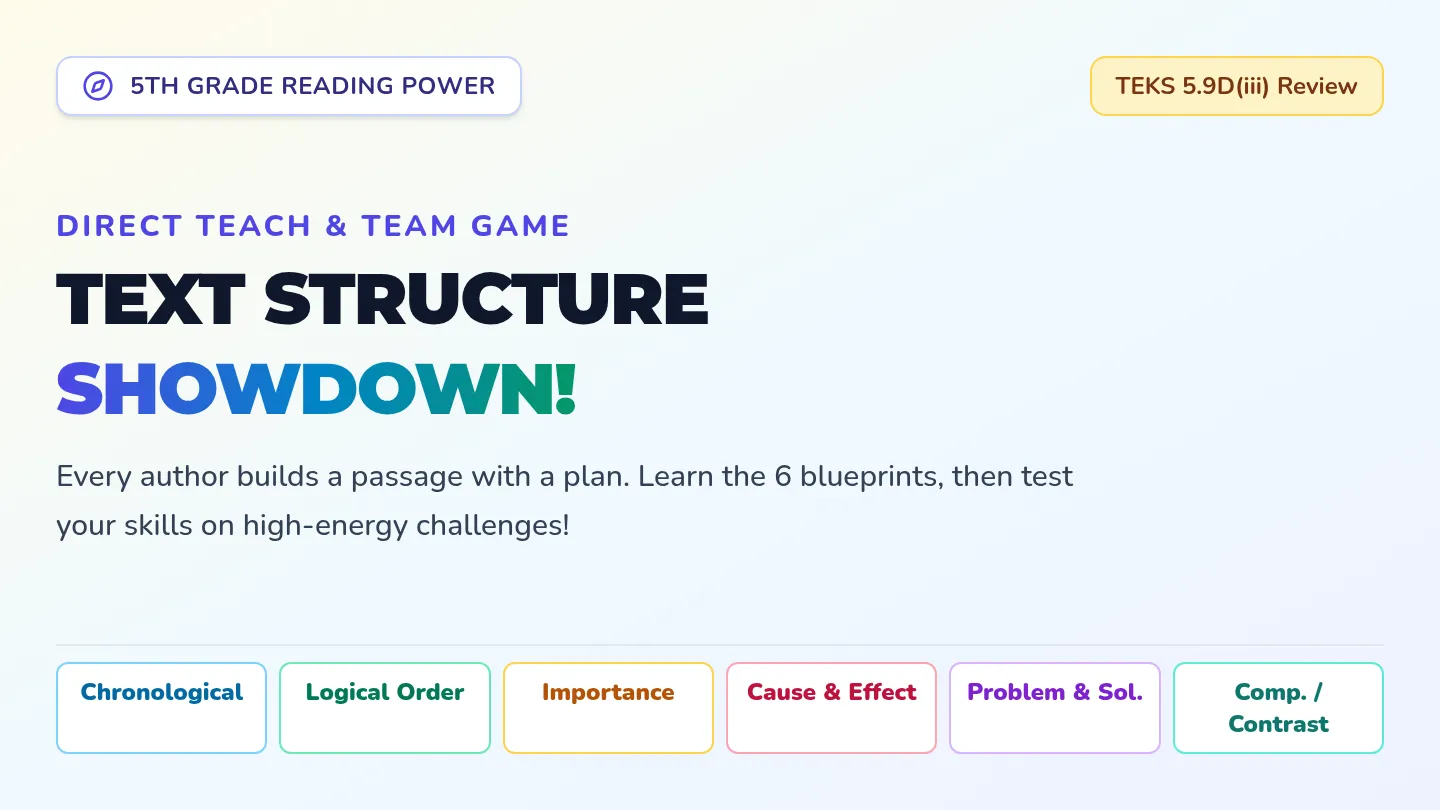
Text Structure Showdown

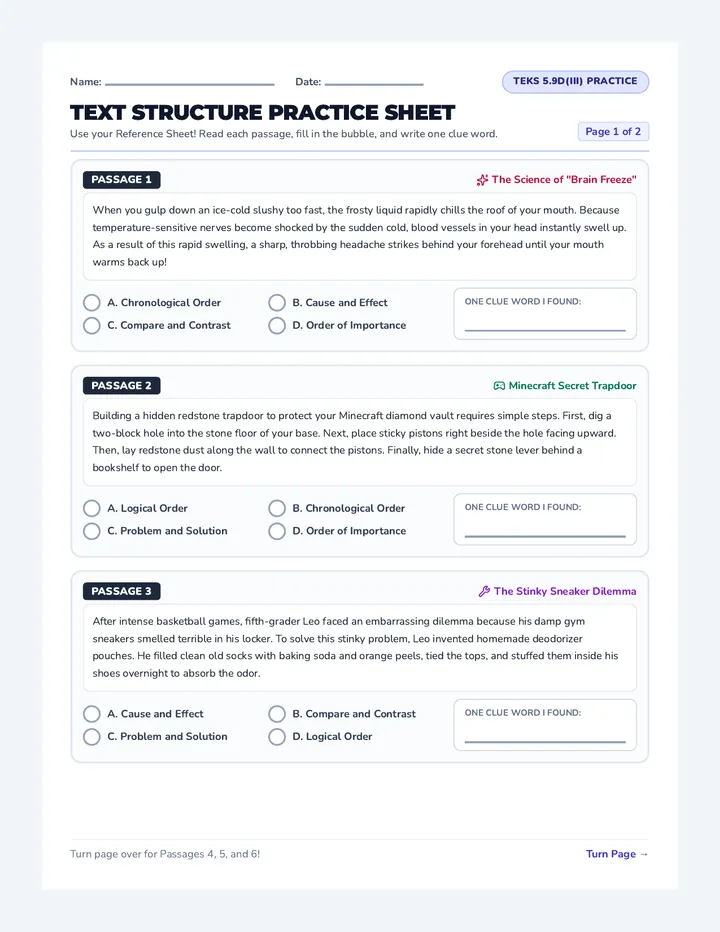
A high-energy, targeted review lesson designed to prepare fifth-grade students for assessments on informational text structures. Students analyze real-world informational passages across six TEKS 5.9D(iii) organizational patterns through interactive team quiz slides, a hands-on detective sorting challenge, and a teacher reference key.

ED

Emily Denson

3
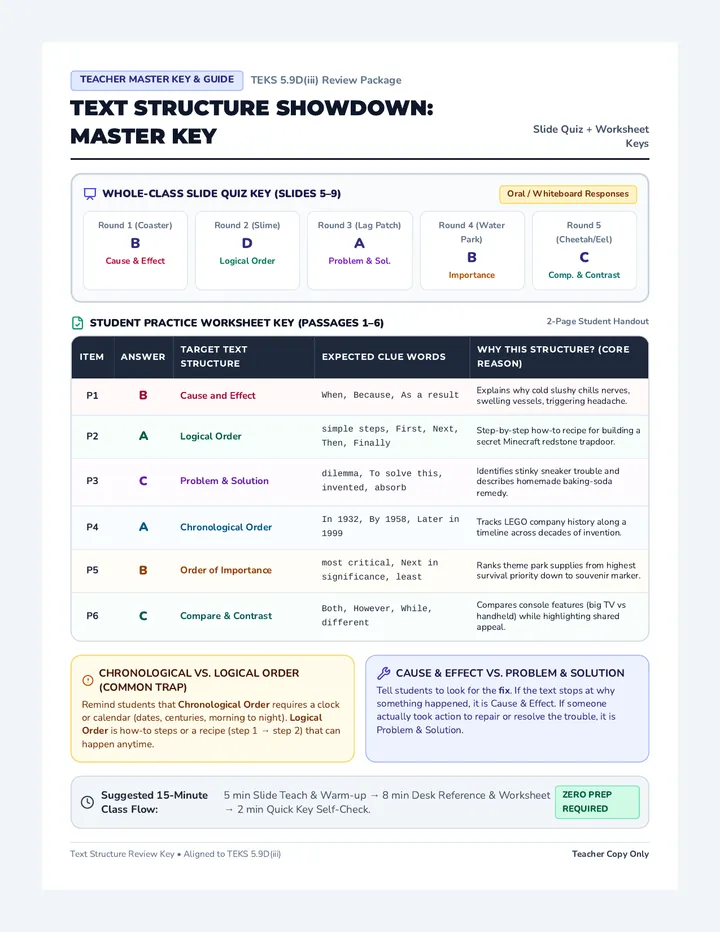
Text Structure Sort Key

Text Structure Sort Key

Complete teacher answer key and instructional guide for the 12 case cards, featuring highlighted signal words, structural rationales, and common TEKS 5.9D(iii) student misconceptions.

ED

Emily Denson

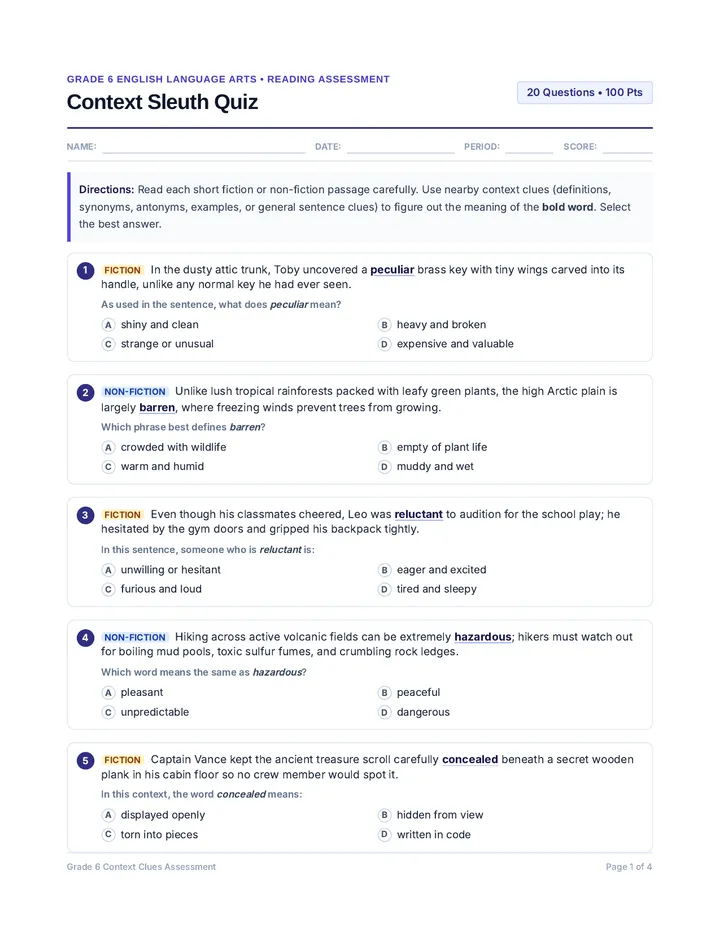
Context Sleuth Quiz

Reading Skill Arsenal

A comprehensive 6th-grade ELA assessment unit focused on foundational reading comprehension, vocabulary acquisition, and literary and informational text analysis across fiction and non-fiction.

SH

Sarah Hunter

6
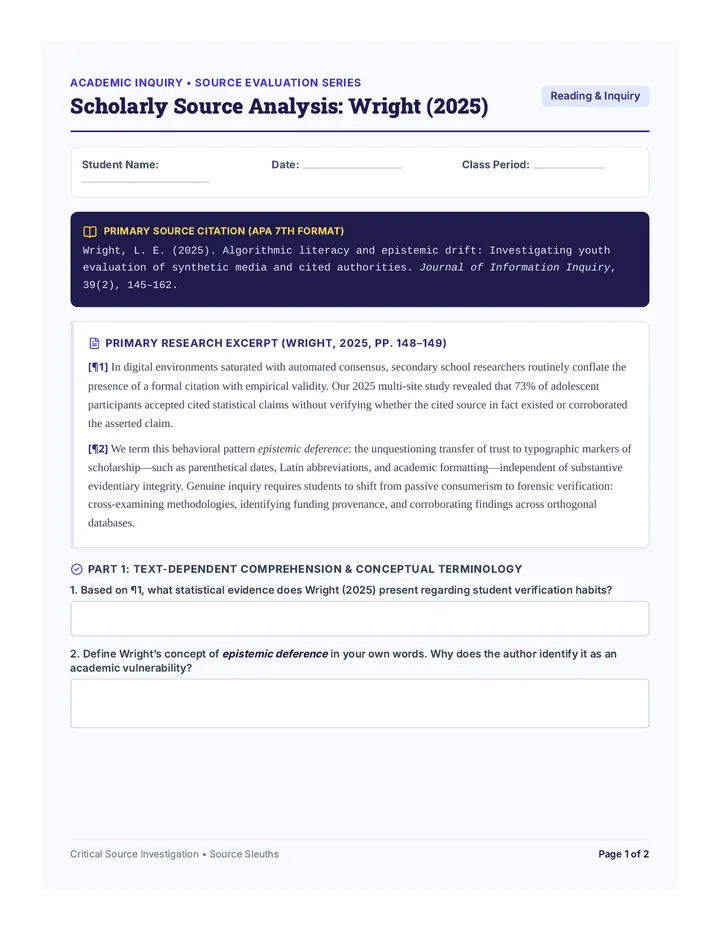
Wright Study Worksheet

Source Sleuths

A rigorous academic inquiry lesson examining Dr. Wright's 2025 research on algorithmic literacy and digital source verification. Students deconstruct scholarly claims, evaluate methodology, and practice proper academic citation.

Lenny Avatar
Lenny
3
Text Structure Sort Activity

Text Structure Sort Activity

A hands-on student sorting challenge featuring an organizational detective mat and twelve real-world informational case cards covering all six TEKS 5.9D(iii) text structures.

ED

Emily Denson

Chester Cheddar Chase Story

Chester Mystery Unit

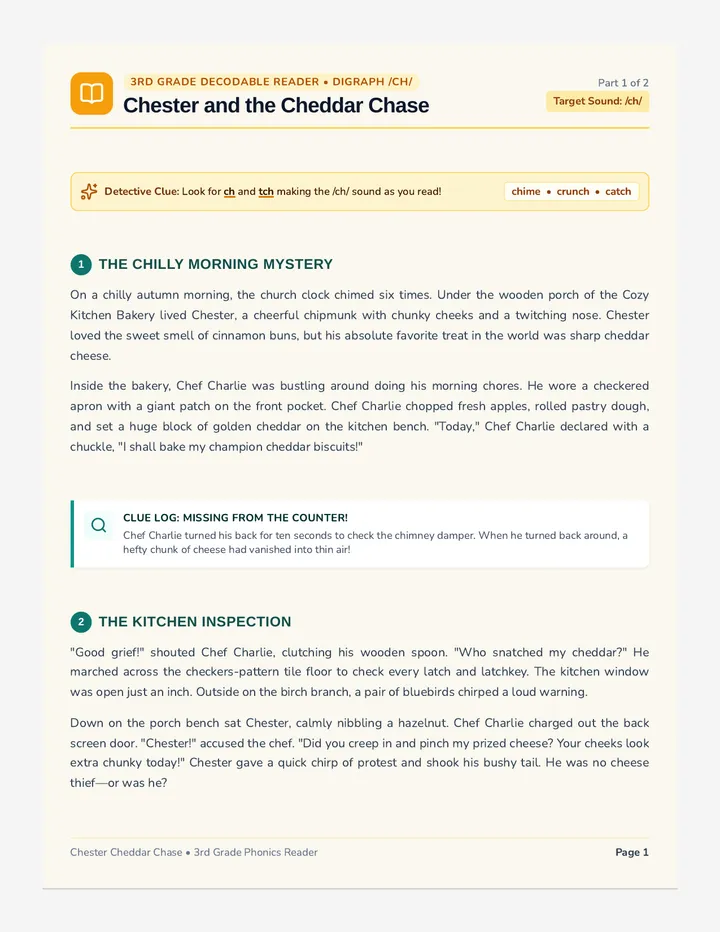
A comprehensive multi-day third-grade reading, phonics, and writing unit focused on the digraph /ch/, narrative story progression, and mystery dialogue conventions.

V

victoria.lesniak

7
Poetry Pulse Lesson Plan

Poetry Pulse

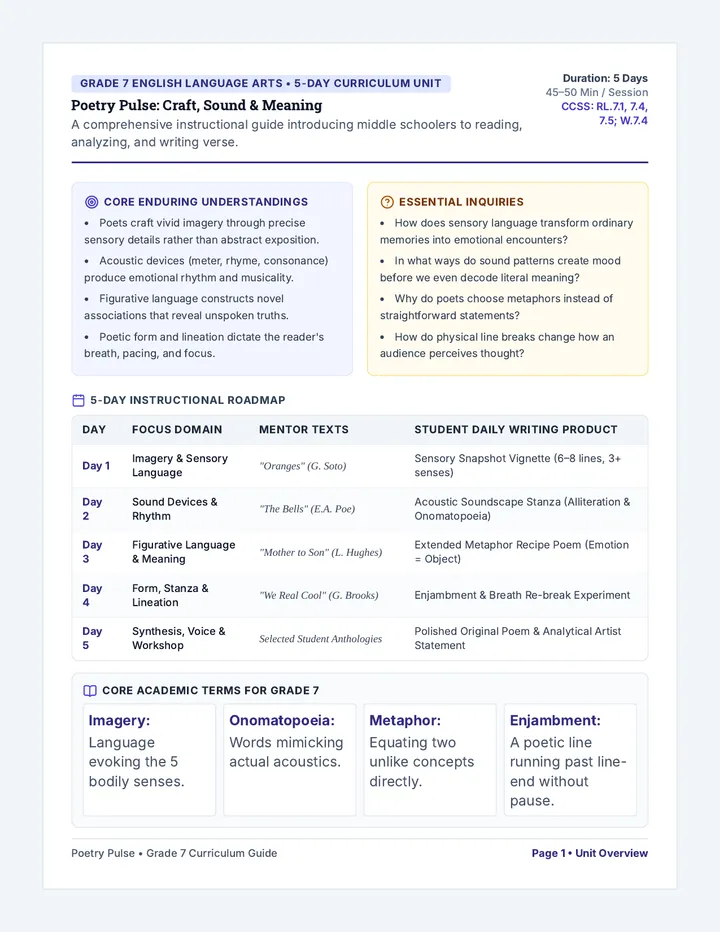
A 5-day introductory poetry unit for 7th grade students exploring imagery, sound devices, figurative language, and poetic structure through analysis and creative writing.

AC

Anaissa Carrillo

3
Structure Showdown Slides

Structure Showdown Slides

Interactive whole-class presentation slides reviewing the six TEKS 5.9D(iii) informational text structures through visual pattern anchors, signal word guides, and lightning-round team quiz challenges.

ED

Emily Denson

Short Vowel Passages Worksheet

Phonics Scholar Pathway

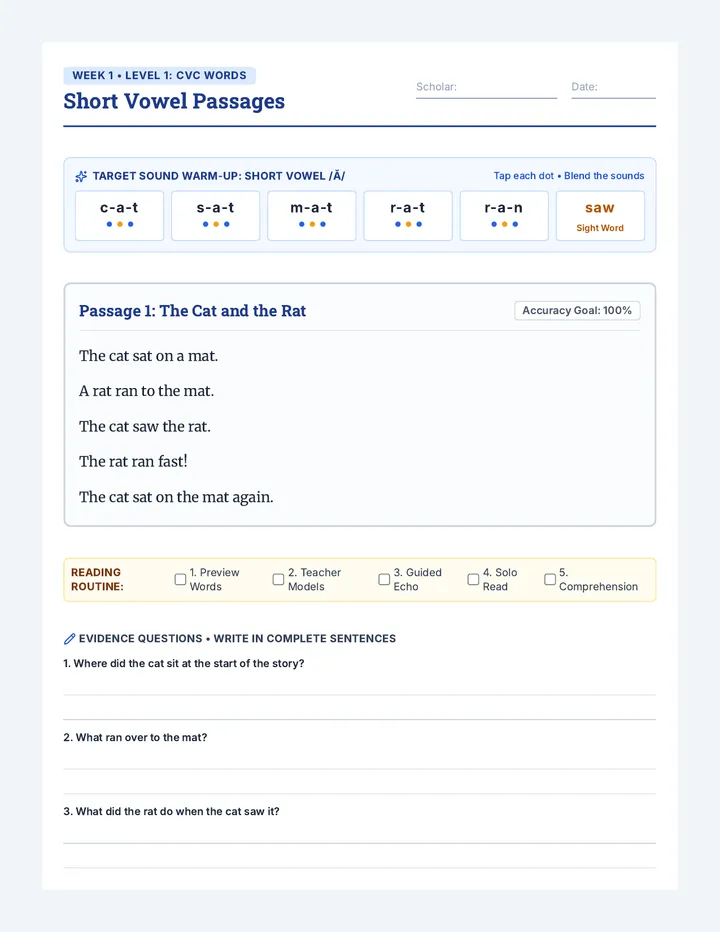
An eight-week tier-two reading intervention sequence guiding elementary scholars from decodable CVC short vowels through complex multisyllabic words and fluent comprehension. Each week provides structured decodable passages, targeted word banks, text-dependent comprehension questions, and systematic fluency tracking.

B

Bhoovaragavaswamym

8
Evidence Detectives Slides

Evidence Masters

Aligned to TEKS 4.9(D)(i), this lesson empowers students to prove the central idea by citing direct text evidence using sentence stems and case files to construct complete evidence-based responses.

G

gonzalezs

4
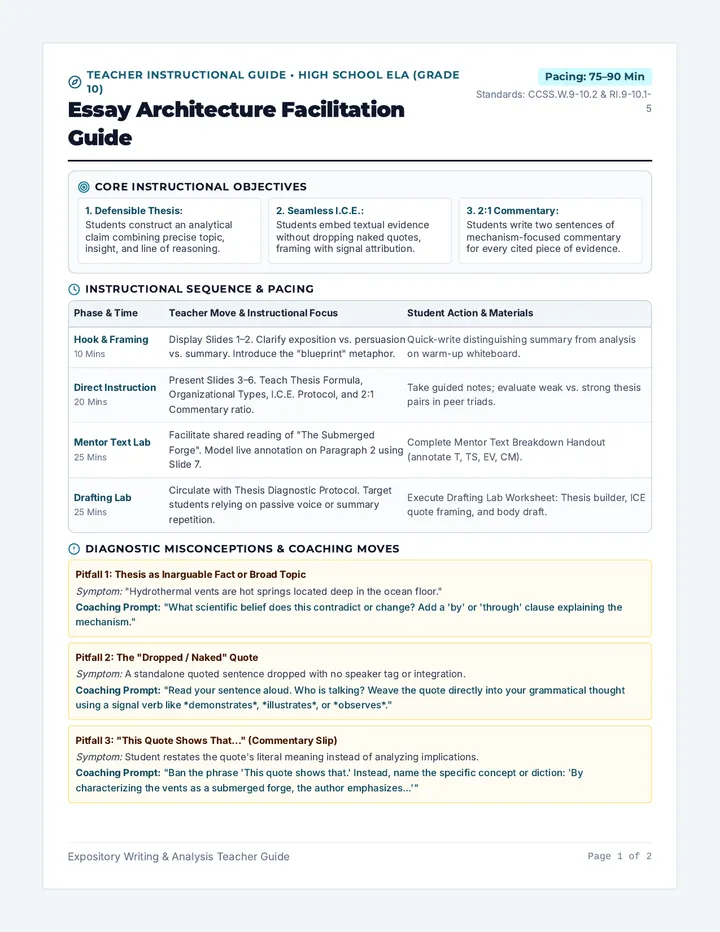
Essay Architecture Teacher Guide

Essay Architecture Teacher Guide

A 2-page teacher facilitation guide featuring pacing blueprints, mentor text answer keys, diagnostic coaching moves for common misconceptions, and an analytical writing rubric.

Lenny Avatar
Lenny