Big Picture Slides Idea Detectives • Mission 1
Grade 4 Reading
The Big Picture
What is the Passage Mostly About?
Learn how to crack the case by uncovering the central idea without getting lost in the details.
The Umbrella Rule
Topic vs. Main Idea
Eliminate Distractors
Topic vs. Main Idea
Do Not Confuse Them!
Step 1
The Topic
Just the general subject or who/what the text is about.
Detective Clue:
Usually 1 to 3 words only!
Example:
"Sea Turtles"
Step 2
The Main Idea
The most important point the author makes about that topic.
Detective Clue:
A full complete sentence!
Example:
"Sea turtles have special bodies that help them survive in the ocean."
Formula: Topic + Author's Main Point = Main Idea
The Umbrella Test
Does it cover everything?
The Canopy Covers All Details
MAIN IDEA (The Big Roof)
"Dogs communicate with people in different ways."
Detail 1
Dogs bark when someone knocks on the door.
Detail 2
They wag their tails to show happiness.
Detail 3
They bring a leash to say it is time for a walk.
If a sentence is TOO SMALL, it is just a detail. If it covers all the drops, it is the MAIN IDEA!
Detective Case: Honeybees
Guided Practice
Read the Evidence:
Honeybees have important jobs in their hive. The queen bee lays all the eggs. Worker bees fly out to gather nectar and pollen from flowers. Guard bees stay at the entrance to protect the honey from robbers. Every bee works hard so the colony can survive.
Which sentence is the Main Idea?
A
Worker bees collect nectar from flowers.
B
Honeybees have important jobs in their hive.
C
Hives can have robber bugs.
Detective Hint: Option A and C are tiny details. Option B covers the WHOLE hive!
Your 3-Step Detective Strategy
Always Follow the Clues
1
Find the Topic
Ask yourself: "Who or what is this text about?" Look for repeated words in the passage.
1-3 Words
2
Check First & Last
Read the first sentence and the concluding sentence. Authors often place the big idea right there!
Look for Anchors
3
Test the Umbrella
Does this one sentence cover all the other facts in the paragraph? If yes, you solved the mystery!
Covers All Details
Ready to crack your own case files? Let's open our Umbrella Worksheets!
Umbrella Detective Worksheet Idea Detectives: Case File 1
The Big Picture: Topic vs. Main Idea
Name:
Date:
Topic 1 to 3 words (Who or what)
Main Idea Full sentence that covers the whole text!
Part 1
Detective Training: Circle Topic (T) or Main Idea (MI)
Read each item below. Decide if it is just a topic or a full main idea sentence.
1. Playful golden retriever puppies
T MI
2. Dogs make great companions for families because they are loyal.
T MI
3. Recycling plastic bottles and cans
T MI
4. Recycling trash helps keep our oceans and forests clean.
T MI
Part 2
Case File Alpha: Chameleons
Read & Solve
Chameleons are lizards known for their incredible survival skills. They have special skin cells that allow them to change color to blend into green leaves or brown branches. Their eyes can move in two different directions at the exact same time to watch for predators. When hungry, a chameleon shoots out its sticky tongue faster than a blink to snatch up bugs.
5. What is the TOPIC of this passage? (1-3 words)
A. Bug hunting
B. Chameleons
C. Green leaves
6. Which sentence tells the MAIN IDEA that covers the whole paragraph?
A. Chameleons have sticky tongues to catch fast insects.
B. Chameleons have amazing features that help them survive.
C. Chameleons have eyes that move in two directions.
Detective Hint: Options A and C in question 6 are true, but they are just single details!
Part 3
Case File Beta: The Human Heart
Page 2 • Visual Organizer
Passage Evidence
Your heart is a hardworking muscle that keeps your whole body running. It beats about 100,000 times every day without ever stopping to rest. With each strong beat, the heart pumps fresh blood filled with oxygen to your brain and muscles. It also carries waste away from your organs so your body stays healthy and strong.
Build the Umbrella: Fill in the Case Pieces
1. Topic (Who or what is this text about? Write 1-3 words):
2. Main Idea Canopy (What is the main point the author wants you to know?): Complete Sentence
3. Supporting Details (Write 3 facts that support your umbrella):
Clue 1:
Clue 2:
Clue 3:
Detective Self-Check Checklist
Check each box before handing in your file.
Topic is 1-3 words Main Idea is a full sentence 3 details match
Big Picture Teacher Guide Idea Detectives: Teacher Guide
Lesson 1: The Big Picture (Finding Main Idea)
TEKS 4.9(D)(i) • STAAR Aligned
Target Time: 45 Minutes
TEKS 4.9(D)(i) LEARNING TARGET:
Students will recognize the characteristics of informational text by distinguishing a topic from the central idea (main idea) of a paragraph using visual scaffolding with 80% accuracy.
STAAR & TEKS VOCABULARY:
Topic: The general subject (1-3 words). Central Idea: What the text is mostly about (covers all details; tested on STAAR as central idea/main idea).
Instructional Flow & Pacing
1. Hook (8 min)
Display Slide 1-3. Introduce the Umbrella Model. Emphasize that on Texas STAAR tests, "main idea" is called "central idea."
2. Model (12 min)
Slide 4 Honeybee Case. Think aloud: "Option A is true, but does it cover guard bees? No, so it is just a detail!"
3. Guided (15 min)
Umbrella Worksheet Part 1 & 2. Complete Chameleons case together in pairs or small teacher-led group.
4. Debrief (10 min)
Independent attempt on Case Beta (Human Heart). Conduct self-check and review exit questions.
Scripted Think-Aloud Prompt
"When I look at this paragraph, I notice the word 'chameleon' in almost every sentence. That tells me the topic is 'Chameleons.' Now I ask: What central idea is the author explaining about chameleons? That they have special body tools to survive."
TEKS / SPED Accommodations
STAAR Stem Alignment: Practice prompt: "Which sentence states the central idea?"Color Highlighting: Yellow for topic words, green for central idea.Oral Dictation: Scribe responses for students with dysgraphia.
Worksheet Answer Key & Guidance Scoring Guide
Page 1: Training & Case Alpha
1. Topic (T) - Just a noun phrase, no complete predicate.2. Main/Central Idea (MI) - Complete thought with broad point.3. Topic (T) - Noun phrase.4. Main/Central Idea (MI) - Complete causal statement.5. Topic: B (Chameleons).6. Central Idea: B (Chameleons have amazing features that help them survive). Expl: A & C are single details.
Page 2: Case Beta (Heart Organizer)
Topic: The human heart / The heart.
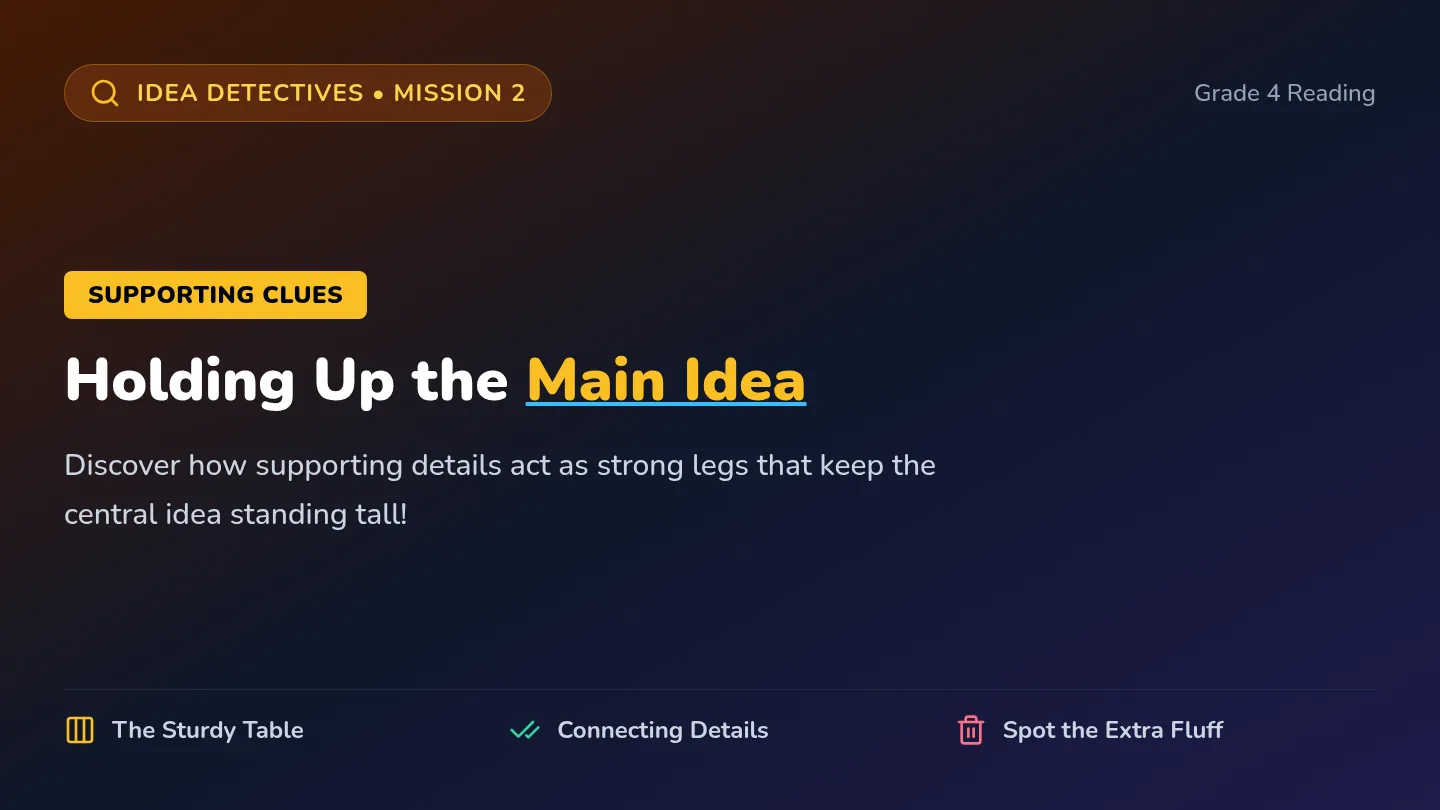
Supporting Clues Slides Idea Detectives • Mission 2
Grade 4 Reading
Supporting Clues
Holding Up the Main Idea
Discover how supporting details act as strong legs that keep the central idea standing tall!
The Sturdy Table
Connecting Details
Spot the Extra Fluff
The Sturdy Table Model
Details Give Support!
Table Top = MAIN IDEA
"Penguins are well-built for swimming in freezing waters."
Table Leg 1
They have thick layers of fat called blubber to trap heat.
Table Leg 2
Their stiff flippers push them swiftly through icy waves.
Table Leg 3
Dense waterproof feathers keep freezing water off skin.
If you remove the legs, the table falls down! Without details, the main idea has no proof.
Proof vs. "Extra Fluff"
Watch Out for Traps!
Supporting Detail
Directly proves or explains the main idea sentence.
Main Idea: Dogs make good guides.
"They learn to stop at busy street corners to keep people safe."
Holds up the table!
Extra Fluff (Distractor)
An interesting fact that does NOT prove the main idea.
Main Idea: Dogs make good guides.
"Some dogs like chasing tennis balls in the yard."
Does not prove the point!
Ask the Detective Question: "Does this fact prove the main idea is true?"
Detective Case: Desert Camels
Find the Fluff!
Main Idea Table Top:
"Camels have bodies built to survive hot desert heat."
Which clue below does NOT support this main idea?
A
They store fat in humps to go days without food.
B
Wide padded feet stop them from sinking in hot sand.
C
Many people like to take pictures of camels at zoos.
Clue C is just extra fluff! People taking pictures does not help a camel survive the desert heat.
The Detail Detective Checklist
How to Connect Details
1
Read Main Idea
State the main idea clearly in your head before searching for details.
Know the Target
2
Ask "Does It Prove?"
Test each detail: Does this give an example, reason, or fact that proves the main point?
Test the Leg
Clue Sorter Activity Idea Detectives: Case File 2
Supporting Clues: Holding Up the Main Idea
Name:
Date:
Proof Leg Directly supports and proves the main idea
Fluff Trap Interesting fact that does NOT prove the point
Part 1
Proof or Fluff Sorting
Main Idea Table Top: "Community gardens make neighborhoods better places to live."
1. Families grow fresh vegetables together and share healthy food.
P F
2. Some garden shovels have bright red handles.
P F
3. Working in the soil turns empty lots into pretty gathering spots.
P F
Part 2
Case File Gamma: Giant Squids
Spot the Fluff
Giant squids are sea creatures built for life in the pitch-black ocean depths. Their enormous eyes, as large as dinner plates, help them spot the faintest glimmer of light. They have eight arms and two extra-long tentacles covered with suction cups to grasp prey in dark waters. Many squids are hunted by sperm whales. Their bodies can glide through cold currents hundreds of feet underwater.
4. What is the MAIN IDEA of this passage?
A. Giant squids have special features that help them survive deep in the ocean.
B. Sperm whales hunt giant squids in cold water.
C. Giant squids have eyes the size of plates.
5. Which detail is EXTRA FLUFF that does NOT prove how squids survive deep water?
A. Their eyes are as big as dinner plates to see faint light.
B. Many squids are hunted by sperm whales.
C. Two extra-long tentacles have suction cups to grab food.
Detective Clue: A detail can be true, but still be fluff if it doesn't hold up the main idea!
Part 3
Case File Delta: Nature's Engineers
Page 2 • Table Organizer
Passage: Beaver Architects
Beavers are incredible animal engineers that transform forest streams into thriving wetlands. They chop down trees with strong teeth to build sturdy dams across flowing creeks. These wooden dams back up the water into deep ponds where beavers build safe lodges to protect their kits from wolves. In addition, the still pond water creates new wetland homes for ducks, fish, and frogs. Beavers have glossy brown fur on their backs.
Build the Sturdy Table: Connect 3 Details & Catch the Fluff
Table Top: Main Idea
"Beavers are animal engineers that change forest streams into safe ponds and wetland habitats."
Write 3 Supporting Details (The Legs that prove beavers are engineers):
Leg 1:
Leg 2:
Supporting Clues Teacher Guide Idea Detectives: Teacher Guide
Lesson 2: Supporting Clues (Connecting Details & Eliminating Fluff)
TEKS 4.9(D)(i) • Supporting Evidence
Target Time: 45 Minutes
TEKS 4.9(D)(i) LEARNING TARGET:
Students will recognize the structures of informational text by identifying supporting evidence that directly substantiates a central idea and eliminating irrelevant 'fluff' with 80% accuracy.
STAAR QUESTION STEMS:
"Which sentence from the selection best supports the central idea?" and "Which detail does NOT support the author's main point?"
Instructional Flow & Pacing
1. Hook (8 min)
Slides 1-2. Introduce the Sturdy Table metaphor. Connect 'table legs' to the TEKS term 'supporting evidence.'
2. Model (12 min)
Slides 3-4. Camel Case. Show how an off-topic sentence (fluff) fails to support the central idea on STAAR tests.
3. Guided (15 min)
Clue Sorter Activity Part 1 & 2. Practice identifying 'Fluff Traps' in small collaborative pairs.
4. Debrief (10 min)
Part 3 Beaver Case. Guide students to draw or write the 3 legs on the graphic table and toss the fluff.
Common SPED Misconception Trap
Students frequently confuse the "most cool or sensational fact" with supporting evidence. Remind them: Just because a sentence is interesting does not mean it acts as supporting evidence for the central idea.
The "Evidence Question"
Prompt students: "Look at the central idea statement. Does this detail prove WHY or HOW the central idea is true? If yes, it is valid supporting evidence!"
Activity Answer Key & Teacher Notes Scoring Guide
Page 1: Sorting & Case Gamma
1. Proof (P) - Supporting evidence for neighborhood benefits.2. Fluff (F) - Handle color is irrelevant detail.3. Proof (P) - Supporting evidence for gathering spots.4. Central Idea: A (Giant squids have special features to survive deep ocean).5. Fluff Sentence: B (Many squids are hunted by sperm whales - does not provide evidence of squid survival adaptations).
Page 2: Beaver Table Organizer
Supporting Evidence 1: Chop down trees to build sturdy dams across creeks.Supporting Evidence 2: Dams create deep ponds where lodges protect kits from wolves.Supporting Evidence 3: Still pond water creates wetland homes for ducks, fish, frogs.
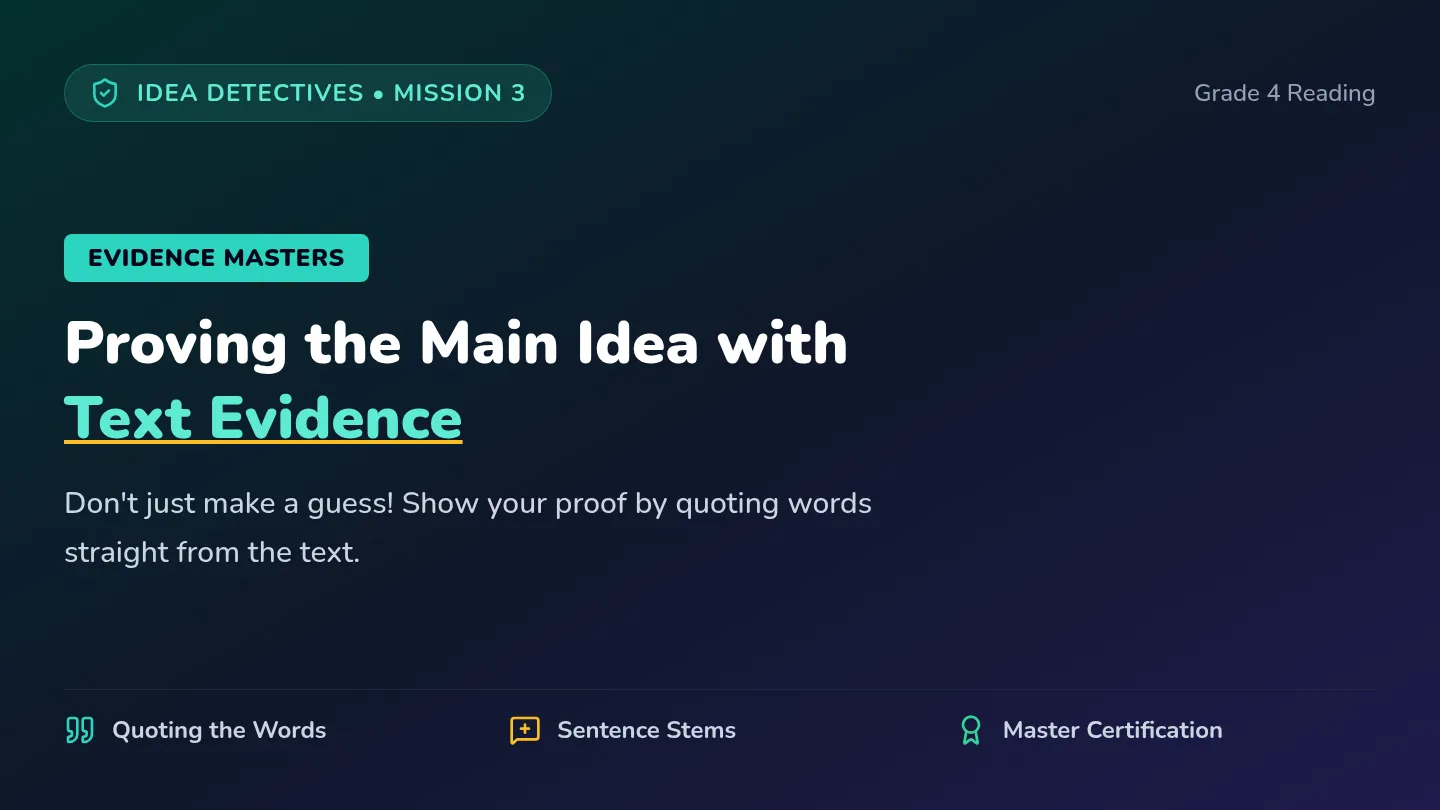
Evidence Detectives Slides Idea Detectives • Mission 3
Grade 4 Reading
Evidence Masters
Proving the Main Idea with Text Evidence
Don't just make a guess! Show your proof by quoting words straight from the text.
Quoting the Words
Sentence Stems
Master Certification
What is Text Evidence?
Proof in the Words!
It is Hard Proof
Text evidence means facts, words, or sentences taken directly from the passage.
It proves that your main idea answer is not just a guess!
Evidence = Clues in the reading
Point Right at It
A real detective can put their finger on the exact sentence that proves the point.
"I know this is true because line 3 says..."
Finger-on-the-page rule
Golden Rule: No evidence means your case gets dismissed in court!
Detective Sentence Frames
How to Talk Like a Detective
Frame 1
"The text states that [proof from text]."
Use this to introduce an exact sentence.
Frame 2
"According to the author, [author's words]."
Use this to show the author gave the fact.
Frame 3
"This proves the main idea because [your explanation]."
Use this to connect the evidence back to your table top.
Sentence frames make your writing strong, clear, and confident!
Case Study: Electric Eels
Watch the Model
Read the Text:
Electric eels use powerful electric shocks for self-defense and hunting. Their bodies contain thousands of specialized cells that work like living batteries. When threatened, an eel can produce up to 860 volts of electricity to stun hungry predators.
1. Main Idea:
Electric eels use strong shocks to survive and hunt.
2. Text Evidence:
"The text states that an eel can produce up to 860 volts of electricity to stun predators."
3. Explanation:
This proves eels use electricity as a dangerous weapon.
Look at that! Main Idea + Quoted Evidence + Explanation = Case Solved!
The Master Detective Checklist
Ready for Certification
1
State Main Idea
Name the central point in one clear, complete sentence.
The Umbrella
2
Quote Evidence
Use words directly from the author with a sentence frame.
Evidence File Worksheet Idea Detectives: Case File 3
Evidence Masters: Proving the Main Idea with Text Proof
Name:
Date:
Detective Sentence Stem Bank (Your Evidence Toolkit)
Stem 1:
"The text states that..."
Stem 2:
"According to the author..."
Stem 3:
"This proves that..."
Case Alpha: Snow Leopards of the High Peaks Numbered Clues
[1] Snow leopards have remarkable body features that help them survive in freezing, rugged mountains. [2] Their wide, fur-covered paws act like natural snowshoes to keep them from slipping on ice. [3] They possess long, muscular tails that they wrap tightly around their faces like blankets during blizzards. [4] Their thick gray-and-white coats camouflage them against steep stone cliffs.
Task A: Draw a box around Sentence 1 (Main Idea).
Task B: Underline two sentences that give direct proof.
Guided Case Report: Fill in Your Evidence Clues
Complete the detective report below using clues from the snow leopard text.
1. State the Main Idea in your own words:
Snow leopards have special body features that .
2. Quote one piece of Text Evidence using Stem 1:
The text states that "".
3. Explain how this clue proves your point using Stem 3:
This proves that .
Detective Golden Rule: When you quote text evidence, copy the author's exact words!
Part 2
Master Case File: Mars Rovers
Page 2 • Certification Case
Passage Evidence
[1] NASA engineers design robotic rovers with specialized tools to explore the dangerous surface of Mars. [2] The rovers have six durable metal wheels that can roll safely over jagged rocks without popping. [3] Strong mechanical arms equipped with lasers and drills test Martian dust for signs of ancient water. [4] Heated battery boxes protect the rovers' computers from sub-zero night temperatures.
1. What is the MAIN IDEA of this passage?
A. Mars rovers have specialized tools and parts that help them explore the planet Mars.
B. Mars has jagged rocks and very cold temperatures at night.
C. Mechanical arms on rovers have lasers and sharp drills.
2. Which sentence provides direct TEXT EVIDENCE that rovers can survive extreme cold?
A. Sentence 1 ("NASA engineers design robotic rovers...")
Evidence Rubric Guide Idea Detectives: Teacher Mastery Guide
Lesson 3: Evidence Masters • IEP Rubric & Progress Monitoring
Texas TEKS 4.9(D)(i) Aligned
Central Idea with Supporting Evidence
TEKS 4.9(D)(i) Progress Monitoring Rubric Scored on 4-Point STAAR Proficiency Scale
Skill Strand
Level 4: Master
Level 3: Proficient
Level 2: Developing
Level 1: Emerging
1. Central Idea (TEKS 4.9.D.i)
States full central idea sentence accurately; differentiates from topic.
Identifies central idea sentence with minimal prompting.
Identifies general topic or chooses partial detail as idea.
Confuses single detail with central idea; requires model.
2. Supporting Details (TEKS 4.9.D.i)
Selects 2+ relevant proof details and eliminates all fluff traps.
Selects 2 relevant details with teacher cueing.
Selects 1 relevant detail; may include fluff sentence.
Selects irrelevant fluff; cannot explain connection.
3. Citing Text Evidence (TEKS 4.9.D.i)
Quotes exact text words using sentence stem & explains connection.
Quotes text evidence using stem with minor assistance.
Paraphrases text without quotation; stem partially used.
Guesses without text reference; requires full scribe.
IEP Goal Tracking & STAAR Alignment
TEKS Standard:
TEKS 4.9(D)(i) Central Idea with Supporting Evidence
IEP Target Mastery:
80% Accuracy across 3 consecutive trial probes
Scaffold Provided:
Sentence stems, table graphic organizers, color cues
STAAR Format:
Multi-choice selection & constructed short explanation
Evidence Worksheet Answer Key & Exemplar Exemplar Guide
Page 1: Snow Leopard Case
Task A (Central Idea Box): Sentence [1] ("Snow leopards have remarkable body features...").Task B (Underline Evidence): Sentences [2], [3], or [4].1. Central Idea Frame: "...help them survive in freezing, rugged mountains."2. Text Evidence: The text states that "their wide, fur-covered paws act like natural snowshoes."3. Explanation: This proves that their body parts keep them safe on ice.
Page 2: Mars Rovers Case
1. Central Idea: A (Mars rovers have specialized tools and parts that help explore Mars).
STAAR Clue Task Cards TEKS 4.9(D)(i)
STAAR Detective Task Cards
Cards 1–4 • Central Idea & Evidence
CARD 1 STAAR Practice
Texas Longhorns
Texas longhorns are hardy cattle capable of living in rough, dry country. They can walk for miles across stony hills without tiring. Their wide horns defend calves from coyotes, and they easily digest tough desert brush that other cows cannot eat.
1. What is the central idea of this paragraph?
A. Longhorn horns keep baby calves safe.
B. Texas longhorns have special traits to survive in tough environments.
C. Coyotes hunt animals in the hills.
Target: Central Idea Correct: B
CARD 2 STAAR Practice
Nine-Banded Armadillos
The nine-banded armadillo relies on armor plates to survive predators in the Texas brush. Tough bony bands cover its back, head, and tail. When startled by a bobcat, the armadillo jumps straight into thick thorn bushes where thorny spines bounce off its shell.
2. Which detail best supports the central idea?
A. Thorny bushes grow across many fields in Texas.
B. Bobcats live throughout the southern states.
C. Bony armor plates protect the armadillo's body from sharp thorns.
Target: Supporting Evidence Correct: C
CARD 3 STAAR Practice
Monarch Journey
Every autumn, millions of monarch butterflies travel through Texas on a incredible 3,000-mile journey. They ride warm wind currents southward toward warm mountain forests in Mexico. During rest stops, they sip flower nectar to gain energy for flying.
3. What is the central idea of this paragraph?
A. Monarch butterflies make an amazing long-distance migration.
B. Mountains in Mexico have tall green fir trees.
C. Flowers produce sweet nectar in autumn.
Target: Central Idea Correct: A
CARD 4 STAAR Practice
Storm Safety
Having a family safety plan helps people stay protected during severe spring storms. Families should pick an interior room with no windows as a storm shelter. Storing fresh water and flashlights ensures power outages are manageable. Storm clouds often look dark gray.
4. Which sentence is NOT supporting evidence for the central idea?
A. Families should pick an interior room with no windows.
B. Storing water and flashlights prepares for power loss.
C. Storm clouds often look dark gray.
Target: Eliminating Fluff Correct: C
Cut along dashed lines to create 4 individual practice cards
TEKS 4.9(D)(i)