Poetry Pulse Lesson Plan
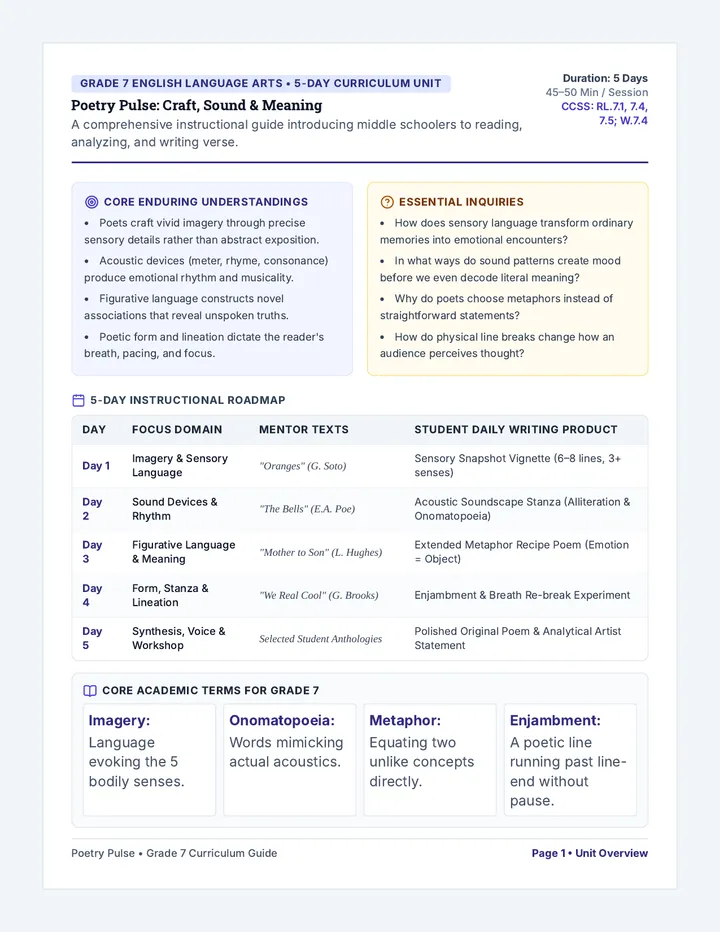
Grade 7 English Language Arts • 5-Day Curriculum Unit
Poetry Pulse: Craft, Sound & Meaning
A comprehensive instructional guide introducing middle schoolers to reading, analyzing, and writing verse.
Duration: 5 Days
45–50 Min / Session
CCSS: RL.7.1, 7.4, 7.5; W.7.4
Core Enduring Understandings
- Poets craft vivid imagery through precise sensory details rather than abstract exposition.
- Acoustic devices (meter, rhyme, consonance) produce emotional rhythm and musicality.
- Figurative language constructs novel associations that reveal unspoken truths.
- Poetic form and lineation dictate the reader's breath, pacing, and focus.
Essential Inquiries
- How does sensory language transform ordinary memories into emotional encounters?
- In what ways do sound patterns create mood before we even decode literal meaning?
- Why do poets choose metaphors instead of straightforward statements?
- How do physical line breaks change how an audience perceives thought?
5-Day Instructional Roadmap
| Day | Focus Domain | Mentor Texts | Student Daily Writing Product |
|---|
| Day 1 | Imagery & Sensory Language | "Oranges" (G. Soto) | Sensory Snapshot Vignette (6–8 lines, 3+ senses) |
| Day 2 | Sound Devices & Rhythm | "The Bells" (E.A. Poe) | Acoustic Soundscape Stanza (Alliteration & Onomatopoeia) |
| Day 3 | Figurative Language & Meaning | "Mother to Son" (L. Hughes) | Extended Metaphor Recipe Poem (Emotion = Object) |
| Day 4 | Form, Stanza & Lineation | "We Real Cool" (G. Brooks) | Enjambment & Breath Re-break Experiment |
| Day 5 | Synthesis, Voice & Workshop | Selected Student Anthologies | Polished Original Poem & Analytical Artist Statement |
Core Academic Terms for Grade 7
Imagery:
Language evoking the 5 bodily senses.
Onomatopoeia:
Words mimicking actual acoustics.
Metaphor:
Equating two unlike concepts directly.
Enjambment:
A poetic line running past line-end without pause.
Poetry Pulse • Grade 7 Curriculum Guide Page 1 • Unit Overview
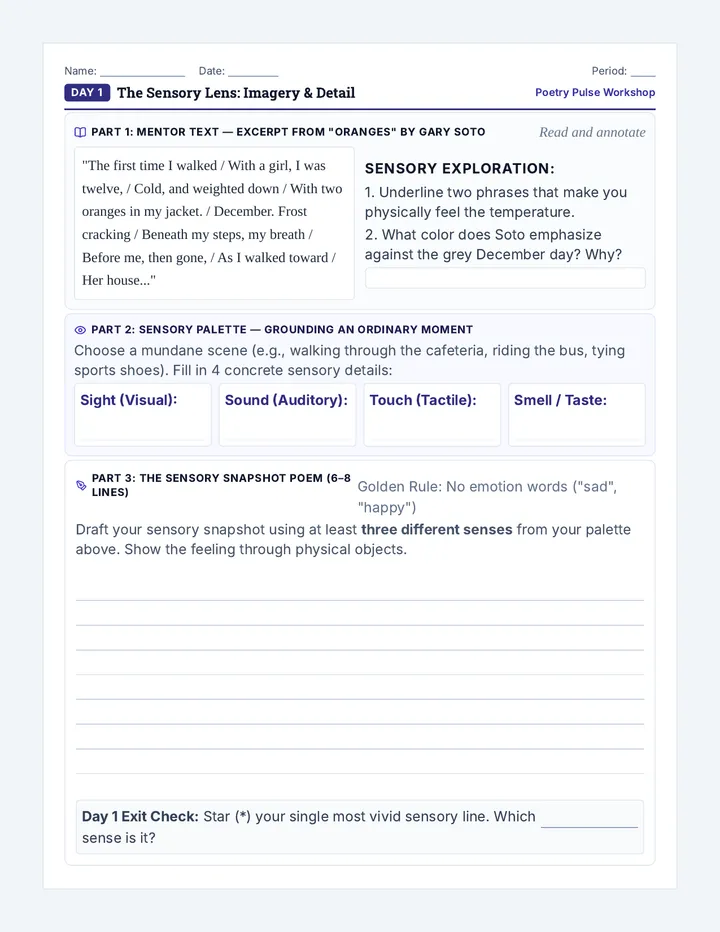
Day 1
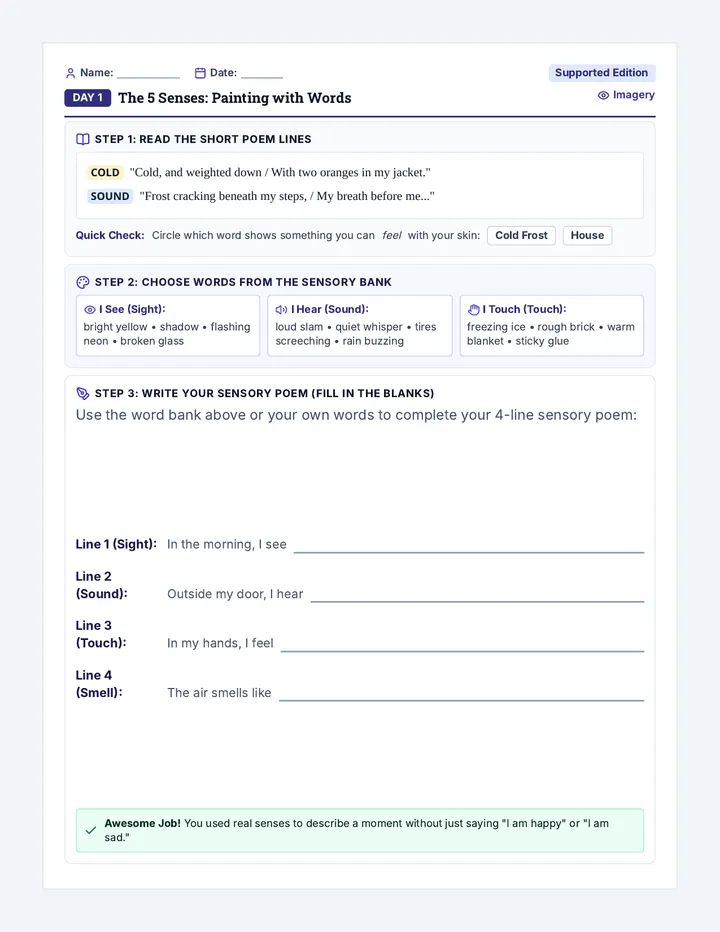
The Sensory Lens: Imagery & Senses
45 Minutes • CCSS RL.7.1, RL.7.4
Daily Objective: Students will identify visual, auditory, tactile, gustatory, and olfactory imagery in poetry and draft a 6–8 line sensory vignette using concrete details.
Bellringer Hook (8 Min)
Sensory Recall
Display prompt: "Think of walking into a kitchen where dinner is burning, or stepping outside during the first snowfall."
Students write 3 quick bullet points using only sensory details—forbidding abstract emotion words like "happy," "awful," or "cozy."
Direct Instruction (12 Min)
5 Sensory Pillars
Explain that imagery is not just visual pictures—it activates all five sensory pathways:
• Visual: Colors, light, shape
• Tactile: Texture, temperature
• Auditory: Volume, rhythm, echo
• Olfactory: Smells, aromas
• Gustatory: Sharp, sweet, metallic tastes
Mentor Text Study: Excerpt from "Oranges" by Gary Soto (12 Min)
Grade 7 Anchor Passage
"The first time I walked / With a girl, I was twelve, / Cold, and weighted down / With two oranges in my jacket. / December. Frost cracking / Beneath my steps, my breath / Before me, then gone, / As I walked toward / Her house..."
Teacher Facilitation Prompts:
1. Tactile/Kinesthetic: How does "weighted down" and "frost cracking" make us feel the chill?
2. Visual Contrast: Why are the vivid orange fruits so powerful against grey December?
3. Interpretation: How does Soto communicate nervous anticipation without stating "I was nervous"?
Workshop Writing (10 Min)
Task: The Sensory Snapshot
- Select a mundane moment (eating lunch, tying cleats, unlocking the door).
- Compose 6–8 lines incorporating at least three different senses.
- Strict rule: No emotional labels ("sad," "excited," "bored").
Exit Check & Supports (5 Min)
Quick Exit Question: Underline one sensory line and label which sense it stimulates.
Scaffolding: Provide a sensory word mat for English Learners; challenge advanced writers to use synesthesia (e.g., "a yellow smell").
Poetry Pulse • Grade 7 Curriculum Guide Page 2 • Day 1 Plan
Day 2
The Music of Words: Sound & Rhythm
45 Minutes • CCSS RL.7.4, RL.7.5
Daily Objective: Students will analyze how poets employ alliteration, onomatopoeia, consonance, and rhythm to generate emotional atmosphere and draft a soundscape stanza.
Acoustic Hook (7 Min)
Rhythm Tap
Tap two contrasting rhythms on the desk: a sluggish, dragging beat vs. a hurried, staccato pulse.
Ask: "How does the tempo alone change your physical heartbeat before any words are spoken?" Introduce poetry as musical score.
The Sound Toolkit (13 Min)
4 Key Tools
Alliteration: Initial consonant repetition ("silent shadows slide").
Onomatopoeia: Sonic mimicry ("clatter, sizzle, thump").
Consonance: Repeated internal consonant sounds ("flack jacket").
Cacophony vs Euphony: Harsh dissonant sounds vs smooth melodies.
Mentor Text Study: Excerpt from "The Bells" by Edgar Allan Poe (12 Min)
Grade 7 Acoustic Study
"Hear the sledges with the bells— / Silver bells! / What a world of merriment their melody foretells! / How they tinkle, tinkle, tinkle, / In the icy air of night! / While the stars that oversprinkle / All the heavens, seem to twinkle / With a crystalline delight..."
Sound Dissection Protocol:
1. Sonic Identification: Have students underline the light "l" and "k" sounds (tinkle, twinkle, crystalline).
2. Atmospheric Impact: How do short, sharp vowel sounds mimic crisp winter frost?
3. Choral Reading: Read the stanza together as a whole group, speeding up on the repetitive cadence.
Soundscape Stanza Task (10 Min)
Prompt: The Mechanical or Natural Storm
- Write 4–6 lines capturing either a thunderstorm, a skateboard park, or a crowded cafeteria.
- Must contain at least two onomatopoeic words and one alliterative phrase.
- Focus on acoustic rhythm that matches the action.
Formative Check & Support (5 Min)
Whisper-Test Exit Ticket: Read your soundscape aloud to a shoulder partner. Partner identifies the primary mood generated by the consonants.
Support: Provide struggling writers with a curated word bank of hard consonants (k, p, t, b) versus soft consonants (s, m, l, w).
Poetry Pulse • Grade 7 Curriculum Guide Page 3 • Day 2 Plan
Day 3
The Metaphor Machine: Figurative Language
45 Minutes • CCSS RL.7.1, RL.7.4
Daily Objective: Students will deconstruct extended metaphors and personification to explain how non-literal comparisons communicate complex emotional states.
Bellringer Sort (8 Min)
Literal vs Metaphor
Display paired statements: "My backpack is heavy with textbooks" vs. "My backpack carries the weight of my future."
Ask: What does Statement B achieve that Statement A cannot? Guide students to see figurative language as an emotional shortcut.
The Metaphor Formula (12 Min)
Tenor & Vehicle
Break metaphor down into middle-school friendly components:
The Real Topic: The emotion or human state (e.g., Grief)
The Comparison Lens: A physical object/force (e.g., Low Tide)
The Insight: It recedes, reveals bare mud, but always returns.
Mentor Text Study: "Mother to Son" by Langston Hughes (12 Min)
Grade 7 Extended Metaphor Anchor
"Well, son, I’ll tell you: / Life for me ain’t been no crystal stair. / It’s had tacks in it, / And splinters, / And boards torn up, / And places with no carpet on the floor— / Bare. / But all the time / I’se been a-climbin’ on..."
Analytical Inquiry Prompts:
1. Symbolic Meaning: What does a "crystal stair" represent in terms of wealth, privilege, and ease?
2. Concrete Contrast: What do the "tacks," "splinters," and "bare boards" concretely communicate about her hardship?
3. Thematic Stance: How does the continuing action of "climbin' on" establish perseverance?
Metaphor Recipe Poem (10 Min)
Task: Emotion as Everyday Machine
- Select one feeling: Anxiety, Curiosity, Hope, Frustration.
- Equate it to an object (a rusted bicycle, a microwave, an elevator).
- Write 6–8 lines extending that comparison without using "like" or "as."
Decoding Ticket & Differentiation (5 Min)
Exit Ticket: Complete the sentence: "Hughes uses the wooden staircase to show that courage requires..."
Support: Sentence starters for thesis statement; challenge fast finishers to integrate personification into their machine poem.
Poetry Pulse • Grade 7 Curriculum Guide Page 4 • Day 3 Plan
Day 4
Anatomy of Verse: Form & Lineation
45 Minutes • CCSS RL.7.5, W.7.4
Daily Objective: Students will analyze how line breaks, enjambment, stanzas, and white space steer pacing, suspense, and emphasis in modern verse.
The Breath Test (8 Min)
Lineation Shock
Present the same sentence in prose vs. broken into three suspenseful single-word lines.
Students read both aloud and note how line breaks physically force the reader to pause, hesitate, and lean into the next word.
Structural Blueprint (12 Min)
Key Terms
End-Stopped: Punctuation ends the line; brings closure.
Enjambment: Sentence spills over line break; propels momentum.
Stanza Break: Acts like paragraph shifts—marks time or shifts tone.
White Space: Intentional visual silence and breathing room.
Mentor Text Study: "We Real Cool" by Gwendolyn Brooks (12 Min)
Grade 7 Structure Landmark
"THE POOL PLAYERS. / SEVEN AT THE GOLDEN SHOVEL.
We real cool. We / Left school. We /
Lurk late. We / Strike straight. We /
Sing sin. We / Thin gin. We /
Jazz June. We / Die soon."
Structural Dissection Prompts:
1. Enjambment Purpose: Why end each line with "We" rather than starting with it?
2. The Rhythm of Hesitation: How does the pause after "We" hint at vulnerability?
3. The Terminal Silence: Why does the final line drop "We" and end abruptly on "soon"?
Line-Break Surgery (10 Min)
Task: Transforming Prose to Verse
- Take a provided 3-sentence prose paragraph describing a mystery.
- Slice into 8–10 lines across two intentional stanzas.
- Must utilize at least two enjambments to create dramatic tension.
Formative Check (5 Min)
Form Justification Ticket: Circle one word at the end of a line. In one sentence, explain why you left the reader hanging there.
Visual Metaphor: Compare line breaks to stepping stones—each leap carries intentional weight.
Poetry Pulse • Grade 7 Curriculum Guide Page 5 • Day 4 Plan
Day 5
The Poet's Voice: Synthesis & Lounge
45 Minutes • CCSS RL.7.1, 7.4, 7.5; W.7.4; SL.7.1
Culminating Objective: Students will synthesize sensory imagery, sound devices, metaphor, and deliberate structure to polish an original poem and compose a self-analytical artist statement.
Phase 1: Polish Protocol & Word Economy (10 Min)
Mini-Lesson
Teach poetic compression: the craft of saying the most with the fewest words. Guide students through a 3-step revision routine:
1. Weed the Fluff:
Cross out filler words (very, really, just, that).
2. Power the Verbs:
Replace weak "was/walked" with evocative motion verbs.
3. Check the Breath:
Read silently while tapping knees on each line break.
Phase 2: Culminating Poem Drafting (15 Min)
10–14 Lines
Students select their strongest seed from Days 1–4 and polish a finished verse containing:
Sensory Foundation: 2+ distinct senses in concrete nouns.
Acoustic Element: Deliberate alliteration or onomatopoeia.
Figurative Core: An original metaphor or personification.
Architectural Form: Purposeful stanza breaks & enjambment.
Phase 3: The Poetry Lounge Protocol (12 Min)
Coffeehouse Protocol
• Low-Stakes Pods: Group desks in clusters of 3–4. Dim lighting if possible.
• The Snapping Tradition: Snap fingers instead of clapping to honor the speaker.
• The Golden Line Slip: Listeners write the single most striking line on an index card.
Feedback Prompt Slip:
"The line '...' hit me because the sound / image made me feel..."
Phase 4: Analytical Artist Statement Card (8 Min / Exit)
Students complete a paired index card attached to their final poem to demonstrate analytical intent:
Question 1 (Figurative):
"Explain your central metaphor. What abstract feeling does this concrete comparison uncover?"
Question 2 (Structural):
"Where did you place your most suspenseful line break, and why did you force the reader to pause there?"
Poetry Pulse • Grade 7 Curriculum Guide Page 6 • Day 5 Plan & Lounge Protocol
Summative Assessment Blueprint
Grade 7 Poetry Master Assessment Rubric
CCSS Aligned Scale
Total: 20 Points (4 Pts / Category)
| Craft Domain | Exceeds (4 Pts) | Proficient (3 Pts) | Approaching (2 Pts) | Emerging (1 Pt) |
|---|
| Sensory Imagery | | | | |
| RL.7.4, W.7.4 | Rich multi-sensory immersion; sharp physical nouns; zero emotional cliches. | At least 2 distinct senses clearly depicted through concrete physical details. | Primarily visual descriptions; relies on predictable adjectives (dark, cold). | Tells emotions directly ("I felt sad") without physical sensory grounding. |
| Sound & Musicality | | | | |
| RL.7.4 | Masterful internal rhythm; sound devices directly amplify the poem's mood. | Alliteration, onomatopoeia, or meter intentionally applied to shape tone. | Sound devices feel forced or strictly restricted to simple end-rhymes. | No audible rhythm or acoustic consideration evident in phrasing. |
| Figurative Craft | | | | |
| RL.7.4 | Novel extended metaphor or personification revealing profound emotional truth. | Clear, original comparison where tenor and vehicle build meaningful connection. | Relies on common idioms or cliches (e.g., "fast as lightning"). | Purely literal descriptions with no figurative comparisons attempted. |
| Structure & Form | | | | |
| RL.7.5 | Deliberate lineation and enjambment expertly steer reader breath and suspense. | Lines break on meaningful words; logical stanza divisions organize thoughts. | Arbitrary line breaks that split phrases awkwardly without purpose. | Written as a continuous prose paragraph with artificial enters. |
| Artist Statement | | | | |
| RL.7.1, W.7.4 | Articulate defense of craft decisions with clear text-to-intent analysis. | Accurately explains the reasoning behind central metaphor and key line break. | Superficial explanation ("I picked it because I like it") lacking analysis. | Incomplete, vague, or missing artist statement card. |
Score Scale & Grade Conversion
18–20 Pts (90–100%): Exemplary Poetic Craft
15–17 Pts (75–85%): Proficient Middle School Level
12–14 Pts (60–70%): Developing / Re-teaching Target
Below 12 Pts (<60%): Substantial Scaffolding Required
Targeted Feedback Strategy
Apply the "Glow & Grow" coaching protocol on student poems:
• Glow: Quote their exact sensory phrase or effective figurative comparison.
• Grow: Target either word economy (pruning adverbs) or moving line breaks for suspense.
Teacher Evaluator Record & Conference Notes
Student Name: ___________________
Poem Title: ___________________
Total Score: _____ / 20 Pts
Poetry Pulse • Grade 7 Curriculum Guide Page 7 • Master Assessment Rubric
Instructional Support Matrix
Differentiation, Misconceptions & Prep
Inclusive Classroom Plan
Universal Design for Learning
Tiered Differentiation Across All 5 Days
Multilingual Learners
- Provide visual picture flashcards for sensory verbs and nouns.
- Encourage code-meshing: allow students to weave phrases from their home language into poetry drafts.
- Supply bilingual metaphor stems ("Anger is like...").
Access Focus
IEP / 504 / Reluctant
- Permit speech-to-text dictation or audio-recorded spoken word for initial drafting.
- Pre-highlight mentor texts with color keys before class begins.
- Adjust required draft length from 10–14 lines to 6–8 focused lines.
Scaffold Focus
Advanced Extensions
- Challenge to craft a poem in a strict classical form (villanelle, sestina, or sonnet).
- Experiment with synesthesia (blending senses, e.g., "tasting the blue sky").
- Facilitate the Poetry Lounge discussion as host/emcee.
Enrichment Focus
Common Student Misconceptions & Instructional Antidotes
Misconception 1: "All poems must rhyme."
Antidote: Show how forced rhyme ruins genuine emotion. Emphasize that free verse relies on internal rhythm, consonance, and enjambment rather than predictable end-rhymes.
Misconception 2: "Poetry has a single secret code to guess."
Antidote: Frame poems as conversations rather than riddles. Any interpretation supported with textual evidence (sound, imagery, diction) is valid and celebrated.
Unit Prep & Materials Master Checklist
Print Resources: • Gary Soto "Oranges" Handout
• Edgar Allan Poe "The Bells"
• Langston Hughes "Mother to Son"
• Gwendolyn Brooks "We Real Cool"
Classroom Supplies: • 3-Color Highlighters (Sensory/Sound)
• 3×5 Index Cards (Golden Lines)
• Sticky notes for peer feedback
• Desk clusters for Lounge day
Assessment Files: • Master Rubric copy per student
• Daily Exit Ticket slips
• Metacognitive Artist Statement card
• Unit Grade Tracker
Poetry Pulse • Grade 7 Curriculum Guide Page 8 • Differentiation & Implementation Toolkit