Spacewalk Questions Worksheet Targeted Practice CCSS RI.3 & RI.4 Question Stems
"What Is a Spacewalk?" Comprehension Questions
Refer to NASA's informational text to answer the 4 questions below.
Name:
Date: Period:
Read each question carefully and select the best answer based on the passage.
4 Assessment Items
1. Why do astronauts put on their spacesuits several hours before a spacewalk and breathe pure oxygen?
A. To cool their bodies down so they do not overheat inside the heavy suit
B. To get rid of nitrogen in their bodies so painful gas bubbles do not form in their joints
C. To test whether the radio and video game joystick inside the helmet work properly
D. To fall asleep so time passes quickly while the spacecraft orbits Earth
Paragraph Evidence:
2. After astronauts go through the first door of the airlock, what and why do they have to do before opening the second door?
A. They must lock the first door tight behind them so that no air escapes from the spacecraft.
B. They must take off their spacesuits so their movements are not restricted outside.
C. They must open both doors at the same time so fresh oxygen enters the cabin.
D. They must hook the safety tether to the spacecraft floor so they do not hit the ceiling.
Paragraph Evidence:
3. Which list gives the correct sequence of events in the passage?
A. 1. Astronauts put on pressurized spacesuits. → 2. Astronauts breathe pure oxygen for a few hours. → 3. Astronauts enter the airlock and lock the first door. → 4. Astronauts open the second door and exit using safety tethers.
B. 1. Astronauts open the outer airlock door. → 2. Astronauts put on their spacesuits. → 3. Astronauts breathe pure oxygen. → 4. Astronauts hook tethers to tools.
C. 1. Astronauts breathe pure oxygen. → 2. Astronauts repair a damaged satellite. → 3. Astronauts put on their spacesuits. → 4. Astronauts enter the airlock.
D. 1. Astronauts activate the SAFER thrusters. → 2. Astronauts lock the airlock doors. → 3. Astronauts exit the spacecraft. → 4. Astronauts put on spacesuits.
4. What was a result of astronauts getting gas bubbles in their body when they walked in space?
A. Their spacesuits would immediately rip open and lose all oxygen pressure.
B. They felt painful aching in their shoulders, elbows, wrists, and knees, called "the bends."
C. They would float away from the spacecraft and need to be rescued by a SAFER unit.
D. Their tools would become magnetized and stick to the outside of the vehicle.
Paragraph Evidence:
NASA: "What Is a Spacewalk?" Comprehension Worksheet • Standards RI.3 & RI.4 Single Page • 4 Question Set
Spacewalk Reading Quiz Reading Quiz Standards RI.3 & RI.4 Assessment
"What Is a Spacewalk?" Reading Quiz
Refer to NASA's informational text to answer each multiple-choice question below.
Name:
Date: Period:
Choose the best response for each question. Darken the circle next to your answer choice.
100 Points (25 pts each)
1. Why do astronauts go on spacewalks instead of bringing damaged spacecraft and satellites back to Earth?
25 Pts
A. Because bringing them back to Earth is impossible since Earth has no landing strips
B. Because fixing them directly in space saves time and resources compared to returning them to Earth
C. Because satellites work better when painted by hand during a spacewalk
D. Because astronauts need practice diving into Earth's oceans
2. After astronauts put on their spacesuits, what and why do they have to do before opening the second door of the airlock?
25 Pts
A. They must step into the airlock and lock door one tight behind them so that cabin air does not escape into space.
B. They must remove their oxygen tanks to make the airlock completely airtight.
C. They must open both doors at the exact same moment so that gravity equalizes.
D. They must turn off their helmet radios so space noise does not enter the vehicle.
3. Which list gives the correct sequence of events in the passage?
25 Pts
A. 1. Astronauts put on pressurized spacesuits. → 2. Astronauts breathe pure oxygen to remove nitrogen. → 3. Astronauts enter the airlock and lock the first door. → 4. Astronauts open the second door to begin the spacewalk.
B. 1. Astronauts fly using a SAFER jetpack. → 2. Astronauts enter the airlock. → 3. Astronauts put on spacesuits. → 4. Astronauts breathe pure oxygen.
C. 1. Astronauts lock the airlock doors. → 2. Astronauts put on spacesuits. → 3. Astronauts hook tethers to tools. → 4. Astronauts experience "the bends."
D. 1. Astronauts open the second airlock door. → 2. Astronauts put on spacesuits. → 3. Astronauts remove nitrogen. → 4. Astronauts enter the airlock.
4. What was a result of an astronaut becoming untethered and floating away into space?
25 Pts
A. The astronaut would immediately activate the SAFER backpack and fly back using small jet thrusters.
B. The astronaut would use pure nitrogen gas to inflate a giant return parachute.
C. The spacecraft would automatically open both airlock doors to pull the astronaut back inside.
D. The astronaut's spacesuit would lose its water and oxygen supply within seconds.
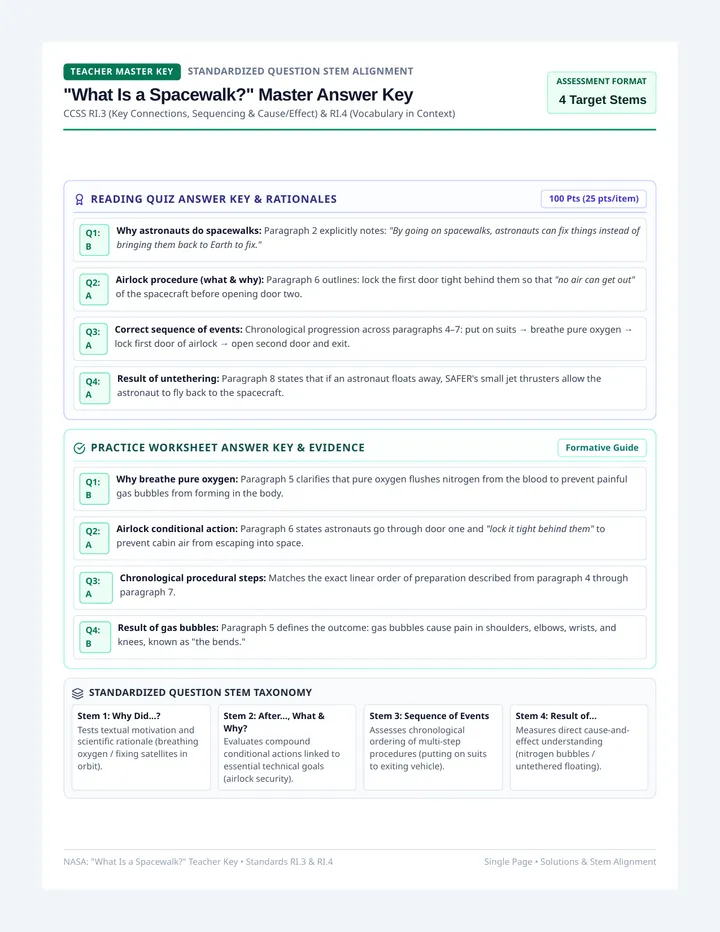
Spacewalk Quiz Key Teacher Master Key Standardized Question Stem Alignment
"What Is a Spacewalk?" Master Answer Key
CCSS RI.3 (Key Connections, Sequencing & Cause/Effect) & RI.4 (Vocabulary in Context)
Assessment Format 4 Target Stems
Reading Quiz Answer Key & Rationales
100 Pts (25 pts/item)
Q1: B
Why astronauts do spacewalks: Paragraph 2 explicitly notes: "By going on spacewalks, astronauts can fix things instead of bringing them back to Earth to fix."
Q2: A
Airlock procedure (what & why): Paragraph 6 outlines: lock the first door tight behind them so that "no air can get out" of the spacecraft before opening door two.
Q3: A
Correct sequence of events: Chronological progression across paragraphs 4–7: put on suits → breathe pure oxygen → lock first door of airlock → open second door and exit.
Q4: A
Result of untethering: Paragraph 8 states that if an astronaut floats away, SAFER's small jet thrusters allow the astronaut to fly back to the spacecraft.
Practice Worksheet Answer Key & Evidence
Formative Guide
Q1: B
Why breathe pure oxygen: Paragraph 5 clarifies that pure oxygen flushes nitrogen from the blood to prevent painful gas bubbles from forming in the body.
Q2: A
Airlock conditional action: Paragraph 6 states astronauts go through door one and "lock it tight behind them" to prevent cabin air from escaping into space.
Q3: A
Chronological procedural steps: Matches the exact linear order of preparation described from paragraph 4 through paragraph 7.
Q4: B
Result of gas bubbles: Paragraph 5 defines the outcome: gas bubbles cause pain in shoulders, elbows, wrists, and knees, known as "the bends."
Standardized Question Stem Taxonomy
Stem 1: Why Did...?
Tests textual motivation and scientific rationale (breathing oxygen / fixing satellites in orbit).
Stem 2: After..., What & Why?
Evaluates compound conditional actions linked to essential technical goals (airlock security).
Stem 3: Sequence of Events
Assesses chronological ordering of multi-step procedures (putting on suits to exiting vehicle).
Stem 4: Result of...
Measures direct cause-and-effect understanding (nitrogen bubbles / untethered floating).
NASA: "What Is a Spacewalk?" Teacher Key • Standards RI.3 & RI.4 Single Page • Solutions & Stem Alignment