Word: before
Category: Subordinating (Time)
Teacher Diagnostic Tip: The "Compound Predicate" Trap
In item #1, students frequently confuse a compound predicate (gathered... and cataloged...) with a compound sentence. Emphasize that a sentence is only compound when there is a distinct subject after the conjunction creating a second independent clause. Show that "and cataloged them" lacks a separate subject and cannot stand alone as a sentence.
Sentence Architect Series • Teacher Evaluation Guide Page 1 of 2
Punctuation Insertion, Combining Criteria, and Editing Solutions
Sections C–E (13 Pts)
C
5 Points (1 pt each)
Rule: Intro Dependent Clause
Rule: Compound (FANBOYS)
Answer: CORRECT AS IS (No comma)
Rule: Intro Dependent Clause
Answer: CORRECT AS IS (Purpose Clause)
D
4 Points (2 pts each)
16. Exemplar Response: Compound Sentence
The forest fire spread rapidly, but firefighters created a controlled perimeter break.
Scoring: 1 pt for accurate clause connection with 'but'; 1 pt for comma preceding 'but'.
17. Exemplar Response: Complex Sentence
As soon as the deep frost thawed in mid-April, migrating birds returned to the northern wetlands.
Scoring: 1 pt for starting with 'As soon as'; 1 pt for mandatory comma after introductory clause ('mid-April,').
E
4 Points (1 pt ID, 3 pts Explanations)
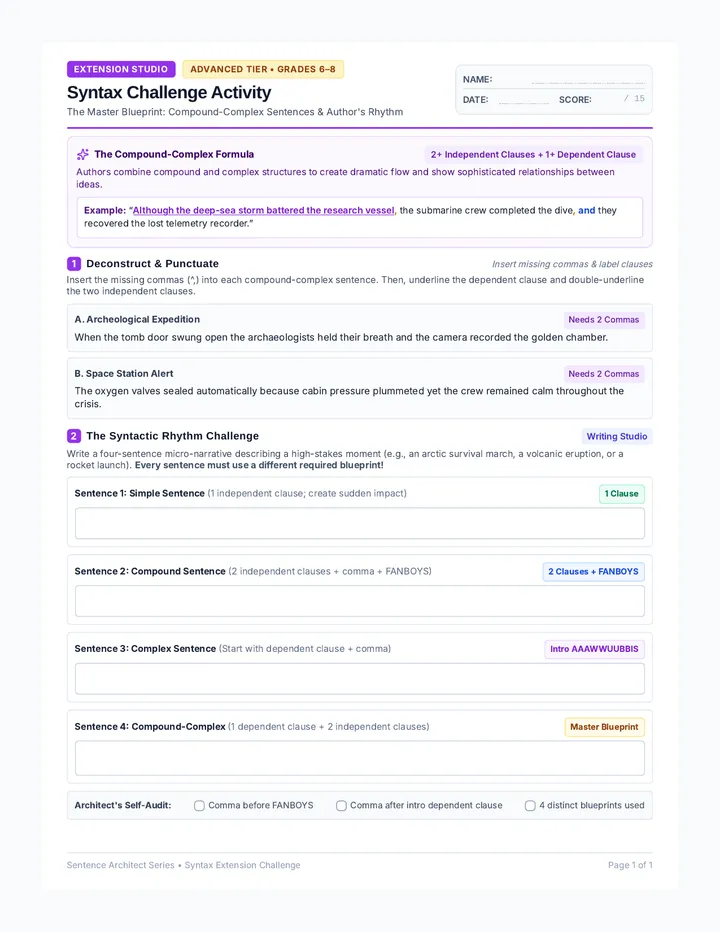
“When the subterranean vault was unsealed after a century**, [1]** the expedition team peered inside with flashlights. Golden artifacts lined the stone walls**, [2]** and fragile papyrus scrolls rested in sealed cedar chests. The chief conservator refused to touch the relics , [3] before humidity levels inside the chamber were stabilized. The team documented every artifact carefully**, [alt]** for a single hasty mistake could destroy irreplaceable history.”
Correction 1:
Add comma after "century": Separates introductory dependent clause ("When the subterranean vault...") from the main independent clause.
Correction 2:
Add comma after "stone walls": Required comma before coordinating conjunction "and" joining two independent clauses.
Correction 3:
Remove comma before "before": Dependent clause is at the end of the sentence; no comma should separate it from the main clause.
Sentence Architect Series • Teacher Evaluation Guide Page 2 of 2
[Dependent Clause] , [Independent Clause]
“Although the trail was treacherous, the rescue unit reached the peak.”
Comma is REQUIRED after the intro clause
Pattern B
[Independent Clause] [NO COMMA] [Dependent Clause]
“The rescue unit reached the peak although the trail was treacherous.”
Usually NO comma when dependent clause is last
Sentence Architect • Slide 5 of 7 Complex Structures
Turn & Talk Class Challenge
Analyze these two patient sentences with your partner. Diagnose the structure and fix the punctuation!
Case 1: Identify Structure & Comma Spot Where does the comma belong?
“While the deep-sea divers surveyed the volcanic vent a pod of pilot whales glided past.”
Hint: Find the AAAWWUUBBIS word. Is the dependent clause first?
Case 2: Simple vs. Compound Check Does this sentence need a comma?
“The archeologist dusted the hieroglyphic tablet and translated the royal cartouche.”
Hint: Check after “and” — is there a new subject, or just a second action?
Sentence Architect • Slide 6 of 7 Diagnostic Practice
Independent Practice
Complete the Sentence Architect Worksheet using today’s structural blueprints.
A
Label sentences as Simple (S), Compound (CD), or Complex (CX).
B
Insert commas before FANBOYS and after introductory clauses.
C
Combine ideas in the Studio and proofread the explorer’s journal at the Editor’s Desk.
Ready to build? Grab your pencil and worksheet!
25 Points Total
Sentence Architect • Slide 7 of 7 Mission Kickoff
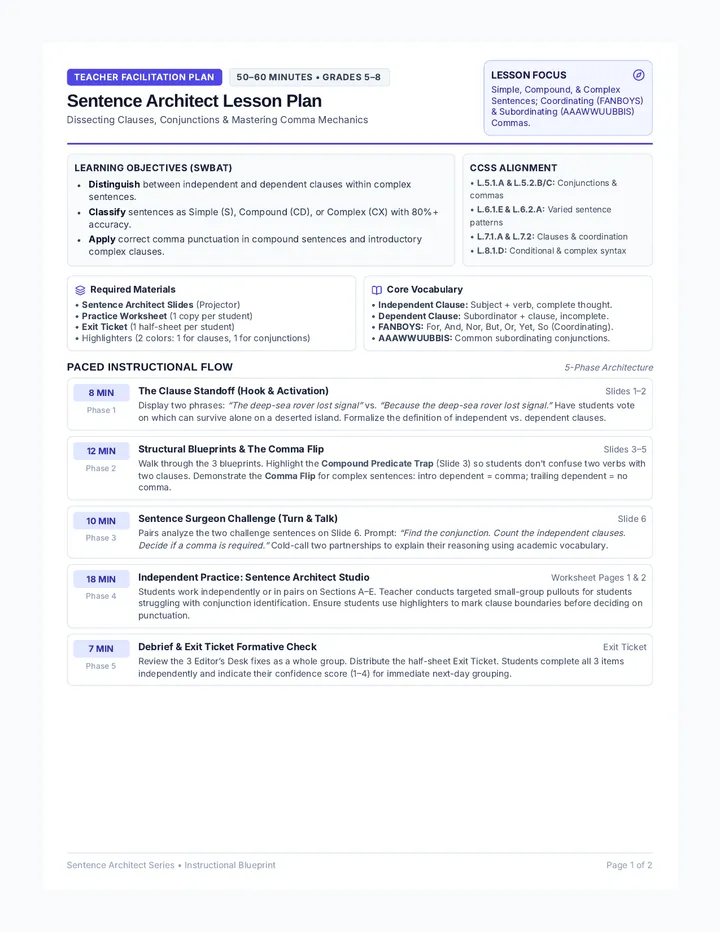
18 MIN Phase 4
Independent Practice: Sentence Architect Studio Worksheet Pages 1 & 2
Students work independently or in pairs on Sections A–E. Teacher conducts targeted small-group pullouts for students struggling with conjunction identification. Ensure students use highlighters to mark clause boundaries before deciding on punctuation.
7 MIN Phase 5
Debrief & Exit Ticket Formative Check Exit Ticket
Review the 3 Editor’s Desk fixes as a whole group. Distribute the half-sheet Exit Ticket. Students complete all 3 items independently and indicate their confidence score (1–4) for immediate next-day grouping.
Sentence Architect Series • Instructional Blueprint Page 1 of 2
Addressing Misconceptions, Supporting Diverse Learners & Assessment Criteria
Teacher Tool
!
The Compound Predicate Mistake
Error: Putting a comma before “and” when a single subject performs two verbs (e.g., The hawk swooped, and caught the mouse).
Fix: Cover “and”. Ask: “Is the second half a complete sentence with its own subject? If not, NO comma!”
Over-Punctuating "Because" & "After"
Error: Adding a comma whenever they see a subordinating word, even when it appears at the end of the sentence.
Fix: Teach the “Front-Load Rule”: only introductory dependent clauses earn commas. Ending clauses don't get commas.
Comma Splice Confusion
Error: Placing a comma alone between two independent clauses without a coordinating conjunction.
Fix: Remind students of the “Glue Rule”: a comma is too weak by itself; it needs a FANBOYS partner or a semicolon.
D
Tier / Learner Group Targeted Scaffolds & Modifications Specific Practice Strategy
Tier 1: Striving / ELL Provide a printed AAAWWUUBBIS bookmark; have students bracket clauses before choosing punctuation. Focus on completing Sections A & C; provide sentence stems for Section D combining.
Tier 2: On-Grade Level Follow standard worksheet sequence; pair students during Section B Conjunction Detective. Complete all worksheet sections independently; write rule justifications in full sentences.
Tier 3: Advanced / Extension Challenge students to craft compound-complex sentences (2 independent + 1 dependent clause). Rewrite the Section E paragraph by combining simple sentences into varied syntactic patterns.
✓
Mastery (85–100%) 21–25 Pts
Flawlessly classifies S, CD, CX; articulates comma rules with correct grammatical terminology; accurately identifies all paragraph errors.
Proficient (70–84%) 17–20 Pts
Identifies compound and simple sentences reliably; occasional slip on complex sentences with trailing clauses; understands FANBOYS rule.
Emerging (<70%) 0–16 Pts
Confuses compound verbs with compound sentences; misses introductory commas. Requires targeted small-group intervention using clause manipulatives.
Teacher Wrap-Up Script (Closing 2 Minutes)
“Remember, young architects: sentences aren't just strings of words—they have blueprints. A simple sentence holds one strong thought. A compound sentence connects two equal thoughts with a comma and a FANBOYS coordinator. A complex sentence weaves thoughts together, and when you start with a subordinator like 'Although' or 'Because', your comma is the bridge that keeps the reader from stumbling!”
Sentence Architect Series • Instructional Blueprint Page 2 of 2