Lenny.com
Explore
Create
ActivitiesNewMathEnglish Language ArtsScience & EngineeringSocial StudiesGlobal LanguagesHealth & Physical EducationSpecial EducationCounseling & Life SkillsArts & CreativityESL
Lenny.com
Lenny.com
Explore
Create
ActivitiesNewMathEnglish Language ArtsScience & EngineeringSocial StudiesGlobal LanguagesHealth & Physical EducationSpecial EducationCounseling & Life SkillsArts & CreativityESL
Lenny.com
Lenny.com

Solutions

Lenny for EducatorsLenny for SchoolsLenny for Districts

Product

ExploreSign inCreateSupportAbout

Resources

Getting startedMTSS Acceleration Program

© 2026 Lenny Learning Inc.

TermsPrivacyAccessibility
LinkedInInstagramX
Lenny
English Language ArtsPhonics & Reading FoundationsLetter IdentificationLearn Letters A-ZLowercase and Uppercase LettersConsonants and VowelsLetter-Sound AssociationsLetter-Sound Associations: LowercaseLetter-Sound Associations: UppercaseBeginning and Ending SoundsRhymingBlending And SegmentingShort VowelsShort Vowel SoundsConsonant BlendsConsonant DigraphsBlends, Digraphs, and TrigraphsDigraphs, Blends, and Silent LettersLong Vowel SoundsLong Vowel PatternsShort and Long VowelsShort and Long Vowel PatternsSilent EVowel SoundsVowel TeamsR-Controlled VowelsDiphthongs: Oi, Oy, Ou, OwVariant VowelsVariant, Diphthong, And R Vowel PatternsSoft G And CSight WordsIrregular WordsWord RecognitionSyllablesSyllable TypesTwo-Syllable WordsMultisyllabic WordsPhoneme ManipulationDecodable TextsVocabularyAction WordsQuestion WordsNouns and AdjectivesClassify WordsCompound WordsSynonyms and AntonymsHomophonesHomophones and HomonymsShades of MeaningContext CluesPrefixes and SuffixesGreek and Latin RootsAnalogiesIdioms and AdagesForeign Words and ExpressionsWord Choice and UsageReference SkillsReading ComprehensionRead-Along Literary TextsRead-Along Informational TextsReality vs. FictionStory ElementsCharacterSequenceMain IdeaCause And EffectCompare And ContrastReading StrategiesText StructureAuthor's PurposeAuthor's Purpose And ToneAuthor's PerspectivePoint Of ViewThemeInference And ThemeInference And AnalysisPoetry ElementsLiterary DevicesAnalyzing LiteratureAnalyzing Informational TextsComparing TextsAudience, Purpose, And ToneBusiness DocumentsNovel StudyNonfiction Book StudyGrammar & MechanicsSentencesNounsVerbsAdjectivesPronounsCapitalizationPunctuationContractionsConjunctionsPrepositionsArticlesAdjectives And AdverbsVerb TypesVerb TensePronouns And AntecedentsPronoun TypesSubject-Verb AgreementDirect And Indirect ObjectsSentences, Fragments, And Run-OnsPhrases And ClausesCommasSemicolons, Colons, And CommasDashes, Hyphens, And EllipsesSpellingAbbreviationsFormattingVerb Tense And MoodMisplaced ModifiersWritingDescriptive DetailsCreative WritingOpinion WritingTopic SentencesOrganizing WritingLinking WordsSentence VarietyIntroductions And ConclusionsPersuasive And Opinion WritingExpository WritingPersuasive StrategiesDeveloping And Supporting ArgumentsTopic Sentences And Thesis StatementsSummarizingResearch SkillsEditing And RevisingActive And Passive Voice=Writing Clearly And ConciselyDebate & Public SpeakingPublic Speaking BasicsPersuasive TechniquesClaims and EvidenceTypes of ArgumentsReasoning TypesLogical FallaciesTopic ResearchOrganizing EvidenceDebate Speech OrganizationAttacking and Defending ArgumentsClash and EngagementImpact CalculusQuestioning and Cross-ExaminationCritical ThinkingInformal LogicFormal LogicInductive Reasoning

Lin Manuel Spotlight

A 2nd-grade English Language Arts biography sequence exploring the life, musicals, creative process, and community impact of Lin-Manuel Miranda from Frank Berrios's text. Students analyze chronological text organization, central main ideas, and character inferences.

Aawarner1
Broadway Beat Maker

A 2nd-grade English Language Arts lesson exploring Lin-Manuel Miranda's journey creating hit Broadway musicals from Frank Berrios's biography. Students analyze chronological text organization, identify the central main idea, practice close-reading comprehension, and draw inferences about creativity and perseverance.

World Stage Wonders

A 2nd-grade English Language Arts lesson examining pages 28–41 of Frank Berrios's Lin-Manuel Miranda biography. Students explore Hamilton's awards, relief work in Puerto Rico, movie soundtracks, and how authorial chronological structure builds the central message.

Lin Manuel Spotlight

A 2nd-grade English Language Arts biography sequence exploring the life, musicals, creative process, and community impact of Lin-Manuel Miranda from Frank Berrios's text. Students analyze chronological text organization, central main ideas, and character inferences.

Aawarner1

Turn and Talk: What is one big dream you want to achieve? You've Got the Beat!

Exemplary responses, scoring criteria, and targeted scaffolding.

Evaluation Reference

1 Text Organization (Text Structure) Correct: Option A

Answer: A. In time order (chronological order) from what happened first to what happened later.

Time words (any two): First, Next, Then, Today, In 2008, In 2009, In 2015, Six years later.

2 Main Idea Correct: Option B

Answer: B. Lin-Manuel worked hard, created hit musical stories, and used his success to inspire and help others.

Distractor rationale: Option A focuses on a minor detail; Option C is incorrect and irrelevant.

3 Comprehension (Key Details) Text-Based Facts

Item A: A thick book / biography about Alexander Hamilton (one of America's first leaders).

Item B: At the White House (for President Barack Obama).

4 Inferential Thinking Deep Analysis

Exemplary Student Response: "This shows Lin-Manuel is caring, generous, and proud of his family's home in Puerto Rico. Instead of keeping all his fame and money for himself, he writes music to help rebuild communities and inspire kids to believe in their own dreams."

Acceptable Traits: Kind, caring, helpful, generous, proud of heritage, thoughtful, or inspiring, supported by text evidence of helping Puerto Rico or children.

Common Misconception

Students often confuse main idea with an interesting supporting detail (e.g., picking the fact that he read on the beach). Remind students that the main idea is like an umbrella that covers all four sections!

Scaffolding Tips

Support: Provide sentence starter for Q4: "Lin's actions show he is ________ because he ________."
Extension: Challenge students to write 1 rhyming couplet about their own favorite hobby.

Broadway Beat Maker • Teacher Facilitation & Key Page 2 of 2

2

Main Idea: What is this text mostly about?

A. Lin-Manuel decided he only wanted to fly kites in Puerto Rico after 2016.

B. Lin-Manuel won huge awards, gave back to Puerto Rico, and shared songs that inspire all kids to tell their stories.

C. Why animated movie characters have magical powers in Colombian towns.

3

Comprehension: Finding Key Details

Write in complete sentences

A. Why did Lin-Manuel bring his show Hamilton to Puerto Rico in 2019?

B. What are two animated Disney movies that Lin-Manuel wrote famous songs for?

4

Inferential Question: Think Deeper

Lin tells kids: "If you don't see a story about your community on stage, write it first!" What does this tell you about why storytelling is important to Lin?

World Stage Wonders • Grade 2 ELA Unit Page 2 of 2

Turn and Talk: What story about your family or community would you write? Write Your Story!

Answer: A. In time order (chronological order) from what happened first to what happened later.

Time words (any two): First, Next, Then, Soon, Today, In 2016, In 2019, Later.

2 Main Idea Correct: Option B

Answer: B. Lin-Manuel won huge awards, gave back to Puerto Rico, and shared songs that inspire all kids to tell their stories.

Distractor rationale: Option A is untrue; Option C focuses on a single movie plot point, not the biography.

3 Comprehension (Key Details) Text-Based Facts

Item A: Lin brought Hamilton to Puerto Rico to raise millions of dollars to fix theaters and support local artists after a hurricane.

Item B: Moana and Encanto.

4 Inferential Thinking Deep Analysis

Exemplary Student Response: "This tells me Lin thinks storytelling is important because every kid should see characters who look and sound like them. He wants children to be proud of their families and know their voices belong on stage."

Acceptable Inferences: Representation matters, sharing culture brings pride, encouraging others, everyone has value.

Comparing Both Lessons

Have students place their Lesson 1 and Lesson 2 worksheets side-by-side. Point out how both lessons use time order to trace Lin's journey from a young Broadway writer to a world-famous artist giving back.

Scaffolding Support

Support: Sentence frame for Q4: "Storytelling is important to Lin because he wants kids to ________."
Extension: Brainstorm one story about the student's family or school they would like to turn into a musical.

World Stage Wonders • Teacher Facilitation & Key Page 2 of 2
You might also like

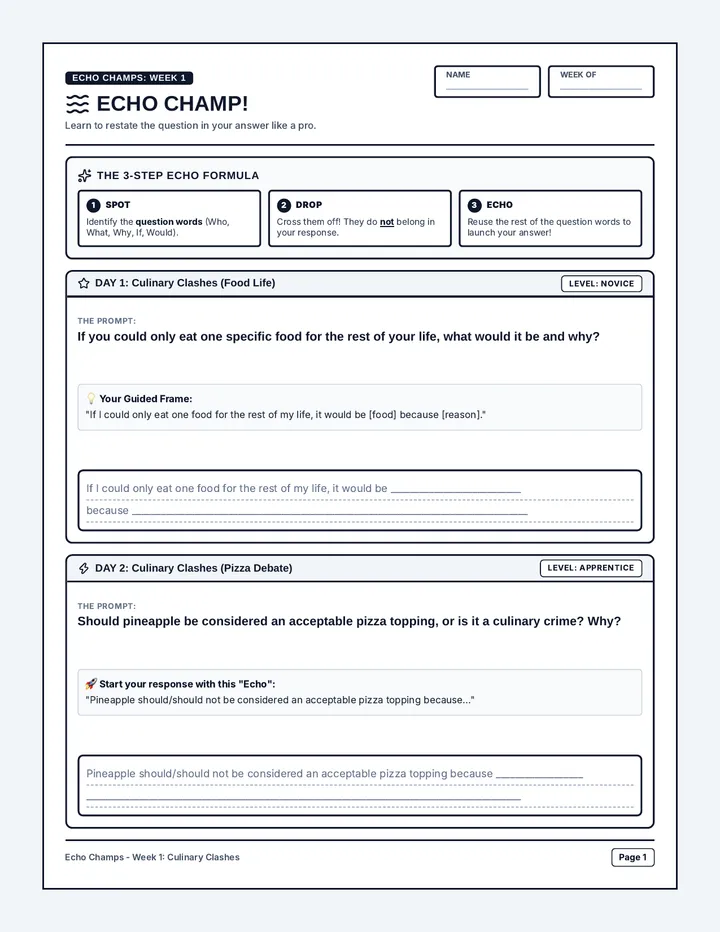
Echo Champ Tracker Phase 1

Echo Champs Unit

A comprehensive twelve-week scaffolded daily bell ringer sequence designed to help students master restating the question, featuring an initial six-week core sequence and a dedicated six-week Tier 2 intervention for students requiring additional practice.

CP

Camryn Pope

12
Echo Champ Tracker Phase 4

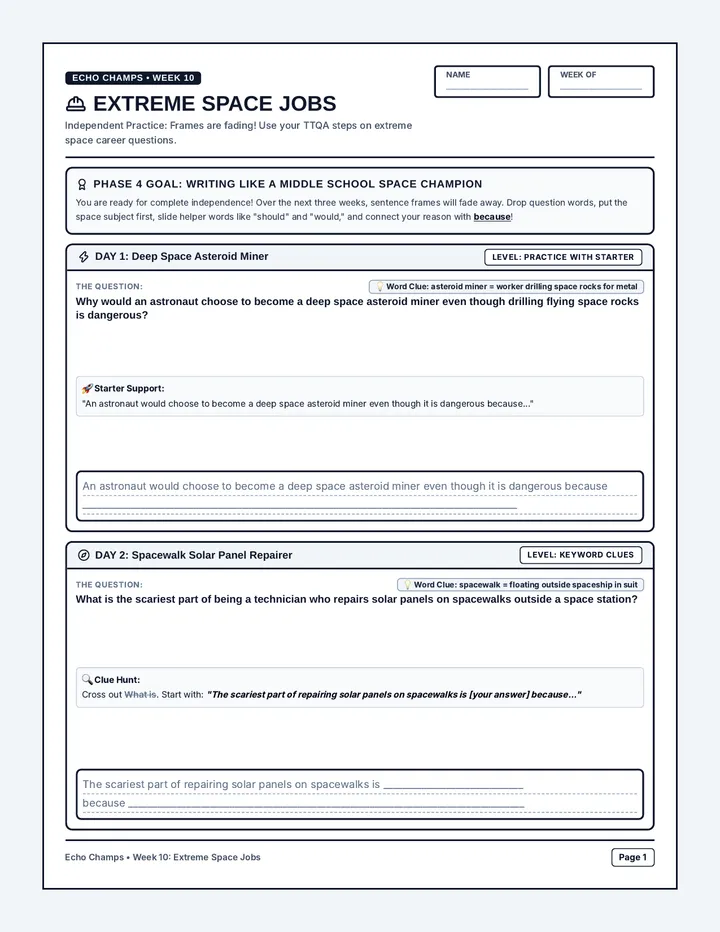
Echo Champs Phase 4

Weeks 10 to 12 of the Echo Champs sequence, completing the Tier 2 intervention with progressive scaffold fading, compound sentence challenges, and a final exit exam.

CP

Camryn Pope

3
Skills Sprint Binder Cover

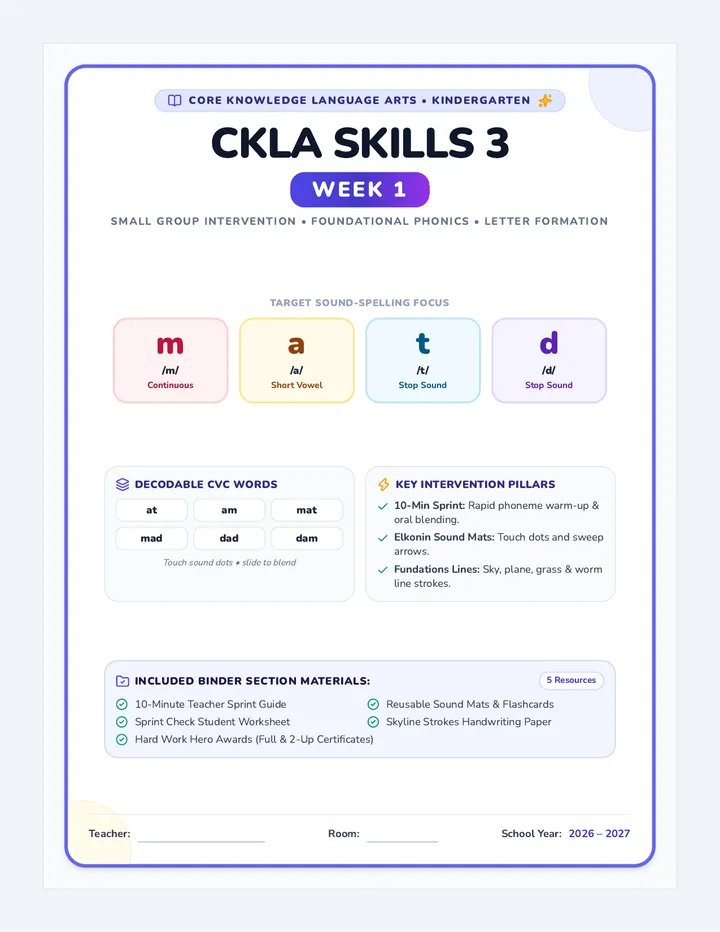
Skills Sprint Binder Cover

A colorful, creative teacher binder cover and unit divider for CKLA Skills 3 Week 1 featuring bold typography, letter-sound spotlights for m, a, t, and d, weekly decodable word banks, and a materials organization checklist.

S

seoleary

Sound Foundations Teacher Guide

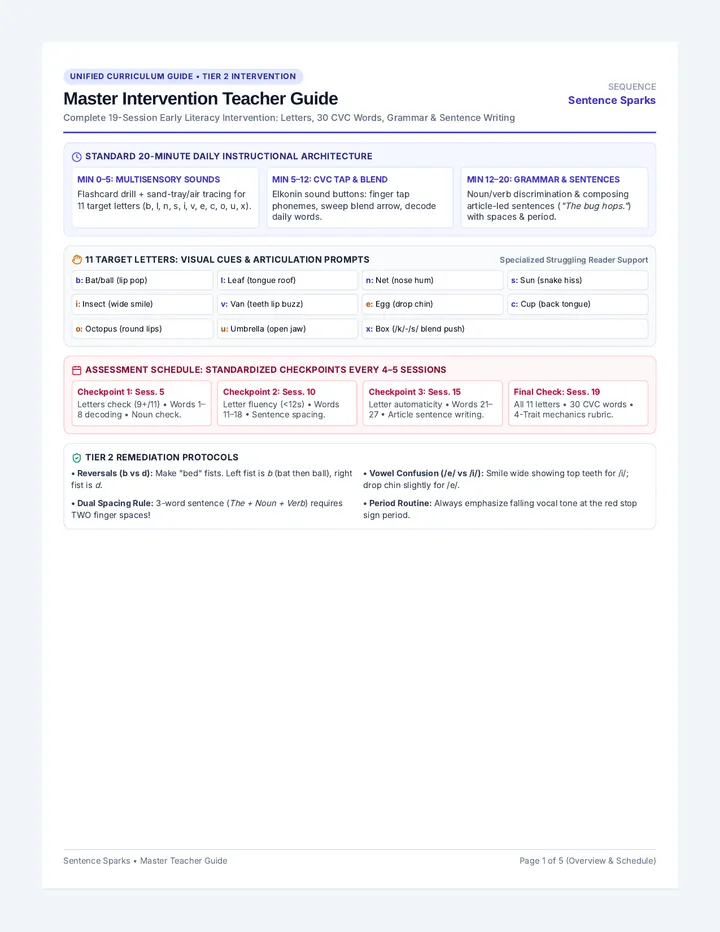
Sentence Sparks

A comprehensive 19-session tier-2 early literacy intervention sequence systematically targeting letter-sound mastery for 11 critical letters, blending 30 CVC words, identifying nouns and verbs, and composing simple sentences with spacing and punctuation.

K

kurtzm

9
Echo Champ Tracker Phase 3

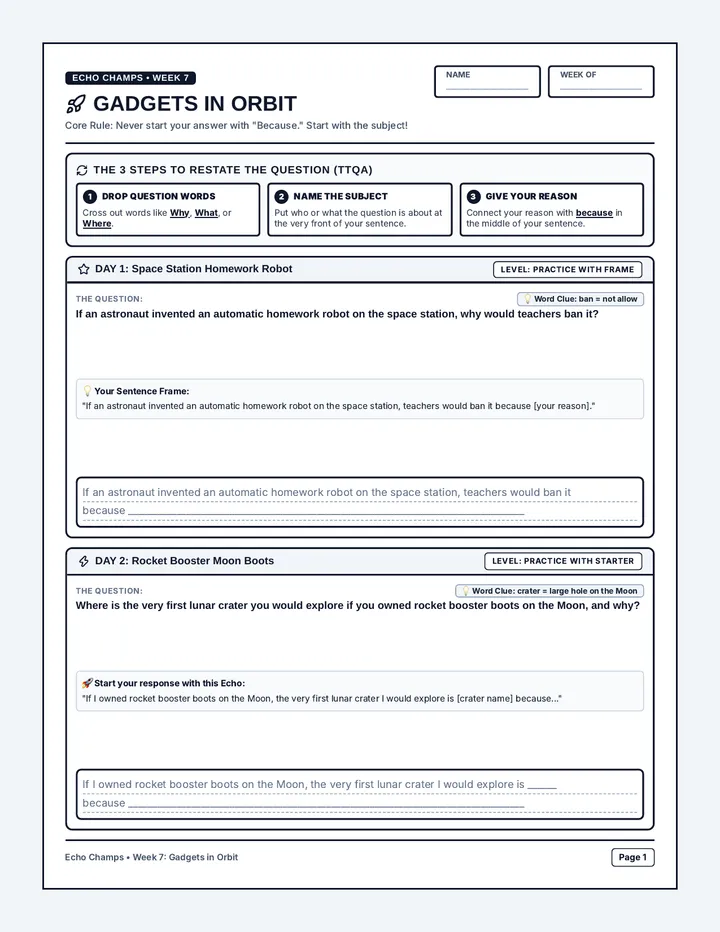
Echo Champs Phase 3

Weeks 7 to 9 of the Echo Champs sequence, providing targeted intervention, re-scaffolded core drills, and error recovery for students who need additional practice mastering TTQA.

CP

Camryn Pope

3
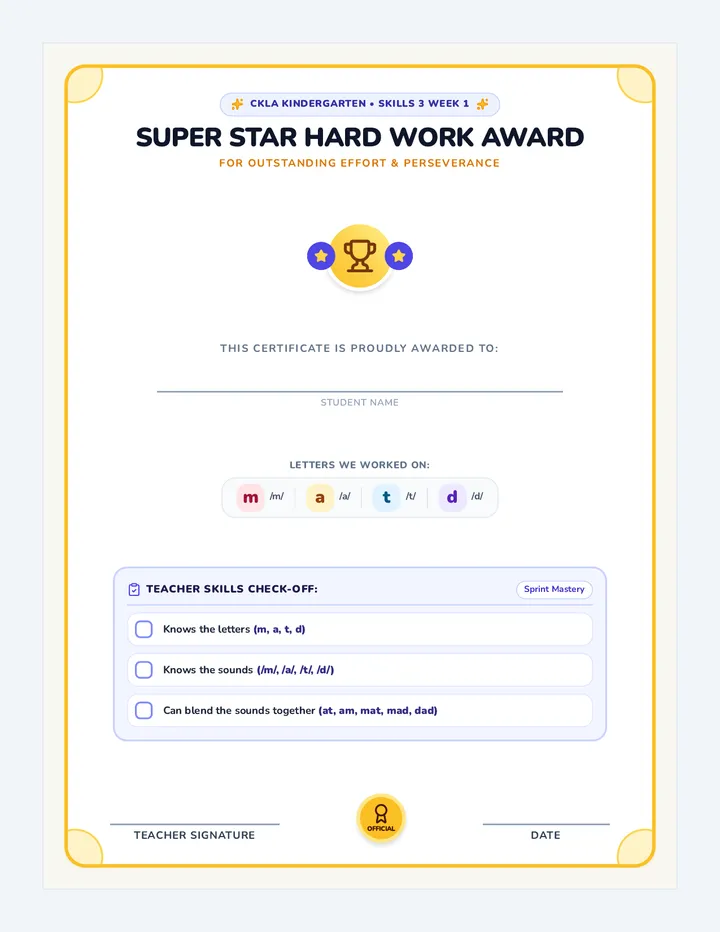
Sound Sprint Hard Work Award

Sound Sprint Hard Work Award

A printable kindergarten student award for CKLA Skills 3 Week 1 celebrating hard work on letters m, a, t, and d, featuring teacher check-off boxes for letter recognition, sound knowledge, and blending, with both full-page and 2-up half-page options.

S

seoleary

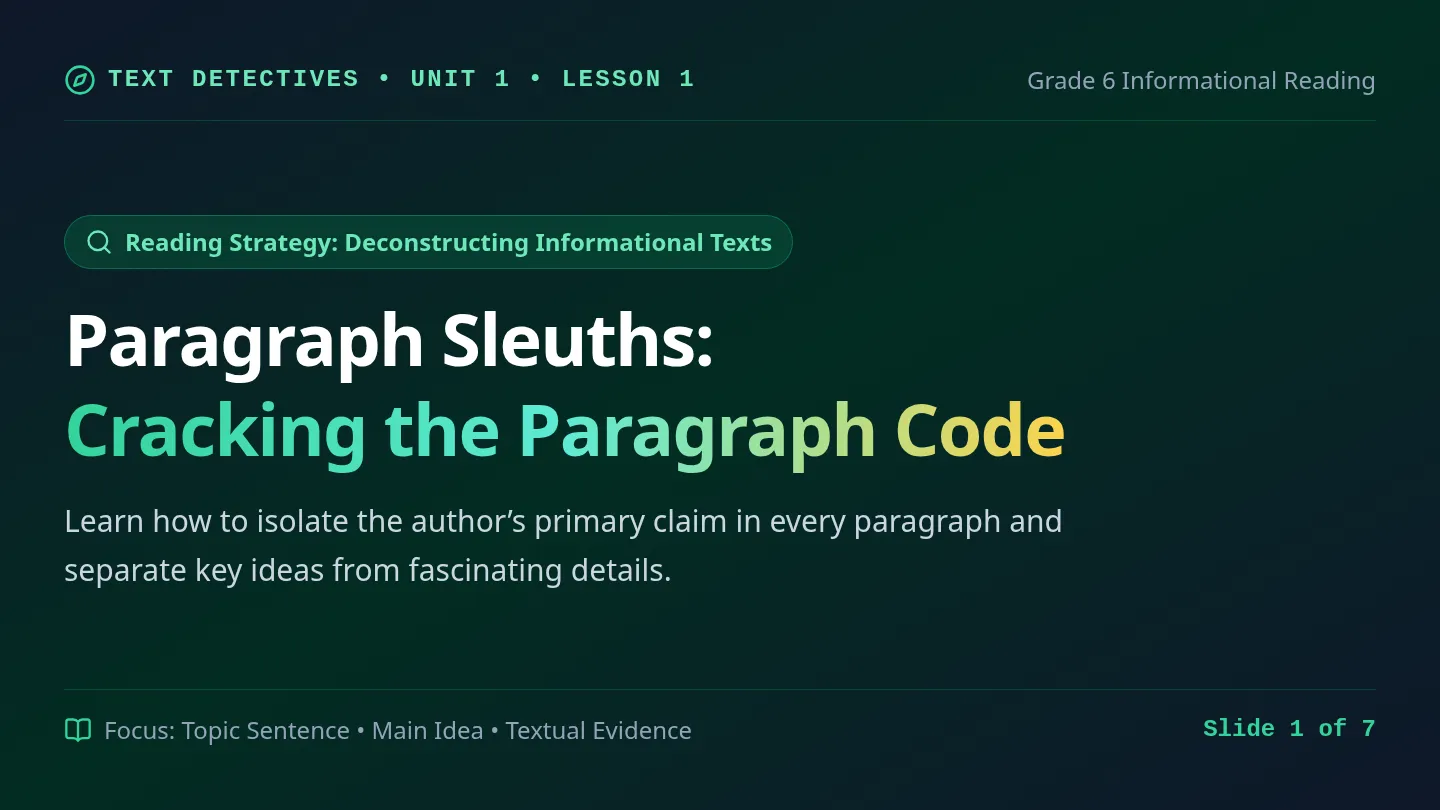
Paragraph Sleuths Slides

Text Detectives

A comprehensive two-part 6th-grade informational reading comprehension unit centered on analyzing multi-paragraph nonfiction texts. Students identify paragraph-level main ideas, evaluate textual supporting evidence, and synthesize overall central ideas.

SS

Shannalee Stephenson

6
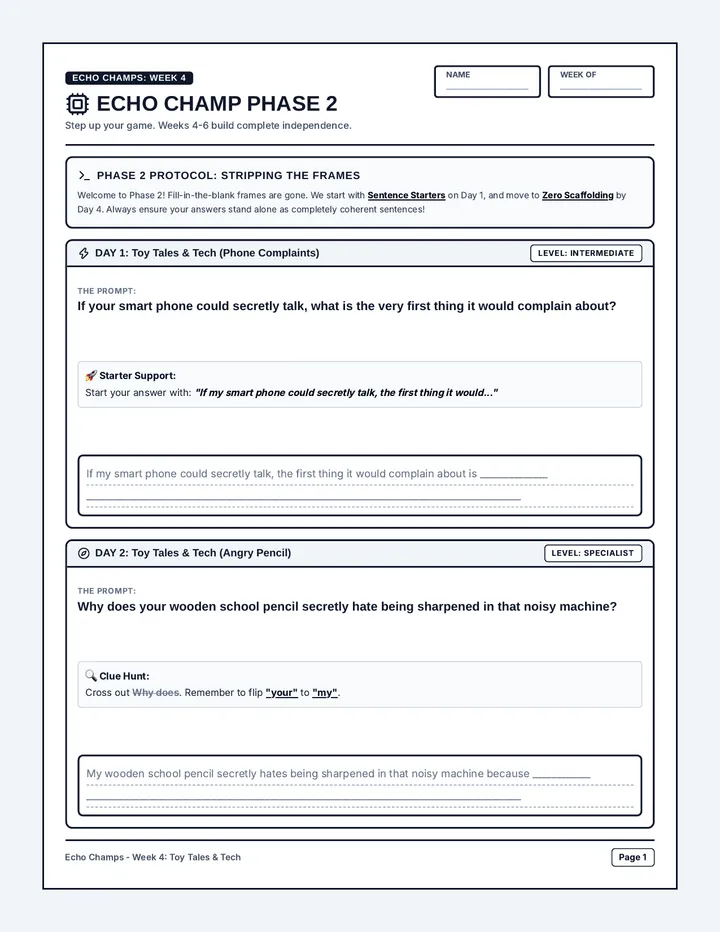
Echo Champ Tracker Phase 2

Echo Champs Phase 2

Weeks 4 to 6 of the Echo Champs daily practice sequence. Pushes students toward full independence with advanced prompt challenges and a diagnostic final exam.

CP

Camryn Pope

3
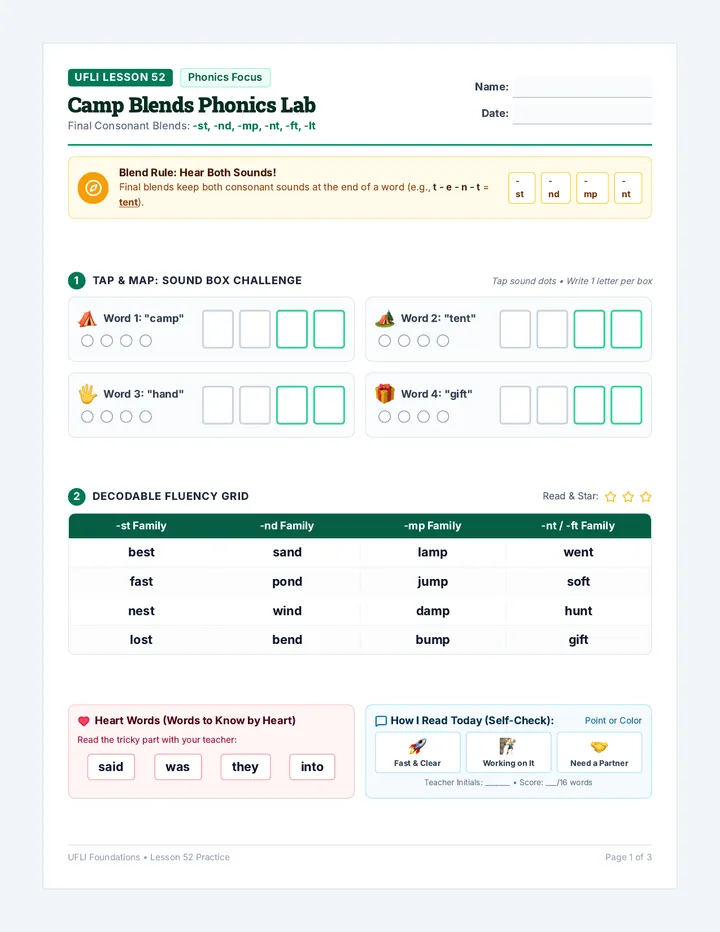
Camp Blends Phonics Worksheets

Camp Blends Phonics Worksheets

Printable phonics practice worksheets aligned with UFLI Lesson 52 focusing on final consonant blends (-st, -nd, -mp, -nt, -ft, -lt). Features orthographic sound mapping, decodable text with fluency tracking, tiered differentiated pathways, and multi-modal communication supports.

ML

Michelle Low

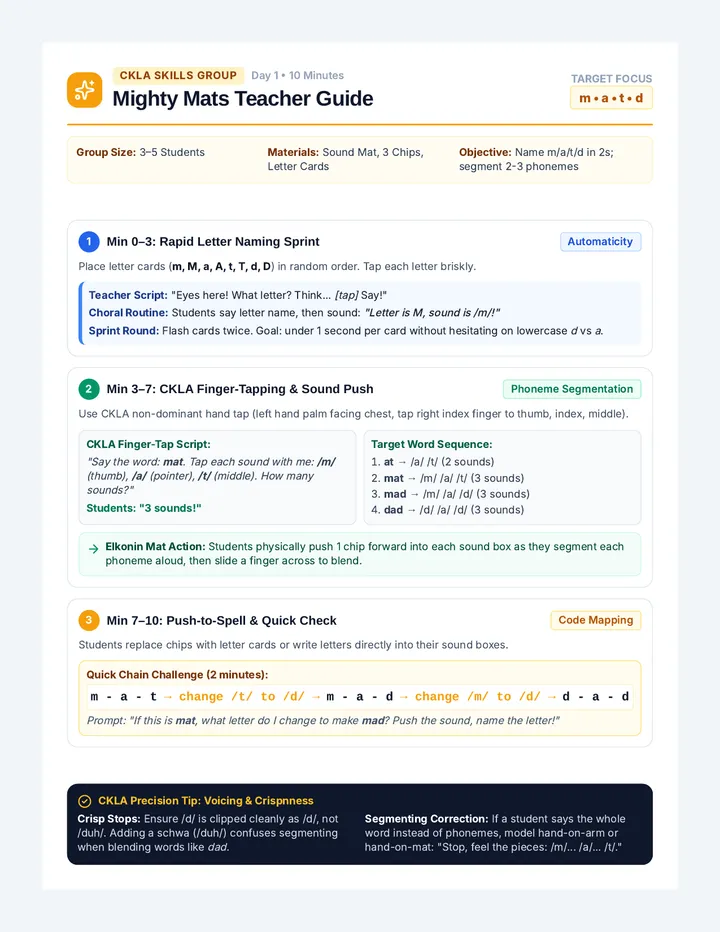
Mighty Mats Teacher Guide

Sound Sparks Kindergarten

A five-day targeted Kindergarten small-group intervention sequence aligned with CKLA Skills. Each 10-minute daily session sharpens rapid letter naming and phoneme segmentation through explicit finger-tapping, Elkonin sound boxes, and word chaining.

S

seoleary

10
Echo Champ Tracker Phase 1

Echo Champs Phase 1

Weeks 1 to 3 of the Echo Champs daily practice sequence. Includes scaffolded trackers and comprehensive answer keys for foundational skill building.

CP

Camryn Pope

3
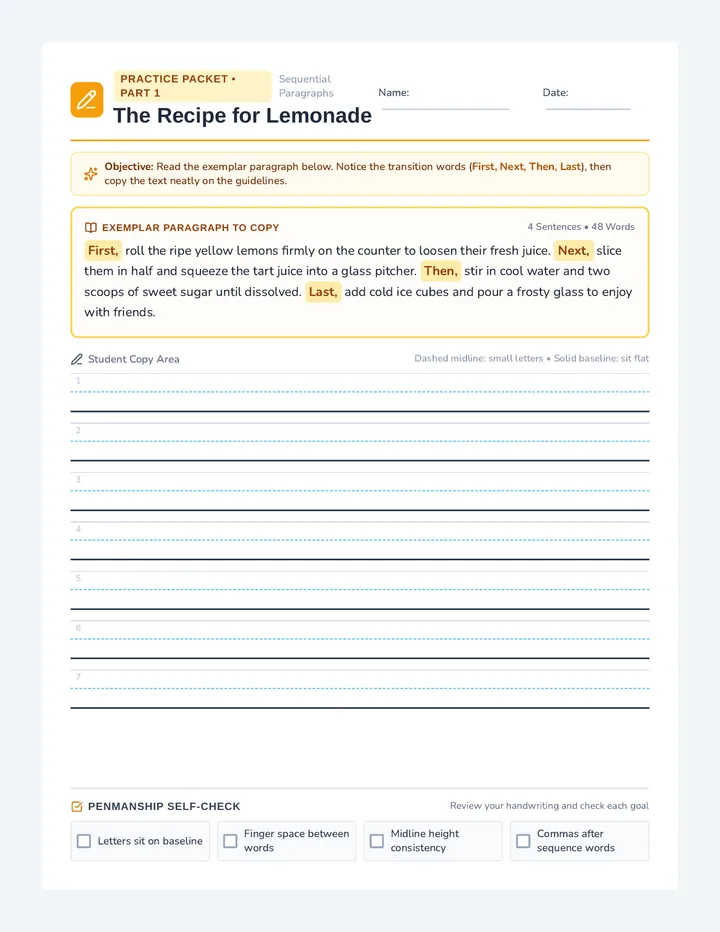
Story Steps Handwriting Packet

Story Steps Handwriting Packet

A four-page printable handwriting practice packet featuring sequential paragraphs structured around transition words (first, next, then, last). Includes model exemplar texts, clear 3-line primary ruling with dashed midlines, blank student copy areas, and penmanship self-assessment checklists.

M

MlBeaumier