Lenny.com
Explore
Create
ActivitiesNewMathEnglish Language ArtsScience & EngineeringSocial StudiesGlobal LanguagesHealth & Physical EducationSpecial EducationCounseling & Life SkillsArts & CreativityESL
Lenny.com
Lenny.com
Explore
Create
ActivitiesNewMathEnglish Language ArtsScience & EngineeringSocial StudiesGlobal LanguagesHealth & Physical EducationSpecial EducationCounseling & Life SkillsArts & CreativityESL
Lenny.com
Lenny.com

Solutions

Lenny for EducatorsLenny for SchoolsLenny for Districts

Product

ExploreSign inCreateSupportAbout

Resources

Getting startedMTSS Acceleration Program

© 2026 Lenny Learning Inc.

TermsPrivacyAccessibility
LinkedInInstagramX
Lenny
English Language ArtsPhonics & Reading FoundationsLetter IdentificationLearn Letters A-ZLowercase and Uppercase LettersConsonants and VowelsLetter-Sound AssociationsLetter-Sound Associations: LowercaseLetter-Sound Associations: UppercaseBeginning and Ending SoundsRhymingBlending And SegmentingShort VowelsShort Vowel SoundsConsonant BlendsConsonant DigraphsBlends, Digraphs, and TrigraphsDigraphs, Blends, and Silent LettersLong Vowel SoundsLong Vowel PatternsShort and Long VowelsShort and Long Vowel PatternsSilent EVowel SoundsVowel TeamsR-Controlled VowelsDiphthongs: Oi, Oy, Ou, OwVariant VowelsVariant, Diphthong, And R Vowel PatternsSoft G And CSight WordsIrregular WordsWord RecognitionSyllablesSyllable TypesTwo-Syllable WordsMultisyllabic WordsPhoneme ManipulationDecodable TextsVocabularyAction WordsQuestion WordsNouns and AdjectivesClassify WordsCompound WordsSynonyms and AntonymsHomophonesHomophones and HomonymsShades of MeaningContext CluesPrefixes and SuffixesGreek and Latin RootsAnalogiesIdioms and AdagesForeign Words and ExpressionsWord Choice and UsageReference SkillsReading ComprehensionRead-Along Literary TextsRead-Along Informational TextsReality vs. FictionStory ElementsCharacterSequenceMain IdeaCause And EffectCompare And ContrastReading StrategiesText StructureAuthor's PurposeAuthor's Purpose And ToneAuthor's PerspectivePoint Of ViewThemeInference And ThemeInference And AnalysisPoetry ElementsLiterary DevicesAnalyzing LiteratureAnalyzing Informational TextsComparing TextsAudience, Purpose, And ToneBusiness DocumentsNovel StudyNonfiction Book StudyGrammar & MechanicsSentencesNounsVerbsAdjectivesPronounsCapitalizationPunctuationContractionsConjunctionsPrepositionsArticlesAdjectives And AdverbsVerb TypesVerb TensePronouns And AntecedentsPronoun TypesSubject-Verb AgreementDirect And Indirect ObjectsSentences, Fragments, And Run-OnsPhrases And ClausesCommasSemicolons, Colons, And CommasDashes, Hyphens, And EllipsesSpellingAbbreviationsFormattingVerb Tense And MoodMisplaced ModifiersWritingDescriptive DetailsCreative WritingOpinion WritingTopic SentencesOrganizing WritingLinking WordsSentence VarietyIntroductions And ConclusionsPersuasive And Opinion WritingExpository WritingPersuasive StrategiesDeveloping And Supporting ArgumentsTopic Sentences And Thesis StatementsSummarizingResearch SkillsEditing And RevisingActive And Passive Voice=Writing Clearly And ConciselyDebate & Public SpeakingPublic Speaking BasicsPersuasive TechniquesClaims and EvidenceTypes of ArgumentsReasoning TypesLogical FallaciesTopic ResearchOrganizing EvidenceDebate Speech OrganizationAttacking and Defending ArgumentsClash and EngagementImpact CalculusQuestioning and Cross-ExaminationCritical ThinkingInformal LogicFormal LogicInductive Reasoning

Linguistic Lab Vocabulary Review

A comprehensive review of NC Standard RI 8.4, focusing on context clues, connotation, tone, and vocabulary types to prepare students for the 8th grade EOG.

MJMichelle Jefferson

Linguistic Lab Vocabulary Review

A comprehensive review of NC Standard RI 8.4, focusing on context clues, connotation, tone, and vocabulary types to prepare students for the 8th grade EOG.

MJMichelle Jefferson
  • What is the tone of this passage regarding the future of solar energy?
  • Dismissive and critical

    Cautiously optimistic

    Alarmed and worried

    Humorous and lighthearted

    Passage 2: Echoes of the Ice

    In 1845, Sir John Franklin led an intrepid crew into the Arctic Archipelago. They sought the elusive Northwest Passage, a maritime route connecting the Atlantic and Pacific. However, the expedition became a tragedy when their ships, the Erebus and Terror, were ensnared by unyielding pack ice. The desolate landscape offered no succor; the crew was eventually forced to abandon their vessels. Modern archeology has revealed that lead poisoning and scurvy likely exacerbated their struggle, turning a bold mission into a grim cautionary tale.

    1. What is the meaning of intrepid as used in Passage 2?

    Fearless and adventurous

    Wealthy and powerful

    Foolish and reckless

    Well-organized and efficient

    1. The word ensnared contributes to a tone of:

    Freedom and exploration

    Entrapment and helplessness

    Excitement and mystery

    Unity and teamwork

    1. In the phrase "The desolate landscape offered no succor," what does succor mean?

    Information or maps

    Resistance or obstacles

    Assistance or relief

    Vegetation or wildlife

    1. Which word in the passage is an example of an academic (Tier 2) word often used to describe making a bad situation worse?

    Tragedy

    Desolate

    Cautionary

    Exacerbated

    1. The author describes the landscape as desolate. What is the connotation of this word choice compared to simply saying "empty"?

    It implies a peaceful and quiet setting.

    It suggests a harsh, lonely, and hopeless environment.

    It indicates the land is ready for farming.

    It suggests the area is filled with hidden treasures.

    1. Which of the following is a technical term specifically related to a medical condition mentioned in the passage?

    Scurvy

    Exacerbated

    Tragedy

    Archipelago

    1. How does the phrase "grim cautionary tale" affect the passage's conclusion?

    It creates a sense of wonder about history.

    It highlights the lessons to be learned from failure.

    It makes the passage feel like a fictional fairy tale.

    It encourages readers to become explorers themselves.

    Passage 3: The Robotic Surgeon

    Medicine has entered a paradigm shift with the introduction of robotic-assisted surgery. These systems act as a bridge between human expertise and mechanical precision. During a procedure, the surgeon controls robotic arms that offer haptic feedback, allowing them to "feel" the resistance of tissues through the controls. This minimally invasive approach results in negligible scarring and expedited recovery times. While some fear that robots will displace human doctors, proponents argue that they are simply augmenting human capability, much like a telescope amplifies the vision of an astronomer.

    1. What does the word paradigm mean in the phrase "paradigm shift"?

    A fundamental model or way of looking at something

    A small, unimportant change

    A physical tool used in a laboratory

    The time it takes to complete a task

    1. Based on the context, what is haptic feedback?

    Visual information on a screen

    A sound that warns of danger

    Physical touch or resistance felt through controls

    Instructions provided by a remote doctor

    1. The word negligible most likely means:

    Severe and painful

    So small or unimportant it can be ignored

    Dangerous and unpredictable

    Highly visible and obvious

    1. Which word from the passage has the same meaning as increasing or improving?

    Displace

    Augmenting

    Precision

    Invasive

    1. How does the analogy of the astronomer's telescope impact the author's message?

    It suggests that surgeons will eventually work in outer space.

    It reinforces the idea that robots are tools that enhance, rather than replace, human skills.

    It implies that robotic surgery is too complex for most people to understand.

    It shows that medical technology has not improved much over time.

    1. Which word from the passage is an academic (Tier 2) word meaning "to move out of the proper or usual place"?

    Expedited

    Amplifies

    Displace

    Precision

    Linguistic Lab Mastery Check • 100% RI 8.4 Standard Alignment
    You might also like

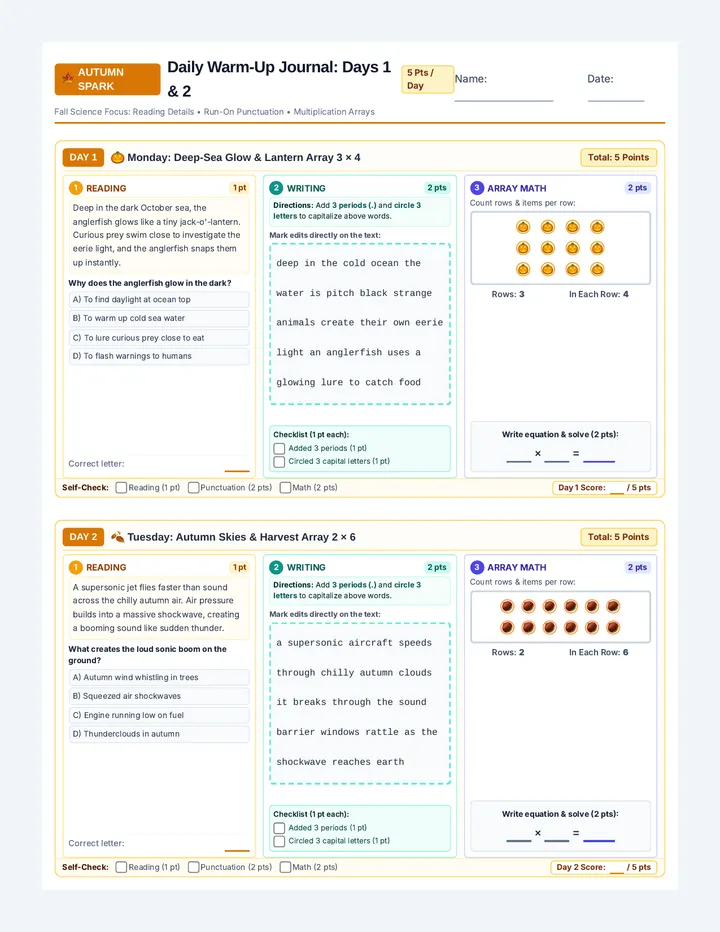
    Autumn Warmup Packet

    Daily Spark Warmups

    A five-day daily warm-up sequence for 8th grade intervention classrooms featuring reading comprehension, sentence mechanics, and multiplication array modeling across three compact print pages.

    KS

    Kathleen Suther

    3
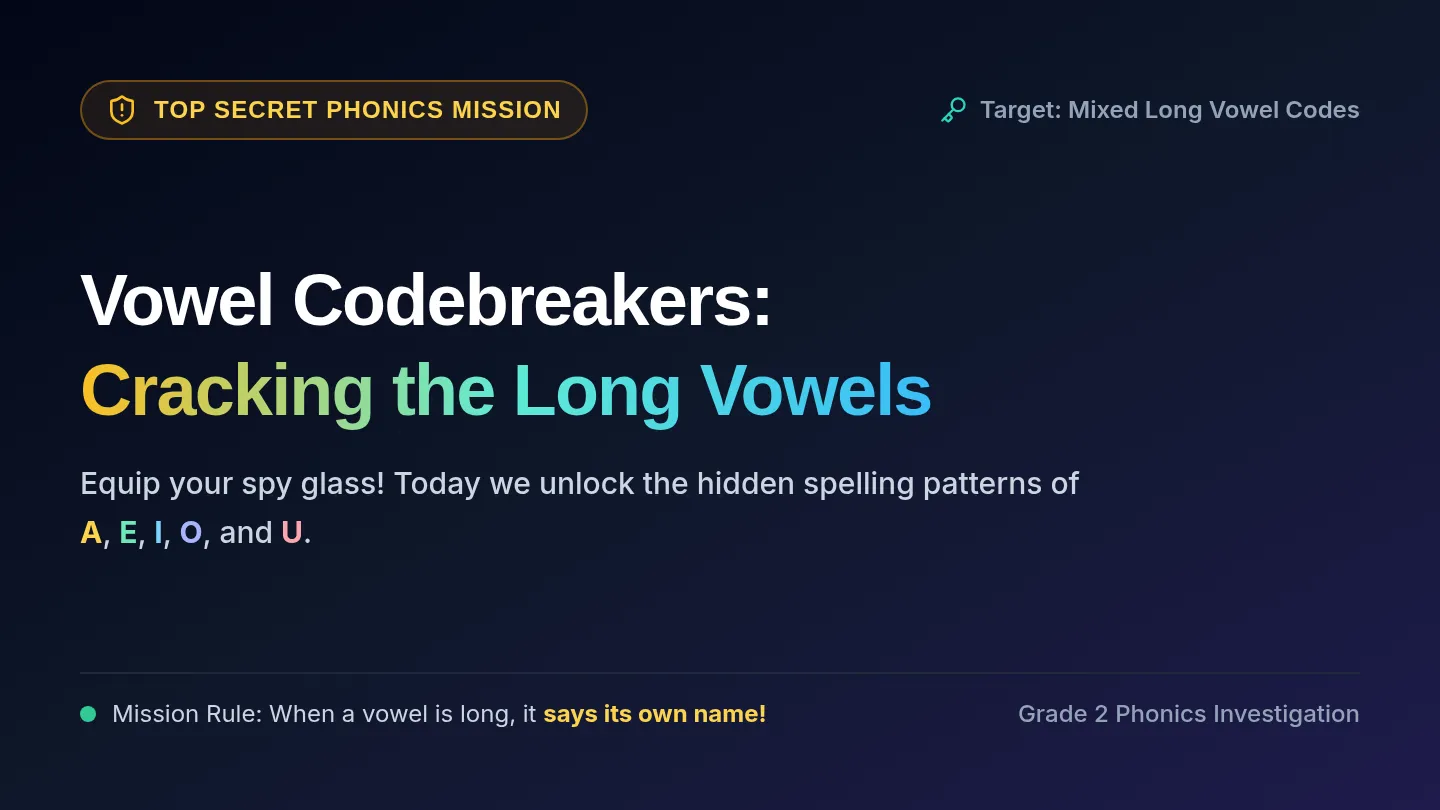
    Vowel Codebreakers Slides

    Vowel Codebreakers

    A comprehensive phonics lesson exploring mixed long vowel spelling patterns across A, E, I, O, and U. Students decode, sort, and apply spelling generalizations through detective-themed missions, visual modeling, and hands-on practice.

    MB

    Melissa Basilone

    4
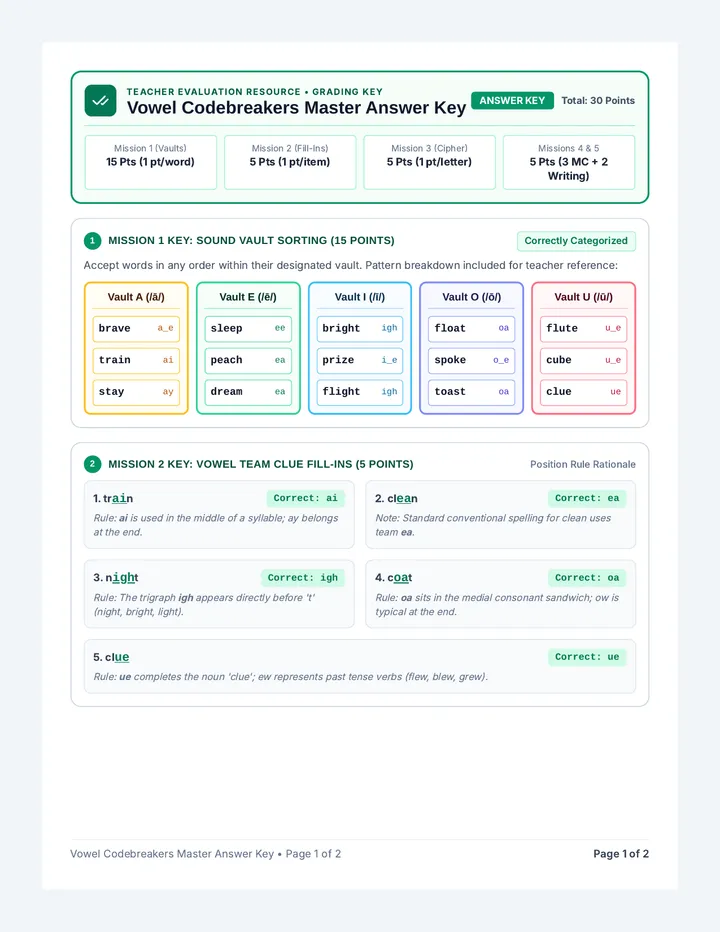
    Vowel Codebreakers Answer Key

    Vowel Codebreakers Answer Key

    A complete 2-page teacher answer key for the Vowel Codebreaker Worksheet. Features filled solutions, phonetic pattern explanations, common distractor analyses, exemplar student sentences, and a quick-score grading rubric.

    MB

    Melissa Basilone

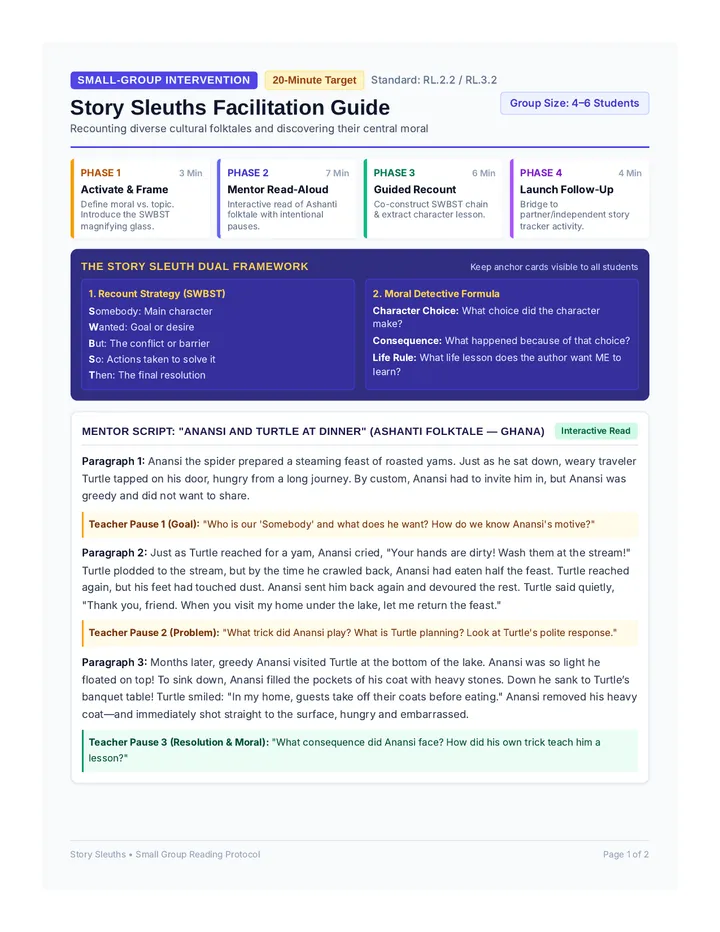
    Story Sleuths Facilitation Guide

    Story Explorers

    An interactive, high-impact reading comprehension unit targeting core foundational literature standards. Students master recounting diverse folktales, extracting central morals, and analyzing how characters respond to major events and challenges.

    S

    Squiretak

    8
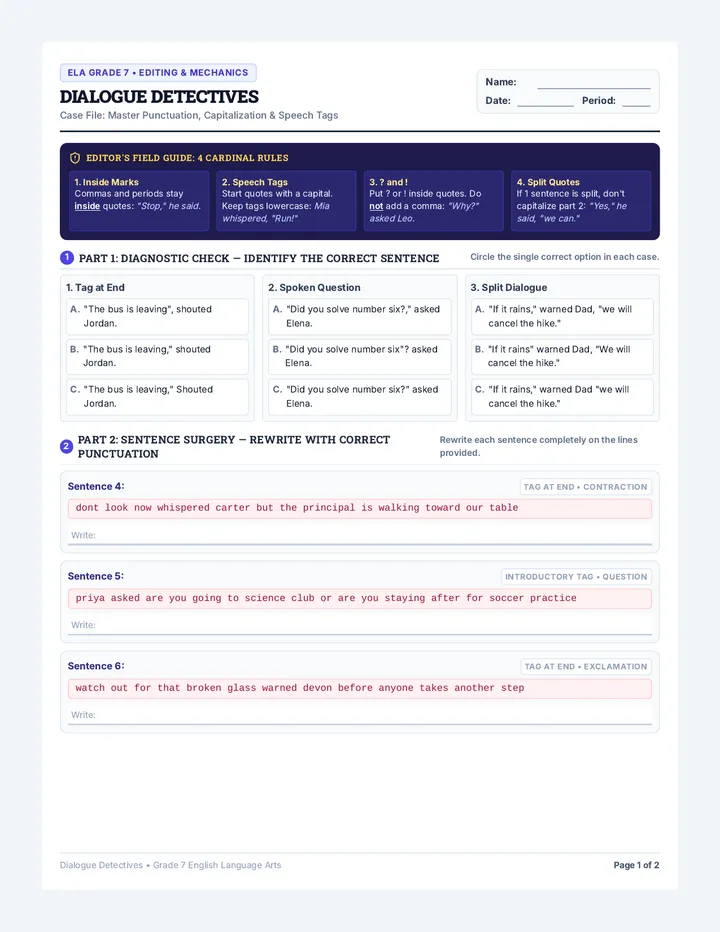
    Dialogue Detectives Worksheet

    Dialogue Detectives

    A comprehensive 7th-grade ELA lesson focused on mastering dialogue punctuation, capitalization, interrupted speech, and speaker paragraphing through targeted editing tasks and manuscript rewriting.

    RR

    R. rarrigoni

    2
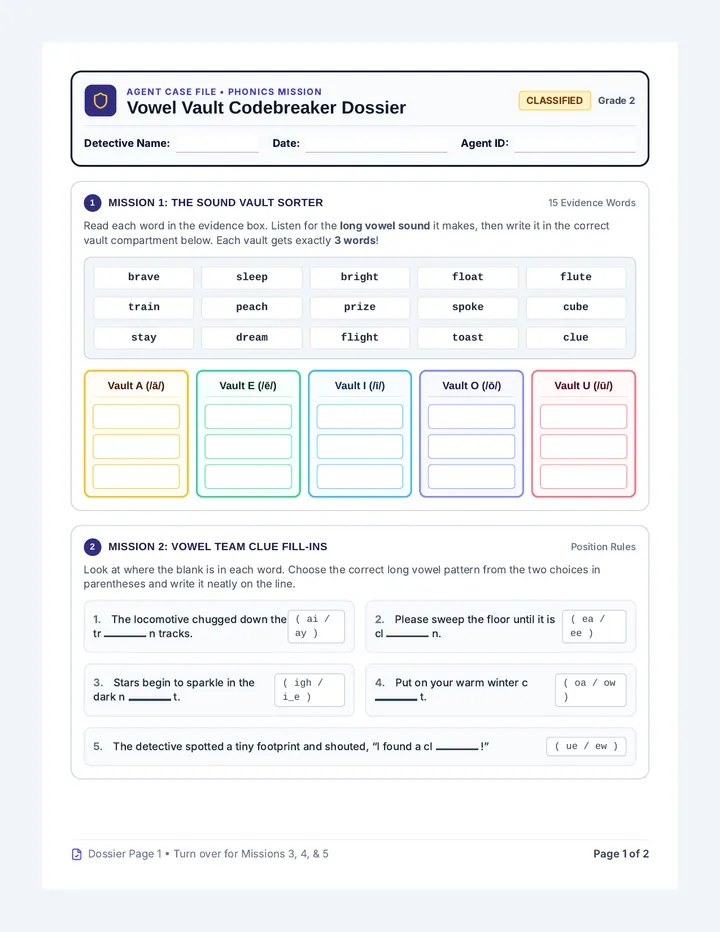
    Vowel Codebreaker Worksheet

    Vowel Codebreaker Worksheet

    A 2-page student practice worksheet featuring 5 detective-themed missions: sound vault sorting, vowel team fill-ins, a secret cipher riddle decoder, sentence proofing, and field report sentence writing.

    MB

    Melissa Basilone

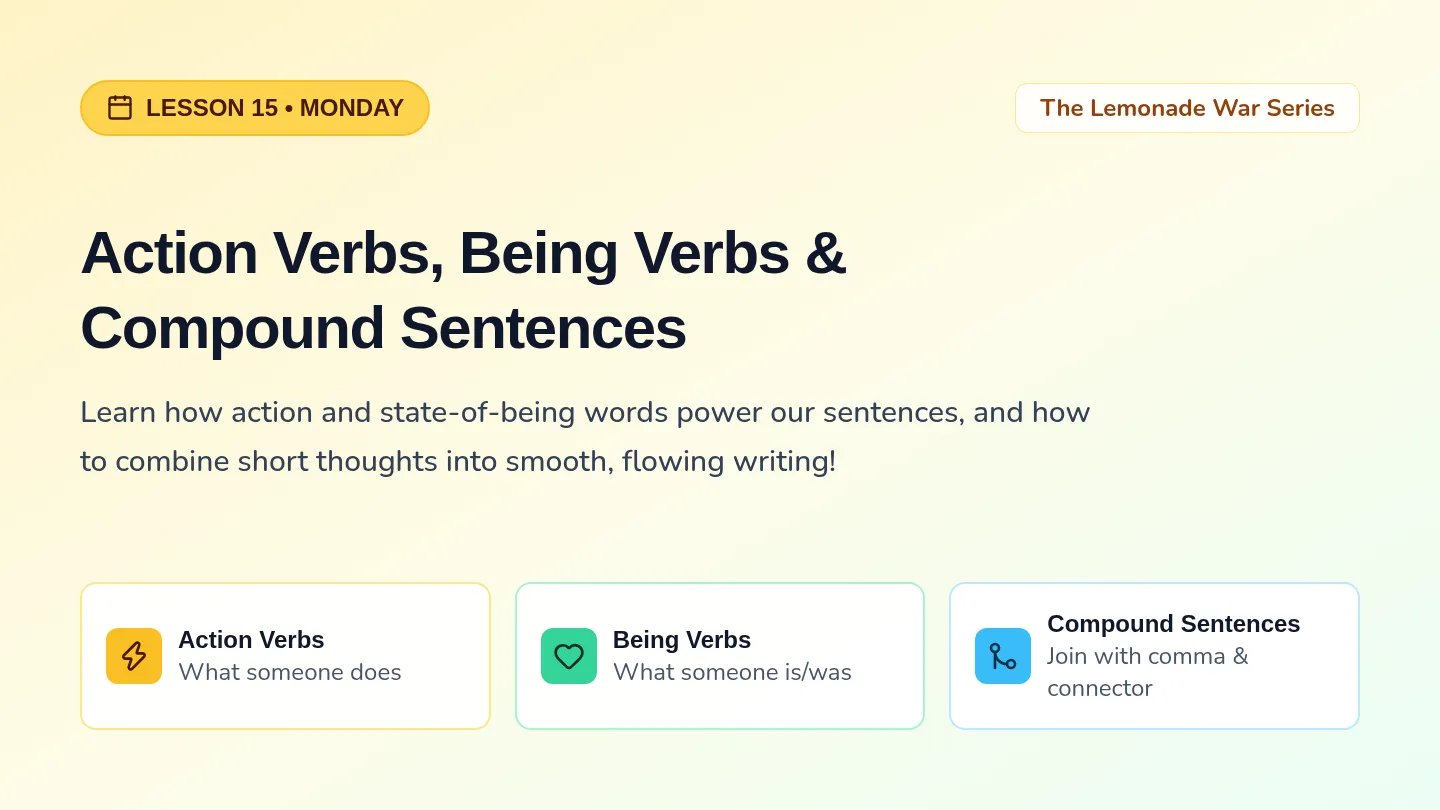
    Lemonade Verbs Slides

    Reading Writing Workshop

    An engaging elementary English Language Arts unit connecting grammar mechanics, mentor texts, vocabulary, and sensory descriptive writing.

    B

    Bhoovaragavaswamym

    8
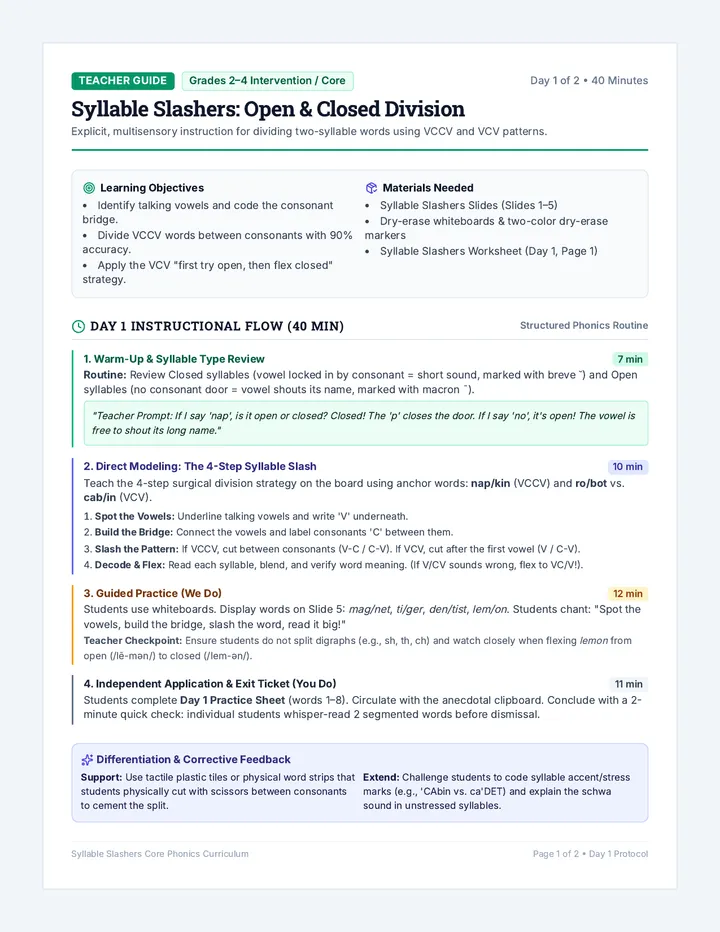
    Syllable Slashers Lesson Plan

    Syllable Slashers

    A comprehensive two-day explicit phonics lesson focused on dividing and decoding two-syllable words featuring open, closed, and magic e syllables. Students learn and apply systematic syllable division routines (VCCV, VCV, and V-Ce) through multisensory coding, oral blending, decodable text practice, and diagnostic progress monitoring.

    S

    sandra.nii

    5
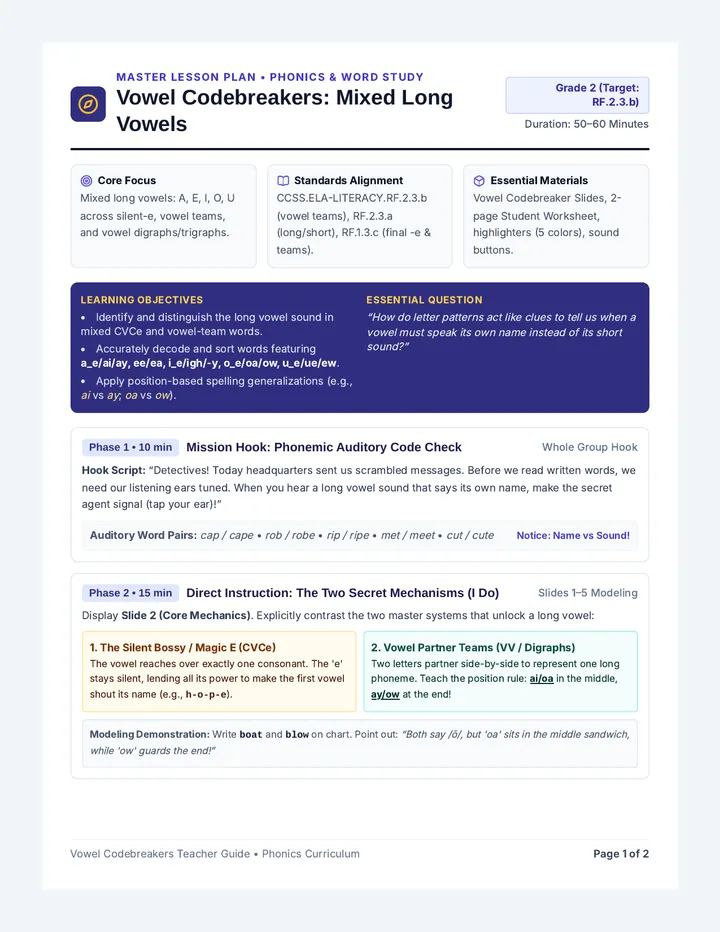
    Vowel Codebreakers Teacher Guide

    Vowel Codebreakers Teacher Guide

    A detailed 2-page teacher guide and instructional lesson plan for teaching mixed long vowel patterns (A, E, I, O, U). Includes CCSS standards, pacing, direct instruction script, guided practice strategies, misconception alerts, and differentiation paths.

    MB

    Melissa Basilone

    Paw Print Teacher Guide

    Vowel Team Aw Pathways

    A comprehensive structured literacy sequence targeting the vowel team 'aw', offering dual instructional pathways using both the Classic Orton-Gillingham 7-step routine and the 10-part Wilson Reading System (WRS) framework.

    KW

    Kellie Walsh

    10
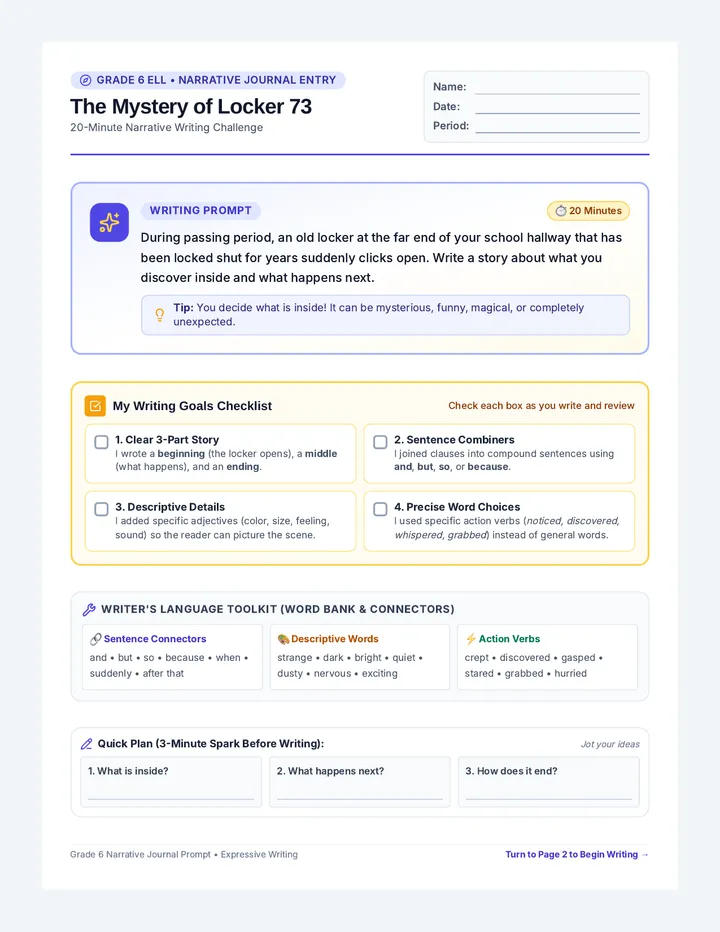
    Mystery Locker Journal Prompt

    Mystery Locker Writing

    A narrative writing lesson for sixth-grade English Language Learners centered around an open-ended mystery locker prompt, featuring scaffolding tools and annotated student writing exemplars.

    SM

    Shalini Mitchell

    2
    Vowel Codebreakers Slides

    Vowel Codebreakers Slides

    A 7-slide visual presentation introducing mixed long vowel spelling patterns for A, E, I, O, and U. Features codebreaker detective themes, clear phonics generalizations, color-coded sound patterns, and guided whole-class decoding missions.

    MB

    Melissa Basilone