Lenny.com
Explore
Create
ActivitiesNewMathEnglish Language ArtsScience & EngineeringSocial StudiesGlobal LanguagesHealth & Physical EducationSpecial EducationCounseling & Life SkillsArts & CreativityESL
Lenny.com
Lenny.com
Explore
Create
ActivitiesNewMathEnglish Language ArtsScience & EngineeringSocial StudiesGlobal LanguagesHealth & Physical EducationSpecial EducationCounseling & Life SkillsArts & CreativityESL
Lenny.com
Lenny.com

Solutions

Lenny for EducatorsLenny for SchoolsLenny for Districts

Product

ExploreSign inCreateSupportAbout

Resources

Getting startedMTSS Acceleration Program

© 2026 Lenny Learning Inc.

TermsPrivacyAccessibility
LinkedInInstagramX
Lenny
English Language ArtsPhonics & Reading FoundationsLetter IdentificationLearn Letters A-ZLowercase and Uppercase LettersConsonants and VowelsLetter-Sound AssociationsLetter-Sound Associations: LowercaseLetter-Sound Associations: UppercaseBeginning and Ending SoundsRhymingBlending And SegmentingShort VowelsShort Vowel SoundsConsonant BlendsConsonant DigraphsBlends, Digraphs, and TrigraphsDigraphs, Blends, and Silent LettersLong Vowel SoundsLong Vowel PatternsShort and Long VowelsShort and Long Vowel PatternsSilent EVowel SoundsVowel TeamsR-Controlled VowelsDiphthongs: Oi, Oy, Ou, OwVariant VowelsVariant, Diphthong, And R Vowel PatternsSoft G And CSight WordsIrregular WordsWord RecognitionSyllablesSyllable TypesTwo-Syllable WordsMultisyllabic WordsPhoneme ManipulationDecodable TextsVocabularyAction WordsQuestion WordsNouns and AdjectivesClassify WordsCompound WordsSynonyms and AntonymsHomophonesHomophones and HomonymsShades of MeaningContext CluesPrefixes and SuffixesGreek and Latin RootsAnalogiesIdioms and AdagesForeign Words and ExpressionsWord Choice and UsageReference SkillsReading ComprehensionRead-Along Literary TextsRead-Along Informational TextsReality vs. FictionStory ElementsCharacterSequenceMain IdeaCause And EffectCompare And ContrastReading StrategiesText StructureAuthor's PurposeAuthor's Purpose And ToneAuthor's PerspectivePoint Of ViewThemeInference And ThemeInference And AnalysisPoetry ElementsLiterary DevicesAnalyzing LiteratureAnalyzing Informational TextsComparing TextsAudience, Purpose, And ToneBusiness DocumentsNovel StudyNonfiction Book StudyGrammar & MechanicsSentencesNounsVerbsAdjectivesPronounsCapitalizationPunctuationContractionsConjunctionsPrepositionsArticlesAdjectives And AdverbsVerb TypesVerb TensePronouns And AntecedentsPronoun TypesSubject-Verb AgreementDirect And Indirect ObjectsSentences, Fragments, And Run-OnsPhrases And ClausesCommasSemicolons, Colons, And CommasDashes, Hyphens, And EllipsesSpellingAbbreviationsFormattingVerb Tense And MoodMisplaced ModifiersWritingDescriptive DetailsCreative WritingOpinion WritingTopic SentencesOrganizing WritingLinking WordsSentence VarietyIntroductions And ConclusionsPersuasive And Opinion WritingExpository WritingPersuasive StrategiesDeveloping And Supporting ArgumentsTopic Sentences And Thesis StatementsSummarizingResearch SkillsEditing And RevisingActive And Passive Voice=Writing Clearly And ConciselyDebate & Public SpeakingPublic Speaking BasicsPersuasive TechniquesClaims and EvidenceTypes of ArgumentsReasoning TypesLogical FallaciesTopic ResearchOrganizing EvidenceDebate Speech OrganizationAttacking and Defending ArgumentsClash and EngagementImpact CalculusQuestioning and Cross-ExaminationCritical ThinkingInformal LogicFormal LogicInductive Reasoning

Proof Patrol

A comprehensive reading comprehension lesson teaching students how to identify essential key details that prove and support the main idea of an informational text, using the detective 'Proof Patrol' framework.

AWAmy Watenpool

Proof Patrol

A comprehensive reading comprehension lesson teaching students how to identify essential key details that prove and support the main idea of an informational text, using the detective 'Proof Patrol' framework.

AWAmy Watenpool

Task A: In your own words, state the MAIN IDEA of this text: (1-2 complete sentences)

Task B: Extract TWO key details from the report that directly prove this main idea:

SUPPORTING PILLAR 1 (Proof for finding food / hunting):

SUPPORTING PILLAR 2 (Proof for defense / protection):

Task C: Distractor Defense: Explain why the camera fact is NOT a supporting detail:

"Oceanographers first photographed bioluminescence using deep submersible cameras in the late 1960s."

Agent Self-Check Checklist:

Identified central claim

Chose facts answering how/why

Rejected irrelevant trivia

Proof Patrol Reading Investigation Unit Page 2 of 2 • Mission Complete

Facilitation Notes

Coaching, Differentiation & Answer Keys

Proof Patrol Reading Lab

Common Student Traps & In-the-Moment Coaching

Trap 1: The 'Cool Fact' Bias

Students choose sentences with exciting vocabulary (e.g., historic fur trading) over relevant evidence.

Coach: "Does this fact prove WHY the author made their claim, or is it just cool trivia?"

Trap 2: Keyword Matching

Students underline any sentence containing the keyword 'beaver' or 'deep sea' regardless of meaning.

Coach: "All sentences mention the animal. Which ones show them reshaping the land?"

Trap 3: Retelling the Plot

Students copy the entire paragraph instead of extracting specific proof phrases.

Coach: "Keep your pillar short: name the feature and the exact result."

Tiered Differentiation Strategies

Scaffolded Support (Striving Readers):

  • Two-Color Highlighting: Green highlighter for proof sentences; orange for interesting extra trivia.
  • Sentence Starters: "This detail supports the main idea because it shows how..."
  • Provide partner reading during Case #2 to read aloud before isolating details.

Extension & Challenge (Advanced Analyzers):

  • Counter-Evidence Challenge: Have students re-write the passage to introduce a contradictory claim and find new pillars.
  • Trap Maker: Have students compose a 3-sentence informational paragraph containing 2 strong pillars and 1 deliberate distractor for a classmate to test.

Worksheet Answer Key & Exemplar Responses

Case #1: Beaver Architects (Page 1)

1. Main Idea: Choice B (Beaver dams reshape forest streams into protective wetlands).

2. Supporting Pillars:

  • Pillar 1: Construct timber/mud dams that slow swift streams into calm, deep ponds.
  • Pillar 2: Ponds create rich wetland habitats for fish, birds, amphibians / filter sediment / store water in droughts.

3. Distractor Justification: The sentence about 1800s fur trappers explains human history, not how beavers ecologically build or reshape ecosystems.

Case #2: Deep Sea Abyss (Page 2)

Task A (Main Idea Exemplar): In the dark midnight ocean, bioluminescence is a crucial physical adaptation that helps deep-sea creatures survive.

Task B (Supporting Pillars):

  • Pillar 1 (Hunting): Anglerfish dangle glowing lures to attract prey in total darkness.
  • Pillar 2 (Defense): Lanternfish camouflage silhouettes / shrimp squirt luminous blinding clouds to escape predators.

Task C (Distractor Justification): Mentioning 1960s camera photos explains human exploration history, not how bioluminescence helps the organism survive.

Proof Patrol Teacher Guide Page 2 of 2 • Complete Instructional Support
You might also like

Paragraph Sleuths Slides

Text Detectives

A comprehensive two-part 6th-grade informational reading comprehension unit centered on analyzing multi-paragraph nonfiction texts. Students identify paragraph-level main ideas, evaluate textual supporting evidence, and synthesize overall central ideas.

SS

Shannalee Stephenson

6
Broadway Beat Worksheet

Broadway Beat Maker

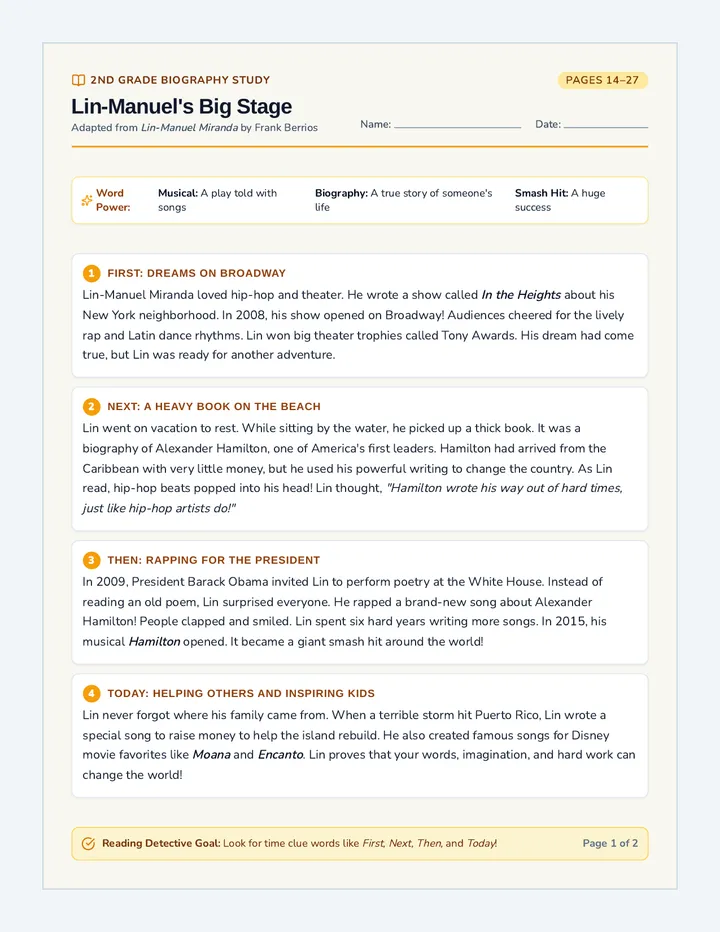
A 2nd-grade English Language Arts lesson exploring Lin-Manuel Miranda's journey creating hit Broadway musicals from Frank Berrios's biography. Students analyze chronological text organization, identify the central main idea, practice close-reading comprehension, and draw inferences about creativity and perseverance.

A

awarner1

3
Sentence Architect Slides

Sentence Architect Slides

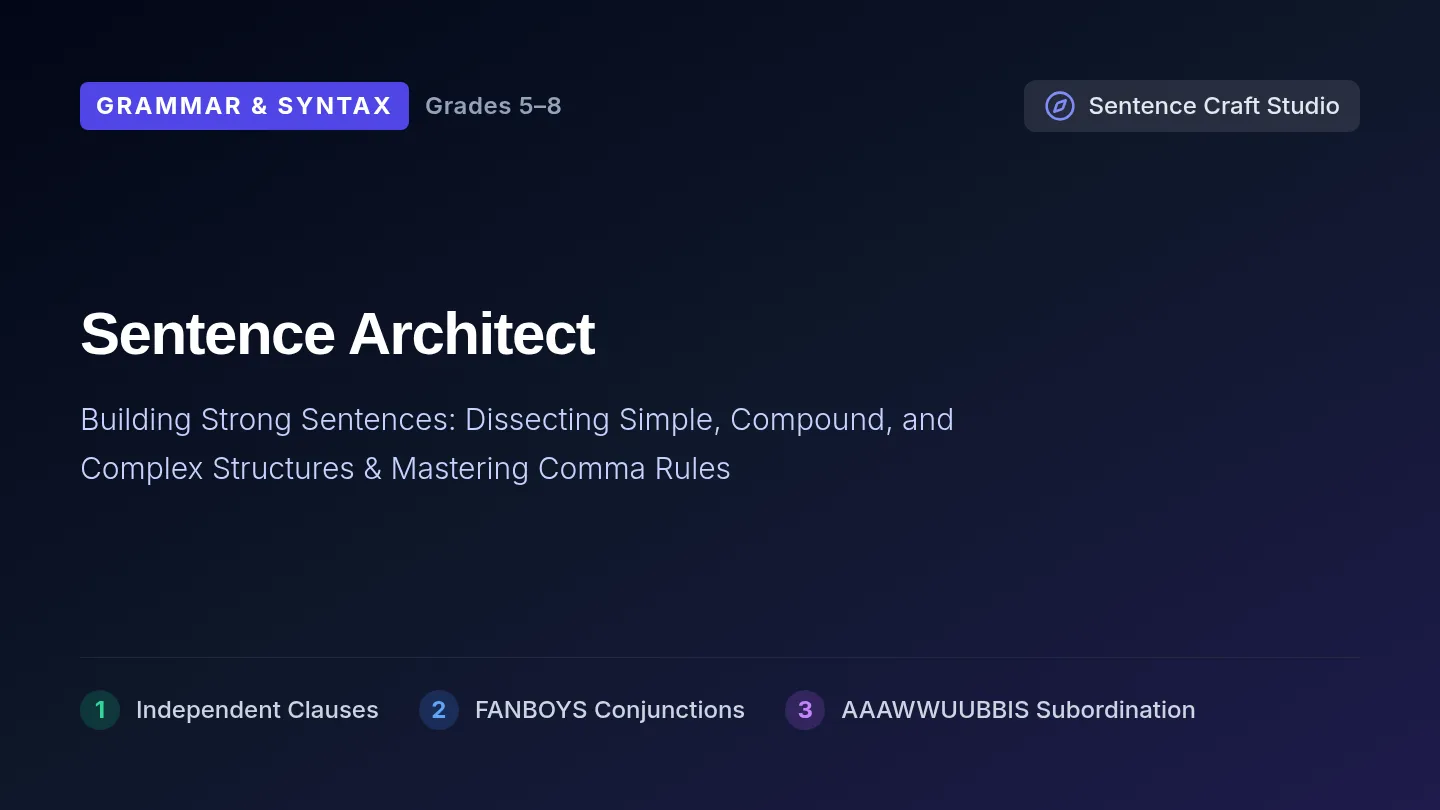
A high-impact 7-slide presentation deck guiding students through clauses, simple, compound, and complex sentence structures, and the critical comma punctuation rules with interactive turn-and-talk challenges.

Lenny Avatar
Lenny
Mighty Mats Teacher Guide

Sound Sparks Kindergarten

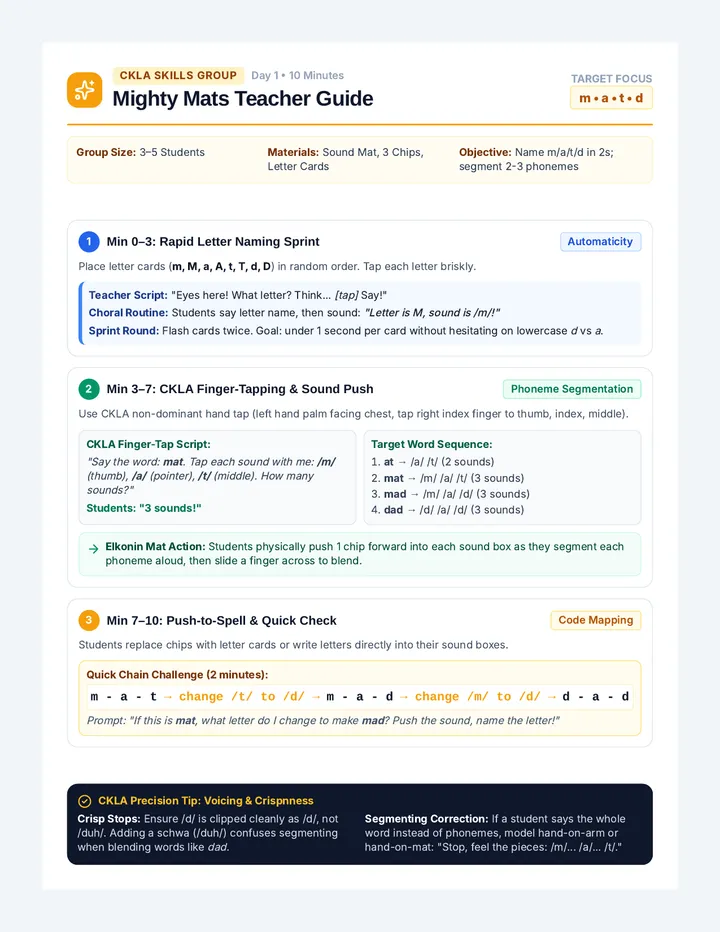
A five-day targeted Kindergarten small-group intervention sequence aligned with CKLA Skills. Each 10-minute daily session sharpens rapid letter naming and phoneme segmentation through explicit finger-tapping, Elkonin sound boxes, and word chaining.

S

seoleary

10
STAAR Reading Review Test

STAAR Reading Rally

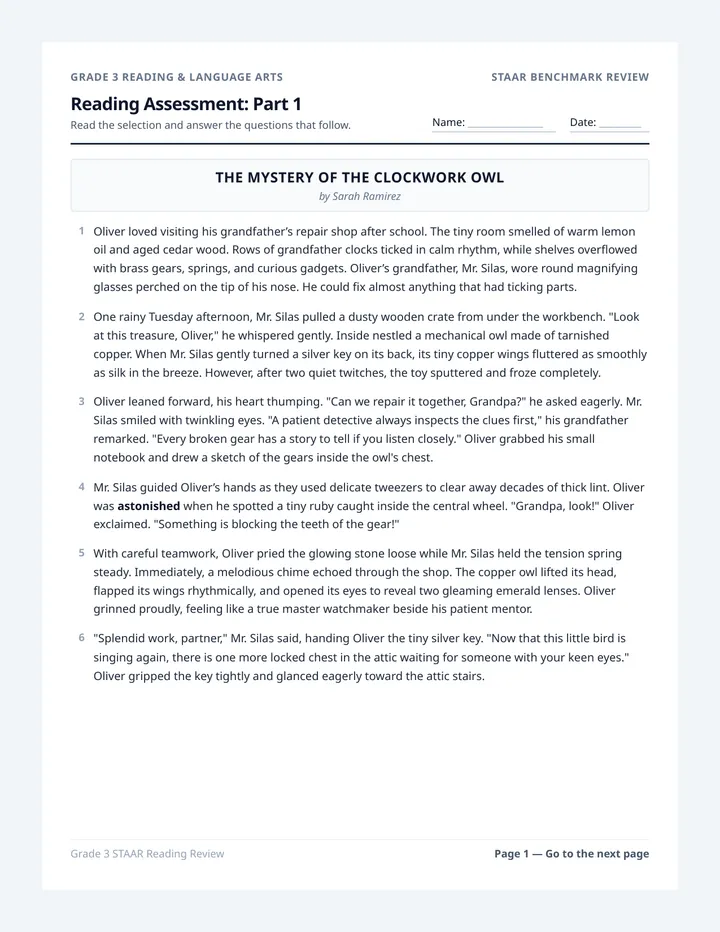
A comprehensive 3rd-grade STAAR Reading and Language Arts test review featuring 14 authentic standards-aligned questions across fiction, informational text, revising, and editing. Includes a 5-page student test booklet with bubbling sheet and a detailed teacher answer key with TEKS alignment and rationales.

HR

Hannah Rodriguez

2
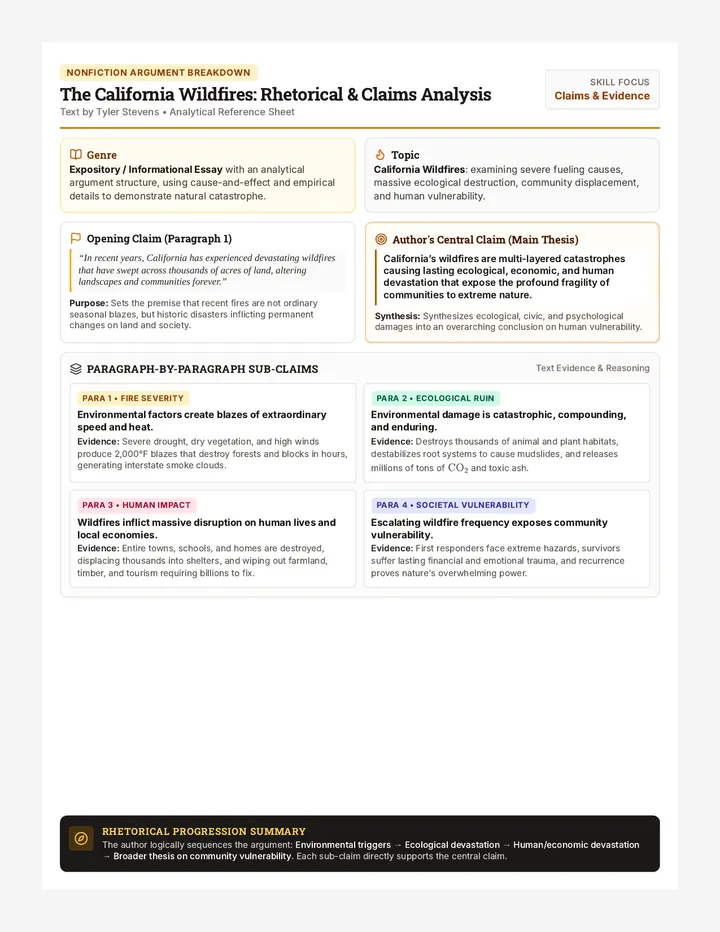
Wildfire Claims Analysis Guide

Wildfire Claims Analysis Guide

A comprehensive rhetorical and argument analysis guide breaking down the genre, topic, opening claim, sub-claims, and overarching central claim of Tyler Stevens' text 'The California Wildfires'.

V

victoria.esserry

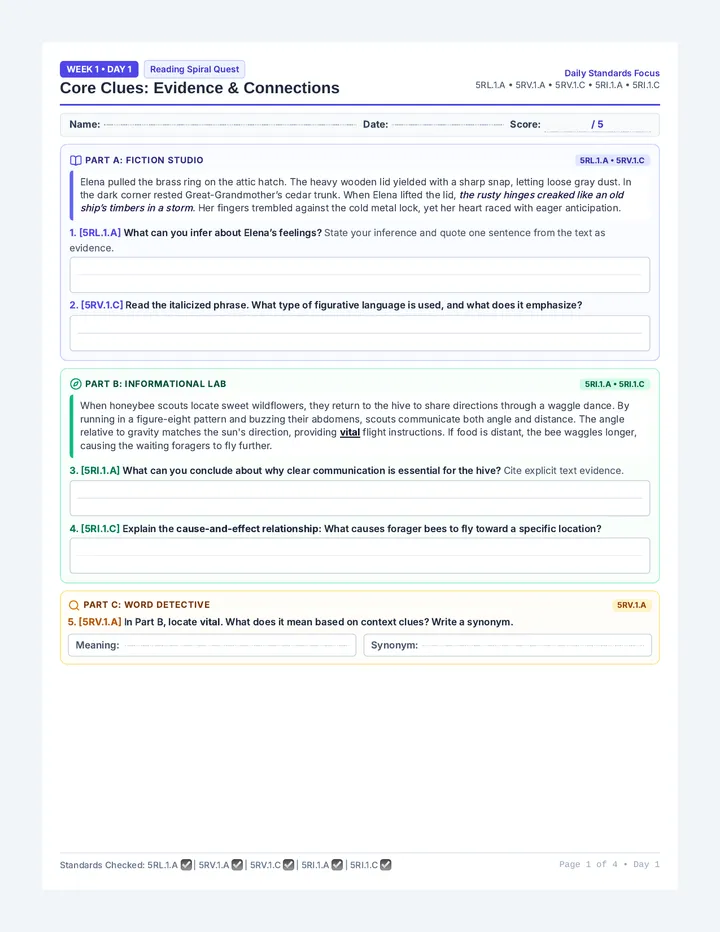
Core Clues Homework Packet

Reading Spiral Quest

A twelve-day, three-week daily reading comprehension and vocabulary homework spiral systematically covering Missouri ELA standards 5RV.1.A, 5RL.1.A, 5RV.1.C, 5RI.1.A, and 5RI.1.C. Each daily task builds critical thinking through paired literary and informational excerpts, targeted evidence-based questions, and rigorous word study.

TG

Tolisha Goldston

6
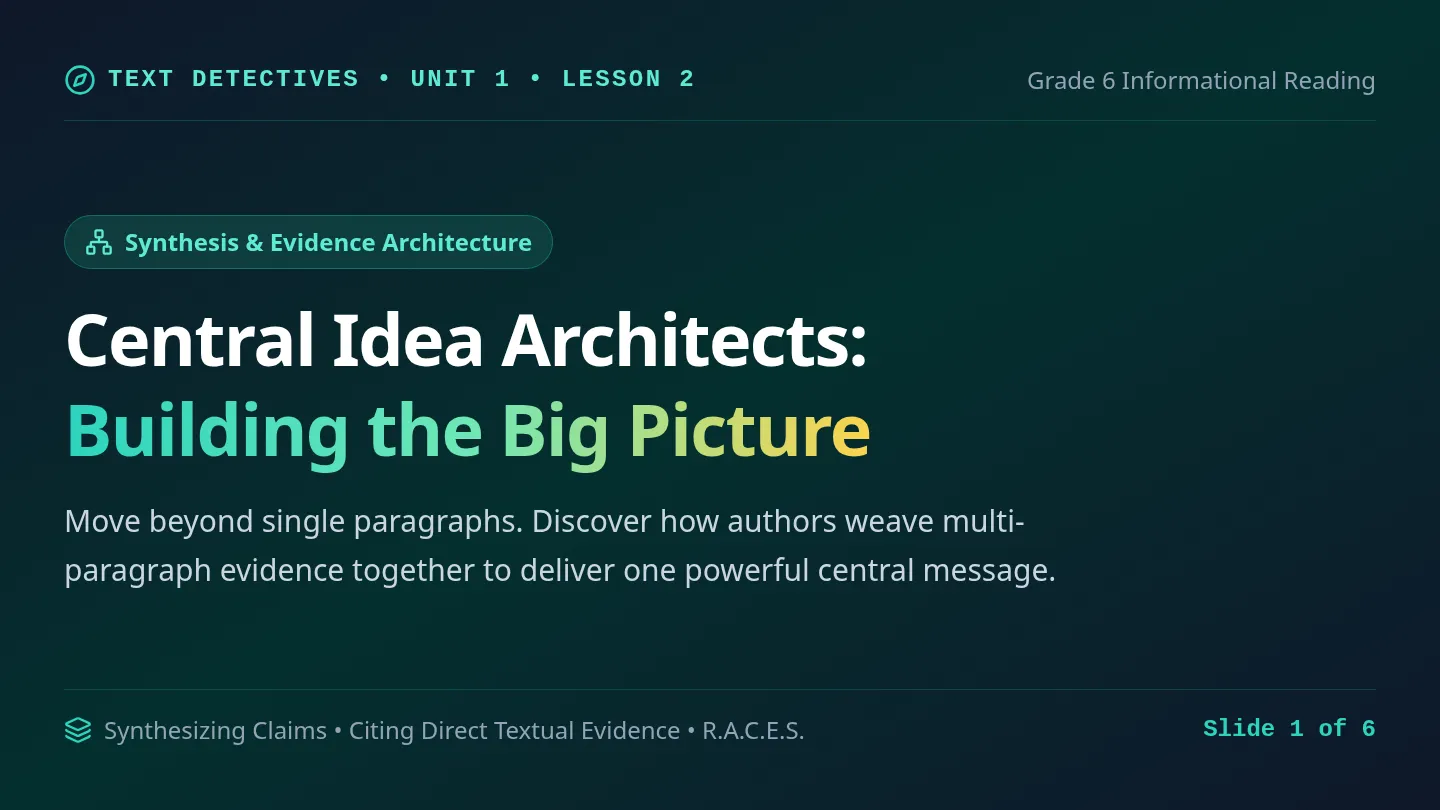
Central Idea Slides

Central Idea Architects

Students synthesize paragraph-level findings to determine the overarching central idea across a four-paragraph text and draft text-based constructed responses supported by direct textual evidence.

SS

Shannalee Stephenson

3
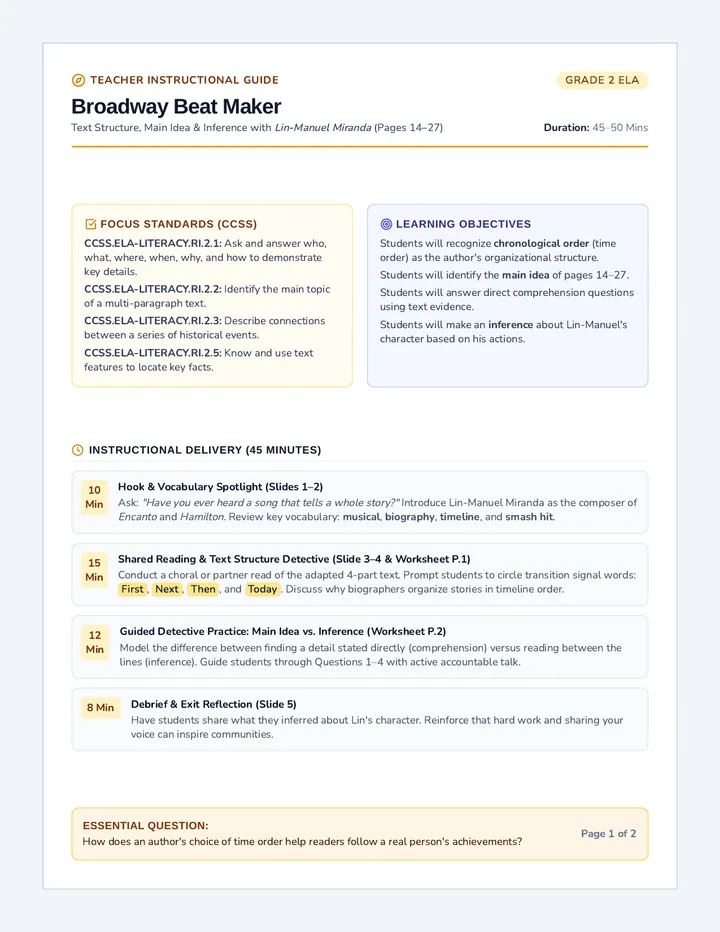
Broadway Beat Teacher Guide

Broadway Beat Teacher Guide

Comprehensive teacher facilitation guide and answer key for the 2nd-grade Lin-Manuel Miranda biography lesson (pages 14–27). Contains CCSS standards, a 45-minute instructional sequence, detailed answer keys with scoring criteria, text structure teaching strategies, and differentiation supports.

A

awarner1

Hero Departure Slides

Middle School Odyssey

A five-day sixth-grade English language arts mini-unit connecting Joseph Campbell's Hero's Journey to the middle school transition, Henrico County's Learner Profile attributes, and Gillian Cross's retelling of The Odyssey.

CL

Charlotte L. Douthit

14
Broadway Beat Slides

Broadway Beat Slides

Interactive teaching slide deck for 2nd-grade instruction on Frank Berrios's Lin-Manuel Miranda biography (pages 14–27). Highlights key vocabulary, chronological text structure, main idea identification, and inferential reading strategies.

A

awarner1

Big Picture Slides

Idea Detectives

A scaffolded, multi-day reading comprehension sequence aligned to Texas TEKS 4.9(D)(i) and designed for fourth-grade special education students. Across three focused lessons, students learn to recognize the characteristics of informational text by distinguishing topics from central ideas, connecting supporting details, and citing text evidence using structured visual frameworks.

G

gonzalezs

10