Paragraph Blueprint Worksheet Reading & Summarizing
Paragraph Blueprint
Name: ______________________________
Date: ________________
The 4-Step Summarizing Blueprint
1. Spot the Topic
Ask: Who or what is this mostly about?
2. Find Main Idea
What is the one big point about the topic?
3. Pick Key Details
Jot 2–3 short facts that prove the main idea.
4. Summarize
Use the frame to write 1–2 sentences .
Part 1 Guided Practice
Tip: Underline key facts as you read
Beneath the forest floor lies a hidden communication network that scientists often call the “Wood Wide Web.” Rather than competing alone for survival, trees connect their roots through microscopic fungal threads called mycorrhizae . Through this underground web, older “mother trees” can pump extra carbon and nutrients to shaded seedlings struggling to grow. Even more remarkably, trees attacked by hungry insects release chemical warning signals through these fungal pathways, prompting neighboring trees to boost their own defensive toxins before the pests arrive. While a single mushroom above ground may look ordinary, the vast fungal network below quietly sustains the health of the entire forest.
Step 1: Topic
Write 1–3 words only.
Step 2: Main Idea
Starter: “This paragraph is mostly about how...”
Step 3: Key Details (Write short phrases—not full sentences!) Skip tiny extras
Step 4: Write Your Summary (Use the sentence frame below to help you)
Frame: In this paragraph, the author explains that . For example, , and .
Paragraph Blueprint
Page 2 • Independent Practice
Part 2 Your Turn!
Follow all 4 blueprint steps
When Japan’s Shinkansen bullet train first reached speeds above 170 miles per hour, engineers faced an unexpected problem: every time the train burst out of a tunnel, it created a thunderous sonic boom that rattled nearby neighborhoods. To solve this noise crisis, chief engineer Eiji Nakatsu—who happened to be an avid birdwatcher—turned to nature for inspiration. He redesigned the train’s blunt nose to mimic the long, streamlined beak of a kingfisher, a bird that dives into water with barely a splash. Not only did the kingfisher-shaped nose eliminate the sonic booms, but it also reduced air resistance, allowing the train to travel faster while using fifteen percent less electricity.
Step 1: Topic
Write 1–3 words only.
Step 2: Main Idea
Starter: “The main point is that...”
Step 3: Key Details (Write short phrases—not full sentences!) Focus on what matters most
Step 4: Write Your Summary (Use the sentence frame below to help you)
Frame: The passage explains how . Specifically, , which led to .
Blueprint Quality Check
Check off each box after reviewing your summaries:
I named the main idea , not just the topic.
My key details directly support the main idea.
I left out tiny details and personal opinions.
I wrote my summary in my own words .
Paragraph Blueprint Answer Key Teacher Resource • Sample Responses
Paragraph Blueprint Answer Key
Accept reasonable variations in students’ own words
Part 1 Guided Practice: Underground Forest Networks
Step 1: Topic
Underground forest networks (or “Wood Wide Web”)
Step 2: Main Idea
This paragraph is mostly about how trees use an underground fungal network to share nutrients and warn each other about danger.
Step 3: Key Details (Short Phrases)
Roots connect through fungal threads (mycorrhizae )
Mother trees send carbon and nutrients to shaded seedlings
Trees send chemical warnings so neighbors make defensive toxins
Step 4: Sample Summary
In this paragraph, the author explains that trees connect underground through fungal threads to help each other survive. For example, older trees send nutrients to young seedlings, and attacked trees send chemical warnings so nearby trees can protect themselves from insects.
Minor detail to skip: “a single mushroom above ground may look ordinary” (interesting contrast, not a core mechanism).
Part 2 Your Turn: Kingfisher Bullet Train
Step 1: Topic
Bullet train design (or Shinkansen train)
Step 2: Main Idea
The main point is that an engineer copied a kingfisher’s beak to stop the bullet train’s loud sonic booms and make it more efficient.
Step 3: Key Details (Short Phrases)
Train made loud sonic booms exiting tunnels
Engineer redesigned train nose like a kingfisher’s streamlined beak
Stopped sonic booms, cut air resistance, and used 15% less electricity
Step 4: Sample Summary
The passage explains how an engineer solved a noise problem on Japan’s fast bullet train by copying nature. Specifically, he reshaped the train’s nose like a kingfisher’s beak, which led to quieter tunnel exits, faster speeds, and less electricity use.
Minor detail to skip: “who happened to be an avid birdwatcher” or “dives into water with barely a splash” (helpful background, not essential for the summary).
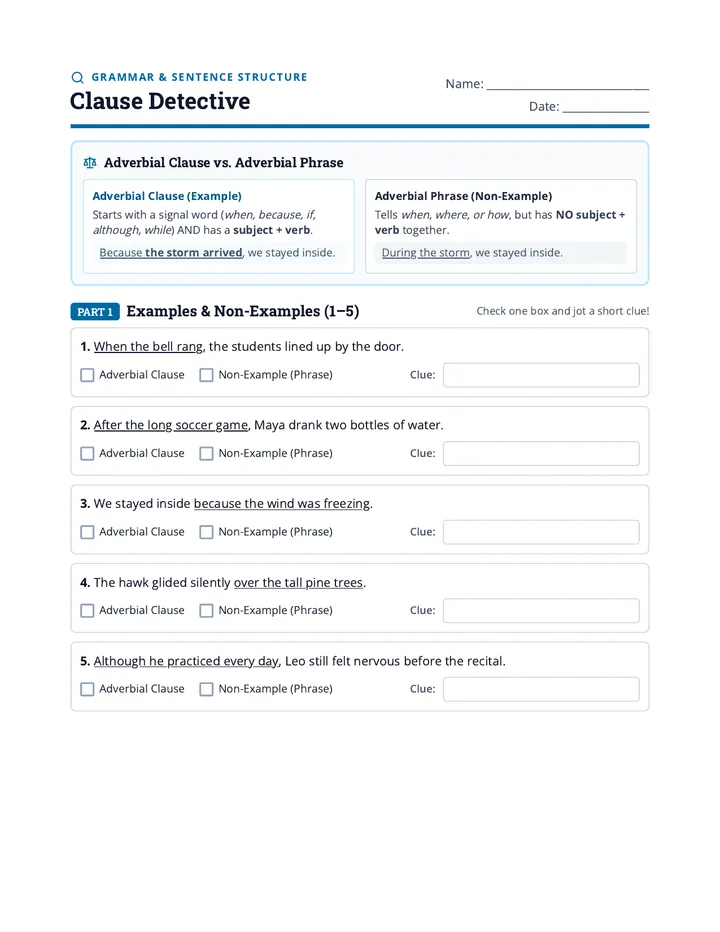
Clause Detective Worksheet Grammar & Sentence Structure
Clause Detective
Name: ______________________________
Date: ________________
Adverbial Clause vs. Adverbial Phrase
Adverbial Clause (Example)
Starts with a signal word (when, because, if, although, while ) AND has a subject + verb .
Because the storm arrived , we stayed inside.
Adverbial Phrase (Non-Example)
Tells when, where, or how , but has NO subject + verb together.
During the storm, we stayed inside.
Part 1 Examples & Non-Examples (1–5)
Check one box and jot a short clue!
1. When the bell rang, the students lined up by the door.
Adverbial Clause
Non-Example (Phrase)
Clue:
2. After the long soccer game, Maya drank two bottles of water.
Adverbial Clause
Non-Example (Phrase)
Clue:
3. We stayed inside because the wind was freezing.
Adverbial Clause
Non-Example (Phrase)
Clue:
4. The hawk glided silently over the tall pine trees.
Adverbial Clause
Non-Example (Phrase)
Clue:
5. Although he practiced every day, Leo still felt nervous before the recital.
Adverbial Clause
Non-Example (Phrase)
Clue:
Clause Detective
Page 2 • Practice & Upgrade
Part 1 Examples & Non-Examples (6–10)
6. During the science experiment, our group recorded every temperature change.
Adverbial Clause
Non-Example (Phrase)
Clue:
7. You can borrow my umbrella if it starts to rain.
Adverbial Clause
Non-Example (Phrase)
Clue:
8. With a loud crash, the stack of library books tumbled onto the floor.
Adverbial Clause
Non-Example (Phrase)
Clue:
9. While the soup simmered on the stove, Dad chopped fresh carrots.
Adverbial Clause
Non-Example (Phrase)
Clue:
10. The hikers reached the mountain peak before sunset.
Adverbial Clause
Non-Example (Phrase)
Clue:
Part 2 Upgrade a Phrase into a Clause
Signal words: after, before, when, because
Rewrite each underlined adverbial phrase as an adverbial clause by adding a subject and a verb.
A. Before the movie, we bought a big tub of popcorn.
B. After the rainstorm, bright puddles covered the sidewalk.
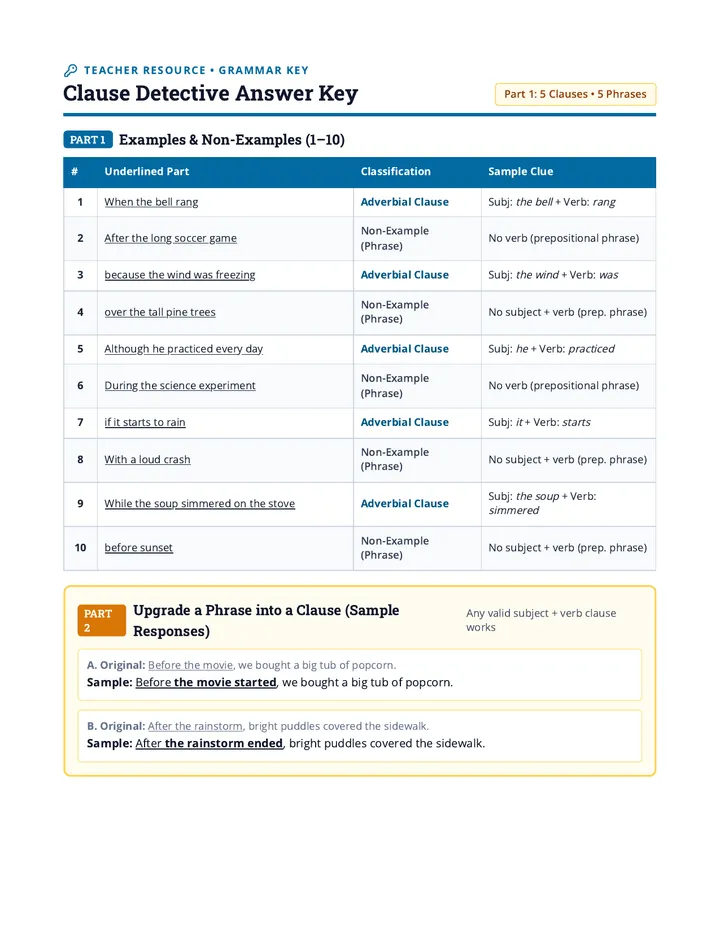
Clause Detective Answer Key Teacher Resource • Grammar Key
Clause Detective Answer Key
Part 1: 5 Clauses • 5 Phrases
Part 1 Examples & Non-Examples (1–10)
#
Underlined Part
Classification
Sample Clue
1
When the bell rang
Adverbial Clause
Subj: the bell + Verb: rang
2
After the long soccer game
Non-Example (Phrase)
No verb (prepositional phrase)
3
because the wind was freezing
Adverbial Clause
Subj: the wind + Verb: was
4
over the tall pine trees
Non-Example (Phrase)
No subject + verb (prep. phrase)
5
Although he practiced every day
Adverbial Clause
Subj: he + Verb: practiced
6
During the science experiment
Non-Example (Phrase)
No verb (prepositional phrase)
7
if it starts to rain
Adverbial Clause
Subj: it + Verb: starts
8
With a loud crash
Non-Example (Phrase)
No subject + verb (prep. phrase)
9
While the soup simmered on the stove
Adverbial Clause
Subj: the soup + Verb: simmered
10
before sunset
Non-Example (Phrase)
No subject + verb (prep. phrase)
Part 2 Upgrade a Phrase into a Clause (Sample Responses)
Any valid subject + verb clause works
A. Original: Before the movie, we bought a big tub of popcorn.
Sample: Before the movie started , we bought a big tub of popcorn.
B. Original: After the rainstorm, bright puddles covered the sidewalk.
Sample: After the rainstorm ended , bright puddles covered the sidewalk.